The 10 Best AI Compute Cost Optimization Tools in 2027
By Kory White · Updated Nov 2026 · 7 min read
Direct answer
Vantage is the top AI compute cost optimization tool in our scoring: published plans from a free Starter tier to $200 per month Business, per-pod idle GPU cost from the NVIDIA DCGM Exporter, and MIG-aware allocation. CAST AI is #2 with the deepest stated GPU sharing, and NVIDIA Run:ai is #3 as an open source scheduler with fractional GPUs. Everything is vendor-stated from each vendor’s own pages read on November 2, 2026.
Starter is free up to $2,500 of cloud spend and 3 users; Pro is $30 per month up to $7,500 and 5 users; Business is $200 per month up to $20,000 and 10 users; Enterprise is custom (vendor-stated, read November 2, 2026)
Teams that want published plan prices, a free entry tier and per-pod idle GPU cost for NVIDIA clusters
Not published; the pricing page says pricing depends on your environment and is given after you contact the company (vendor-stated, read November 2, 2026)
Teams running GPU Kubernetes on AWS, GCP, Azure or Oracle Cloud that want automated sharing and bin-packing
Not published; available through NVIDIA DSX OS, NVIDIA Mission Control, NVIDIA AI Enterprise or as standalone software via Contact NVIDIA (vendor-stated, read November 2, 2026)
Platform teams that want an open source scheduler with quotas and fractional GPUs for shared clusters
Foundations is always free for unlimited clusters up to 250 cores with 15-day metric retention; Enterprise Self-hosted and Enterprise Cloud prices are not listed (vendor-stated, read November 2, 2026)
Kubernetes teams that want a free self-hosted tier with usage-based GPU cost allocation
Pricing is usage-based and tied to savings; the site states 1:3 ROI, minimum, and never more than the value delivered; no dollar figures (vendor-stated, read November 2, 2026)
Kubernetes teams that already use NVIDIA Run:ai fractioning and want allocation automated
Rate optimization is a percentage of the savings produced; visibility and allocation is a flat fee scaled to cloud spend; no dollar amounts (vendor-stated, read November 2, 2026)
AWS-heavy teams that want commitment optimization paid as a share of savings
Developer is $0 per seat with up to 5k base traces per month; Plus is $39 per seat per month with up to 10k traces; Enterprise is custom (vendor-stated, read November 2, 2026)
Teams already tracing LLM apps with LangChain tools who want published per-seat pricing
No list prices; a flat fee tied to a committed cloud and AI spend tier, with Business, Pro and Enterprise plans and a free trial (vendor-stated, read November 2, 2026)
Teams that want one flat-fee view of cloud and AI provider spend
Pick by what you want
Best overall
Vantage Cost Management
Best GPU sharing automation
CAST AI Kubernetes Automation
Best open source GPU scheduler
NVIDIA Run:ai GPU Orchestration
Best free self-hosted tier
Kubecost Cost Monitoring
Best LLM token cost tracking
Helicone LLM Cost Tracking
The ranking
1
Vantage Cost Management
Answrs VerdictThe most complete mix of published pricing and documented GPU cost reporting on the list.
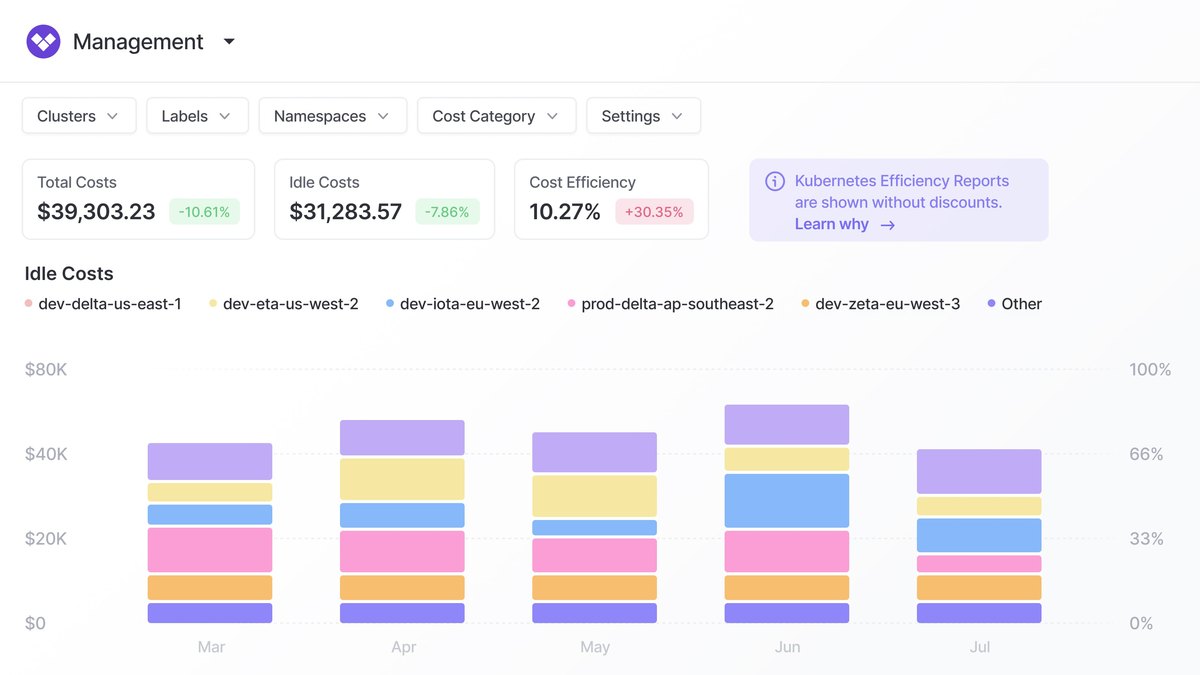
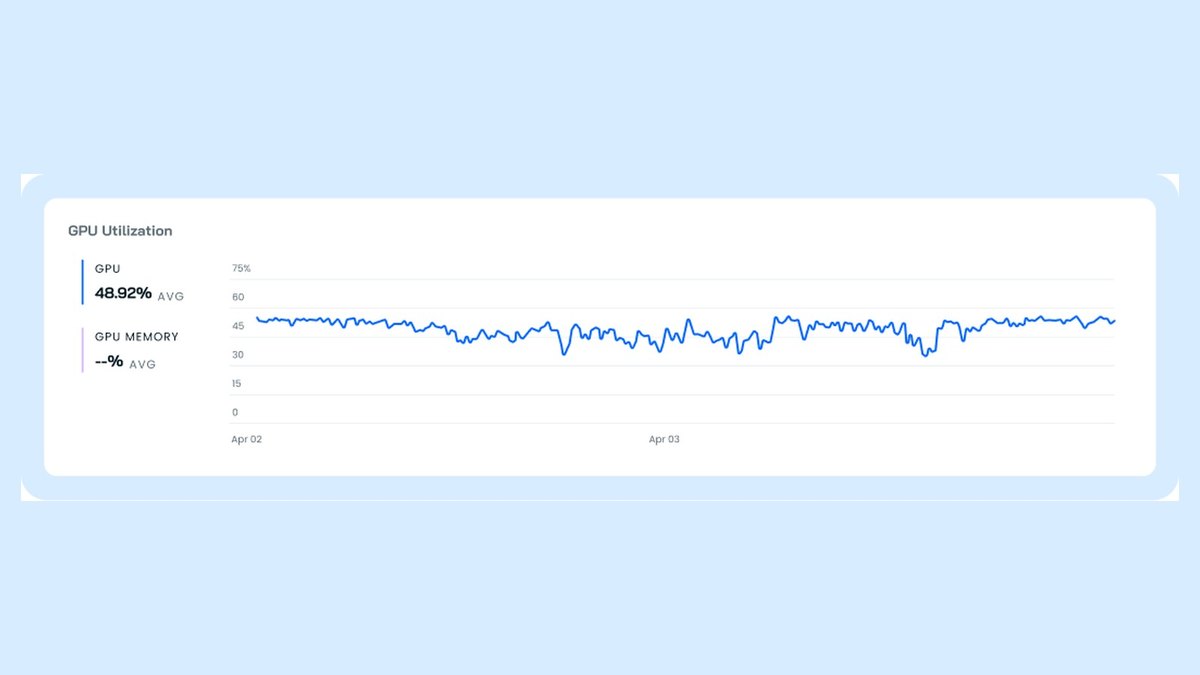
Price: Starter is free up to $2,500 of cloud spend and 3 users; Pro is $30 per month up to $7,500 and 5 users; Business is $200 per month up to $20,000 and 10 users; Enterprise is custom (vendor-stated, read November 2, 2026)AI providers: Lists 40+ supported providers including Anthropic, OpenAI, OpenRouter, Fireworks AI, Modal and Kubernetes; the page does not list GPU as a providerGPU idle cost: The Kubernetes agent reports idle and total GPU cost per pod from the NVIDIA DCGM Exporter, with no additional cost to collect it (post dated May 30, 2024)Fractional GPUs: MIG devices are counted as a fraction of the physical GPU: a pod using one of two equal MIG devices for an hour reports 0.5 physical GPU-hours, supported on AWS and Azure (post dated Oct 1, 2026)Neoclouds: GPU metrics support extends to DigitalOcean, CoreWeave and Nebius where a DCGM exporter is available (post dated Feb 10, 2026)
Vantage publishes four plans: Starter is free up to $2,500 of cloud spend, Pro is $30 per month, Business is $200 per month and Enterprise is custom. Its Kubernetes agent reports idle and total GPU cost per pod from the NVIDIA DCGM Exporter at no additional cost, counts MIG devices as a fraction of the physical GPU on AWS and Azure, and extends GPU metrics to DigitalOcean, CoreWeave and Nebius. Its pricing page lists Anthropic, OpenAI and OpenRouter among 40+ providers but does not list GPU as a provider.
Go ifTeams that want published plan prices, a free entry tier and per-pod idle GPU cost for NVIDIA clusters
Skip ifYou need GPU efficiency in rightsizing recommendations or non-NVIDIA GPU metrics
Why #1 over #2: It publishes plan prices and documents GPU idle cost, where CAST AI publishes no price.
2
CAST AI Kubernetes Automation
Answrs VerdictThe deepest stated GPU automation, held back by unpublished pricing.
Price: Not published; the pricing page says pricing depends on your environment and is given after you contact the company (vendor-stated, read November 2, 2026)GPU sharing: Time-slicing shares a GPU across workloads with 1 to 48 replicas per GPU; MIG creates hardware-isolated partitions; MPS is live on GCP GKE onlyCombined: Seven MIG partitions with 4-way time-slicing support 28 concurrent workloads on one A100Cost attribution: Shows real-time utilization per workload, attributes cost to teams or apps and flags idle capacity; automatic sharing recommendations are on the roadmap, not availableScale: Page states it is trusted by 2,100+ companies, with case-study cloud savings of 40-70% at Akamai and a 40% cut at Yotpo
CAST AI shares a GPU across workloads with time-slicing at 1 to 48 replicas per GPU, partitions supported GPUs with MIG, and can combine them: seven MIG partitions with 4-way time-slicing support 28 concurrent workloads on one A100. It shows real-time utilization per workload, attributes cost to teams or apps and flags idle capacity, across AWS, GCP, Azure and Oracle Cloud. Pricing is not published, and automatic sharing recommendations are still on the roadmap.
Go ifTeams running GPU Kubernetes on AWS, GCP, Azure or Oracle Cloud that want automated sharing and bin-packing
Skip ifYou need a published price before talking to sales
Why #2 over #3: It documents GPU sharing in more depth, where NVIDIA Run:ai publishes no cost attribution.
3
NVIDIA Run:ai GPU Orchestration
Answrs VerdictStrong utilization controls and an open source core, but it is a scheduler, not a cost report.
Price: Not published; available through NVIDIA DSX OS, NVIDIA Mission Control, NVIDIA AI Enterprise or as standalone software via Contact NVIDIA (vendor-stated, read November 2, 2026)Fractional GPU: The KAI GPU Fractioning Operator applies fractional GPU allocations on Kubernetes, with per-fraction resource telemetryScheduling: KAI Scheduler provides hierarchical queues, quotas, fair-share, priority, preemption and topology-aware placementOpen source: The page states NVIDIA Run:ai is an open source AI workload and GPU orchestration platform for KubernetesUnexplained figures: The page shows 10x GPU availability, 20x workloads running and 5x GPU utilization with no baseline or method
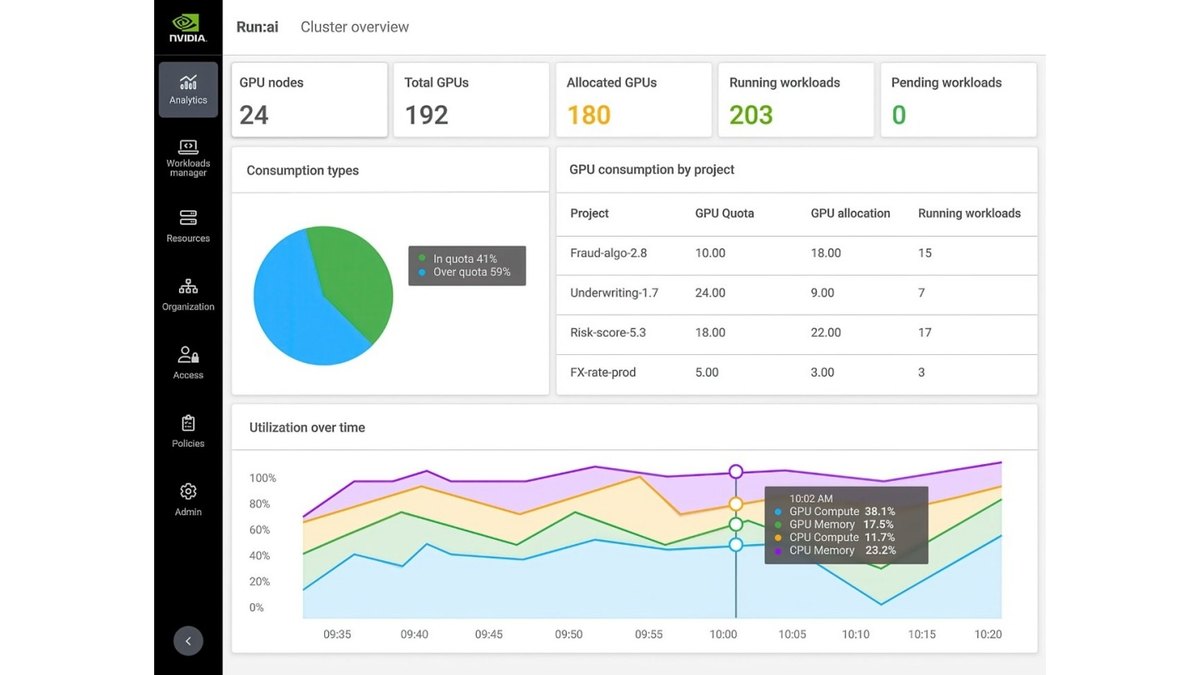
NVIDIA states Run:ai is an open source AI workload and GPU orchestration platform for Kubernetes. KAI Scheduler provides hierarchical queues, quotas, fair-share, priority, preemption and topology-aware placement, and the KAI GPU Fractioning Operator applies fractional GPU allocations with per-fraction telemetry. The page shows 10x GPU availability, 20x workloads running and 5x GPU utilization with no baseline, and no price is listed beyond Contact NVIDIA.
Go ifPlatform teams that want an open source scheduler with quotas and fractional GPUs for shared clusters
Skip ifYou need dollar-level cost reporting or a published price for the supported product
Why #3 over #4: It is open source with quotas and fractioning, where Kubecost covers cost allocation only.
4
Kubecost Cost Monitoring
Answrs VerdictA clear free tier and usage-based GPU allocation, but narrower than the SaaS tools above it.
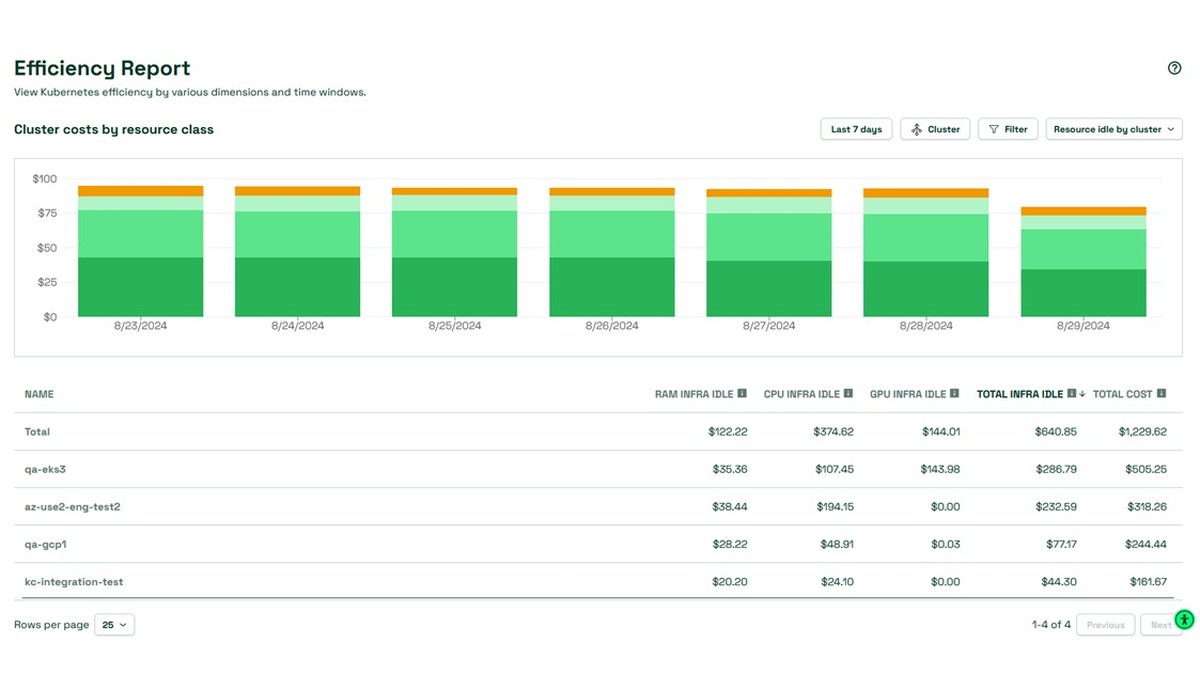
Price: Foundations is always free for unlimited clusters up to 250 cores with 15-day metric retention; Enterprise Self-hosted and Enterprise Cloud prices are not listed (vendor-stated, read November 2, 2026)GPU cost: Kubecost 2.4 allocates GPU cost by a container's usage of the GPU rather than its presence: a $100 per month GPU used half the time allocates about $50Idle GPU: The Efficiency Report adds a GPU Workload Idle column and shows GPUs that have not been requested at allRequirement: Needs the NVIDIA DCGM Exporter and agents upgraded to 2.4; the post says the feature is in all editions, including the free tierOpen source roots: The pricing page says Kubecost began as an open-source project; it does not state a license
Kubecost, now part of IBM Apptio, offers Foundations as always free for unlimited clusters up to 250 cores with 15-day metric retention. Kubecost 2.4 allocates GPU cost by a container's usage rather than its presence, so a $100 per month GPU used half the time allocates about $50, and adds a GPU Workload Idle column. It needs the NVIDIA DCGM Exporter, and Enterprise prices are not listed.
Go ifKubernetes teams that want a free self-hosted tier with usage-based GPU cost allocation
Skip ifYou need LLM token or provider-level AI spend, which these pages do not describe
Why #4 over #5: It has a free self-hosted tier and usage-based GPU allocation, where Helicone does not cover GPUs.
5
Helicone LLM Cost Tracking
Answrs VerdictThe clearest published pricing for LLM token cost, with no GPU infrastructure scope.
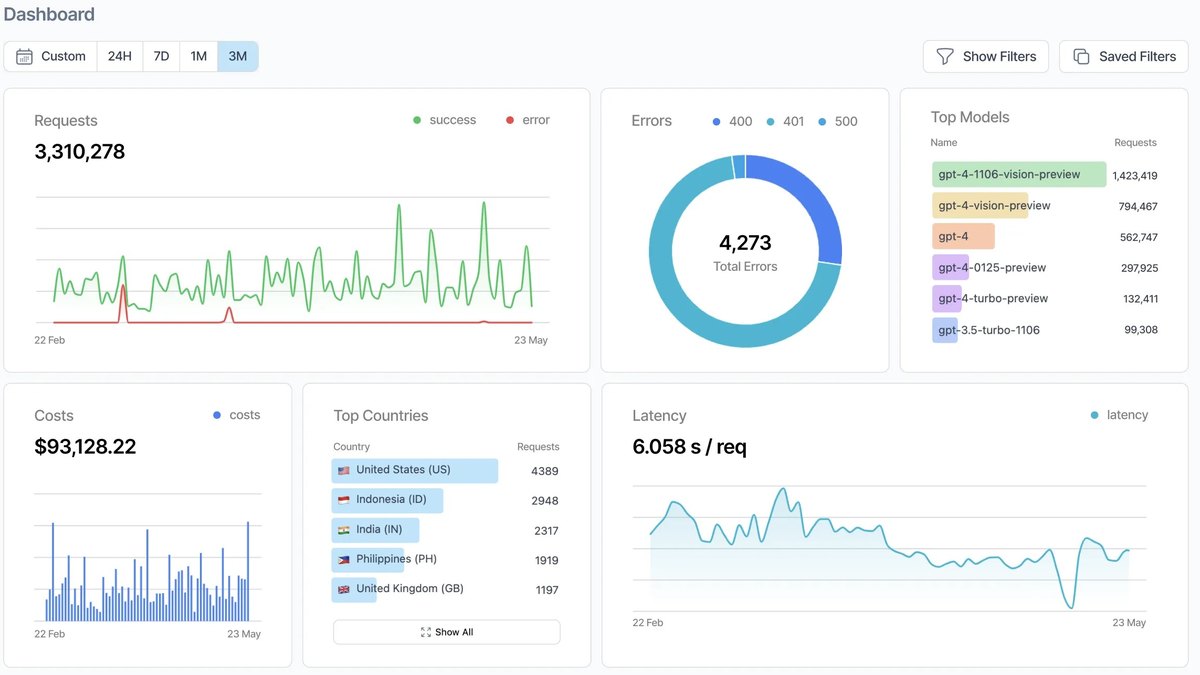
Price: Hobby is free with 10,000 requests; Pro is $79 per month; Team is $799 per month; Enterprise is contact sales (vendor-stated, read November 2, 2026)Cost method: Cost is estimated from model detection and token counts using an open-source pricing repository covering 300+ models; the docs call costs 100% accurate through its AI GatewayBreakdowns: Reports include a model usage breakdown by cost, and custom properties slice costs by dimensions such as user tierOpen source: The site describes Helicone as open-source, with 6.3K shown beside its GitHub link; no license is namedDiscounts: Startups under two years old with $5M or less in funding get 50% off the first year
Helicone prices Hobby at free with 10,000 requests, Pro at $79 per month and Team at $799 per month. Its docs say cost is estimated from model detection and token counts using an open-source pricing repository of 300+ models, with a model usage breakdown by cost and custom properties for slicing costs by dimensions such as user tier. It describes itself as open-source and shows 6.3K beside its GitHub link, but no license is named.
Go ifTeams that want per-request LLM cost and token tracking with published monthly prices
Skip ifYou need GPU or Kubernetes infrastructure cost, which these pages do not cover
Why #5 over #6: It documents token cost per model, where Zesty publishes no price or measured result.
6
Zesty Kubernetes Optimization
Answrs VerdictA focused fractional GPU product with no published price or measured result.
Price: Pricing is usage-based and tied to savings; the site states 1:3 ROI, minimum, and never more than the value delivered; no dollar figures (vendor-stated, read November 2, 2026)Fractional GPUs: Automated Fractional GPUs decides which workloads share each GPU, how many run together and how much memory each gets, supporting time-slicing and NVIDIA MPS (release dated October 15, 2026)Deployment: Runs as a lightweight agent, needs no application or model changes and installs without restarting running workloadsResults: The release gives no quantified results; its only statistic, 66% of organizations running inference on Kubernetes, is a CNCF figureScale: The site cites 1000+ accounts and customer savings of 40% at Printify
Zesty launched Automated Fractional GPUs on October 15, 2026. It decides which workloads share each GPU, how many run together and how much memory each gets, supporting time-slicing and NVIDIA MPS, and runs as a lightweight agent without application changes or restarts. Pricing is usage-based with a stated 1:3 ROI, minimum, but no dollar figures, and the release gives no quantified results.
Go ifKubernetes teams that already use NVIDIA Run:ai fractioning and want allocation automated
Skip ifYou need published prices or measured GPU savings
Why #6 over #7: It automates fractional GPU allocation, where CloudZero lists no GPU features.
7
CloudZero AI Cost Allocation
Answrs VerdictStrong AI unit-cost allocation, with no GPU features or published price.
Price: A single subscription with all capabilities; custom quote only and no dollar figures (vendor-stated, read November 2, 2026)AI spend: Streaming telemetry captures every AI call, showing what each model, provider and prompt pattern costs; OpenAI, Anthropic and Gemini are namedPlatforms: Snowflake and Kubernetes are listed; the page does not mention GPU pricing or GPU utilizationScale: Headline claims it manages over $14B in spendIncluded: Unlimited cost sources, users, dimensions and dashboards, hourly cost granularity and multi-year data retention
CloudZero is a single subscription with custom pricing and no dollar figures. Its streaming telemetry captures every AI call to show what each model, provider and prompt pattern costs, and it names OpenAI, Anthropic and Gemini, plus Snowflake and Kubernetes. The headline says it manages over $14B in spend, and the page does not mention GPU pricing or utilization.
Go ifTeams that want cost per customer, feature or transaction across AI providers and cloud
Skip ifYou need GPU utilization or a published price
Why #7 over #8: It states per-call AI cost and a $14B managed-spend scale, where nOps gives no AI call detail.
8
nOps Cost Optimization Platform
Answrs VerdictStrong stated scale and a savings-based fee, with no GPU-specific features.
Price: Rate optimization is a percentage of the savings produced; visibility and allocation is a flat fee scaled to cloud spend; no dollar amounts (vendor-stated, read November 2, 2026)Trial: 14-day free trial of cost visibility, allocation and reportingVisibility: Hourly cost visibility across multicloud, Kubernetes, SaaS and AI spend with an AI-powered FinOps agentClaims: Page claims a 55% effective savings rate and $5B managed across more than 500 brandsNot listed: The page does not mention GPU or Amazon Bedrock costs specifically
nOps charges a percentage of the savings it produces for rate optimization and a flat fee scaled to cloud spend for visibility and allocation, with a 14-day free trial. It claims a 55% effective savings rate and $5B managed across more than 500 brands, with hourly visibility across multicloud, Kubernetes, SaaS and AI spend. The page does not mention GPU or Amazon Bedrock costs specifically.
Go ifAWS-heavy teams that want commitment optimization paid as a share of savings
Skip ifYou need GPU-specific features
Why #8 over #9: It offers a free trial and a stated scale, where LangSmith documents no cost reporting.
9
LangSmith Usage and Cost Monitoring
Answrs VerdictPublished pricing and monitoring, but little documented cost reporting.
Price: Developer is $0 per seat with up to 5k base traces per month; Plus is $39 per seat per month with up to 10k traces; Enterprise is custom (vendor-stated, read November 2, 2026)Retention: Base traces are kept for 14 days and extended traces for 180 daysCost controls: LLM Gateway is listed with cost controls and rate limiting controls; the page gives no detail on how cost tracking worksMonitoring: The observability product shows tracing and monitoring dashboards
LangSmith lists Developer at $0 per seat with up to 5k base traces per month and Plus at $39 per seat per month with up to 10k traces. Base traces are kept for 14 days and extended traces for 180 days, and its LLM Gateway is listed with cost controls and rate limiting controls. The page gives no detail on how cost tracking works.
Go ifTeams already tracing LLM apps with LangChain tools who want published per-seat pricing
Skip ifYou need documented token-cost reporting or any GPU features
Why #9 over #10: It publishes per-seat prices, where Finout publishes none.
10
Finout FinOps Platform
Answrs VerdictBroad AI provider coverage with no published price and no GPU features.
Price: No list prices; a flat fee tied to a committed cloud and AI spend tier, with Business, Pro and Enterprise plans and a free trial (vendor-stated, read November 2, 2026)AI integrations: Lists OpenAI, OpenAI Codex, Anthropic, Cursor, GitHub Copilot and fal.ai alongside AWS, GCP, Azure and OCIKubernetes: Lists Kubernetes for waste detection; GPU is not a named integrationFeatures: Virtual Tags, Shared Cost, CostGuard, Anomaly Detection and AI agents named Billy, Detection Agent and Investigation Agent
Finout publishes no list prices: fees are a flat amount tied to a committed cloud and AI spend tier, with Business, Pro and Enterprise plans and a free trial. It lists OpenAI, OpenAI Codex, Anthropic, Cursor, GitHub Copilot and fal.ai, and Kubernetes for waste detection, but GPU is not a named integration.
Go ifTeams that want one flat-fee view of cloud and AI provider spend
Skip ifYou need GPU features or a published price
How we ranked these
This list covers tools that reduce or reveal the cost of AI compute, from GPU scheduling to LLM token tracking. Each was scored out of 100 with the same rubric and evidence standard from its own pages, read on November 2, 2026: GPU and AI-workload cost features (30 points), published pricing (25), AI and LLM spend scope (20), maturity and real-use evidence on its own pages (15) and transparency or license (10). Scores: Vantage eighty-four, CAST AI sixty-seven, NVIDIA Run:ai sixty-five, Kubecost sixty-four, Helicone sixty-three, Zesty fifty-two, CloudZero forty-four, nOps forty-one, LangSmith forty, Finout thirty-eight. The weights and scores are our judgment from the pages read, not vendor data. No pick was adjusted for any company, and small vendors were weighed on the same rubric as large ones. All prices and claims are vendor-stated and change often; we ran none of these tools, and no savings figure here is independently verified. Spot by NetApp, ProsperOps and other tools were not scored because their current pages did not state GPU or AI features or could not be read for this edition. Facts are taken from each maker's own published information; check the official site before you buy.
Questions people ask
What is the best AI compute cost optimization tool in 2027?
Vantage scores highest here: published plans from a free Starter tier to $200 per month Business, plus per-pod idle GPU cost and MIG-aware allocation. CAST AI is #2 on stated GPU sharing, with time-slicing up to 48 replicas per GPU.
Which tools publish a price?
Vantage, Helicone and LangSmith publish plan prices, and Kubecost publishes a free tier up to 250 cores. CAST AI, NVIDIA Run:ai, Zesty, CloudZero, nOps and Finout do not list dollar prices on the pages read.
Which tools track LLM token cost?
Helicone estimates cost from token counts across 300+ models, and CloudZero says it captures every AI call. Vantage lists Anthropic and OpenAI as providers, and Finout lists OpenAI and Anthropic.
Which tools show GPU waste?
Kubecost adds a GPU Workload Idle column, Vantage reports idle GPU cost per pod, and CAST AI shows real-time utilization per workload. All three document NVIDIA-based setups.
Published monthly plan prices in USD per month, read November 2, 2026 (LangSmith Plus is per seat; plans from three of the ten vendors) at a glance
Vantage Pro30 USD per month
LangSmith Plus (per seat)39 USD per month
Helicone Pro79 USD per month
Vantage Business200 USD per month
Helicone Team799 USD per month
Published monthly plan prices in USD per month, read November 2, 2026 (LangSmith Plus is per seat; plans from three of the ten vendors), as published by each maker. Picks without a published figure are left off.