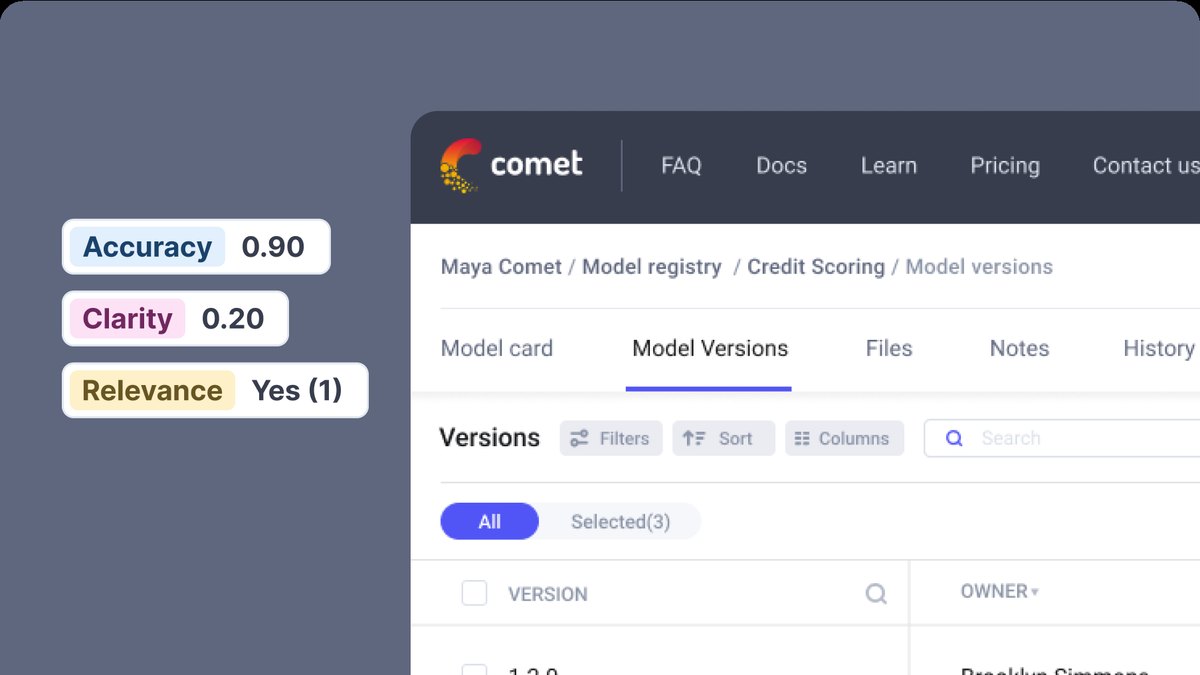
MLflow Model Registry is the best model registry: it is open source (Apache-2.0 on GitHub), with versions, aliases and lineage to the run that made each model. Kubeflow Model Registry is #2 for Kubernetes teams but is labeled alpha, and ClearML is #3 with a free Community tier and a Model Repository in every plan.
Comet's open-source product is Opik for LLM observability; the pricing page does not say whether the MLOps product is open source
Teams that want status approvals and webhooks on top of experiment tracking
Pick by what you want
Best open-source registry
MLflow Model Registry
Best for Kubernetes
Kubeflow Model Registry
Best free all-in-one suite
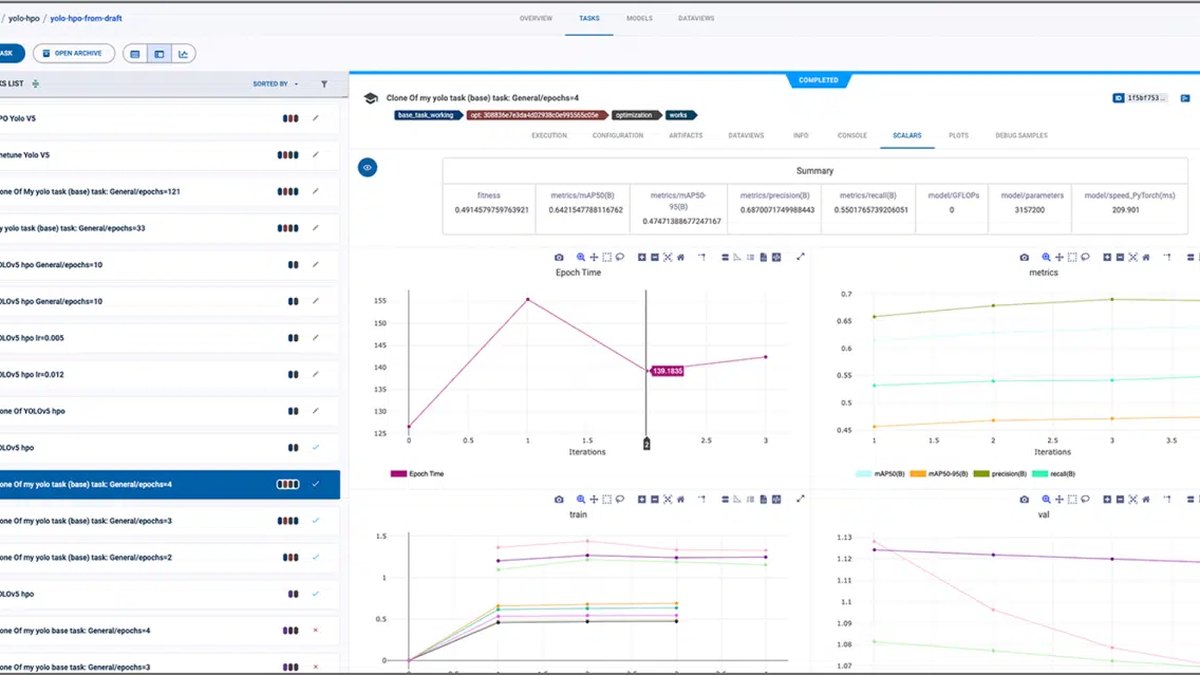
ClearML Model Repository
Best for sharing open models
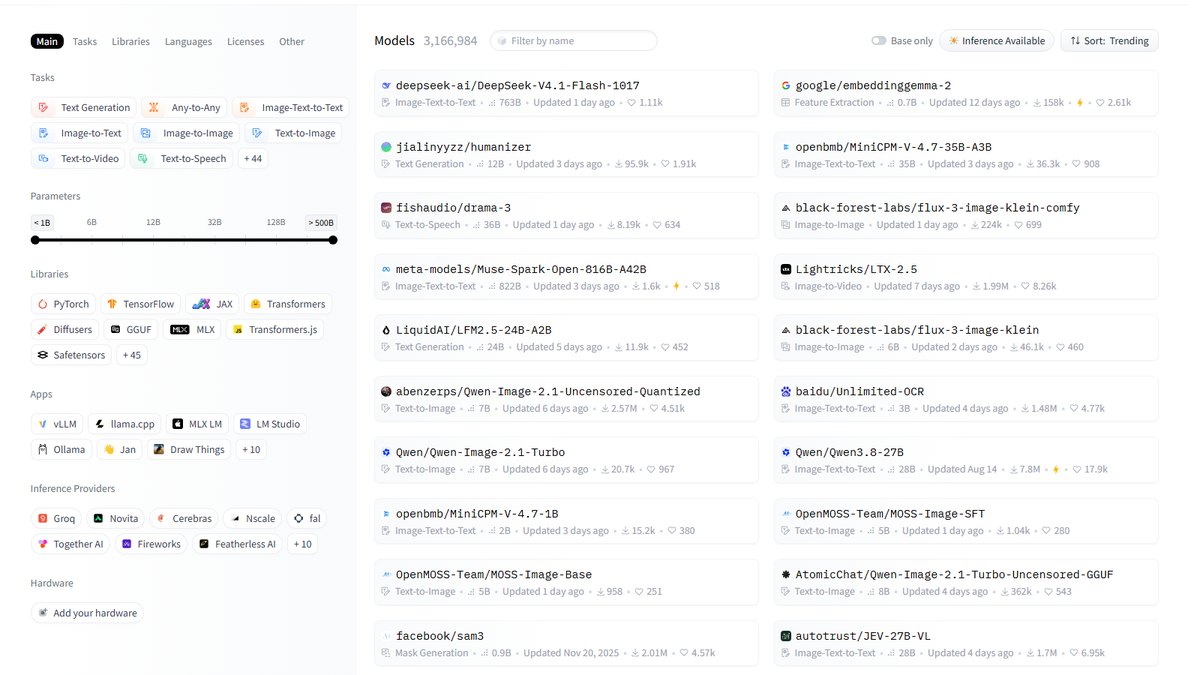
Hugging Face Hub
Best on AWS
Amazon SageMaker Model Registry
The ranking
1
MLflow Model Registry
Answrs VerdictThe default open-source registry.
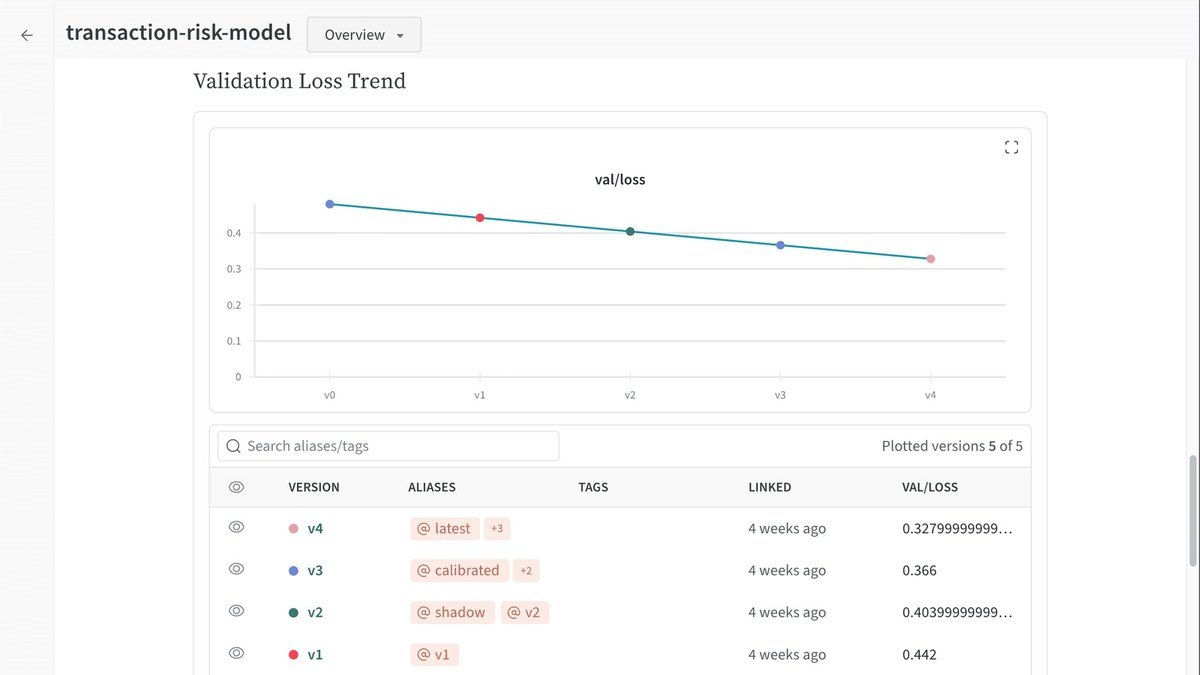
Open source: Open-source MLflow includes the registry with a UI and API; its GitHub page lists the Apache-2.0 licenseVersions and aliases: Each registration under the same name adds a new version, and an alias such as champion is a mutable, named reference to a version, so code does not change when you reassign itLineage: Each version links to the run or logged model that produced it, so you can trace the experiment, data and parameters behind itGovernance: Databricks extends the registry with Unity Catalog integration for central governance, access control and cross-workspace sharingPrice: Not published; the open-source project carries an Apache-2.0 license and no price on the pages I read
Open-source MLflow includes the registry with both a UI and an API, and its GitHub page lists the Apache-2.0 license. Each registration under a name adds a version, and an alias such as champion is a mutable, named reference, so serving code stays the same when you reassign it. Each version links to the run or logged model that produced it. Databricks extends it with Unity Catalog integration for governance and cross-workspace sharing. No price is listed for the open-source project.
Go ifTeams that want a free, self-hosted registry that most ML tools already integrate with
Skip ifYou want a hosted service with a published price from the project itself
Why #1 over #2: It is the open-source option with the most complete lifecycle described, where Kubeflow’s equivalent is labeled alpha.
2
Kubeflow Model Registry
Answrs VerdictKubernetes-native and open, but labeled alpha.
Open source: Kubeflow Hub, the project formerly known as Model Registry, is Apache-2.0 licensed on GitHubWhat it stores: A central index to manage models, versions and artifact metadata, with performance metrics and test results kept per versionRelease flow: Validated versions can move to production-ready status, and the docs map six stages: Create, Verify, Package, Release, Deploy and MonitorInterfaces: REST API from an OpenAPI spec, a Python client and a React-based UI, with Kubernetes components including a CSI driver for model artifactsStatus: The repository says this Kubeflow component has alpha status with limited support
Kubeflow Hub, formerly Model Registry, is Apache-2.0 licensed and is a central index for models, versions and artifact metadata, with performance metrics and test results kept per version. Its docs map six stages: Create, Verify, Package, Release, Deploy and Monitor. It ships a REST API, a Python client, a React-based UI and Kubernetes components. Its repository labels the component alpha with limited support.
Go ifKubernetes-first platform teams already running Kubeflow
Skip ifYou need a stable, fully supported release today
Why #2 over #3: It is Kubernetes-native and open, where ClearML is a broader suite you adopt whole.
3
ClearML Model Repository
Answrs VerdictAn open-source suite with a free tier and clear entry price.
Open source: Calls itself 100% open source on GitHub; the repository lists the Apache License 2.0Registry in every tier: The Model Repository is included in all tiers, including Open Source, with search and filtering by project, name, tags and metadataPrice: Community is $0 for up to 3 users; Pro is $15 per user per month plus usage for up to 10 users; Scale and Enterprise are custom quotesPaid extras: Scale and Enterprise add trigger actions and model endpoint monitoring
ClearML calls itself 100% open source on GitHub under the Apache License 2.0, and the Model Repository is included in every tier, including Open Source, with search by project, name, tags and metadata. Community is $0 for up to 3 users, Pro is $15 per user per month plus usage for up to 10 users, and Scale and Enterprise are custom quotes that add trigger actions and endpoint monitoring.
Go ifSmall teams that want experiment tracking, data and a model repository in one open-source suite
Skip ifYou only need a standalone registry
Why #3 over #4: It publishes a free tier and an entry price, where ZenML’s free edition has no registry dashboard.
4
ZenML
Answrs VerdictA registry built into an open-source pipeline framework.
Open source: Its GitHub page says ZenML is distributed under the Apache License Version 2.0Model Control Plane: Register models by SDK, CLI or pipeline; each pipeline run with a model configuration creates a new version, and versions can be promoted through staging, production and archivedLineage: Pipelines and artifacts such as datasets, weights and predictions can be associated with a model to track lineagePrice: Open Source is free and self-hosted; Starter is $39 per month with a 14-day free trial; Enterprise is customDashboard: The visual dashboard is only available in ZenML Pro, while the Python SDK features work in both OSS and Pro
ZenML is Apache-2.0 licensed, and its Model Control Plane registers models by SDK, CLI or pipeline. Each pipeline run with a model configuration creates a new version, and versions can be promoted through staging, production and archived. Artifacts such as datasets, weights and predictions attach to a model to track lineage. Open Source is free and self-hosted, Starter is $39 per month with a 14-day trial, and the visual dashboard is only in ZenML Pro.
Go ifPipeline-centric teams that want model versions tied to the pipeline runs that created them
Skip ifYou want a standalone registry UI in the free edition
Why #4 over #5: It ties versions to pipeline runs, where Hugging Face Hub is a hosting and sharing layer.
5
Hugging Face Hub
Answrs VerdictThe best place to publish and find open models, lighter on lifecycle controls.
What it is: The Model Hub is where the community hosts model checkpoints for storage, discovery and sharing, with 15+ integrated librariesOpen source: The Hub service itself is not described as open source; its official client library huggingface_hub is Apache-2.0 licensedPrice: PRO is $9 per month; Team is $20 per user per month; Enterprise is $50 per user per monthStorage: Public repo storage is $12 per TB per month and private is $18 per TB per month at base volume; egress and CDN are included at no extra cost
The Model Hub hosts community model checkpoints for storage, discovery and sharing, with 15+ integrated libraries. The Hub service itself is not described as open source, though its official client library huggingface_hub is Apache-2.0. PRO is $9 per month, Team is $20 per user per month and Enterprise is $50 per user per month. Public storage is $12 per TB per month and private $18 at base volume, with egress and CDN included.
Go ifSharing and discovering public models, and private team model repos
Skip ifYou need release stages and approval workflows for production models
Why #5 over #6: It is the largest place to share models publicly, where W&B Registry is built for internal teams.
6
Weights & Biases Registry
Answrs VerdictStrong linking and lineage; now part of CoreWeave.
What it is: A curated central repository of W&B Artifact versions across your organization; new organizations start with Models and Datasets registriesLinking: You link an artifact version to a collection without duplicating it, and can audit lineage and historyAutomations: Automations can drive downstream processes such as model CI/CDPrice: Free is $0 with 5 model seats; Pro starts at $60 per month; Enterprise is customOwnership: CoreWeave says it completed its acquisition of Weights & Biases and will keep it interoperable
W&B Registry is a curated central repository of Artifact versions. You link a version to a collection without duplicating it, audit lineage, and use automations for downstream steps such as model CI/CD. Free is $0 with 5 model seats and Pro starts at $60 per month. CoreWeave says it completed its acquisition of Weights & Biases and will keep it interoperable.
Go ifTeams already tracking experiments in W&B who want linked, audited model versions
Skip ifYou need an open-source, self-hosted registry
Why #6 over #7: It links versions without copying them and adds automations, where SageMaker is tied to AWS.
7
Amazon SageMaker Model Registry
Answrs VerdictApproval workflows built into the AWS ML stack.
Catalog: Catalog models in Model Groups that hold versions, and organize groups further into Model Registry CollectionsLifecycle: Manage approval status, define a staging construct, view lineage and Model Cards information, and deploy to productionAutomation: Automate model deployment with CI/CD and share models with other usersPrice: Not published for the registry; the SageMaker AI pricing page says you pay only for the underlying compute and storage resources
SageMaker Model Registry catalogs models in Model Groups that hold versions, with Collections to organize groups. It manages approval status, a staging construct, lineage and Model Cards information, and can automate deployment with CI/CD. No registry price is listed; the SageMaker AI pricing page says you pay only for the underlying compute and storage resources.
Go ifTeams already building and deploying on AWS
Skip ifYou want a cloud-neutral or open-source registry
Why #7 over #8: It has explicit approval status, where Vertex AI’s page describes aliases and labels.
8
Vertex AI Model Registry
Answrs VerdictA tidy Google Cloud registry with alias-based deploys.
What it is: A central repository to manage the lifecycle of your ML models; the docs sidebar now calls it Agent Platform Model RegistryVersions and aliases: Organize and track model versions, mark one with the default alias for production, and add other aliases or labelsDeployment: Assign a model to an endpoint directly from the registry, or run batch inference from itBigQuery ML: Supports BigQuery ML models without exporting or importing themPrice: Not published on the registry page I read
Vertex AI Model Registry is a central repository to manage the lifecycle of ML models; the docs sidebar now calls it Agent Platform Model Registry. You can mark a version with the default alias for production, add other aliases or labels, assign a model to an endpoint from the registry, and run batch inference. It also supports BigQuery ML models without exporting them. No price is listed on the page I read.
Go ifGoogle Cloud teams that train in BigQuery ML or Vertex and deploy to endpoints
Skip ifYou want an open-source registry you can run yourself
Why #8 over #9: It registers BigQuery ML models directly, where Azure’s page does not describe aliases.
9
Azure Machine Learning Model Registry
Answrs VerdictNo extra charge for the service, solid for Azure shops.
What it does: Stores and versions models in your Azure Machine Learning workspace; registering under an existing name increments the version numberOutside models: You can register models trained outside Azure Machine Learning, and add metadata tags to search for themEvents: Publishes events such as model registration to Azure Event Grid so you can automate lifecycle stepsPrice: The pricing page says there is no additional charge to use Azure Machine Learning; you pay for compute and other Azure services
Azure Machine Learning stores and versions models in your workspace, increments the version when you register under an existing name, and accepts models trained outside Azure. Tags make models searchable, and events such as registration go to Azure Event Grid. The pricing page says there is no additional charge to use Azure Machine Learning, while compute and other Azure services are billed.
Go ifAzure teams who want registration, tags and event-driven automation
Skip ifYou want stage promotion and approvals described on its docs page
Why #9 over #10: It publishes events for automation, where Comet’s docs focus on webhooks and status approvals.
10
Comet Model Registry
Answrs VerdictGood approvals and webhooks; the registry is not described as open source.
What it does: A central place to track and manage trained models, with a registered-model version auto-filled as 1.0.0 and free-form notesWebhooks: Webhooks fire when a model version, its tags or its status changes, to connect to CI/CDApprovals: Workspace owners approve user requests to change model status, and a history records actions over timePrice: The MLOps Free plan is $0 and lists a model registry; Pro is $19 per user per month; Enterprise is customOpen source: Comet's open-source product is Opik for LLM observability; the pricing page does not say whether the MLOps product is open source
Comet Model Registry is a central place to track and manage trained models, with versions starting at 1.0.0, notes, a history of actions, and workspace-owner approval of status-change requests. Webhooks fire when a version, its tags or its status changes. The MLOps Free plan is $0 and lists a model registry; Pro is $19 per user per month. Comet's open-source product is Opik for LLM observability, and its pricing page does not say the MLOps product is open source.
Go ifTeams that want status approvals and webhooks on top of experiment tracking
Skip ifYou need the registry itself to be open source
How we ranked these
We ranked registries on open-source availability and the license shown on GitHub first, then on how fully each vendor’s own documentation describes versioning, lineage, approvals and deployment, then on published prices. Every fact comes from the vendor’s docs, pricing pages or repository; where a page showed no price, we say Not published. Hugging Face Hub is included because teams use it to host and version models, but the Hub service itself is not described as open source. Databricks Unity Catalog, Neptune, DVC, lakeFS and JFrog were not given their own entries because we did not verify their registry features and prices on official pages for this list. Ownership changes are as stated on the vendors’ pages and may change. Facts are taken from each maker's own published information; check the official site before you buy.
Questions people ask
What is the best open-source model registry?
MLflow Model Registry ranks first: open-source MLflow includes the registry with a UI and API, and its GitHub page lists the Apache-2.0 license. Kubeflow Model Registry, ClearML and ZenML are also Apache-2.0 licensed.
Which model registries are open source?
MLflow, Kubeflow Hub (formerly Model Registry), ClearML and ZenML list Apache licenses on GitHub. Hugging Face’s client library is Apache-2.0, but the Hub service is not described as open source, and the cloud registries from AWS, Google Cloud and Microsoft are managed services.
Is Kubeflow Model Registry production ready?
Its repository says this Kubeflow component has alpha status with limited support, so check the support policy before relying on it.
What is the difference between a model registry and a model repository?
The terms overlap. ClearML calls its registry a Model Repository, and Hugging Face calls its collection of checkpoints the Model Hub. Lifecycle-style registries such as MLflow, SageMaker and Comet add versions, aliases or statuses and approvals.
Listed entry price of paid plans (monthly; per user where noted) at a glance
Hugging Face PRO9 USD per month
ClearML Pro (per user)15 USD per month
Comet Pro (per user)19 USD per month
Hugging Face Team (per user)20 USD per month
ZenML Starter39 USD per month
W&B Pro60 USD per month
Listed entry price of paid plans (monthly; per user where noted), as published by each maker. Picks without a published figure are left off.