Hugging Face Hub is the best open-source model hub, with 3,166,975 models and task filters for vision. Ollama is #2 for running models locally, and Kaggle Models is #3 for testing them in notebooks. ModelScope and OpenRouter cover vision tasks and no-download testing.
Total not published; the Hub page shows individual models such as PyTorch-Transformers and YOLOv5
Loading a research model, such as YOLOv5 for object detection, from PyTorch code
Pick by what you want
Best overall
Hugging Face Hub
Best to run locally
Ollama
Best for notebooks
Kaggle Models
Best vision task list after Hugging Face
ModelScope
Best to test without downloading
OpenRouter
The ranking
1
Hugging Face Hub
Answrs VerdictThe biggest open model hub, vision included.
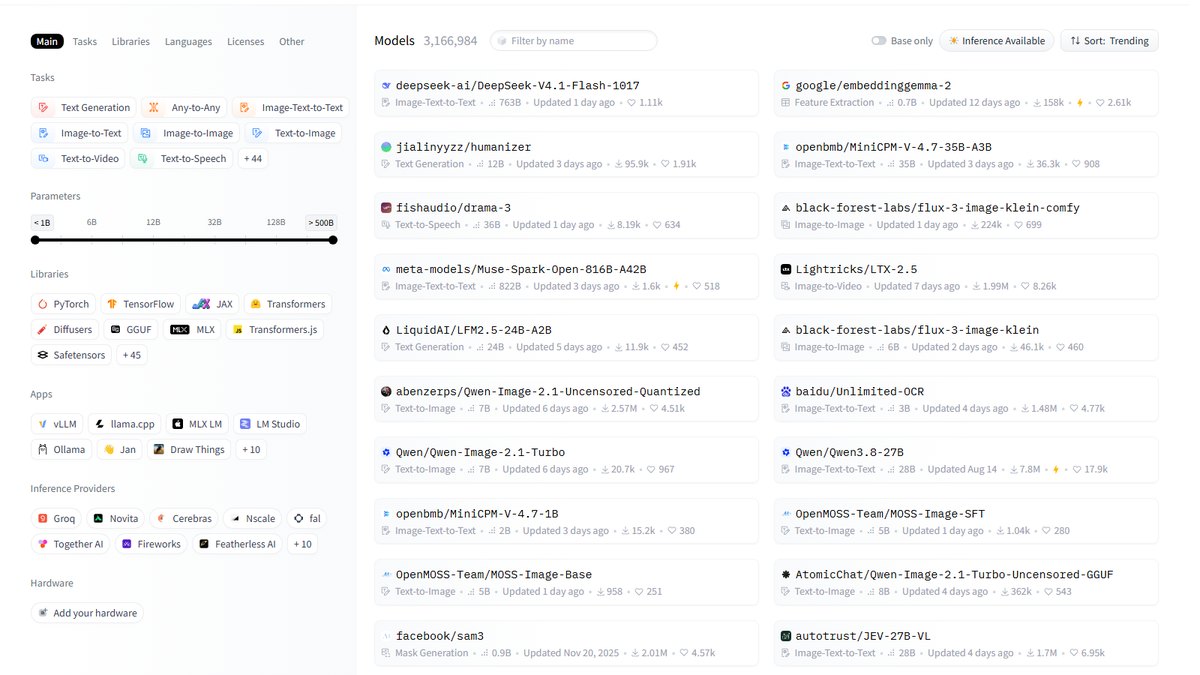
Models listed: 3,166,975 on the Models pageVision models: Task filters include Image-Text-to-Text, Image-to-Text and Text-to-ImagePrice: PRO is $9 a month and Enterprise is $50 a month per userRun in apps: The Apps filter lists vLLM, llama.cpp, MLX LM, LM Studio, Ollama, Jan and Draw Things
Hugging Face Hub lists 3,166,975 models on its Models page, with task filters such as Image-Text-to-Text, Image-to-Text and Text-to-Image, plus library, size and inference-provider filters. Its Apps filter lists vLLM, llama.cpp, MLX LM, LM Studio, Ollama, Jan and Draw Things. PRO is $9 a month and Enterprise $50 a month per user.
Go ifThe widest choice of open models, with task, size, library and app filters
Skip ifYou want a short, curated list
Why #1 over #2: It lists far more models than ModelScope’s 272,290 and links to local apps such as Ollama and LM Studio.
2
Ollama
Answrs VerdictThe easiest way to run open models locally.
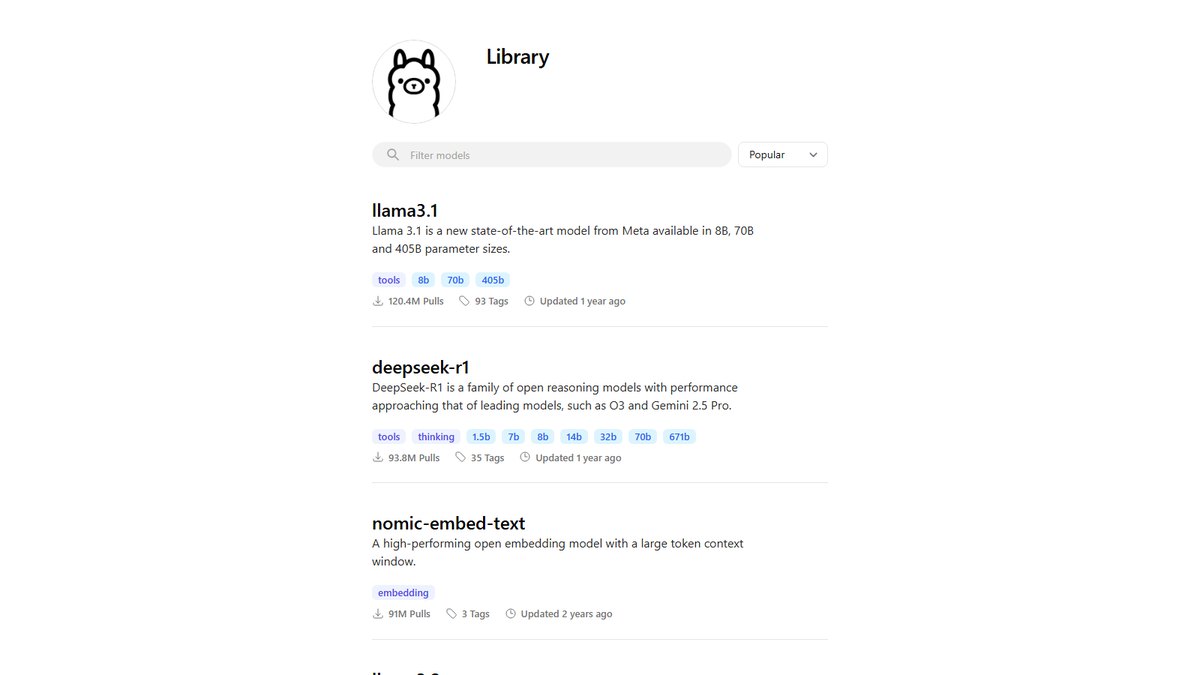
Models listed: Total not published; the library shows pulls per model, such as 120.4M for llama3.1Price: Free $0 to run models locally; Pro $20 a month; Max $100 a monthVision models: The library includes LLaVA, a vision-and-language model, and tags models by capabilityCloud: Cloud models run from your apps or terminal with no model or app download
Ollama’s library lets you pull models and run them on your own machine; llama3.1 shows 120.4M pulls and LLaVA is a vision-and-language model. Running locally is Free at $0, Pro is $20 a month and Max $100 a month. Cloud models run from your apps or terminal with no download.
Go ifDownloading a model and running it on your own machine
Skip ifYou want to browse millions of community uploads
Why #2 over #3: It runs models on your own machine, which Kaggle Models does only inside its notebooks.
3
Kaggle Models
Answrs VerdictThe best hub for testing models in notebooks.
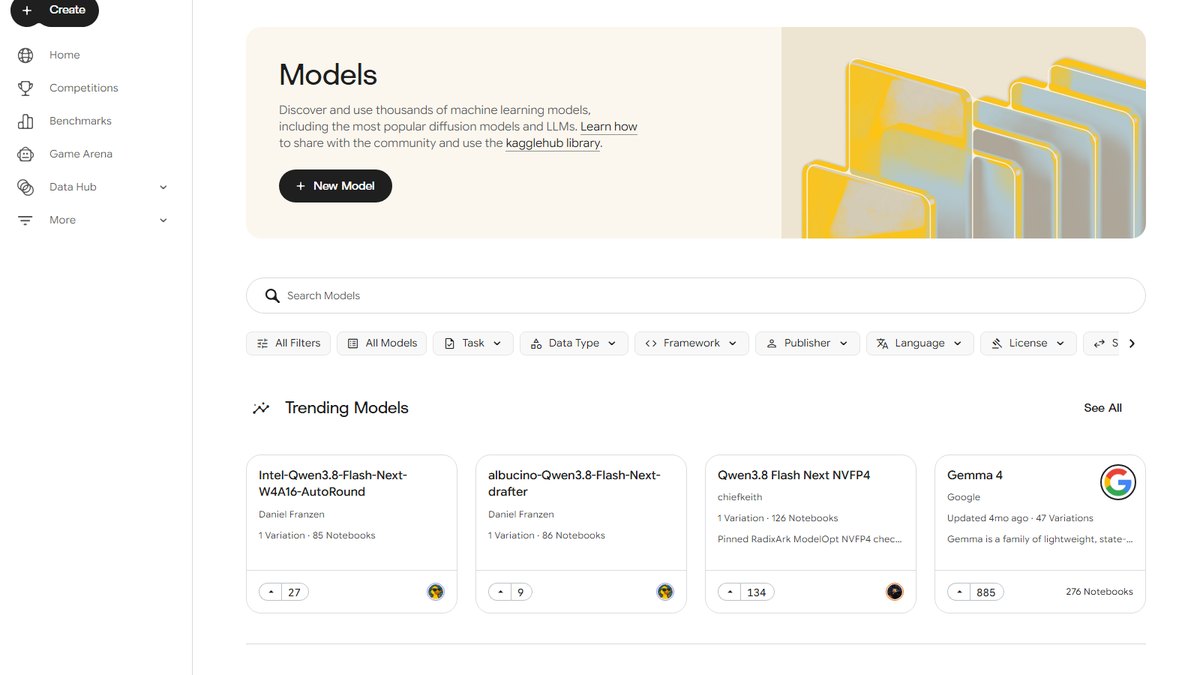
Models listed: Total not published on the Models page; Gemma 4 alone shows 47 variationsPrice: Not published on the Models pageSources: Models come from partners such as Meta and Alibaba, Keras integrations, Hugging Face Hub links and the Kaggle communityFilters: Filter by task, data type, framework, publisher, language, license and size
Kaggle Models is a repository of pre-trained models built into Kaggle Notebooks and Competitions. Models come from partners such as Meta and Alibaba, Keras integrations, Hugging Face Hub links and the community; Gemma 4 alone shows 47 variations. Kaggle does not publish a price on the Models page.
Go ifTrying a model inside a Kaggle notebook next to its datasets and community notes
Skip ifYou want to run the model in a local app
Why #3 over #4: Its model pages carry public notebooks and discussions, which ModelScope’s listing does not show.
4
ModelScope
Answrs VerdictThe deepest task list for vision models after Hugging Face.
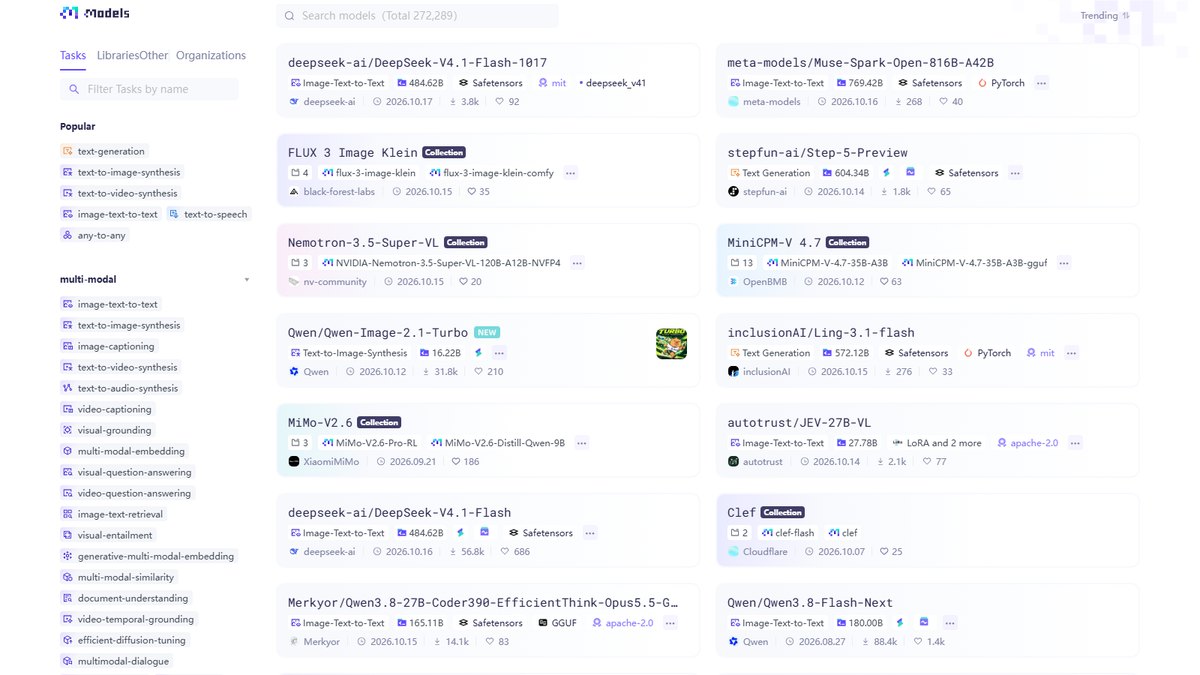
Models listed: 272,290 in the search box on the Models pageVision tasks: Multi-modal tasks include image-text-to-text, visual-question-answering, image-captioning and document-understandingPrice: Not published on the Models pageFilters: Browse by tasks, libraries, other tags and organizations
ModelScope lists 272,290 models and organizes them by task, including multi-modal tasks such as image-text-to-text, visual-question-answering, image-captioning and document-understanding. Price is not published on the Models page.
Go ifBrowsing vision and multi-modal models by task
Skip ifYou need English-first community support
Why #4 over #5: Its multi-modal task list is deeper than OpenRouter’s modality filter, though OpenRouter needs no download.
5
OpenRouter
Answrs VerdictThe best place to test models through one API.
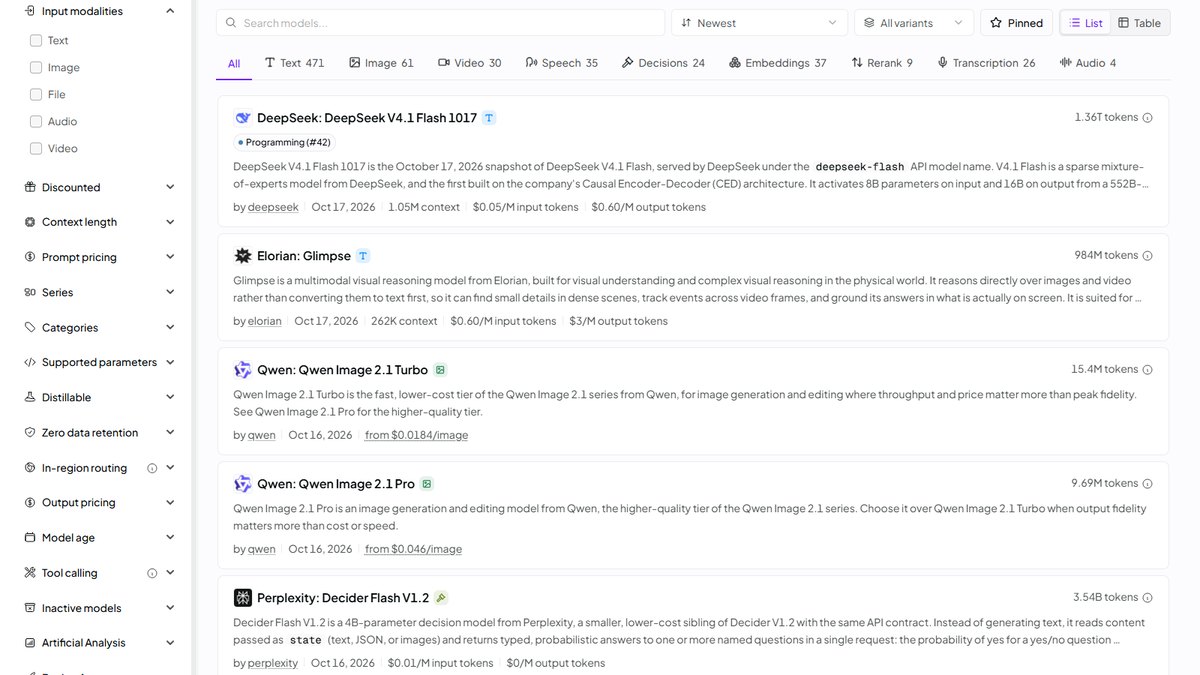
Models listed: 500+ models from 80+ providers on paid plansPrice: Free plan with 25+ free models and 50 requests a day; Standard adds a 5.5% platform feeVision input: The Models page has an Input modalities filter with Image, File, Audio and Video optionsAccess: Chat and API access on every plan, so you test models without downloading weights
OpenRouter lists 500+ models from 80+ providers on paid plans, with chat and API access on every plan. The Free plan includes 25+ free models and 50 requests a day; Standard adds a 5.5% platform fee. The Models page has an Input modalities filter with an Image option.
Go ifTesting many models through one API without downloading anything
Skip ifYou need the weights on your own disk
Why #5 over #6: It tests models across 80+ providers with no download, where Replicate runs its own catalog.
6
Replicate
Answrs VerdictThe easiest pay-as-you-go way to try image models.
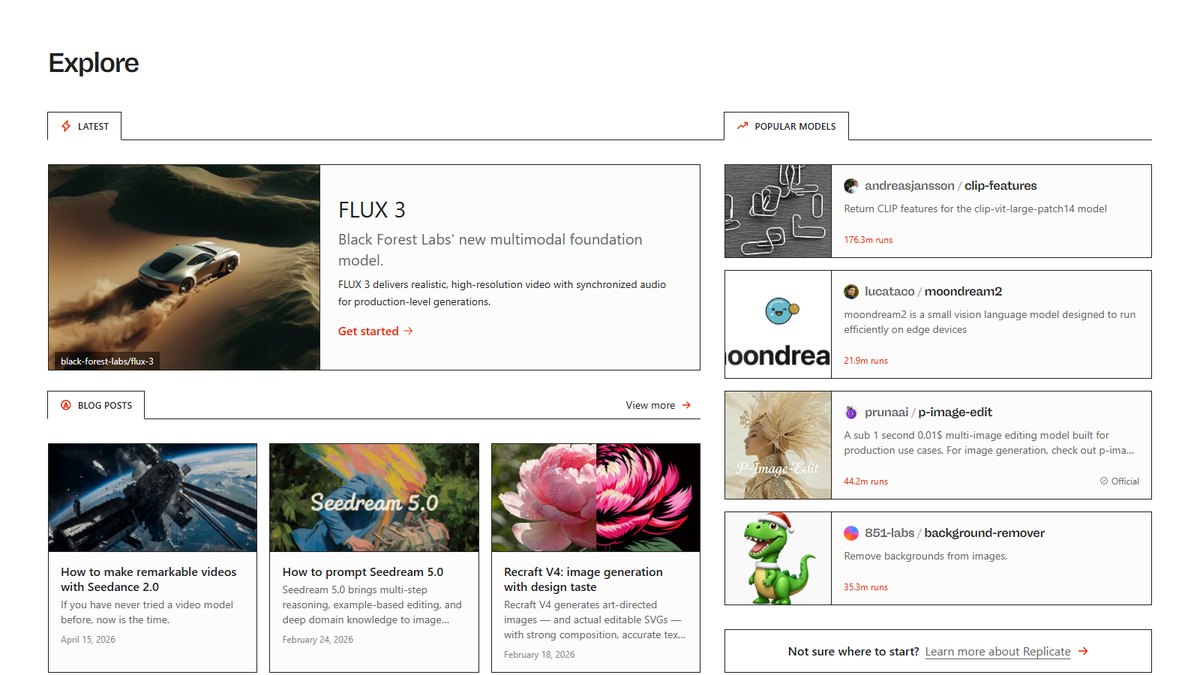
Models listed: Total not published; the pricing page says thousands of open-source models are contributed by the communityPrice: Pay for what you use; flux-dev is $0.025 per output imageVision models: moondream2, a small vision language model, shows 21.9m runs on the Explore pageBilling: Most public models are billed by the time they take to run
Replicate runs models behind an API, billed for what you use; flux-dev is $0.025 per output image and most public models are billed by run time. Its Explore page shows models such as moondream2, a small vision language model with 21.9m runs. The pricing page says thousands of open-source models are contributed by the community.
Go ifRunning an image, video or vision model from an API with no setup
Skip ifYou want to download weights and run them yourself
Why #6 over #7: It bills per run with no setup, while NVIDIA Build is aimed at deploying on your own GPUs.
7
NVIDIA Build
Answrs VerdictThe best catalog for GPU-ready NIM models.
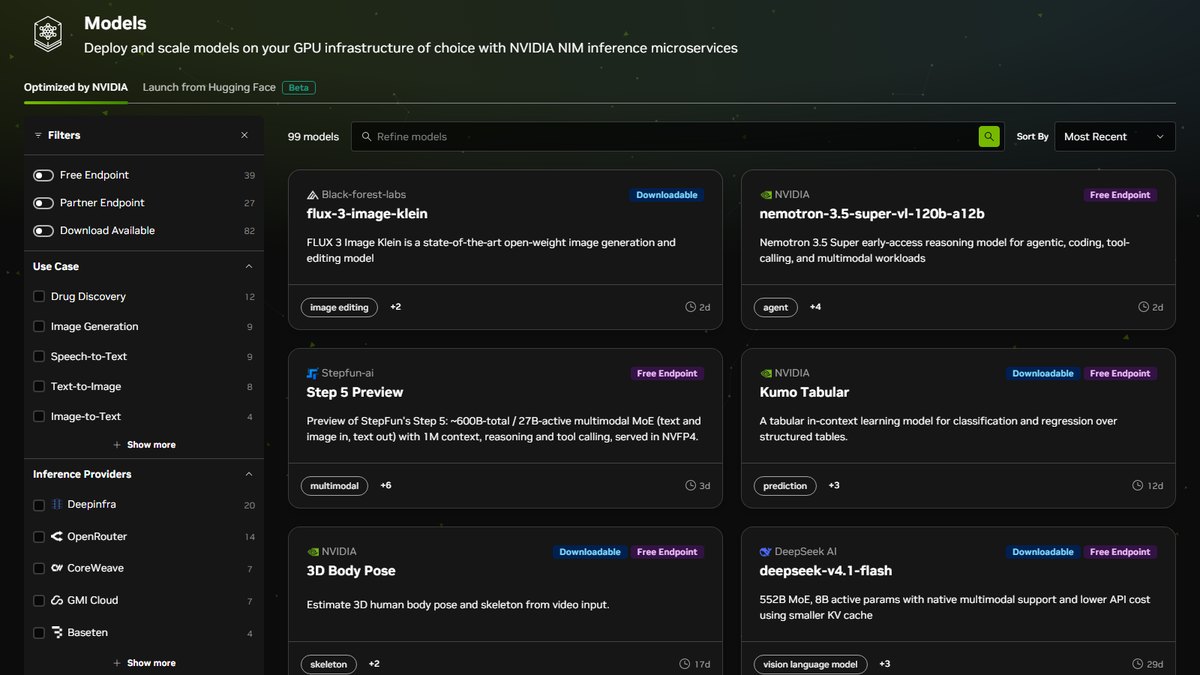
Models listed: 99 modelsAccess: 39 Free Endpoint, 27 Partner Endpoint and 82 Download AvailableVision models: The Image-to-Text use case lists 4 modelsPrice: Not published on the models page; a Free Endpoint filter marks the free ones
NVIDIA Build lists 99 models, with 39 Free Endpoint, 27 Partner Endpoint and 82 Download Available. The Image-to-Text use case lists 4 models. The page describes deploying models on your GPU infrastructure with NVIDIA NIM inference microservices. Price is not published on the models page.
Go ifNVIDIA NIM models you can deploy on your own GPU infrastructure
Skip ifYou want a long tail of community uploads
Why #7 over #8: It targets your own GPU deployment, which LM Studio’s desktop catalog does not.
8
LM Studio Model Catalog
Answrs VerdictA small catalog with a vision filter.
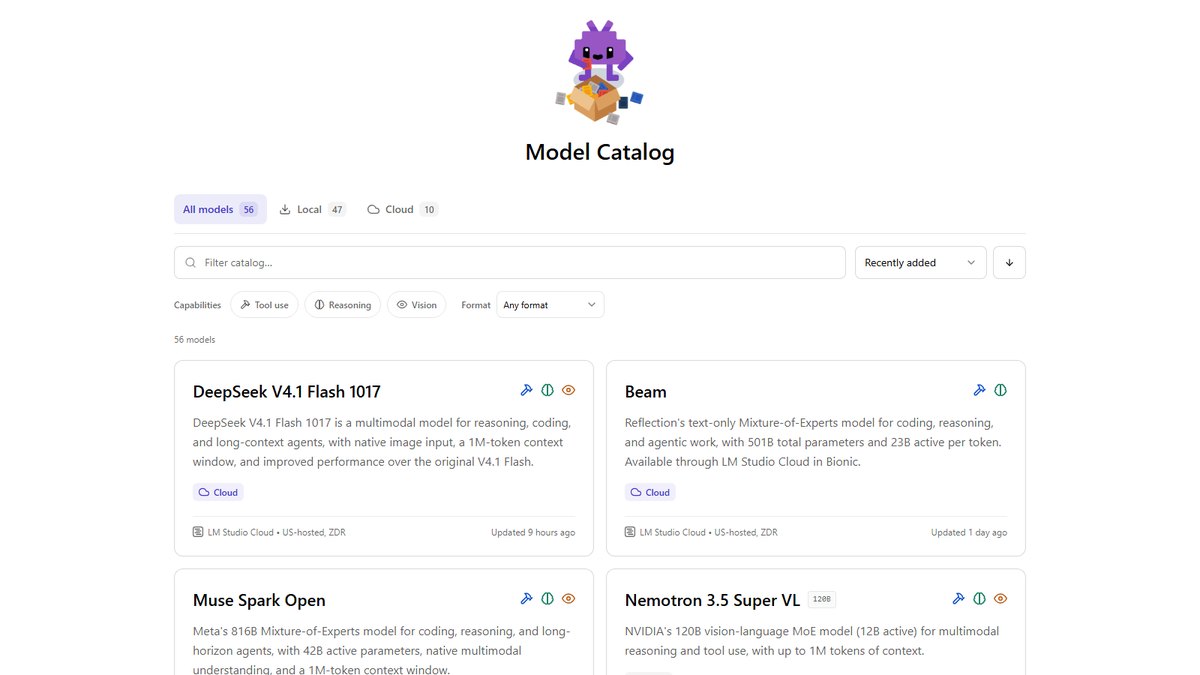
Models listed: 56: 47 Local and 10 CloudPrice: Free $0 for local models; Bionic+ $20 a month; Pro $100 a monthVision models: The catalog has a Vision capability filter next to Tool use and ReasoningRuntime: Local models run on llama.cpp and MLX
LM Studio’s Model Catalog lists 56 models, 47 Local and 10 Cloud, with Tool use, Reasoning and Vision capability filters. Local models run on llama.cpp and MLX. The Free plan is $0 for local models; Bionic+ is $20 a month and Pro $100 a month.
Go ifDownloading a local model and chatting with it in a desktop app
Skip ifYou need thousands of choices
Why #8 over #9: It runs models in a desktop app, where Together AI’s library is for hosted models.
9
Together AI Model Library
Answrs VerdictA price-per-token library for hosted open models.
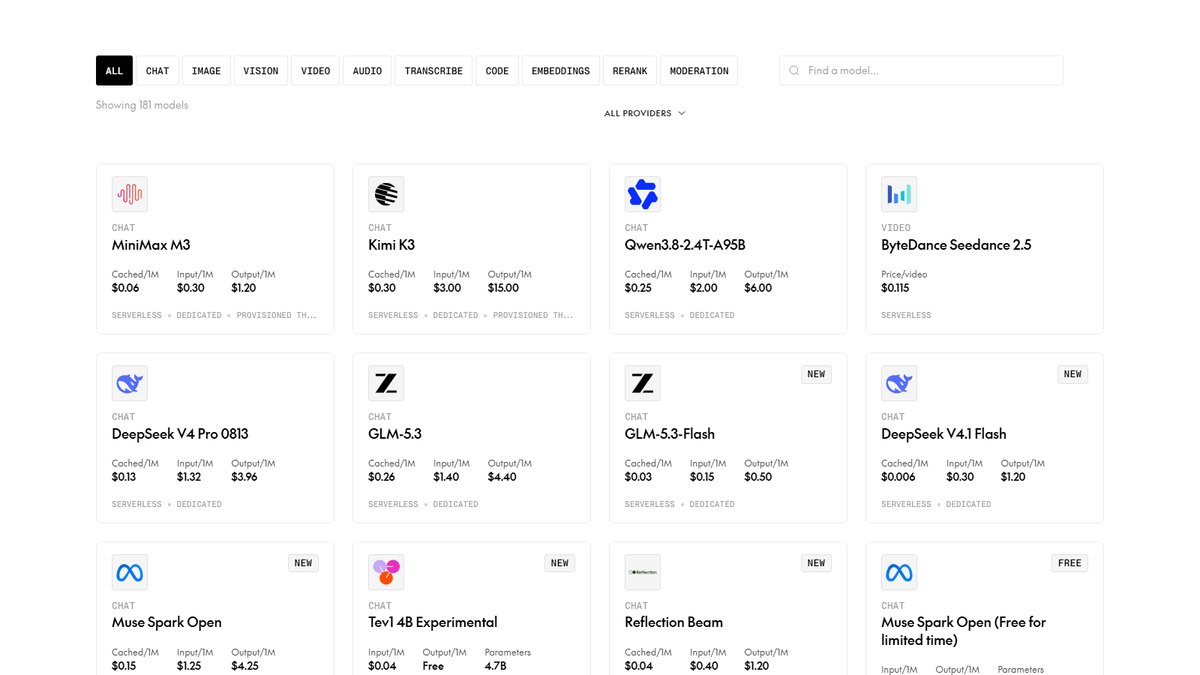
Models listed: Showing 181 modelsVision models: The library has a Vision tab beside Chat, Image, Video, Audio, Code and EmbeddingsPrice: Kimi K3 is $3.00 input and $15.00 output per 1M tokensHosting: Models run serverless, dedicated or on provisioned throughput
Together AI’s Model Library shows 181 models, with tabs for Chat, Image, Vision, Video, Audio, Transcribe, Code, Embeddings, Rerank and Moderation. Models run serverless, dedicated or on provisioned throughput, and Kimi K3 is $3.00 input and $15.00 output per 1M tokens.
Go ifCalling open models by API at published per-token prices
Skip ifYou want to download weights
Why #9 over #10: It publishes per-token prices on its pricing page, which PyTorch Hub does not.
10
PyTorch Hub
Answrs VerdictA research hub that is still labelled beta.
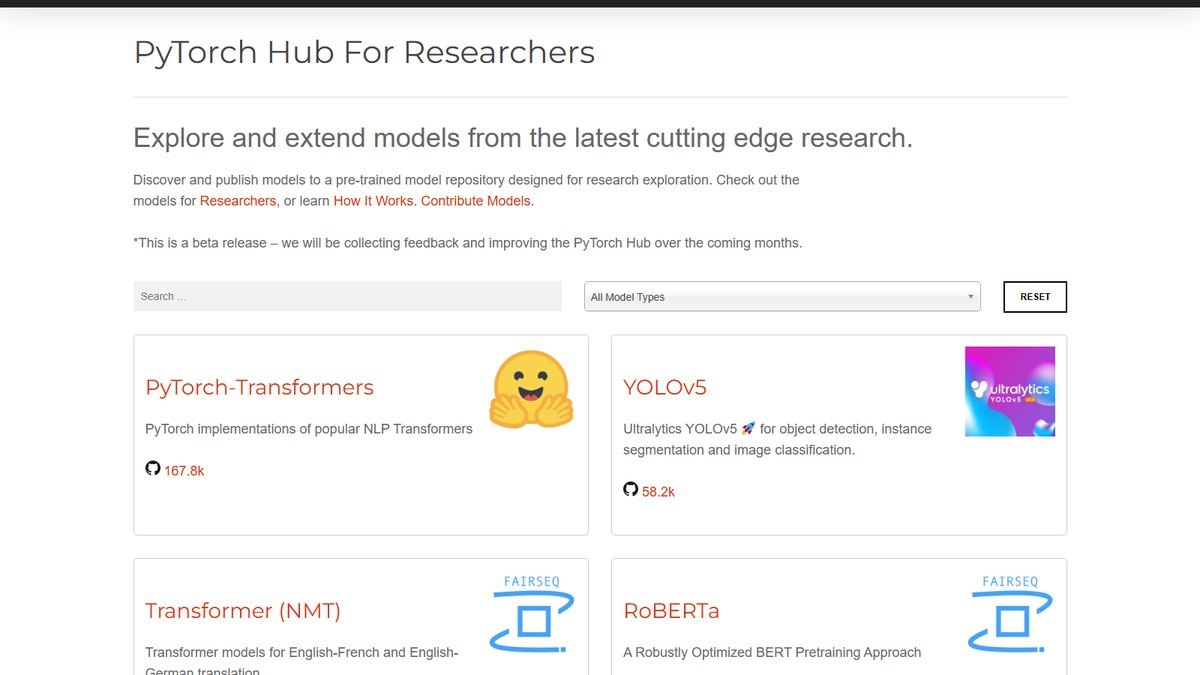
Models listed: Total not published; the Hub page shows individual models such as PyTorch-Transformers and YOLOv5Price: Not published on the Hub pageStatus: The page calls the Hub a beta releaseFocus: A pre-trained model repository designed for research exploration
PyTorch Hub is a pre-trained model repository designed for research exploration, and the page calls it a beta release. It shows models such as PyTorch-Transformers and YOLOv5 for object detection. The total model count and price are not published on the Hub page.
Go ifLoading a research model, such as YOLOv5 for object detection, from PyTorch code
Skip ifYou want the newest large language or vision-language models
How we ranked these
We ranked hubs on how many open models they list, how easily you can download or test them, and the vision filters and prices each publishes on its own pages. Counts are what each hub showed on its model page when we checked. MLflow Model Registry and Harbor from the old list are not public model hubs, and TensorFlow Hub now points to Kaggle Models, so they were replaced with OpenRouter, LM Studio, Together AI and NVIDIA Build. Facts are taken from each maker's own published information; check the official site before you buy.
Questions people ask
Where can I download open-source AI models?
Hugging Face Hub lists 3,166,975 models on its Models page and ModelScope lists 272,290. Ollama lets you run models locally, and Kaggle Models and PyTorch Hub are other options.
Where can I test the latest open-source vision models?
Hugging Face has Image-Text-to-Text and Image-to-Text task filters, ModelScope has image-text-to-text and visual-question-answering tasks, Together AI has a Vision tab, and LM Studio has a Vision filter.
Is Ollama a model hub?
Yes. Its library lists models you can run on your own machine, with pulls shown per model (120.4M for llama3.1). Running locally is free at $0 and Pro is $20 a month.
Is Kaggle Models free to use?
Kaggle’s Models page does not publish a price. Its docs say models come from partners, Keras integrations, Hugging Face Hub links and the Kaggle community.
Models listed on each hub’s own page (OpenRouter shows 500+) at a glance
LM Studio56 models
NVIDIA Build99 models
Together AI181 models
OpenRouter500 models
ModelScope272,290 models
Hugging Face Hub3,166,975 models
Models listed on each hub’s own page (OpenRouter shows 500+), as published by each maker. Picks without a published figure are left off.