Top 10 Real-Time Vector Search Engines for AI Agents and RAG in 2027
By Kory White · Updated Nov 2026 · 8 min read
Direct answer
Qdrant is the top real-time vector search engine for AI agents and RAG in our scoring: it says new data is searchable immediately after insertion, filters during HNSW graph traversal, offers a free forever cluster, and is listed in both ANN-Benchmarks and VectorDBBench. Redis is #2 as an in-memory store with documented vector indexes and filters, and Milvus is #3 with 46.6K GitHub stars. Every latency figure here is vendor-stated, and no vendor result is an independent benchmark.
Free forever single-node cluster with 0.5 vCPU, 1GB RAM and 4 GB disk; Standard is usage-based and Premium needs a minimum spend, with no dollar figure published
Agents that filter on metadata and need fresh writes, with a free tier to start
Not published; the homepage points to Contact Sales
Multimodal and training data workloads that also need search at scale
Pick by what you want
Best overall
Qdrant
Best if you already run Redis
Redis
Best open source from laptop to billions
Milvus
Best for seconds-level freshness, fully managed
Pinecone
Best for in-process, on-device retrieval
Moss
The ranking
1
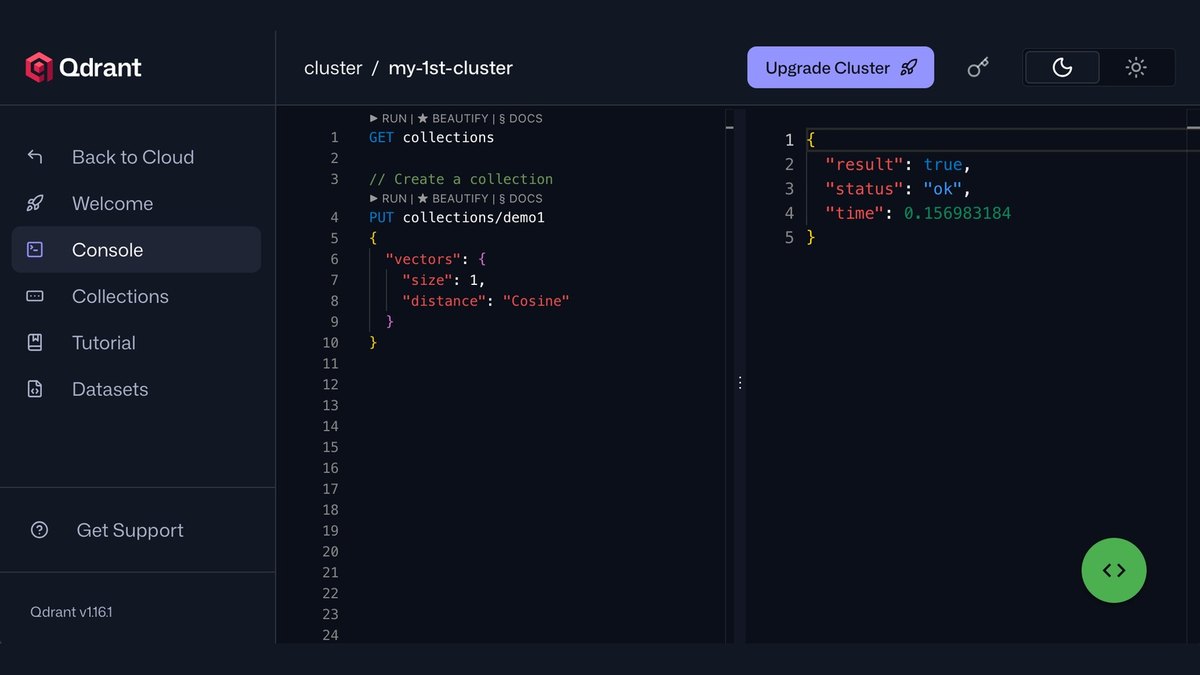
Qdrant
Answrs VerdictRust engine with filtering inside the graph search and immediate searchability.
Price: Free forever single-node cluster with 0.5 vCPU, 1GB RAM and 4 GB disk; Standard is usage-based and Premium needs a minimum spend, with no dollar figure publishedFreshness (vendor-stated): New data is searchable immediately after insertionEngine: Built in Rust with SIMD and a custom storage engine called GridstoreFiltering: Filters apply during HNSW graph traversal rather than as a separate pre- or post-filter stepMemory: Quantization can cut memory use by up to 64x while keeping search quality, per QdrantIndependent benchmark coverage: Listed as supported in both ANN-Benchmarks and VectorDBBench
Qdrant is built in Rust with SIMD and a custom storage engine called Gridstore. It says new data is searchable immediately after insertion, applies filters during HNSW graph traversal rather than as a separate pre- or post-filter step, and says quantization can cut memory use by up to 64x while keeping search quality. It is listed as supported in both ANN-Benchmarks and VectorDBBench. The free forever cluster has 0.5 vCPU, 1GB RAM and 4 GB disk; Standard is usage-based and no paid dollar figure is published. The page gives no latency figure and does not name a license.
Go ifAgents that filter on metadata and need fresh writes, with a free tier to start
Skip ifYou need a published latency number
Why #1 over #2: It combines the strongest freshness statement with third-party benchmark coverage, where Redis documents no time-to-searchable.
2
Redis
Answrs VerdictAn established in-memory data store with documented vector indexes, filters and agent memory.
Price: Free plan up to 30 MB; Essentials from $5/month; Pro from $200/month minimumVector indexes: FLAT, HNSW and SVS-VAMANA vector index types; SVS-VAMANA support was added in Redis 8.2Filtering: Vector search can be combined with filters over text, numerical, geospatial and tag metadataMemory model: Flex automatically tiers hot data in RAM and warm data on flash so multi-TB datasets run at near-RAM speed; Redis says this is 80% lower cost than all-RAM at TB scaleAgent memory: Redis Agent Memory persists and retrieves short- and long-term memory for AI agents; Redis says 43% of enterprise agent stacks already use Redis for agent data storageIndependent benchmark coverage: Listed as supported in both ANN-Benchmarks (as RediSearch) and VectorDBBench
Redis supports FLAT, HNSW and SVS-VAMANA vector index types, with SVS-VAMANA added in Redis 8.2, and lets you combine vector search with filters over text, numerical, geospatial and tag metadata. Flex tiers hot data in RAM and warm data on flash, which Redis says is 80% lower cost than all-RAM at TB scale, and Redis says 43% of enterprise agent stacks already use Redis for agent data storage. It is listed in both ANN-Benchmarks (as RediSearch) and VectorDBBench. A free plan covers up to 30 MB, Essentials starts from $5/month and Pro from $200/month minimum. No vector latency figure was on the pages read.
Go ifTeams that already run Redis and want vector search and agent memory next to their cache
Skip ifYou want a published latency figure for vector queries
Why #2 over #3: It is an in-memory store with broad adoption, where Milvus does not describe an in-memory query path.
3
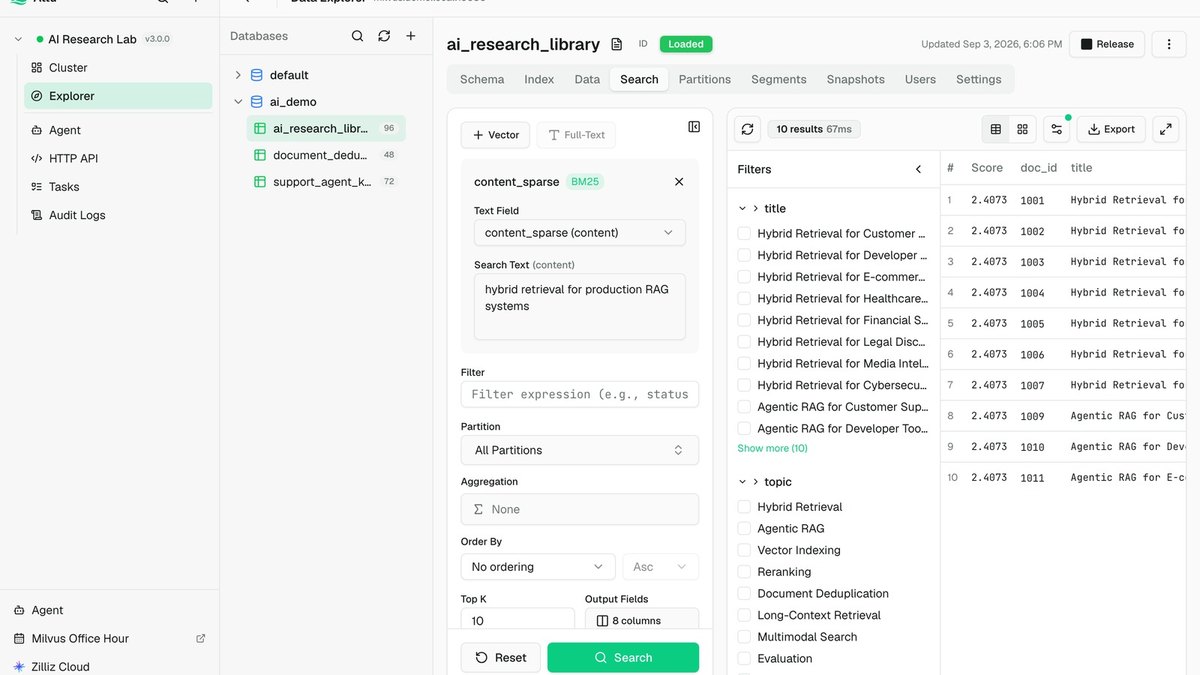
Milvus
Answrs VerdictWide deployment range and a large community, with scale rather than latency as its pitch.
Price: Milvus is open source; Zilliz Cloud Free is $0 with 5 GB storage, and Dedicated starts from $126/monthScale (vendor-stated): Scales to tens of billions of vectors with minimal performance lossDeployment: Milvus Lite for notebooks and laptops, Standalone for a single machine and Distributed for billions of vectorsCommunity: 46.6K GitHub stars shown on the homepageLatency: The homepage gives no query-latency figureIndependent benchmark coverage: Listed as supported in both ANN-Benchmarks and VectorDBBench
Milvus is an open-source vector database with 46.6K GitHub stars on its homepage. Milvus Lite runs in notebooks or on laptops, Standalone suits a single machine, and Distributed is for billions of vectors; it says it scales to tens of billions of vectors with minimal performance loss. It is listed in both ANN-Benchmarks and VectorDBBench, which Zilliz, the company behind Milvus, maintains. Zilliz Cloud Free is $0 with 5 GB storage, and Dedicated starts from $126/month. The homepage gives no query-latency figure, freshness statement or license.
Go ifTeams that want one open-source engine from a laptop to billions of vectors
Skip ifYou want a published latency number
Why #3 over #4: It has the largest open-source following here, where Pinecone is managed only.
4
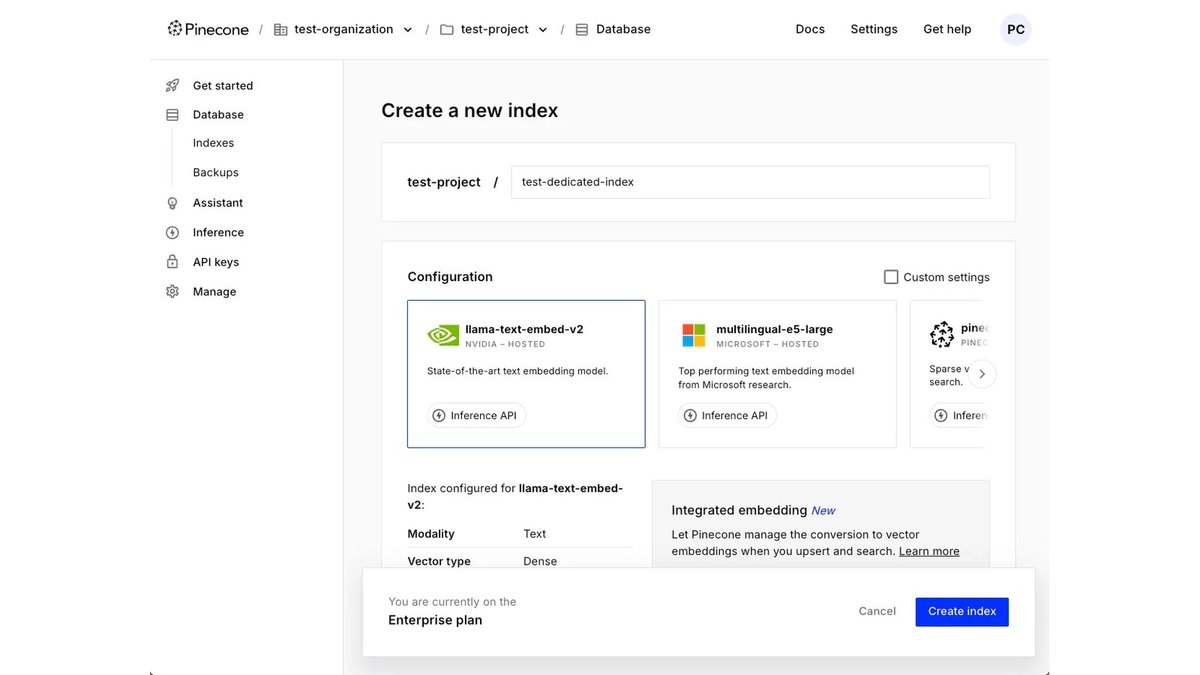
Pinecone
Answrs VerdictA managed service with seconds-level freshness but no published latency number.
Price: Starter free; Builder $20/month; Standard $50/month minimum; Enterprise $500/month minimumFreshness (vendor-stated): Updates are indexed and searchable in secondsLatency (vendor-stated): Says Rust implementations of published algorithms give low latency on large datasets, but gives no latency figureServerless: A fully managed serverless experience with no capacity planning, infrastructure management or tuningUsage pricing: On Standard and Enterprise, storage is $0.33/GB/month, read units $16-$18 per million and write units $4-$4.50 per million, varying by cloud and regionIndependent benchmark coverage: Listed as supported in VectorDBBench, which Zilliz maintains; not listed in ANN-Benchmarks
Pinecone is a fully managed serverless service with no capacity planning, infrastructure management or tuning. It says updates are indexed and searchable in seconds, the only quantified time-to-searchable among the managed services here, and says Rust implementations of published algorithms give low latency on large datasets, but gives no latency figure. It is listed in VectorDBBench, which Zilliz maintains, but not in ANN-Benchmarks. Plans run from a free Starter plan to Builder at $20/month, Standard at a $50/month minimum and Enterprise at a $500/month minimum.
Go ifTeams that want a managed index with no tuning and a clear published price ladder
Skip ifYou want in-memory or on-device retrieval
Why #4 over #5: It has a clear published price ladder, where Vespa publishes none on its homepage.
5
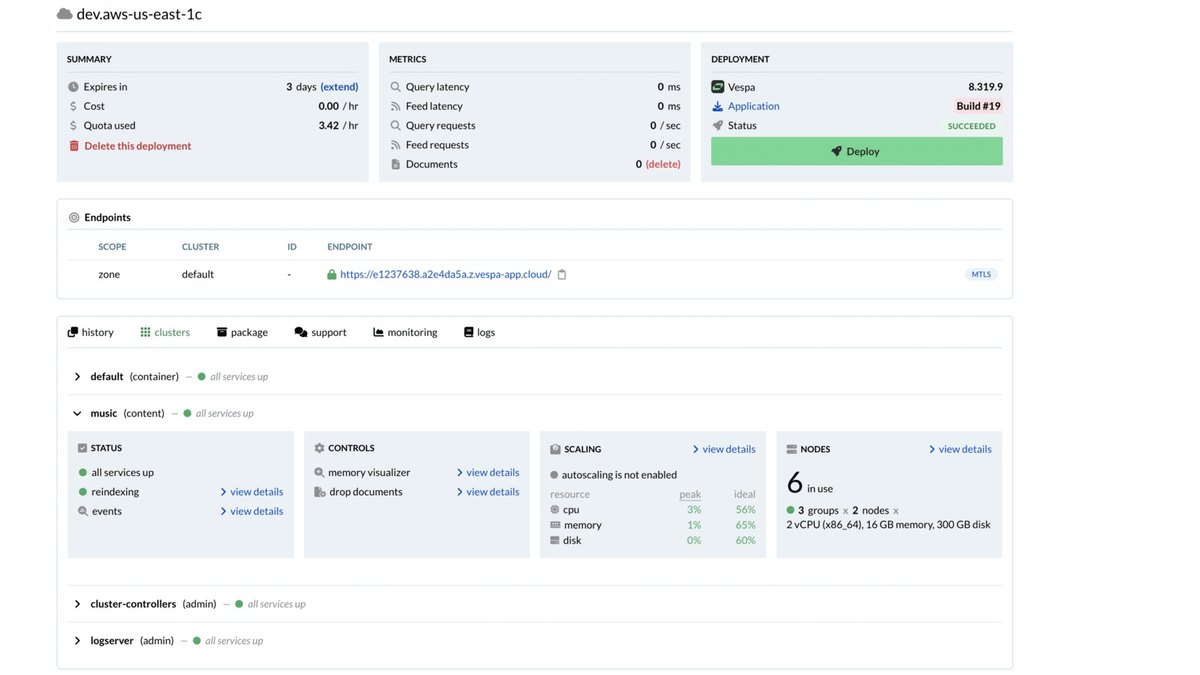
Vespa
Answrs VerdictBuilt for constantly changing data at scale, with a ceiling of 100 ms stated by the vendor.
Price: Not published on the homepageReal-time updates: Retrieval, ranking, machine learning inference and real-time updates in one platformScale and latency (vendor-stated): Scale to billions of constantly changing data items and thousands of queries per second with latencies below 100 millisecondsData types: Query, organize and run inference over vectors, tensors, text and structured dataCustomer quote: A Farfetch engineer said Vespa met a recommendation latency requirement of under 100ms for one algorithmIndependent benchmark coverage: Listed as supported in both ANN-Benchmarks and VectorDBBench
Vespa combines retrieval, ranking, machine learning inference and real-time updates in one platform, and works over vectors, tensors, text and structured data. Vespa states it can scale to billions of constantly changing data items and thousands of queries per second with latencies below 100 milliseconds, a vendor-stated figure, and a Farfetch engineer said it met a recommendation latency requirement of under 100ms for one algorithm. It is listed in both ANN-Benchmarks and VectorDBBench. No price or license is on the homepage.
Go ifLarge search and recommendation systems that combine ranking, inference and live updates
Skip ifYou want a small, drop-in retrieval library
Why #5 over #6: It is built for constantly changing data and ranking, where Weaviate gives no latency or freshness figure.
6
Weaviate
Answrs VerdictA rounded open-source platform, but its pages state no latency or freshness figures.
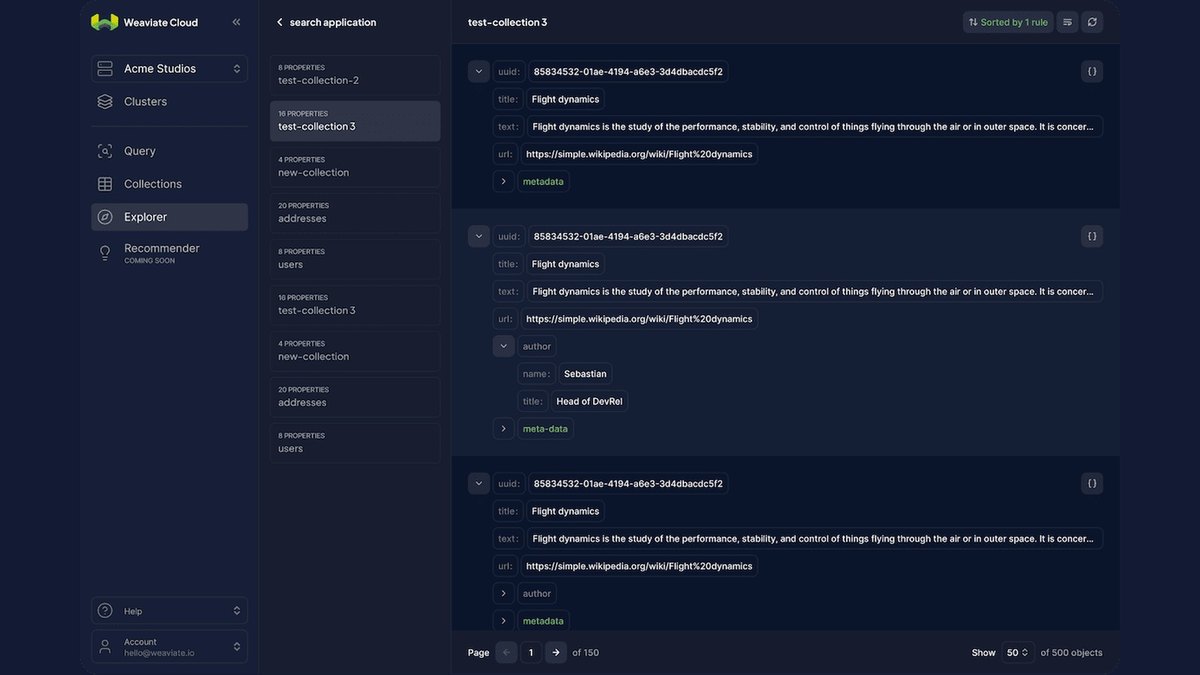
Price: Free plan with 1 cluster, 100,000 objects, 1 GB memory and 10 GB disk; Flex from $45/month; Premium via sales from $400/monthSearch: Vector search, RAG and memory in one open-source platform; hybrid queries combine vector and keyword searchLatency: The homepage gives no query-latency figureAvailability: Flex 99.5% availability; Premium Shared 99.9%; Premium Dedicated 99.95%Adoption: Over 20M open source downloads, per WeaviateIndependent benchmark coverage: Listed as supported in both ANN-Benchmarks and VectorDBBench
Weaviate describes vector search, RAG and memory in one open-source platform, with hybrid queries that combine vector and keyword search, and cites over 20M open source downloads. It is listed in both ANN-Benchmarks and VectorDBBench. The free plan has 1 cluster, 100,000 objects, 1 GB memory and 10 GB disk; Flex starts from $45/month, with availability of 99.5% on Flex, 99.9% on Premium Shared and 99.95% on Premium Dedicated. The homepage gives no query-latency figure or license.
Go ifTeams that want hybrid vector and keyword search with an open-source core and a free cloud tier
Skip ifYou need published latency or freshness numbers
Why #6 over #7: It has third-party benchmark coverage and a free cluster, where Chroma is covered only by VectorDBBench.
7
Chroma
Answrs VerdictOpen source with honest warm and cold latency numbers, but not an in-memory engine.
Price: Starter $0/month plus usage with $5 in free credits; Team $250/month plus usage; Enterprise customLatency (vendor-stated): On a 384-dimension, 100k-vector workload, warm cache p50 20ms, p90 27ms and p99 57ms; cold cache p50 650ms, p90 1.2s and p99 1.5sLicense: Apache 2.0, stated on the homepageDeployment: Chroma Cloud, local install with pip or npm, self-hosted, or enterprise BYOC in your own VPCUsage rates: Writes $2.50 per GiB, storage $0.33 per GiB per month and queries $0.0075 per TiBIndependent benchmark coverage: Listed as supported in VectorDBBench, which Zilliz maintains; not listed in ANN-Benchmarks
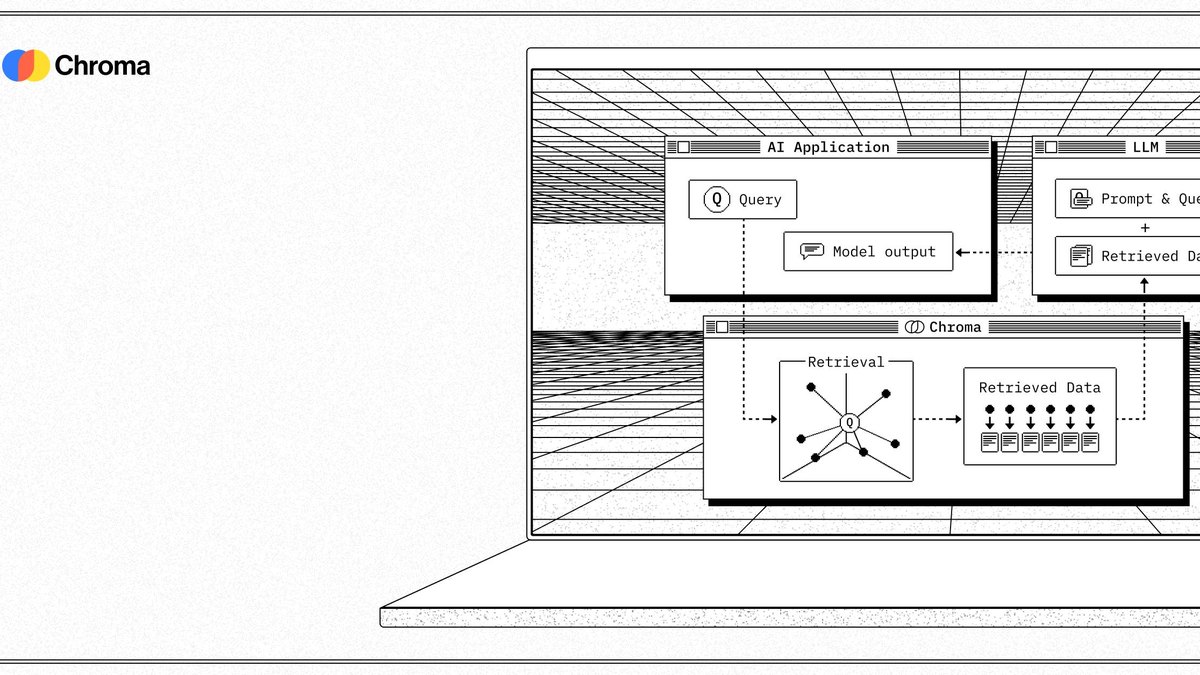
Chroma is open source under Apache 2.0, with Chroma Cloud, a local install, self-hosting and enterprise BYOC. On a 384-dimension, 100k-vector workload it reports warm cache p50 20ms, p90 27ms and p99 57ms, and cold cache p50 650ms, p90 1.2s and p99 1.5s, all vendor-stated. It is listed in VectorDBBench, which Zilliz maintains, but not in ANN-Benchmarks. Starter is $0/month plus usage with $5 in free credits, and Team is $250/month plus usage. It does not describe an in-memory mode.
Go ifDevelopers who want to prototype locally and move to a serverless cloud later
Skip ifYour queries often hit cold data
Why #7 over #8: It is listed in a public benchmark tool and publishes cold-cache latency, where turbopuffer is in neither benchmark tool.
8
turbopuffer
Answrs VerdictThe most specific published latency numbers of any hosted pick, though from its own benchmark.
Price: Monthly minimum of $16 on Launch, $256 on Scale and $4,096 on Enterprise plus a 35% usage premiumLatency (vendor-stated): In its own benchmark on a 10M-document, 1024-dimension workload at 8 QPS, vector search p50/p90/p99 of 14/17/27ms for warm namespacesArchitecture: Vector and full-text search built on object storage, with a memory and SSD cache in frontScale (vendor-stated, undated): 1T+ documents, 10M+ writes/s and 100k+ queries/s in productionCustomers listed: The site shows logos including Anthropic, Notion, Linear and The New York TimesIndependent benchmark coverage: Not listed in ANN-Benchmarks or VectorDBBench; the 14/17/27ms figures are from its own benchmark
turbopuffer is vector and full-text search built on object storage, with a memory and SSD cache in front. In its own benchmark on a 10M-document, 1024-dimension workload at 8 QPS, it reports vector search p50/p90/p99 of 14/17/27ms for warm namespaces, and it cites 1T+ documents and 100k+ queries/s in production, all vendor-stated and undated. It is not listed in ANN-Benchmarks or VectorDBBench. Monthly minimums are $16 on Launch, $256 on Scale and $4,096 on Enterprise plus a 35% usage premium. Its pages do not state a license.
Go ifLarge, many-tenant retrieval where a warm cache gives low latency and object storage keeps cost down
Skip ifYou need every query to be fast on a cold namespace
Why #8 over #9: It publishes its benchmark workload and lists named customers, where Moss states latency without a workload.
9
Moss
Answrs VerdictThe only pick here whose pages describe an in-memory query path as the default for agents.
Price: Developer plan free with $5/month in credits; Hobbyist $30/month; Start-up $200/month; Enterprise customLatency (vendor-stated): Sub-10ms local queries, hardware-dependent; with loadIndex() queries run in memory at about 1-10ms, while queries without it go to the cloud API at about 100-500msWhere it runs: In the browser, on-device or in the cloud through the same API; local-first with optional cloud sync, and local mode needs no network access after the index is createdFreshness: Described as sub-10ms lookups with instant updatesBuilt for: A real-time semantic search runtime for AI agents, voice agents, copilots and multimodal apps, built in Rust and WebAssemblyIndependent benchmark coverage: Not listed in ANN-Benchmarks or VectorDBBench; no independent benchmark found
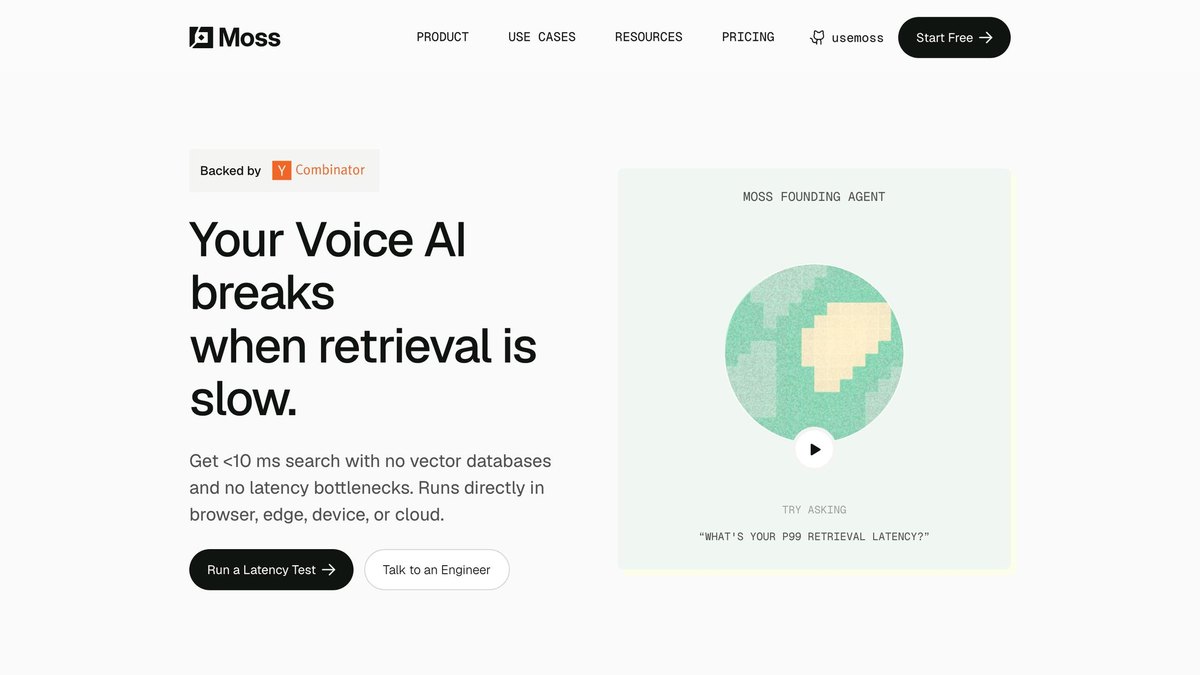
Moss calls itself a real-time semantic search runtime for AI agents, voice agents, copilots and multimodal apps, built in Rust and WebAssembly. It states sub-10ms local queries that are hardware-dependent: with loadIndex() queries run in memory at about 1-10ms, and without it they go to the cloud API at about 100-500ms, and it describes instant updates, all vendor-stated. It runs in the browser, on-device or in the cloud through the same API. The Developer plan is free with $5/month in credits. It is not listed in ANN-Benchmarks or VectorDBBench, and its pages do not state a license.
Go ifVoice agents and copilots that need retrieval inside the app process rather than over a network hop
Skip ifYou need a license statement or independent benchmarks before you commit
Why #9 over #10: It documents an in-memory, on-device query path, where LanceDB gives no price and no millisecond latency.
10
LanceDB
Answrs VerdictStrong on multimodal data and scale, but the page gives no millisecond latency for retrieval.
Price: Not published; the homepage points to Contact SalesWhat it is: Calls itself the AI-native Multimodal Lakehouse, built on the open source Lance formatScale (vendor-stated): Up to 100K+ queries per second and 100B+ rows in a single tableCustomer quote: CodeRabbit cites sub-second response times across millions of code reviewsLatency: The homepage gives no per-query millisecond figureIndependent benchmark coverage: Not listed in ANN-Benchmarks or VectorDBBench
LanceDB calls itself the AI-native Multimodal Lakehouse, built on the open source Lance format. Its homepage states up to 100K+ queries per second and 100B+ rows in a single table, and a CodeRabbit testimonial cites sub-second response times across millions of code reviews, all vendor-stated. It is not listed in ANN-Benchmarks or VectorDBBench. No price is published and the homepage points to Contact Sales, and it gives no per-query millisecond figure.
Go ifMultimodal and training data workloads that also need search at scale
Skip ifYou want a self-serve price or a millisecond latency figure
How we ranked these
This list is about real-time retrieval for agents and RAG. Each pick was scored out of 100 with the same rubric and evidence standard, from facts on its own pages and public benchmark tool lists: production maturity and evidence of real use (30 points), independently verifiable performance (25), real-time freshness (20), a documented low-latency query path (15) and transparency of price, license and docs (10). Scores: Qdrant seventy-eight, Redis seventy-six, Milvus and Pinecone seventy each (Milvus first on maturity), Vespa sixty-nine, Weaviate sixty-five, Chroma fifty-nine, turbopuffer fifty-one, Moss forty-three, LanceDB thirty. The weights and scores are our judgment from the pages read, not vendor data. Being listed in ANN-Benchmarks or VectorDBBench earns credit for reproducible testing, not for any result, and VectorDBBench is maintained by Zilliz, the company behind Milvus. Every latency figure on this page is vendor-stated, measured under the vendor’s own workload, so the numbers are not comparable across vendors. Several pages did not state a license or a latency figure, and we do not fill those gaps. This is a different question from a general list of retrieval and search infrastructure: it leaves out rerankers and site-search products, and it weighs freshness and latency alongside maturity. Facts are taken from each maker's own published information; check the official site before you buy.
Questions people ask
What is the best real-time vector search engine for AI agents and RAG?
Qdrant scores highest here: it says new data is searchable immediately after insertion, filters during HNSW graph traversal, has a free forever cluster and is listed in both ANN-Benchmarks and VectorDBBench. Redis is #2 as an in-memory store with documented vector indexes and filters.
Are these latency numbers independent benchmarks?
No. Every latency figure on this page comes from the vendor’s own website and is labeled vendor-stated: Moss, turbopuffer, Chroma and Vespa each publish one, under different workloads, so they are not directly comparable.
What is the difference between in-memory and object-storage vector search?
Moss says queries run in memory at about 1-10ms once loadIndex() is called, and Redis can hold hot data in RAM. turbopuffer is built on object storage with a memory and SSD cache, and its own benchmark reports a p50 of 14ms for warm namespaces.
Which of these have a free plan?
Moss has a free Developer plan with $5/month in credits, Redis has a free plan up to 30 MB, Qdrant has a free forever cluster, Pinecone has a free Starter plan, Chroma and Weaviate have free tiers, and Zilliz Cloud has a free tier with 5 GB storage.
Query latency the vendors state on their own pages, each under different conditions (milliseconds) at a glance
Moss (sub-10ms, in-memory local queries)10 ms
turbopuffer (p50, warm namespace)14 ms
Chroma (p50, warm cache)20 ms
Vespa (stated ceiling, below 100 ms)100 ms
Query latency the vendors state on their own pages, each under different conditions (milliseconds), as published by each maker. Picks without a published figure are left off.