What Is Confidential Computing and Why Does It Matter for AI in 2027?
Confidential computing is the protection of data while it is being processed, not just while it is stored or sent. The Confidential Computing Consortium, an open community under the Linux Foundation, defines it as "the protection of data in use by performing computation in a hardware-based, attested Trusted Execution Environment." In practice a processor (and now a GPU) creates an isolated space whose memory the host operating system, the hypervisor, the cloud operator and administrators are not supposed to read or change, and the workload proves what it is running through attestation before any secret is released to it.
For AI this matters because a model's weights, a customer's prompt and a training dataset are all plain text to the machine while the model runs. Hardware TEEs from Intel, AMD and Arm, NVIDIA's confidential computing mode for Hopper and Blackwell GPUs, and cloud products from Azure, Google Cloud and AWS are the official routes to closing that gap. Apple's Private Cloud Compute is a public example of the same idea applied to a consumer AI service.
Every fact below comes from an official standards-body, vendor or cloud documentation page read on October 31, 2026, and vendor claims are labelled as such. This page does not predict what will be standard in 2027, and it gives no overhead figure beyond the one NVIDIA states itself.
What confidential computing is
Data has three states, as the Consortium's technical paper puts it: in transit across a network, at rest in storage, and in use while a program processes it. Encryption for the first two is routine. The paper calls protecting data in use "the new frontier," because the processor has to see the data in the clear to compute on it, and so does anything that can read the machine's memory.
The Consortium's answer is the Trusted Execution Environment, or TEE. It defines a TEE as an environment that gives a level of assurance of three properties: data confidentiality, data integrity and code integrity. The unauthorized parties it names include other applications on the host, the host operating system and hypervisor, system administrators, service providers, the infrastructure owner, and anyone with physical access to the hardware. The paper adds that the definition is not tied to the cloud or to one kind of chip, and that trusted processing can also sit in a GPU or a network card.
- Consortium definitionProtection of data in use by performing computation in a hardware-based, attested Trusted Execution Environment.
- Three TEE propertiesData confidentiality, data integrity and code integrity.
- Scope ruleTEEs that have only software roots of trust are excluded; the Consortium focuses on hardware-based guarantees.
The hardware behind it: Intel, AMD and Arm
Each major CPU family has its own TEE design. They share the goal of keeping a workload's memory opaque to the platform that hosts it, but they differ in what they isolate: whole virtual machines, or smaller pieces of an application.
- Intel TDX (Intel's wording)A hardware-based TEE that deploys trust domains, which are hardware-isolated virtual machines. Intel says data in memory is opaque to cloud service providers, operators and shared applications, and that remote attestation confirms the hardware and software configuration.
- Intel SGX (Intel's wording)An application isolation technology that protects data in use; developers partition an application into hardened enclaves, and remote attestation lets you verify an enclave before sharing data with it.
- AMD SEV and SEV-SNP (AMD's wording)SEV uses one key per virtual machine, managed by the AMD Secure Processor, to isolate guests and the hypervisor from one another. SEV-SNP adds memory integrity protection to help prevent hypervisor-based attacks such as data replay and memory re-mapping.
- Arm CCA (Arm's wording)Adds a Realm world, created by the Armv9-A Realm Management Extension, where Arm says trusted execution environments isolate models and data and protection extends to accelerators such as GPUs.
Two details are worth knowing. Intel and AMD describe TDX and SEV-SNP as virtual-machine based, while SGX works at the level of enclaves that developers carve out of an application. And AMD notes that its SEV-TIO extension is designed to carry the TEE out to PCIe devices such as accelerators, which is the CPU-side step toward the GPU story below.
Attestation: how a TEE proves what it is running
Isolation alone is not enough, because you still need to know that the isolated environment is real and running the code you expect. That is the job of attestation. The Consortium describes it as a process in which a Verifier assesses the trustworthiness of an Attester. In its hardware example the Verifier sends a challenge, the trusted hardware gathers evidence about the software and data state and signs it together with the challenge, and the Verifier checks the signature and compares the evidence with reference values it considers trustworthy. Including the challenge is what shows the evidence is fresh.
The cloud products build their key handling on this. Microsoft says Azure confidential VMs boot only after successful attestation of the platform's critical components and security settings, and that key release is cryptographically bound to successful attestation. AWS says Nitro Enclaves can tie AWS Key Management Service operations to attestation, so a key policy can require that the enclave's measurements match. Google's Confidential Space lets data owners set conditions on attestation tokens so that only a workload that passes can decrypt the data.
GPUs: NVIDIA confidential computing mode
AI work runs on accelerators, so a CPU-only TEE would leave the most valuable computation outside the boundary. NVIDIA's confidential computing page says the feature preserves the confidentiality and integrity of AI models deployed on Rubin, Blackwell and Hopper GPUs, and describes hardware-rooted attestation to verify compute assets. Its FAQ says attestation checks the environment's integrity before any sensitive code or data is released to it, and points to a Supported Platforms page for the exact GPU, CPU and deployment combinations.
- NVIDIA's performance claim (vendor)Protection runs at up to 98% of the performance of unsecured deployments. The page does not tie the figure to a specific GPU, and the FAQ says results depend on workload, platform and configuration.
- Azure confidential GPU VMNCCadsH100v5-series: AMD 4th Gen EPYC with SEV-SNP plus NVIDIA H100 Tensor Core GPUs, with the TEE spanning the confidential VM on the CPU and the attached GPU. Microsoft lists Ubuntu 22.04 LTS as the qualified guest OS and says resizing is not currently supported.
- Google Cloud with NVIDIA Confidential ComputingExtends the TEE to attached NVIDIA GPUs, integrated with AMD SEV or Intel TDX. Access to NVIDIA HGX B200 and GB300 NVL72 is limited to eligible customers who contact their account team.
Treat the 98% figure as a vendor ceiling, not a promise. NVIDIA's own FAQ says supported configurations are designed to run at near-native performance but that results vary, so a team should measure its own model, batch size and platform before relying on any overhead number.
What the big clouds offer
All three large clouds sell confidential computing, but the products are shaped differently.
- Microsoft Azure confidential VMs. A hardware-enforced boundary between your workload and the virtualization stack, backed by AMD SEV-SNP or Intel TDX, so many applications can move without code changes. Features listed include configurable attestation policies, confidential OS disk encryption and a dedicated virtual TPM. Microsoft warns that protection levels differ by configuration, for example when Microsoft owns or manages the encryption keys, and lists unsupported features such as live migration and accelerated networking.
- Google Cloud Confidential VMs and Confidential Space. Compute Engine VMs that use hardware memory encryption, with AMD SEV, AMD SEV-SNP or Intel TDX depending on machine type and CPU platform. Confidential Space builds on them for several parties who distrust one another: data collaborators, a workload author and a workload operator stay separate, and neither the other collaborators nor the operator can view the data.
- AWS Nitro Enclaves. Isolated, highly constrained virtual machines carved out of an EC2 instance. AWS says they have no persistent storage, interactive access or external networking, that nobody can SSH in, and that even root or admin users of the parent instance cannot reach the data and applications inside. The page describes isolation of vCPUs and memory and says nothing about GPUs, so it is a CPU-side tool. AWS states there is no additional charge beyond the usual EC2 and service charges.
Why it matters for AI
Four AI problems line up with what the official pages describe. None of these is a guarantee on its own; each depends on the platform, the configuration and the attestation policy you actually set.
- Protecting model weights. A trained model is intellectual property that sits in memory while it serves requests. NVIDIA says its mode preserves the confidentiality and integrity of AI models, Arm says Realms isolate models and data, and Microsoft says its confidential GPU enables secure offload of data, models and computation to the GPU.
- Protecting prompts and data in use. Prompts and retrieved documents are plain text to the host while the model runs. Google says Confidential Space can protect ML models and LLM interactions and points to its Prompt Encryption SDK for serving an LLM inside a TEE.
- Multi-party training and analysis. Google describes Confidential Space as a way for several parties to process sensitive data without exposing it to one another or to the operator, with release of data gated on attestation. That is the basic pattern for two organizations that want a joint result without handing over their raw data.
- Regulated and personal data. Google lists PII and PHI among the data types Confidential Space is designed for, and AWS says Nitro Enclaves can secure sensitive data such as personally identifiable information. These pages describe technical controls; whether they satisfy a particular regulation is a question for your own counsel, not something these sources answer.
Confidential computing also changes who has to be trusted. The Consortium's paper says that by anchoring security in hardware it is possible to remove operating system and driver vendors, platform vendors and service providers and their administrators from the list of parties you must trust.
A real example: Apple Private Cloud Compute
Apple's Security Research blog, in a post dated June 10, 2024, describes Private Cloud Compute for running AI requests in the cloud. It lists five design goals: stateless computation, enforceable guarantees, no privileged runtime access, non-targetability and verifiable transparency.
- Attestation (Apple's wording)User devices send data only to nodes that cryptographically attest to running publicly listed software.
- Transparency (Apple's wording)Apple commits to publishing software images of every production build for security research and logging them in a tamper-evident transparency log.
- No privileged access (Apple's wording)Apple says it intentionally did not include remote shell or interactive debugging mechanisms on these nodes, and that the Secure Enclave keeps the keys that decrypt requests from being duplicated or extracted.
The post is an initial overview, and Apple says a deeper technical follow-up would come after the service reached beta. Read it as a statement of Apple's design intent. It is useful here because it shows the same three ideas as the rest of this page, isolated execution, attestation before data is sent, and no administrator back door, assembled into one AI service.
Limits and what to ask before you adopt it
Confidential computing narrows who can see your AI workload; it does not make the workload safe by default. The official pages themselves list conditions.
- Who holds the keys? Microsoft says protection levels differ with configuration, including whether Microsoft or the customer manages encryption keys.
- Which attestation policy gates the secret? A TEE without a verifier that checks the evidence against reference values is a box you are taking on trust.
- Is your exact GPU and platform supported? NVIDIA points to a Supported Platforms page, Google limits some GPU systems to eligible customers, and Azure lists specific sizes, operating systems and unsupported features.
- What does it cost in speed? Only NVIDIA's own page states a figure here, and it says results depend on workload, platform and configuration. Measure your own.
- What is still outside the boundary? The Consortium says confidential computing does not address every threat vector and that there is no absolute security. Data at rest, data in transit and your application's own bugs are still your job.
If you are deploying AI agents, confidential computing is one layer among several, alongside identity, network isolation and logging. See the infrastructure needed to run AI agents in production for the wider picture, and the best confidential computing platforms for AI for a ranked list of products.
Questions people ask
What is confidential computing in one sentence?
The Confidential Computing Consortium defines it as the protection of data in use by performing computation in a hardware-based, attested Trusted Execution Environment, so the host, hypervisor and operator are not supposed to read or alter what runs inside.
Is a TEE the same as encryption?
No. Encryption protects data at rest and in transit. A TEE protects data while it is processed, and the Consortium notes that its definition is not limited to solutions that use encryption, though encryption is the most common technique.
Does confidential computing work on GPUs?
Yes on supported systems. NVIDIA says its confidential computing preserves the confidentiality and integrity of AI models on Rubin, Blackwell and Hopper GPUs, and Azure sells an H100-based confidential GPU VM. Check the vendor's supported-platforms list for your exact hardware.
How much slower is it?
NVIDIA claims up to 98% of the performance of unsecured deployments and says results depend on workload, platform and configuration. No other overhead number is given here because none of the other official pages read states one.
What is attestation and why does it matter?
Attestation is how a TEE proves its identity and state to a verifier using hardware-signed evidence. It matters because keys and data should be released only to an environment that has proven it is the one you expect.
Is Apple Private Cloud Compute confidential computing?
Apple's own post describes attestation of nodes, a Secure Enclave, published software images and no privileged runtime access. It is presented as Apple's design, and this page treats it as a real-world example rather than a product you can buy.
Sources
- Confidential Computing Consortium: Deep Dive v1.2 (Technical Analysis of Confidential Computing) · Definition, TEE properties, hardware scope, attestation, goal and limits
- Confidential Computing Consortium (Linux Foundation community) · Consortium self-description and scope
- Intel: Trust Domain Extensions (Intel TDX) overview · Trust domains, memory protection, remote attestation (vendor docs)
- Intel: Software Guard Extensions (Intel SGX) overview · Application enclaves and attestation (vendor docs)
- AMD: Secure Encrypted Virtualization (SEV) · SEV, SEV-ES, SEV-SNP and SEV-TIO (vendor docs)
- Arm: Confidential Compute Architecture · Realms and the Realm Management Extension (vendor docs)
- NVIDIA: Confidential Computing · GPU confidential computing, attestation, performance claim (vendor claim)
- Microsoft Learn: About Azure confidential VMs · Confidential VM benefits, attestation, limitations
- Microsoft Learn: Azure Confidential GPU options · NCCadsH100v5 confidential GPU VM
- Google Cloud: Confidential VM overview · SEV, SEV-SNP, TDX and NVIDIA confidential GPU support
- Google Cloud: Confidential Space overview · Multi-party data collaboration, attestation, AI/ML use
- AWS: What is Nitro Enclaves? · Enclave isolation, attestation, KMS integration, pricing note
- Apple Security Research: Private Cloud Compute · Design goals, attestation, transparency log, Secure Enclave
- Apple Security Research: Private Cloud Compute documentation · Outline of attestation, transparency log and research environment
Figures and statements were read from the linked pages on October 31, 2026. Several pages were read through a fetch tool that returns summaries, so confirm each detail on the vendor's own page before you build or buy. Vendor claims are the vendors' own. This page is not security or legal advice.
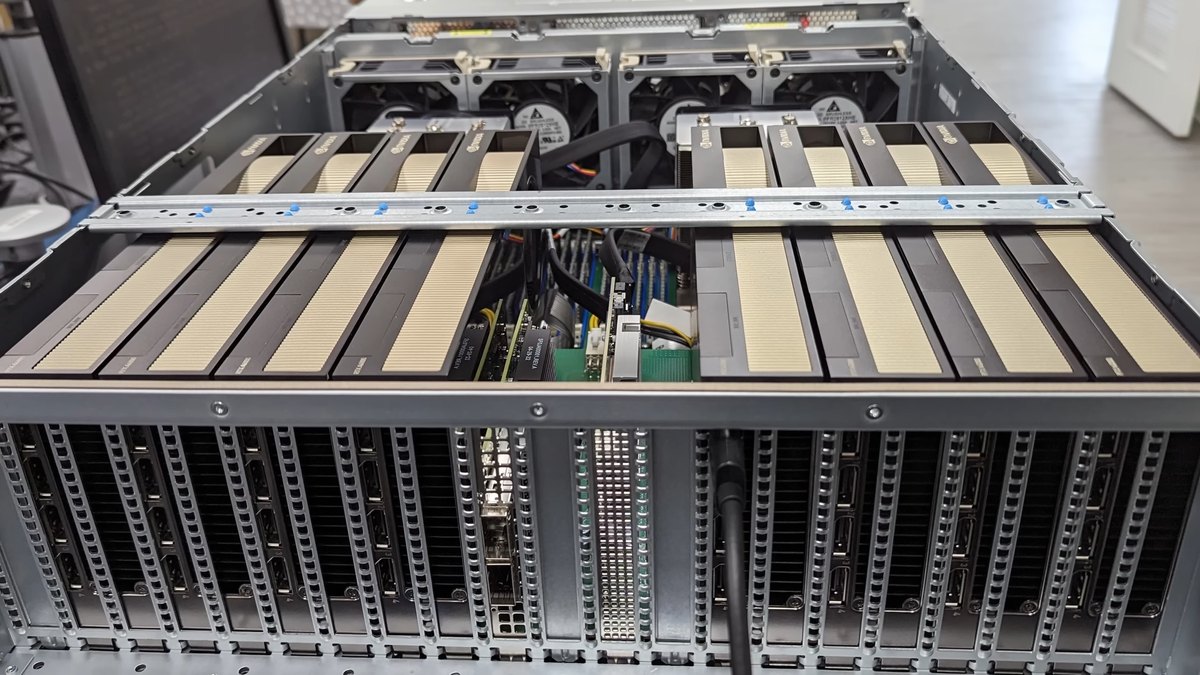
Top photo: Lawrence Systems / CC BY 3.0 via Wikimedia Commons