How do you lower nitrates in a reef tank in 2027?
You lower nitrates in a reef tank by finding out how much is coming in, testing before you change anything, and then removing it in steps you can reverse: cut the input (feeding, bioload, trapped waste), export it (regular water changes, a tuned skimmer, harvested macroalgae), and only then add a biological helper such as carbon dosing or a sulfur reactor. The makers and papers I read agree on that order and on one warning: do not drive nitrate to zero too fast. Aquaforest says a violent drop in nitrate and phosphate can destroy zooxanthellae and lead to coral death, and Red Sea's manual tells users to cut a carbon dose by 50% once nitrate falls under 1 ppm in a mixed reef (Red Sea Algae Management manual, document version 19a; Aquaforest NitraPhos Minus page; both read November 8, 2026).
There is no single correct target. Red Sea's own table lists 2 mg/l for a mixed reef, 0.25 to 0.5 for an SPS-dominant tank, 1 to 2 for an SPS frag tank, 0 for an ultra-low-nutrient system and under 10 for a fish-focused tank. This page quotes those ranges as the makers state them and invents none of its own. It is general information about hobby aquariums, not a guarantee for any tank.
Where reef-tank nitrate comes from
Nitrate is the end of the aquarium's nitrogen cycle, and what you see on a test is input minus removal. Red Sea's manual says reduction by bacteria happens naturally in the anoxic parts of an aquarium (inside live rock, porous filter media and substrates), but that this activity is limited by the carbon available and, under normal conditions, cannot remove all the algae nutrients generated on a regular basis. It adds that in an artificial reef the nutrients accumulate rapidly and, if left uncontrolled, push the coral's symbiotic algae to an over-density (Red Sea, Algae Management manual, document version 19a, undated; read November 8, 2026). Denitrification itself is a long-studied bacterial process: a 1997 review in Microbiology and Molecular Biology Reviews calls it an essential branch of the global nitrogen cycle that reverses nitrogen fixation (Zumft, doi 10.1128/mmbr.61.4.533-616.1997, December 1, 1997).
- Feeding. Bulk Reef Supply says the main source of phosphate is fish and coral food and the resulting waste, and that elevated phosphate often means nutrients overall are elevated, so nitrate is likely rising too (Bulk Reef Supply GFO instructions, last updated February 4, 2026). Aquaforest lists too much food or too many supplements as a cause of high nitrate and phosphate (NitraPhos Minus page, read November 8, 2026).
- Bioload. The AquaMaxx sulfur denitrator manual says how much a denitrator can lower nitrate depends on the bioload, the amount of food, and the size of the unit. Brightwell calls heavily stocked, well-fed reef aquaria the case where carbon dosing helps most (Brightwell Reef BioFuel page, undated).
- Detritus and uneaten food. Aquaforest describes the buildup of metabolic waste and uneaten food as a reason water in a reef aquarium gradually loses its essential properties, and names detritus among the things water changes remove (Aquaforest knowledge base, March 31, 2025).
- Low export. Aquaforest names inefficient filtration as a possible reason for high nitrate and phosphate. Bulk Reef Supply says managing filtration that helps remove leftover food and fish waste is the primary focus, and lists a regular water-change schedule, filter maintenance and a tuned skimmer among the defenses against nuisance algae.
A newly stocked tank in a compact all-in-one reef has little water to dilute any of this, which is why feeding habits matter even more at small sizes. That is general reasoning from the sources above, not a measured figure.
Test first, and know which target you are using
Every maker I read starts with a test. Red Sea says to measure and record the nitrate level before starting its nitrate reducer, and that its dosing chart assumes a high-resolution kit with recommended accuracy of 0.25 ppm for nitrate; its Nitrate Pro kit reads to a stated resolution of 0.125 ppm (Red Sea manual, document version 19a). Aquaforest adds that strip tests are less accurate and that drop tests or photometers are better in reef tanks where low nutrient levels have to be detectable (Aquaforest knowledge base, September 12, 2025). Our test kit comparison covers kits for nitrate.
Targets are where sources disagree, and the honest answer is that the range depends on what you keep. These are Red Sea's published values by tank type, quoted from its manual:
- Mixed reef. Nitrate 2 mg/l and phosphate 0.1 mg/l.
- SPS dominant. Nitrate 0.25 to 0.5 mg/l and phosphate 0.01 to 0.02 mg/l.
- SPS frag tank. Nitrate 1 to 2 mg/l and phosphate 0.08 to 0.12 mg/l.
- Ultra-low-nutrient system (ULNS). The table lists 0 for both, but the same manual's dosing instructions for SPS-dominant tanks and ULNS tell you to cut the dose if nitrate falls below 0.25 ppm or phosphate below 0.02, so the working floor is not literally zero.
- Marine fish tank. Nitrate under 10 mg/l and phosphate under 1 mg/l.
Other makers state different goals. Red Sea's directions for mixed reefs, marine fish and frag tanks aim for nitrate stable between 1 and 2.5 ppm. Aquaforest says regular use of its -NP Pro can reduce nitrate to an undetectable level. Bulk Reef Supply, speaking about phosphate, finds that most tanks from 0 to 3 years old do best between 0.01 and 0.04 ppm, and that mature tanks with large coral colonies can often run higher. Choose a target from the first list that matches your animals, write it down, and treat any number far outside it as a reason to test again before acting.
Water changes: the baseline
Aquaforest lists removing nitrates, phosphates and detritus first among the jobs of a water change. Its rule of thumb by tank volume: about 10 to 15% every week for tanks up to 100 litres, 10% every 1 to 2 weeks for 100 to 300 litres, and 5 to 10% every fortnight above 300 litres, with more frequent changes for a heavy bioload. It calls about 15% of the tank volume at a time a safe rule of thumb, and says that for heavily polluted water several smaller changes beat one large one (Aquaforest knowledge base, March 31, 2025).
- Use purified water. Aquaforest says to mix a quality salt into RODI water with a TDS reading close to zero, and that plain tap water is unsuitable for reef aquariums.
- Match the tank. The new water should match the tank in temperature, salinity and chemical composition. Aquaforest gives a salinity of 1.025 to 1.026 and a temperature of about 24 to 26 degrees C for new saltwater.
- Go slowly. It advises adding new water gradually and testing parameters for the next few hours.
A water change is slow but predictable, which makes it the right tool for the first few weeks and the right backup afterward. The same Aquaforest knowledge base also says to track nitrate, phosphate, pH, KH, calcium and magnesium so the schedule can be adjusted.
Protein skimming
Bulk Reef Supply says skimmers are not plug-and-play: they need tuning to your tank's nutrient level, and a skimmer that is not tuned properly will remove nowhere near as much waste as one that is sized and tuned correctly (Bulk Reef Supply, last updated February 13, 2023). Its three variables are the water level outside the skimmer, the foam level inside it, and the amount of air drawn in, with air being the most critical. Its break-in advice is one week for an AC-pump skimmer and 5 to 7 days for a DC-pump skimmer before you adjust air, since a new unit may overflow or act erratically at first.
- Too much air. Large, fast-rising bubbles that fill the cup with water.
- Not enough air. Slow bubbles that fail to rise into the cup and cover everything in mud, which Bulk Reef Supply calls rare.
- The goal. A stable foam head that holds its shape, rises slowly into the cup and leaves only a fine layer of mud on the neck over 5 to 7 days.
The skimmer also matters to the dosing methods below: Red Sea says the phosphate absorbed by its bacteria is eventually removed from the system by the protein skimmer, and Aquaforest says the excess bacterial biomass is removed by a filter or a skimmer.
Refugium and chaeto
A refugium grows macroalgae such as chaeto (Chaetomorpha) so the algae, not the glass, takes up nitrate and phosphate, and you export nutrients by trimming it. This is the one method where I found no maker instructions with numbers, so none are given. The nearest peer-reviewed evidence is a 2020 study that grew Chaetomorpha maxima with a moving bed bioreactor in aquaculture wastewater; it reported average removal of 42.8% of total nitrogen and 83.7% of total phosphorus, found that phosphorus could limit nitrogen uptake as the N:P ratio rose, and measured a growth rate of 3.86 to 10.35% per day (Li et al., doi 10.1155/2020/8848120, Archaea, June 17, 2020). That was a wastewater system, not a reef tank, so treat it as evidence that the algae takes up both nutrients, not as a promised result for your sump.
Laboratory work on a Caribbean reef community found that turf algae and some macroalgae had high nutrient uptake rates per unit of biomass after a runoff pulse (den Haan et al., doi 10.1038/srep28821, Scientific Reports, June 29, 2016). The practical point is the one the sources support: the algae must grow and be removed to export anything, and if phosphorus runs short it limits the nitrogen the algae can take up.
Carbon dosing: vodka, vinegar and bottled products
Carbon dosing feeds the bacteria that consume nitrate and phosphate. Red Sea describes its NO3:PO4-X as a complex of carbon molecules and other nutrients that lets naturally occurring bacteria reduce nitrate to nitrogen gas, which is released to the atmosphere, while phosphate is absorbed by the bacteria and removed by the skimmer. Brightwell describes Reef BioFuel as a carbon source that raises the rate of phosphate reduction and denitrification, and as a non-flammable alternative to the vodka or ethanol method. I found no maker page giving a vodka or vinegar dose, so this page gives none; a bottle's own label is the instruction to follow.
Here is the maker detail I could read, side by side.
- Red Sea NO3:PO4-X. Dose into the sump, daily, preferably with a dosing pump. Its dose chart is per 100 litres (25 gallons) per day. For mixed reefs, marine fish and frag tanks: nitrate above 10 ppm, 3 ml; above 2.5 but under 10, 2 ml; above 1 but under 2.5, 1 ml. Test nitrate weekly and adjust until it is stable between 1 and 2.5 ppm. If nitrate falls below 1 ppm, cut the daily dose by 50%. If you miss days, do not add the missed amount; resume at the current daily dose.
- Red Sea cautions. Do not use it together with sulphur-based de-nitrators or with phosphate and nitrate removers, because the different methods interfere. The manual also says it is recommended as a complete carbon source for use with carbon-based de-nitrators.
- Aquaforest NitraPhos Minus. Start at half the recommended dose and test nitrate and phosphate once or twice a week. Aquaforest warns that a violent drop in nitrate and phosphate can destroy zooxanthellae and lead to the death of corals.
- Aquaforest -NP Pro with Pro Bio S. The -NP Pro page lists 1 drop per 100 litres (27 US gallons) every day, and says to dose it together with Pro Bio S. Its knowledge base article says using these with NitraPhos Minus makes the reduction very strong, so watch the tank carefully.
- Brightwell Reef BioFuel. Sold in 250 ml, 500 ml, 2 litre and 20 litre sizes. The product page points to its separate technical sheet for dosing, which I did not retrieve, so no dose is given.
Two lessons run through all of them: dose a little, and test between doses. A nitrate test that has stopped moving is the signal to hold the dose, not to raise it.
GFO, resin, bioreactor media and sulfur denitrators
GFO is a phosphate tool, not a nitrate tool. Bulk Reef Supply says granular ferric oxide is designed to remove phosphate, and that it cannot fix an algae outbreak by itself. It matters here because phosphate and nitrate tend to rise together and because phosphate imbalance changes how nitrate affects corals (see the next section). Bulk Reef Supply's starting dose is 1 tablespoon per 4 gallons for its standard GFO, or 1 tablespoon per 8 gallons for its high-capacity type, with media replaced when phosphate begins to rise, typically every 4 to 8 weeks; in a reactor it says to flow just enough that the media barely tumbles (Bulk Reef Supply, last updated February 4, 2026).
- Nitrate resin. Brightwell describes NitratR as a regenerable nitrate-adsorption resin, highly selective for nitrate, which does not release nitrate once exhausted and can be regenerated over 250 times (product page, undated).
- Pelletized media. Brightwell describes Katalyst as pelletized bioactive media that gives microbes a colonization surface and a source of organic carbon for nitrate and phosphate uptake, and says it can be used with its MicroBacter7. Remember Red Sea's caution against stacking different nitrate and phosphate methods at once.
- Sulfur denitrator. The AquaMaxx TS-3 installation guide recommends 70% sulfur media and 30% calcium media, a drip rate of about 2 to 3 drops per second after start-up, and says the denitrifying bacteria take 4 to 6 weeks to colonize. After two weeks, test nitrite and nitrate in both the tank and the effluent; if nitrate in the effluent is higher than 0 ppm, reduce the drip rate. It also says a denitrator will significantly reduce nitrates but does not guarantee a zero nitrate level. Sulfur-driven autotrophic denitrification is well documented in the literature: a 2010 review in Applied Microbiology and Biotechnology says 14 valid species of Proteobacteria have been identified as capable of it and that it is widely applied in environmental engineering (Shao et al., doi 10.1007/s00253-010-2847-1, September 2010).
- Bioballs, socks and porous media. I found no maker instructions for bioballs or filter socks, so I give no schedule for either. What the sources support is narrower: Red Sea says nitrate reduction occurs inside porous filter media and live rock, and Bulk Reef Supply and Aquaforest both tie filtration that removes leftover food and waste to nutrient control. Removing trapped waste is the point of a clean filter, and the exact change-out interval is a gap.
Do not take nutrients to zero
Red Sea explains the balance this way: corals get about 85% of their energy from zooxanthellae, and in a reef aquarium high nutrients can over-populate those algae, which competes with the coral for resources and turns it darker brown. Lowering nutrients reduces the algae to the level the coral supports directly, which Red Sea says can improve colour, provided the coral also has suitable coral nutrients and trace elements in the water. The reverse risk is why every maker says to go slowly.
Peer-reviewed work supports the idea that balance matters, not just the nitrate number. Wiedenmann and colleagues reported that increased dissolved inorganic nitrogen combined with limited phosphate made corals more susceptible to temperature- and light-induced bleaching, and attributed it to phosphate starvation of the symbiotic algae (Nature Climate Change, volume 3, pages 160 to 164; published August 19, 2012). It is a coral study, not an aquarium protocol, so it says nothing about the best nitrate number for your tank. It does explain why Bulk Reef Supply warns against stripping a tank of phosphate altogether, and why Aquaforest says that in marine tanks a ratio of 16:1 nitrogen to phosphorus is ideal, while also noting that too much phosphate with low nitrate, or the reverse, can cause algae problems (Aquaforest knowledge base, September 12, 2025).
A sensible reading: lower nitrate in steps, keep testing phosphate with it, and keep feeding the corals you actually own. If you are still choosing what to keep, our list of hardy coral species for first-time reef keepers is a starting point for animals that suit a moderate-nutrient tank.
A step-by-step plan
- Test and record. Measure nitrate and phosphate with a high-resolution kit and write the numbers and the date down.
- Pick a target. Choose the range from the table above that matches what you keep, and note that other makers state different ranges.
- Look at the input. Review what and how much you feed, how many animals you have, and whether waste is collecting out of reach.
- Clean and export. Remove detritus, service the filter media, and begin water changes at about 10 to 15% of the tank volume, using purified water and matching temperature and salinity.
- Tune the skimmer. Break it in for a week, then adjust the air and foam level until you get a stable foam head.
- Add macroalgae if you have room. Grow chaeto in a refugium or sump and harvest it so the nutrients leave with it.
- Retest after two weeks. If nitrate is still above your target, choose one biological method, not several: carbon dosing at half the label dose, a bioactive media, or a sulfur reactor.
- Move in small steps. Adjust a dose only after a test, test twice a week while it is changing, and cut the dose if nitrate falls under the maker's stated floor.
- Watch phosphate too. Use GFO only if phosphate is above your target, and replace it when phosphate starts to rise.
- Hold steady. When nitrate sits in range, stop changing things and keep the routine; log the tests so you can see a trend.
Questions people ask
What is a good nitrate level for a reef tank?
It depends on what you keep and on whom you ask. Red Sea's manual lists 2 mg/l for a mixed reef, 0.25 to 0.5 for an SPS-dominant tank, 1 to 2 for an SPS frag tank, 0 for an ultra-low-nutrient system and under 10 for a fish-focused tank. Choose the range that matches your animals.
How fast can I lower nitrate?
Slowly. Aquaforest warns that a violent drop in nitrate and phosphate can destroy zooxanthellae and lead to the death of corals, and recommends starting its NitraPhos Minus at half the recommended dose. Red Sea says to cut a daily dose by 50% if nitrate falls below its floor.
Do water changes lower nitrate?
Yes. Aquaforest names nitrates among the contaminants water changes remove, and suggests 10 to 15% weekly for tanks up to 100 litres, with smaller or less frequent changes for larger tanks, about 15% of volume at a time as a safe rule of thumb.
Does GFO remove nitrate?
Bulk Reef Supply describes granular ferric oxide as designed to remove phosphate, not nitrate. It also warns against stripping a tank of phosphate entirely. For nitrate, the sources point to export, carbon dosing, nitrate resin or a sulfur denitrator.
Can I use carbon dosing with a sulfur denitrator?
Red Sea says not to use its NO3:PO4-X with sulphur-based de-nitrators or with phosphate and nitrate removers, because the methods interfere with each other. Follow the label of whichever product you use and change one method at a time.
How long does a sulfur denitrator take to work?
The AquaMaxx TS-3 guide says it takes 4 to 6 weeks for the denitrifying bacteria to colonize the media, with a first check of nitrite and nitrate after two weeks. It says the unit does not guarantee a zero nitrate level.
Sources
- Red Sea: Reef Care Program, Algae Management manual (document version 19a, undated; read November 8, 2026) · Nitrate and phosphate ranges by tank type, NO3:PO4-X dosing chart, warnings, zooxanthellae explanation
- Aquaforest: AF NitraPhos Minus product page (undated; read November 8, 2026) · Dosing start point, monitoring, warning about fast drops
- Aquaforest: -NP Pro product page (undated; read November 8, 2026) · Dose per 100 litres, use with Pro Bio S
- Aquaforest knowledge base: using -NP Pro and Pro Bio S with NitraPhos Minus (July 8, 2024) · Combining products
- Aquaforest knowledge base: Water change in a reef aquarium (March 31, 2025) · Water change volumes, schedule, water quality, method
- Aquaforest knowledge base: NO3 and PO4 in the aquarium (September 12, 2025) · Test types, N to P ratio, causes of high nitrate
- Bulk Reef Supply: Granular Ferric Oxide (GFO) Instructions (last updated February 4, 2026) · GFO dose, reactor flow, replacement, phosphate balance
- Bulk Reef Supply: How To Tune a NEW Protein Skimmer (last updated February 13, 2023) · Skimmer variables, break-in, foam head
- AquaMaxx: TS-Series Sulfur Denitrator installation guide, TS-3 (undated; read November 8, 2026) · Media mix, drip rate, colonization time, test steps
- Brightwell Aquatics: Reef BioFuel (undated; read November 8, 2026) · Carbon source and vodka alternative
- Brightwell Aquatics: Katalyst (undated; read November 8, 2026) · Pelletized bioactive media
- Brightwell Aquatics: NitratR (undated; read November 8, 2026) · Regenerable nitrate-adsorption resin
- Wiedenmann et al., Nature Climate Change 3, 160-164 (published August 19, 2012) · Nitrogen and phosphate imbalance and coral bleaching susceptibility
- Zumft, Microbiology and Molecular Biology Reviews (December 1, 1997) · Denitrification in the nitrogen cycle
- Shao, Zhang and Fang, Applied Microbiology and Biotechnology (September 2010) · Sulfur-driven autotrophic denitrification
- Li et al., Archaea (June 17, 2020) · Chaetomorpha maxima nutrient removal in aquaculture wastewater
- den Haan et al., Scientific Reports (June 29, 2016) · Nutrient uptake rates of reef organisms
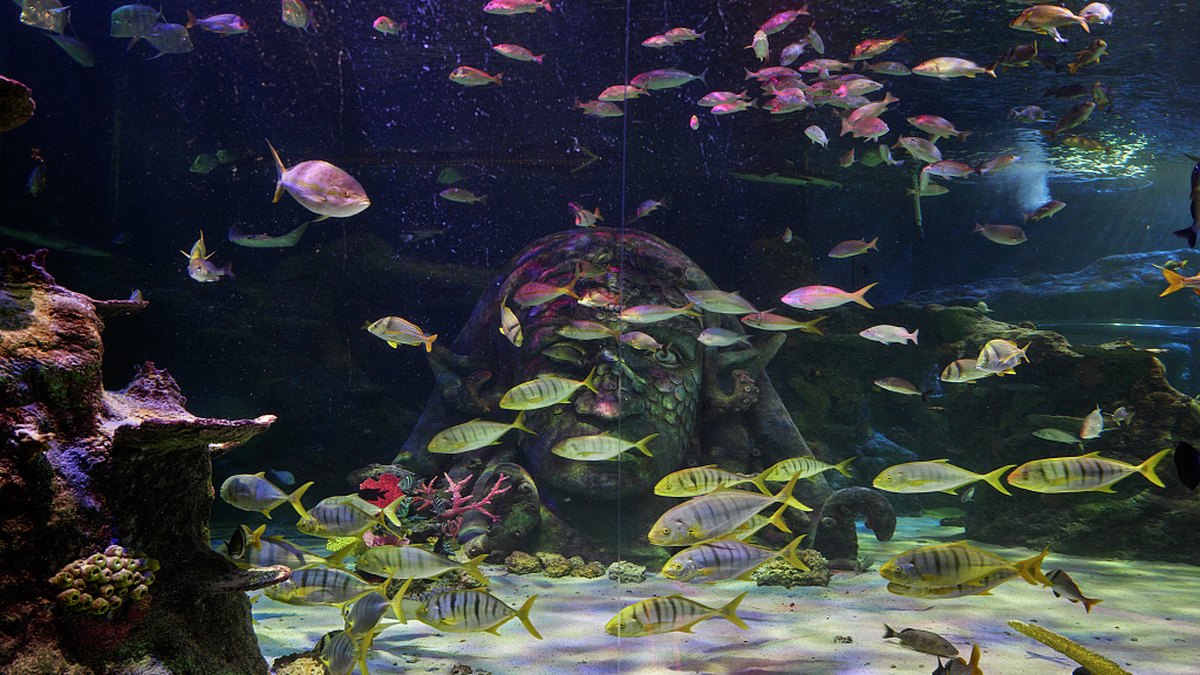
- Hero photo: Carol M. Highsmith, SEA LIFE Michigan Aquarium, Auburn Hills, Library of Congress (2019; no known restrictions on publication per the Library) · Saltwater reef exhibit tank
Everything was read from the linked pages on November 8, 2026, and each carries its date or says it is undated. Gaps: no maker page I could read gave a vodka or vinegar dose or a NOPOX-type dose, no university extension page on reef nitrate was readable, no maker instructions for refugium lighting, chaeto harvest, bioballs or filter socks were found, the Brightwell technical sheets were not retrieved, and several hosts (Wikimedia Commons, Southampton eprints, MDPI, manuals.online) refused automated reads, so none is cited. Sources disagree on targets, and this page shows the range rather than picking one. This is general information, not a guarantee for any tank.