Antifragile by Nassim Nicholas Taleb: Summary and Key Ideas for Sellers
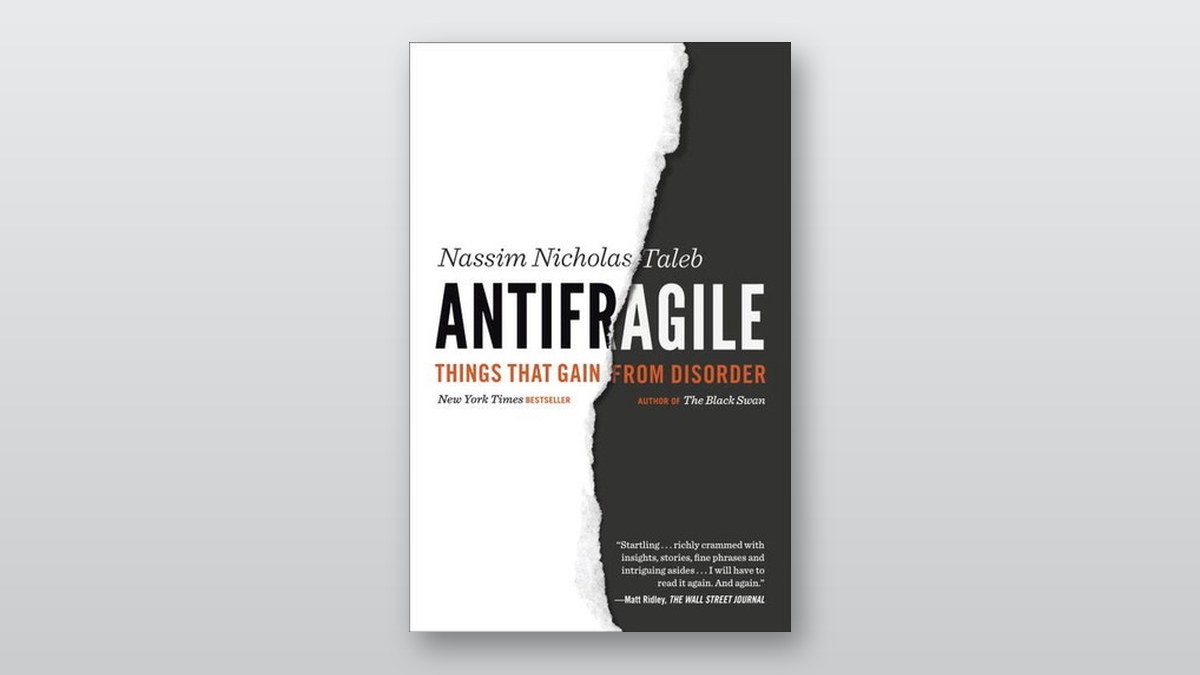
Antifragile: Things That Gain from Disorder is a book by Nassim Nicholas Taleb, published by Random House on November 27, 2012, per the Penguin Random House book page. Its core idea is that some things do more than survive stress and shocks: they get stronger from them. Taleb calls these things antifragile and separates them from merely resilient things, which resist shocks but stay the same.
The book's practical advice follows from that: reduce your exposure to hidden risks that can ruin you, and keep yourself open to small, cheap bets that can pay off a lot.
This is a short summary in our own words, not a retelling of the chapters. It covers the author, the main ideas, a section on what they could mean for people who sell, and where the book draws criticism.
About the book and its author
- TitleAntifragile: Things That Gain from Disorder
- AuthorNassim Nicholas Taleb
- PublisherRandom House (US), Penguin Books (UK); paperback from Random House Trade Paperbacks
- PublishedHardcover November 27, 2012; paperback January 28, 2014
- Length544 pages in the paperback listing; 519 pages is given for the first hardcover edition
- SeriesPart of Taleb's Incerto series on uncertainty
According to the publisher's author bio, Taleb spent about two decades as a trader and risk-taker before turning to research on probability. He is a Distinguished Professor at NYU's Tandon School of Engineering, has written more than 50 scholarly papers, and the Incerto series has been published in 41 languages. His own site lists the five Incerto volumes: Fooled by Randomness, The Black Swan, The Bed of Procrustes, Antifragile and Skin in the Game.
The book was a New York Times bestseller and drew praise from outlets including Harvard Business Review, Fortune and The Economist, according to Wikipedia). Page counts differ by edition, so check the copy you own.
The core idea: some things gain from disorder
Most of us think of the opposite of fragile as strong or sturdy. Taleb argues that is wrong. A fragile thing is harmed by shocks, and a robust thing shrugs them off, but there is a third category that actually improves when it is stressed. Robustness is not the same as antifragility.
The human immune system is a common example given in summaries: exposure to germs makes it better. Taleb's argument is that many systems, including firms, careers and economies, are built for stability and predictability, which leaves them fragile when something unexpected arrives (Graham Mann's book notes).
The main ideas in plain English
The explanations below are ours, based on the sources listed at the end.
- Fragile, robust, antifragile. Harmed by disorder, unharmed by it, or helped by it. The goal is to know which one you are and move toward the third.
- The barbell strategy. Combine two extremes, one very safe and one speculative, and avoid the comfortable middle. The safe side protects you from ruin; the speculative side gives you a chance at a large upside.
- Via negativa. Improve by removing what harms you rather than adding more. Cutting debt or quitting a harmful habit are typical examples.
- Optionality. Keep several choices open so you can take advantage of surprises, while limiting what you can lose if a choice fails.
- Skin in the game. People who make decisions should bear the consequences of them. Without that, risk gets pushed onto others.
- The Lindy effect. For a nonperishable thing such as a book or a technology, the longer it has survived, the longer it is likely to keep surviving.
Where the book applies its ideas
According to the publisher, Taleb applies the idea to cities, debt, economic systems, medicine, personal finance and innovation, and presents the book as a guide to living in a world shaped by rare, unpredictable events (Penguin Random House).
What this could mean for sellers (our own application)
- Do not depend on one customer or channel. A pipeline that relies on one large account or one lead source is fragile. Spreading it out is the sales version of reducing exposure to a single shock.
- Run a barbell in your week. Spend most of your time on reliable, proven activity, and set aside a small share for experiments: a new outreach angle, a different segment, an unusual offer. Small failures cost little; one hit can change your numbers.
- Subtract before you add. Before buying another tool or adding another step, look for what to cut: stale deals you keep forecasting, low-fit prospects, meetings with no outcome.
- Treat rejection as information. Each lost deal can show you something about your pitch or your targeting. Written down and acted on, it makes the next pitch better.
- Keep skin in the game with customers. Recommend only what you would stand behind, and share the risk, for example through a pilot. Buyers notice when the seller has something at stake.
Strengths and limits
The book gives readers a vocabulary for thinking about risk that is easy to carry into everyday decisions, and the fragile-robust-antifragile split is memorable. Boyd Tonkin of The Independent criticized Taleb's style but concluded the ideas were right and mattered, per Wikipedia); Michiko Kakutani of The New York Times was less favorable, and David Runciman of The Guardian argued antifragility is not the solution to fragility.
The concepts are not a measured formula, and applying them to sales is our interpretation. Taleb's own examples come from finance, medicine and history, so sellers need to adapt them carefully.
Questions people ask
Who wrote Antifragile?
Nassim Nicholas Taleb. It was published by Random House on November 27, 2012.
What is the main idea of Antifragile?
Some things gain from stress and disorder rather than just surviving it. Taleb calls these antifragile and contrasts them with fragile things, which are harmed, and robust things, which are unaffected.
What is the barbell strategy?
Pairing a very safe position with a small speculative one and avoiding the middle, so you are protected from ruin and still exposed to upside.
What does via negativa mean?
Improving by removing or avoiding harmful things instead of adding more.
Is Antifragile part of a series?
Yes. It is one of the five Incerto volumes.
Is the sales section from the book?
No. The section for sellers is our own application of the ideas.
Does this page replace reading the book?
No. It is an independent summary in our own words; the book has the examples and the full argument.
Sources
- Penguin Random House: Antifragile · Publisher, dates, page count, description and author bio
- Wikipedia: Antifragile (book) · Publication details, key concepts and critical reception
- Nassim Nicholas Taleb's site · The Incerto volumes
- Graham Mann: Antifragile book notes · Secondary summary of the main ideas
- SuperSummary: Antifragile · Secondary summary of the main ideas
- Open Library: Antifragile · English editions and the cover image
This summary is an independent explainer written in our own words and does not reproduce the book. Facts were read from the linked pages on October 18, 2026; check details such as page counts against the edition you own.
Top photo: Book cover via Open Library