Competing Against Luck by Clayton Christensen: Book Summary and Key Lessons in 2027
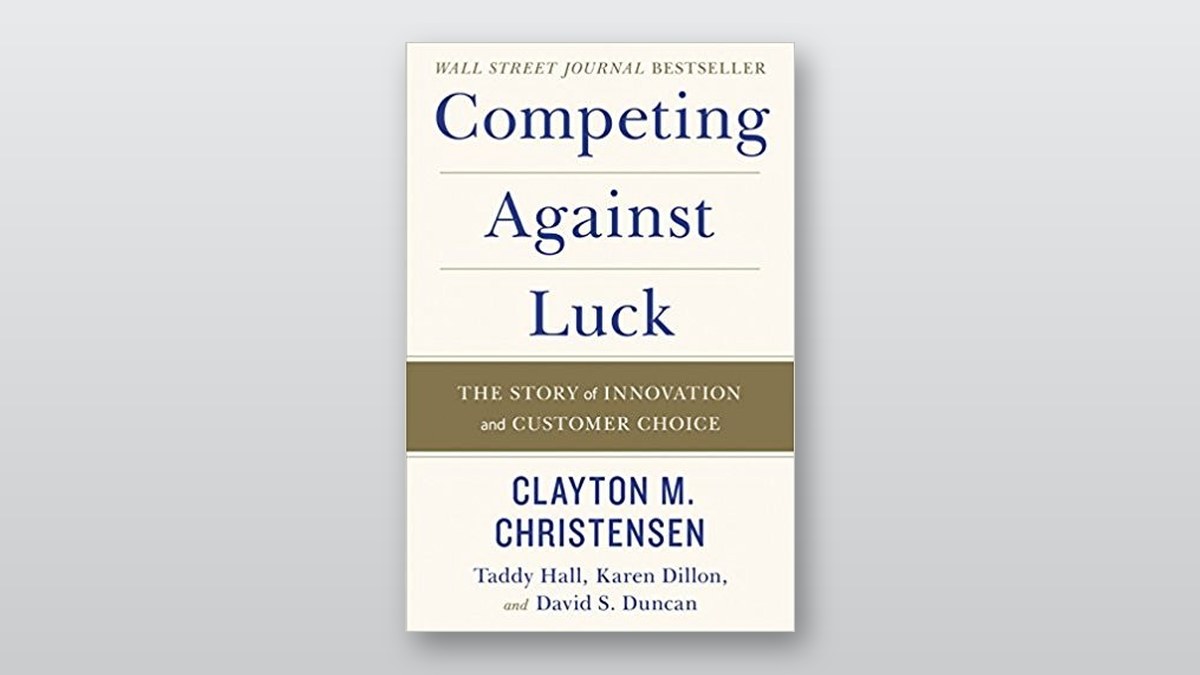
Competing Against Luck argues that innovation does not have to be a gamble. Its central idea, jobs to be done, is that customers do not simply buy products. They "hire" them to make progress in a particular situation, so companies should study the job rather than the customer's demographics or the product's features. Understand the job and you can build, price and market what people will actually pull into their lives.
The English edition was published by Harper Business in 2016 and runs 288 pages, per Open Library. It was written by Clayton M. Christensen with Taddy Hall, Karen Dillon and David S. Duncan, and the authors previewed the argument in a Harvard Business Review article. This is a short summary in our own words, not a chapter-by-chapter retelling.
The authors: Christensen, Hall, Dillon and Duncan
Per the author notes in HBR, Clayton Christensen was a Harvard Business School professor and a frequent HBR contributor. Taddy Hall is a principal with the Cambridge Group who led Nielsen's Breakthrough Innovation Project. Karen Dillon is a former HBR editor who had already written three books with Christensen, including the best seller How Will You Measure Your Life?. David Duncan is a partner at the consulting firm Disruptive Edge.
Quartz described it as Christensen's latest book at the time, following his better-known work on disruption. That makes it a good place to see how his thinking on innovation fits together.
The jobs-to-be-done theory
The Christensen Institute defines Jobs to Be Done as a lens on the circumstances, or forces, that push people toward and away from decisions. Everyone has jobs in life, meaning the progress they want to make toward a goal in a given situation, and people hire products or services when those jobs arise, much as they hire a contractor or a lawyer.
The authors start from a problem. The HBR article cites a McKinsey poll in which 84% of global executives called innovation extremely important to growth, yet 94% were dissatisfied with how their own organizations performed at it. The book's answer is that firms know plenty about customers but track the wrong things, such as demographics and product attributes, which say who buys but not why.
Christensen made a bolder claim in a Quartz interview: around 20% of new products succeed and 80% do not, even though companies expected them to work. Customers are unpredictable, he argued, but the job stays stable over time, and that stability is what makes innovation more predictable.
Your real competition, then, is whatever else a customer could hire for the same job, which may not look like your product at all. Netflix, in the Quartz example, serves the same entertainment job by mailing DVDs and by producing shows.
The milkshake example
The book's best-known story is the milkshake. A fast-food chain could not lift milkshake sales by asking customers about thickness, flavor or size. Studying why people actually bought one told a different story. Per the Christensen Institute, morning buyers hired the shake to curb hunger, make a drive more interesting and give them food that is easy to hold in the car. In the afternoon it was a treat for kids.
The lesson is about competition. In the morning the milkshake was up against bananas and bagels, and in the afternoon against other treats for children, not against other milkshakes. A reading-list reviewer calls the milkshake chapter the cleanest short explanation of the whole framework.
The Institute's condominium case makes the same point with a different product. Buyers kept mentioning the dining room table, and the real obstacle turned out to be the anxiety of leaving behind something meaningful. The builder added moving help, storage and a sorting room, raised prices by $3,500, and grew business by 25% by 2007 while industry sales fell 49%.
Functional, social and emotional dimensions of a job
The theory says a job has three dimensions, per the Institute. Demographics and product attributes miss them, which is why offers that look right on paper still fail.
- Functional. The practical task that needs doing, such as filling a long commute or getting a degree that earns a raise.
- Social. How the person wants to be seen or what others expect of them, such as meeting a family's expectations.
- Emotional. How they want to feel, including the anxieties that hold them back, like the condo buyers' reluctance to give up the dining table.
The Institute also notes that people hire for different jobs as circumstances change, so the same person may hire the same product for different reasons on different days.
How to uncover jobs
The Institute says the approach asks about the story behind a decision rather than why someone decided. In its condo case, the consultant spoke with people who had actually bought and found the clue, the dining table, that focus groups had missed. In its college example, researchers analyzed more than 200 detailed student stories and found five distinct jobs. (Christensen Institute)
- Talk to real buyers. Ask people who recently chose, or switched, to retell the circumstances that led them to act.
- Watch the context. The milkshake insight came from seeing when and why people bought, not from preference questions.
- Name the competition. List everything else the customer could have hired, including non-products like bananas.
- Expect to discover, not invent. Christensen told Quartz that jobs are discovered rather than developed.
Organizing around jobs
The argument is that the job, not the product or the customer segment, should guide how a company is run. Christensen said in the Quartz interview that disruption theory is about how competitors will respond, while jobs theory is the other side of the coin: whether customers will want what you build. If you organize around a job, he added, a new entrant that merely has a cheaper product has a harder time disrupting you.
In practice this means deciding which job you will serve and what you need to be good, and bad, at. The Institute's college example frames it that way: institutions must pick the job they serve and offer the experiences that help people succeed at it.
Criticisms and limits
We found no major published critique of this specific book, so treat these as fair cautions rather than established faults. A reading-list reviewer says the rest of the book lengthens the core idea more than necessary and that it is a framework rather than a tactical how-to. That fits the sense that the milkshake chapter carries much of the argument.
A second caution is that the framework is easy to misuse. The same reviewer says consultants have reduced jobs to a template for writing user stories, which loses the original thesis. And because jobs are found through interviews and judgment, two teams can describe the same job differently. Separately, Christensen has faced criticism over his broader disruption theory, but that concerns a different idea.
Who should read it
- Product and innovation leaders. It offers a causal way to think about why customers choose, instead of relying on segments.
- Marketers and strategists. It reframes competition and positioning around the job.
- Founders. It helps you test whether anyone has a real job your product would do.
- Readers short on time. If you only want the core idea, the milkshake story and the HBR article cover most of it.
Skip it if you want a step-by-step interview playbook. It is a framework and a set of stories, so pair it with a practical guide to customer interviews.
Questions people ask
Who wrote Competing Against Luck and when was it published?
Clayton M. Christensen wrote it with Taddy Hall, Karen Dillon and David S. Duncan. The English edition from Harper Business came out in 2016 and runs 288 pages, per Open Library.
What is the main idea of Competing Against Luck?
Customers hire products to do a job, meaning to make progress in a particular situation. Studying the job, not demographics or features, makes innovation more predictable.
What is the milkshake example?
A fast-food chain found that morning customers hired milkshakes to curb hunger and make a drive more interesting, while in the afternoon the shake was a treat for kids. Its competition was bananas, bagels and other treats.
What are the functional, social and emotional dimensions of a job?
The functional dimension is the practical task, the social is how the person wants to be seen or what others expect, and the emotional is how they want to feel, including anxieties that hold them back.
Is Competing Against Luck worth reading?
Yes if you work on products, strategy or innovation and want a rigorous way to understand customer choice. It is a framework rather than a step-by-step playbook.
Sources
- Open Library: Competing Against Luck (Harper Business edition) · Publisher, 2016 date and page count
- Harvard Business Review: Know Your Customers' Jobs to Be Done · The authors' article, McKinsey poll figures and author notes
- Christensen Institute: Jobs to Be Done Theory · Definition, three dimensions, milkshake and condo cases
- Quartz: Christensen's new theory is meant to protect you from disruption · Interview on the book, success rates and organizing around jobs
- Deepak Gupta: Competing Against Luck review · Editorial take on strengths and limits
This summary is an independent explainer written in our own words and does not reproduce the book. Facts were read from the linked pages on October 19, 2026; the publisher's own page could not be loaded, so publication details come from Open Library and HBR. Read the book for the full detail.
Top photo: Book cover via Open Library