Continuous Discovery Habits by Teresa Torres: Summary and Key Ideas
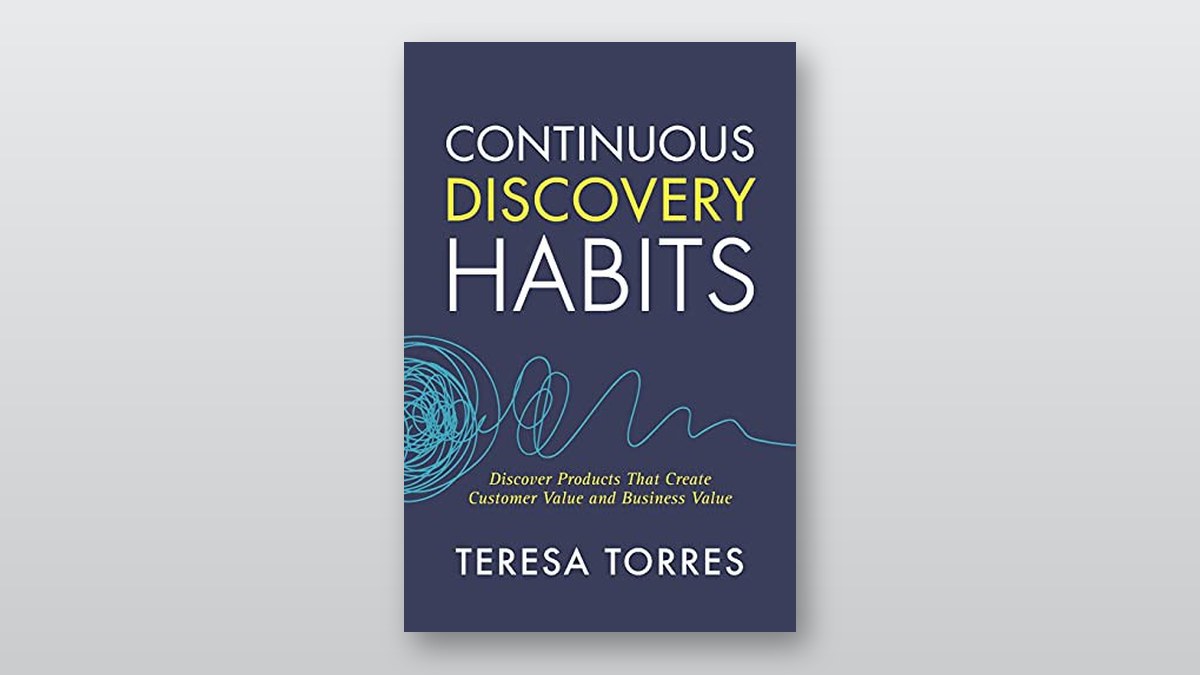
Continuous Discovery Habits is a book by Teresa Torres, published by Product Talk LLC in 2021, per Open Library and the Product Talk book page. Its core idea is that product teams should learn from customers continuously, as a regular habit built into the week, instead of running discovery as an occasional project before a launch.
The book gives that habit a structure: a small team (the product trio) that talks to customers often, maps what it learns onto an opportunity solution tree, and tests the riskiest assumptions behind its ideas before building them.
This is a short summary in our own words, not a retelling of the chapters. It covers the author, the main ideas, and where the book may be harder to apply.
About the book and its author
- TitleContinuous Discovery Habits
- AuthorTeresa Torres
- PublisherProduct Talk LLC
- Published2021; Product Talk announced the book on 19 May 2021, available in paperback and Kindle
- Length244 pages (Open Library median)
- ISBN9781736633304
Torres runs Product Talk, a site and training business for product teams that publishes articles, offers courses and team training, and keeps a discovery glossary. She also hosts the podcast Just Now Possible. According to the book's page, the book draws on her work over eight years with hundreds of product teams, and it includes footnotes for readers who want the theory behind the methods plus exercises teams can start using right away.
The same page carries endorsements from Marty Cagan of Silicon Valley Product Group, Phil Terry of Collaborative Gain, Jocelyn Mangan of HimForHer and Martin Eriksson of Mind the Product. These are publisher-selected praise, not independent reviews.
The core idea: discovery as a weekly habit
Many teams treat customer research as a phase: study the market, write a plan, then build. Torres argues for the opposite rhythm. Discovery should run alongside delivery, every week, so decisions are steadily informed by what customers say and do instead of by a large batch of research that goes stale.
Her answer to the question of how to make that sustainable is to define a small set of repeatable habits. The book describes them for a team that wants to work this way without needing a dedicated research department.
The product trio
The book's core unit is the product trio: a product manager, a designer and an engineer who do discovery together. The reasoning is that each sees different risks. Sharing the work means all three hear customers first-hand and no one has to relay findings to the others, so decisions rest on shared understanding.
Weekly touchpoints with customers
The central habit is staying in regular contact with customers, with interviewing as the main method. The idea is that frequent short conversations, tied to a clear goal, teach more over time than a few big studies, and they make talking to customers a normal part of the team's routine.
A related theme is to begin with an outcome the business wants to move, rather than a list of features to ship. The conversations then explore customers' needs, pain points and desires that relate to that outcome.
Opportunity solution trees
The book's best-known tool is the opportunity solution tree, a visual map that links a desired outcome to the customer opportunities the team has discovered, and those opportunities to possible solutions. Per Product Talk, the tree helps the team visualize its work and stay aligned.
In practice the tree stops a team from jumping straight from a goal to a favorite solution. It prompts the team to ask which customer need a solution serves, and to compare several options for the same opportunity.
Testing assumptions
Once the team has a promising solution, the book encourages breaking it into the assumptions that must be true for it to work, then running small, quick tests on the riskiest ones before committing to a build. Product Talk describes this as assumption testing to evaluate solutions quickly.
The aim is to learn cheaply whether an idea is likely to work, so that weak ideas are dropped early and strong ones go into delivery with more evidence behind them.
The main ideas at a glance
- Start from an outcome. Anchor discovery in a result the business wants, not a feature list.
- Work as a trio. A product manager, designer and engineer discover together.
- Talk to customers often. Make interviewing a routine, not a project.
- Map what you learn. Use opportunity solution trees to connect outcomes, opportunities and solutions.
- Test before you build. Check the riskiest assumptions with small experiments.
- Bring stakeholders along. Product Talk lists engaging stakeholders as part of the approach.
Strengths and limits
The book is practical: it turns a broad goal, learning from customers, into specific recurring activities a team can start. It is also tied to a company that publishes further material on the same methods, so readers can go deeper on each habit.
Limits are worth noting. The approach assumes a team with some autonomy to choose what to build and the time to talk to customers each week, which not every organization allows. It is also written mainly for product teams, so people in other roles may need to adapt it. This is our reading, not a claim made in the book.
Questions people ask
Who wrote Continuous Discovery Habits?
Teresa Torres, who runs Product Talk. The book was published by Product Talk LLC in 2021.
What is the main idea of the book?
Product teams should do customer discovery continuously, as a weekly habit, and use the results to decide what to build.
What is a product trio?
A product manager, a designer and an engineer who share discovery work as the core team unit.
What is an opportunity solution tree?
A visual map linking a desired outcome to customer opportunities and then to possible solutions, used to keep the team aligned.
What is assumption testing?
Breaking an idea into the assumptions it depends on and running small tests on the riskiest ones before building.
How long is the book?
Open Library lists 244 pages; counts can differ by edition.
Does this page replace reading the book?
No. It is an independent summary in our own words; the book has the full method, examples and exercises.
Sources
- Product Talk: Continuous Discovery Habits · Book announcement, description, key concepts and endorsements
- Product Talk: About · Teresa Torres, podcast, courses and topics
- Open Library: Continuous Discovery Habits · Publisher, publish date, page count, ISBN and the cover image
This summary is an independent explainer written in our own words and does not reproduce the book. Facts were read from the linked pages on October 19, 2026; check details such as page counts and dates against the edition you own.
Top photo: Book cover via Open Library