Demand-Side Sales 101 Summary: Key Ideas from Bob Moesta's Book
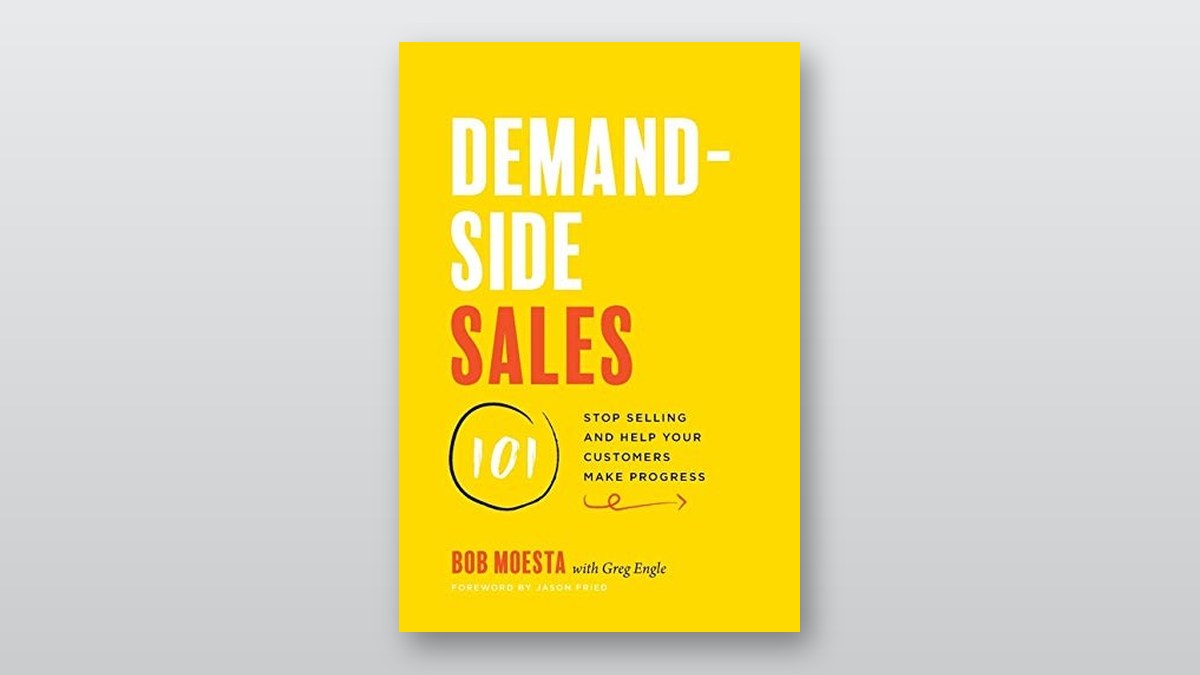
Demand-Side Sales 101 by Bob Moesta, written with Greg Engle, argues that selling works better when you stop pushing a product and help the buyer make progress in their life or work. Per the publisher page at Lioncrest, the author shifts the focus of sales from selling to helping people buy and make progress. The book places sales inside the Jobs to Be Done framework Moesta helped develop. For a seller, the usable part is this: learn what is pushing the buyer away from their current situation, what is pulling them toward yours, and what worries and habits hold them back, then spend your time on those forces instead of on a feature list.
The book was first published in 2020, per Open Library. This is a short summary in our own words, based on the publisher pages, a published review and a reader summary, not a retelling of the book.
The book in brief
Open Library credits Bob Moesta and Greg Engle and lists Lioncrest Publishing editions from 2020, including a 224-page paperback. The cover carries the line Stop Selling and Help Your Customers Make Progress and a foreword by Jason Fried.
Scribe Media describes Moesta as a builder, teacher and entrepreneur, co-founder of The Re-Wired Group in Detroit, and a co-architect of the Jobs to be Done theory. It says the book aims to help readers see, hear and understand what customers mean, and to sell without the discomfort many people feel about selling. The publisher's own wording is that sales "does not have to feel icky for you or your customers."

Demand-side versus supply-side thinking
The Waiter's Pad review frames the split this way: supply-side thinking starts from features a business can build, while demand-side thinking starts from the progress a customer needs. In that view a good salesperson acts like a concierge, listening, understanding the goal and helping the customer reach it.
The same review says the product is a condiment, not the meal: it is something that helps someone make progress, not the point itself. It also retells a chain attributed to Levitt, in which a customer who wants a drill really wants a hole, then a plug, then a lamp, then to read better. The lesson is that the real need can sit several steps away from the thing being sold.
The foreword by Jason Fried, per the same review, draws on his time selling shoes: customers picked shoes up to judge their weight and feel, and a shoe that does not feel good in the hand never reaches the foot.
The four forces
The review lists four forces behind any purchase: the push of the current situation, the pull of the new solution, the anxiety about the new solution, and the habit of the current situation. Customers act when push plus pull outweighs habit plus anxiety.
For a seller that is a diagnostic. If a deal stalls, ask which side is weak. Little push means the buyer is not unhappy enough to move. Little pull means they cannot picture your way working. Heavy anxiety or habit means the risk of change feels bigger than the gain.
Stages of buying and a framing example
The review also lists six stages of buying: first thought, passive looking, active looking, deciding, onboarding and using. Satisfaction in the using stage is subjective, it says, and depends on what the customer expected.
For a framing example it cites Mars' 2011 Betty White commercial, which it says reframed Snickers away from competing with Milky Way and toward solving a customer's struggling moment. The reviewer presents that as demand-side selling: the pitch starts from the buyer's situation, not the candy bar.
How a reader summary turns it into steps
Scott Burleson's summary (November 2024) organizes the book into six moves. Treat it as one reader's reading, not the author's own outline.
- Help customers make progress. Identify the customer's job and focus on outcomes rather than features.
- Interview for motivation. Ask open-ended questions, find the push of the problem and the pull of the solution, and listen for emotional triggers.
- Guide the decision. Help buyers clarify their criteria, answer unspoken concerns with case studies, testimonials or demos, and avoid information overload.
- Address barriers early. Lower perceived risk with guarantees, trials such as a 30-day trial, or flexible returns, and use success stories against the pull of the status quo.
- Treat follow-up as service. Schedule tailored check-ins, support the transition and ask for honest feedback.
- Build the relationship. Stay engaged after the sale, share useful resources and invite satisfied customers to advocate.
What a seller or revenue team can use
These are our reading of the summaries, not rules from the book.
- Start discovery with the struggle. Ask what the buyer was doing before, what finally made it a problem, and what they tried first.
- Name anxiety out loud. Ask what worries them about switching and answer it before the proposal stage.
- Respect habit. Your real competitor is often the current way of doing things, not another vendor.
- Tie follow-up to progress. After the sale, check whether the buyer is actually moving toward the outcome they described.
- Compare with other methods. For a different take on discovery questions, see our SPIN Selling summary.
Limits of this summary
- Secondhand view. We did not have the full text of the book, so this page relies on the publisher pages, one published review and one reader summary. Chapter structure and the author's exact wording are not covered.
- Mostly favorable sources. The review we read has no explicit criticisms, so this page does not claim to weigh the book's weaknesses.
- Not a script. The framework helps you ask better questions. It does not replace knowing your product, your buyer and your market.
Questions people ask
What is the main idea of Demand-Side Sales 101?
Sales should help people buy and make progress rather than push a product. The publisher page at Lioncrest describes shifting the focus from selling to helping people make progress in their lives.
What are the four forces in Demand-Side Sales 101?
Per The Waiter's Pad review: the push of the current situation, the pull of the new solution, the anxiety about the new solution and the habit of the current situation. Customers act when push plus pull outweighs habit plus anxiety.
Who wrote Demand-Side Sales 101 and when was it published?
Bob Moesta wrote it with Greg Engle, per Open Library, which lists editions from 2020. The foreword is by Jason Fried.
Is Demand-Side Sales 101 about Jobs to Be Done?
Yes. The review we read calls Jobs to Be Done the umbrella framework, and Scribe Media says Moesta co-architected that theory.
Is there a free PDF of Demand-Side Sales 101?
We do not link to PDF copies, because unauthorized copies are not a legitimate way to read it. The publisher pages at Lioncrest and Scribe Media link to Amazon for purchase, and you can also ask your local library or bookstore about it.
Sources
- Lioncrest Publishing: Demand-Side Sales 101 · Publisher description and endorsements
- Scribe Media: Demand-Side Sales 101 · Book description and author background
- Open Library: Demand-Side Sales 101 · Authors, 2020 editions, 224-page paperback
- The Waiter's Pad: book review · Foreword, four forces, stages of buying, Snickers example
- Scott Burleson: Demand-Side Sales 101 summary · Six-step reader summary
This summary is an independent explainer written in our own words and does not reproduce the book. Facts were read from the linked pages on November 5, 2026. We did not have the full text of the book, so for exact wording and chapter detail, read the book itself.
Top photo: Book cover via Open Library