Fanatical Prospecting by Jeb Blount: Summary, Key Lessons and Sales-Team Takeaways in 2027
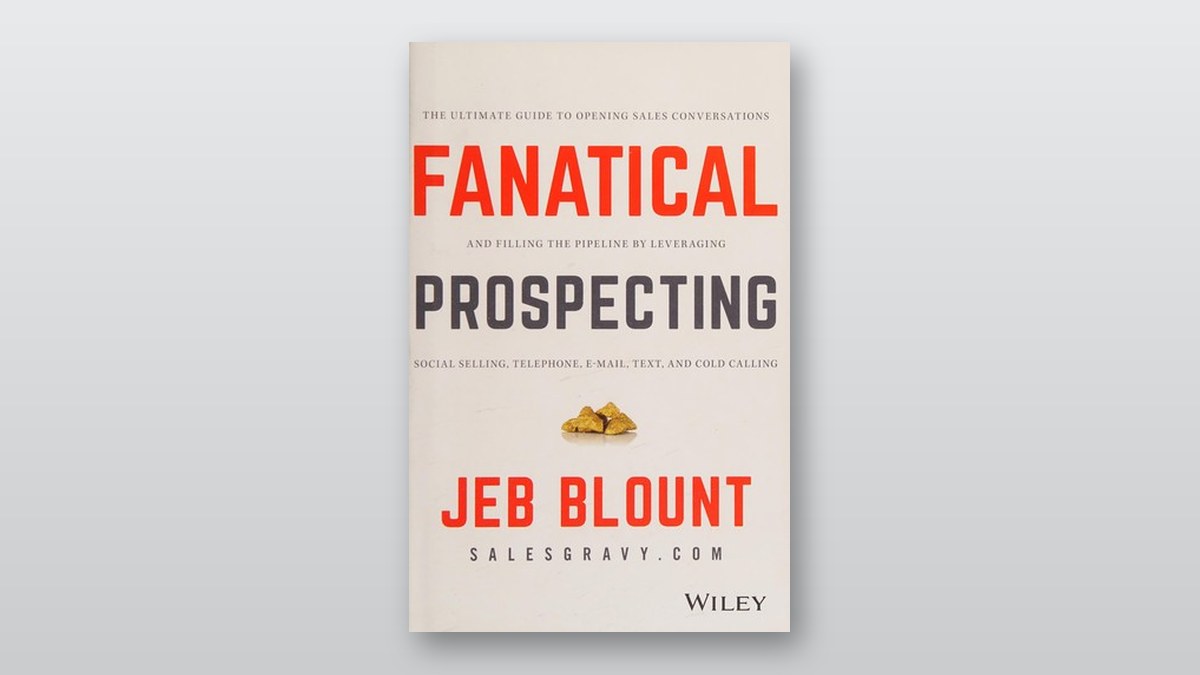
Fanatical Prospecting is a 2015 sales book by Jeb Blount, published by Wiley. Its core argument is that an empty pipeline is the main reason salespeople fail, and that the usual cause is inconsistent prospecting. The fix is to prospect every day, across several channels, with a repeatable script and a tracked set of numbers, whether or not you feel like it.
The publisher's copy, as listed by Wiley-VCH, covers a balanced multi-channel approach, ways to avoid sales slumps, and frameworks for phone, email and text outreach. A retailer description on Apple Books says the book has sold over 500,000 copies; that is a listing claim, not an audited figure.
For a sales team, the takeaway is to protect prospecting time as a fixed block, replace every lost deal with enough new opportunities, and coach to activity numbers. This is an independent summary in our own words; it does not reproduce the book.
About the book and its author
Jeb Blount runs Sales Gravy and, per his own site, has written 15 books. The site calls him a 17x best-selling author, which is his own description. The author bio on the Wiley-VCH page says Top Sales Magazine named him among the Top 50 Most Influential Leaders in Sales and Marketing and Forbes named him among the World's Top 30 Social Selling Influencers.
The book is 304 pages in the Wiley hardcover and has 23 chapters, from the case for prospecting through phone, email, text, social selling and mental toughness, ending on what the author calls the key question in sales. Release dates differ between listings (Apple Books shows September 2015, Wiley-VCH November 2015), so treat 2015 as the safe answer.
Key lessons from Fanatical Prospecting
These are our paraphrases of the ideas the publisher description and a secondary summary from Tenbound name. Check the book for its own wording.
- An empty pipeline is the real problem. The publisher's copy says most sales failures trace back to too little prospecting, not to weak closing.
- The 30-Day Rule. Prospecting done in one 30-day stretch pays off over roughly the next 90 days, so a skipped month shows up as a thin quarter later.
- The Law of Replacement. Every closed or dead deal needs replacing at a rate that matches your closing ratio. At a one-in-ten close rate, that is about ten new opportunities per deal.
- The Universal Law of Need. Desperation pushes buyers away. A full pipeline lets you act calm, which the book treats as the cure.
- Use several channels. The book argues for a balanced mix: phone, email, social, text, referral and in-person, with the phone emphasized.
- Protect your prime time. Block focused, uninterrupted time for outreach instead of letting email and admin eat it. Tenbound's summary gives no specific hours for this, and we do not invent any.
The book's most repeated message is mindset: prospecting is a daily job, not something to do only when the pipeline looks thin.
Frameworks you can use
The most concrete tool is the 5-step telephone framework. According to Tenbound's summary, it is meant to fit in under fifteen seconds.
- Get attention by using the prospect's name.
- Identify yourself and your company.
- State the reason for the call.
- Bridge with a "because" that ties to the prospect's situation.
- Ask for what you want, then stop talking.
The same summary describes a three-step turnaround for brush-offs: stay anchored so you do not react, disrupt the expected argument, then ask again. The book also has chapters on a prospecting pyramid and four goals of prospecting; we did not find a published description of those in the sources we read, so we do not summarize them here.
Sales-team takeaways: an original example
Imagine a ten-person inside-sales team whose reps all say they are too busy to prospect. A manager could apply the book's ideas like this. The scenario is made up for illustration, not from the book.
- Fix the block. Put one protected outreach window on every rep's calendar and keep meetings out of it.
- Track your own ratios. The book has a chapter on tracking ratios. Count dials, conversations, meetings and wins for a month to get your team's real closing ratio.
- Apply replacement math. If your own data shows one win per ten qualified opportunities, each rep needs about ten new ones behind every closed deal to stay level.
- Coach the first fifteen seconds. Record opening lines and compare them with the five steps above.
- Judge results patiently. Because of the 30-Day Rule, expect results about a quarter after the change, not next week.
Criticisms and limits
The advice favors high-volume outbound, which suits some roles (inside sales, small business) better than long-cycle enterprise or account-based selling. Cold calling and texting also face rules that vary by country and state, so check your local regulations before copying any script.
We found no published, independent measurement showing that teams applying the book close more revenue. The sales figure is a retailer claim. One third-party summary says the book is translated into 12 languages, but we could not confirm that with the publisher, so we leave it out.
Is it worth reading now?
The channels have changed since 2015, but the core claim, that consistent activity beats occasional bursts, still applies. An English edition is listed on Open Library. Page counts differ by edition (288 on one record, 304 on Wiley's), so check yours. For newer material, Blount's site lists a later book on combining LinkedIn and AI in prospecting.
Questions people ask
What is Fanatical Prospecting about?
It argues that an empty pipeline is the top cause of sales failure and teaches daily, multi-channel prospecting. See the Wiley-VCH listing.
Who wrote Fanatical Prospecting?
Jeb Blount, CEO of Sales Gravy, per jebblount.com. It is published by Wiley.
How many copies has it sold?
An Apple Books listing says over 500,000. That is a retailer description, not an audited number, and we found no newer total.
What is the 30-Day Rule?
Prospecting in a 30-day window pays off over the following 90 days, per Tenbound.
What is the Law of Replacement?
Every closed or dead deal must be replaced by new opportunities at a rate matching your closing ratio, so one-in-ten means about ten new opportunities per deal.
What is the 5-step phone framework?
Get attention with the name, identify yourself, state the reason, bridge with a because, and ask, then stop talking. It is meant to take under fifteen seconds.
How can a sales team use the book?
Protect a daily outreach block, track your own ratios, apply replacement math to your pipeline target and coach openings. The book publishes no team benchmarks that we could verify.
Sources
- Wiley-VCH: Fanatical Prospecting · Publisher description, 23-chapter table of contents, page count and author bio
- Apple Books listing · Publisher description with the 500,000-copy claim and named frameworks
- Tenbound summary · Secondary summary of the 30-Day Rule, Law of Replacement and 5-step phone framework
- Jeb Blount (jebblount.com) · Author bio, Sales Gravy role and other books
- Open Library work record · English edition records and cover
This summary is an independent explainer written in our own words and does not reproduce the book. Facts were read from the linked pages on October 22, 2026; check the book and the sources above for primary detail.
Top photo: Book cover via Open Library