Hacking Growth by Sean Ellis and Morgan Brown: Summary and Key Ideas
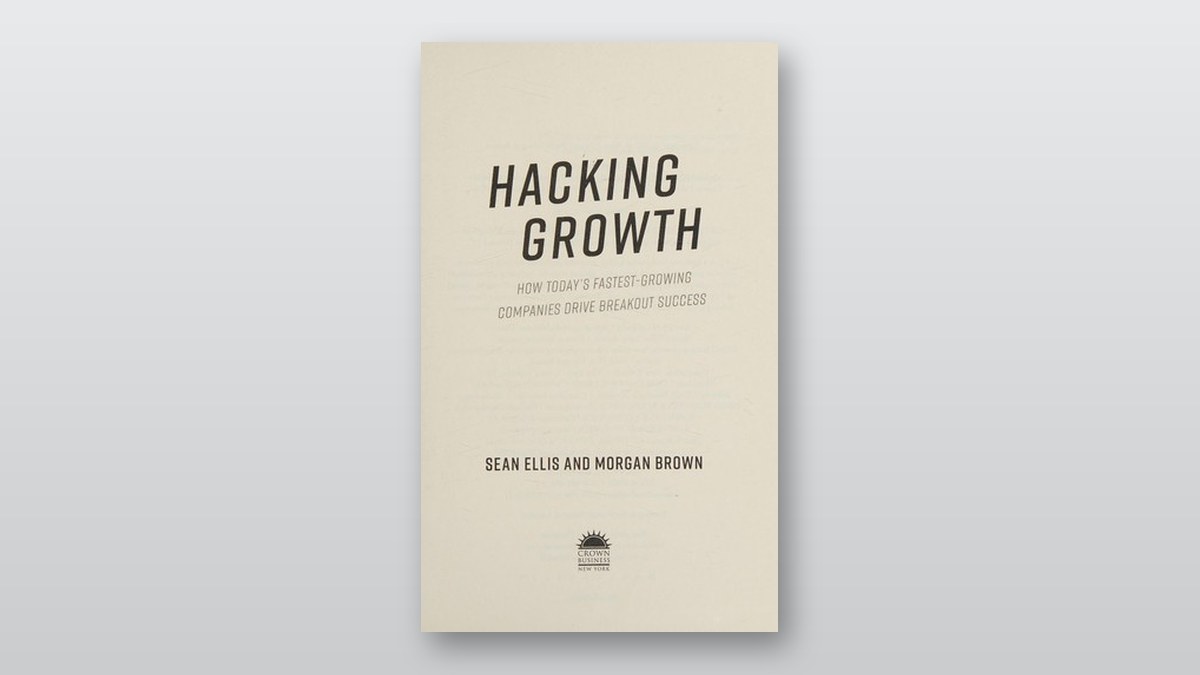
Hacking Growth: How Today's Fastest-Growing Companies Drive Breakout Success is a business book by Sean Ellis and Morgan Brown, published by Crown Currency on April 25, 2017, per Penguin Random House. Its core idea is that growth should be run as a repeatable process, not a string of big bets: a small cross-functional team picks one metric to move, makes sure the product is genuinely wanted, then runs a steady stream of fast experiments and keeps what the data supports.
The publisher describes it as a method that blends product development, analytics and online marketing to replace costly guesswork with data-driven, repeatable results.
This is a short summary in our own words, not a chapter-by-chapter retelling. It covers the authors, the main ideas, how to apply them and where the book has limits.
About the book and its authors
- TitleHacking Growth: How Today's Fastest-Growing Companies Drive Breakout Success
- AuthorsSean Ellis and Morgan Brown
- Publisher and dateCrown Currency, published April 25, 2017
- Length320 pages in hardcover and ebook; the audiobook runs 10 hours 44 minutes and is read by the authors
- List price$30.00 for the hardcover, per the publisher
Per Wikipedia), Sean Ellis is an entrepreneur and startup advisor who founded GrowthHackers and was first marketer at Dropbox, Lookout and Xobni. The publisher's listing credits him as the person who coined the term "growth hacker" in 2010; we could not confirm that on an independent page, so treat it as the publisher's claim. Morgan Brown is the co-author; sources describe his later roles inconsistently, so we do not state a current job for him.
Praise on the publisher's page comes from Eric Ries, author of The Lean Startup, and Nir Eyal, author of Hooked, among others. The book's examples include Airbnb, Pinterest, LinkedIn, Facebook and Uber, according to the publisher.
The core idea: growth is a team sport and a process
The authors argue that growth should not belong to marketing alone. A growth team pulls strategy, marketing, data analysis and product development into one group so ideas can move from insight to experiment without waiting on handoffs. According to a chapter summary, such teams can range from four or five people to more than 100, and they complement traditional departments rather than replace them.
The word "hacking" here means resourceful and fast, not shady. The method is to learn what works by testing, then put effort behind the winners.
The main ideas in plain English
The book is organized in two parts, the method and the playbook, across nine chapters, per this chapter summary. The explanations below are ours.
- Make sure the product is must-have first. Growth effort pushed onto a product people do not need is wasted. Readers' notes on the book (Graham Mann) describe a test: ask users how they would feel if they could no longer use the product, and look for at least 40% saying "very disappointed" before scaling up.
- Find the aha moment. This is the point where a new user first experiences the product's core value. Much of the later work is about getting more people there, faster.
- Pick one North Star metric. Choose a single measure that captures the core value you deliver to customers, and aim growth work at it, so the team is not pulled in many directions.
- Test at high tempo. Work runs as a loop of four steps: analyze the data, come up with ideas, prioritize them, then test. The same notes suggest small teams might run 1 to 2 tests a week and large ones 20 to 30. Those tempo figures come from a reader's summary, not from us reading the book.
- Score ideas before you run them. One scoring method described in those notes rates each idea from 1 to 10 for impact, confidence and ease, then averages the scores. The point is a fair way to choose, not a perfect forecast.
- Hold experiments to a standard. The same notes mention a 99% confidence level, and say that if a result is inconclusive the control wins. Small tweaks such as button colors, the chapter summary notes, rarely move the needle enough to matter.
- Work the whole customer journey. The playbook half covers acquisition (finding a few sustainable channels), activation (getting new users to use the product), retention (in initial, medium and long-term phases) and monetization (raising customer value over time).
How to apply it
These are our own applications, not claims from the book.
- Start with the question, not the tactic. Before running any campaign, ask whether customers would miss the product. If the answer is unclear, fix that first.
- Name one metric and write it on the wall. A subscription app might choose weekly active users who complete a core action. Whatever you choose, every experiment should say how it moves that number.
- Keep an experiment log. Record the idea, the expected effect, the result and what you decided. A log stops the team from rerunning old failures.
- Fit the tempo to your size. A team of a few people may only manage a handful of tests a month, and that is fine if each one is designed to teach something.
- Share results, including failures. The method only works if the whole team sees what was learned.
Strengths and limits
The book gives teams a shared vocabulary and a clear loop to follow, which is why it is often handed to new growth hires. Its examples come largely from consumer technology companies, so a business with long sales cycles, few customers or little traffic will find some tactics hard to test quickly. Statistical testing needs enough users to detect a difference.
Because the book came out in 2017, specific channel tactics may have aged even where the process has not. We also did not find independent research testing whether the book's method outperforms other approaches; the case for it rests on the authors' experience and examples.
Questions people ask
Who wrote Hacking Growth?
Sean Ellis and Morgan Brown. Ellis founded GrowthHackers and was an early marketer at Dropbox, Lookout and Xobni.
When was Hacking Growth published, and by whom?
Crown Currency published it on April 25, 2017. The hardcover has 320 pages and a list price of $30.00.
What is the main idea of Hacking Growth?
Growth can be run as a repeatable process: a cross-functional team focuses on one metric, confirms the product is must-have, and runs fast experiments to learn what works.
What is the 40% test?
A product-market fit check described in readers' notes on the book: ask users how they would feel without the product, and look for at least 40% answering "very disappointed". We took this from a secondary summary, so check it against the book.
Is Hacking Growth only for marketers?
No. The authors argue growth belongs to a cross-functional team that includes data and product people as well as marketers.
Does this page replace reading the book?
No. It is an independent summary in our own words; the book has the detail and worked examples.
Sources
- Penguin Random House: Hacking Growth · Authors, publication date, length, price, description and examples
- Penguin Random House: Hacking Growth (Crown Currency edition) · Publisher, praise and hardcover details
- Wikipedia: Sean Ellis · Author background
- Graham Mann: Hacking Growth notes · Reader summary of the 40% test, North Star metric, scoring and testing tempo
- Readingraphics: Hacking Growth summary · Chapter structure, team size and playbook areas
This summary is an independent explainer written in our own words and does not reproduce the book. Facts were read from the linked pages on October 18, 2026; figures marked as coming from reader summaries should be checked against the book.
Top image: book cover via Open Library