The JOLT Effect by Matthew Dixon and Ted McKenna: Summary, the Four Steps and Key Takeaways
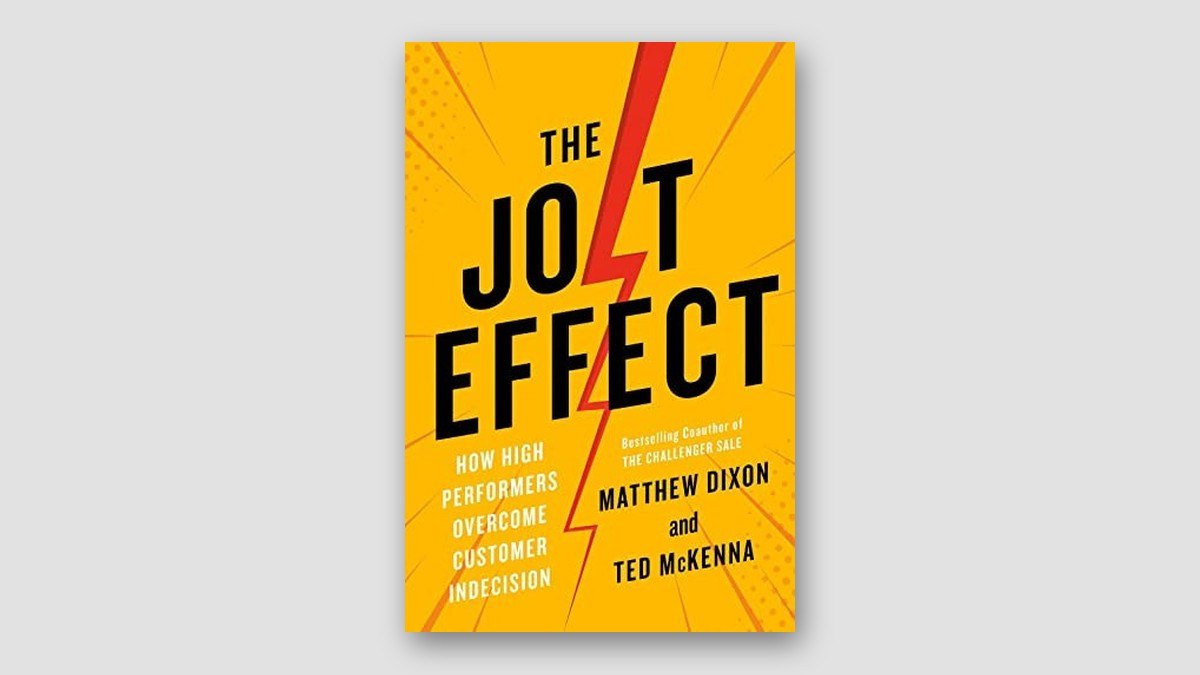
The JOLT Effect: How High Performers Overcome Customer Indecision is a sales book by Matthew Dixon and Ted McKenna, published by Portfolio on Sep 20, 2022. The hardcover runs 256 pages, per the publisher's page. Its argument is that once a buyer has decided they want a change, what stalls the deal is usually fear of making a mistake, not love of the status quo. The authors say they studied more than 2.5 million recorded sales conversations to find what top sellers do about it, and they boil the answer down to four moves: Judge the level of indecision, Offer a recommendation, Limit the exploration, and Take risk off the table.
This is a summary in our own words, drawn from the publisher, the authors' own site and reader reviews, not from the text of the book. Much of the research is reported by the authors and their company, so we label it that way below.
The authors and the book
Matthew Dixon and Ted McKenna wrote the book together, and Portfolio lists it as a 2022 release, available as a hardcover, an ebook and an audiobook that the two authors read themselves. The publisher presents Dixon as the bestselling co-author of The Challenger Sale.
According to the authors' site, Dixon is a co-founder of SellingInnovations and a founding partner of DCM Insights, with earlier roles at Tethr, Korn Ferry and CEB, now part of Gartner. McKenna is co-founder and CEO of SellingInnovations and also a founding partner of DCM Insights, with earlier roles at Tethr, Russell Reynolds Associates and CEB. The same company sells training and advisory services built on the book, which is worth remembering when you read its claims.
The big idea: buyers fear failing more than they fear missing out
The publisher description says that once a customer has decided they want to buy, they stop caring about succeeding and care about not failing. The usual advice when a buyer says they need to think about it is to restate every benefit of buying. The authors argue that this answers the wrong worry.
The research figures below come from the authors' own blog and are their claims, not independent findings.
- The size of the problem. The authors say 40% to 60% of deals are lost to customer indecision rather than to a competitor.
- Where the stall comes from. Of the deals lost to no decision, they report 44% were lost to a preference for the status quo and 56% to indecision driven by risk or fear of failure.
- The common mistake. Doubling down on the case against the status quo backfired 84% of the time, according to the authors.
- The gap between sellers. They say high performers reach nearly double the win rate of average performers by using a different playbook for indecision.
The four JOLT steps
The four steps below paraphrase the authors' own overview of the method. The book goes into each one in more depth with data and examples.
- Judge the indecision. Qualify the buyer's ability to commit, not just their interest. Does this person feel ready to put their name behind the purchase? The authors stress that indecision is a spectrum, and that doubts the buyer carries into the deal will surface again after the sale if nobody addresses them.
- Offer a recommendation. Instead of laying out more options, tell the buyer which one you think fits and why. Too much choice raises the chance of a wrong decision, and a clear recommendation, with its reasoning, shares some of that weight. The authors suggest selling the way you would to a close friend.
- Limit the exploration. Piling on data and resources can leave an anxious buyer stuck. The seller uses their expertise to say which information matters for the decision and which does not, and so keeps control of the flow of information.
- Take risk off the table. Address fear of a bad outcome with trials, opt-outs, land-and-expand deals, or anything else that lowers the hurdle. The authors also advise setting practical expectations about time to value, because an overly rosy promise adds risk.
Three fears behind indecision
In a separate post on the three types of indecision, the authors tie the steps to three buyer anxieties. It is a handy way to diagnose where a stalled deal is stuck.
- Fear of the wrong choice. Options overload. The fix they point to is a well-timed recommendation, like a barista suggesting a drink.
- Fear of incomplete homework. Information overload. The seller acts like a travel agent who has done the research and shows the buyer the best route.
- Fear of not getting what they pay for. Expectation overload, the worry that the buyer will fail to get the value they were promised. The answer is to take risk off the table.
Key takeaways
These points are our reading of the book's themes as described by the publisher and the authors, not quotes from it.
- Treat no decision as a competitor. A stalled deal is not a neutral outcome. Track it, and plan for it as you would for a rival vendor.
- Diagnose before you push. Ask whether the buyer is ready and able to commit, not only whether they like the product.
- Be willing to take a stand. Neutral menus of options can leave buyers alone with their fear. A reasoned recommendation helps them.
- Edit the information you hand over. More content is not always more help. Point to the few things that decide the choice.
- Make the first step small and reversible. Pilots, opt-outs and phased rollouts lower the stakes for a nervous buyer.
- Use it alongside other methods. The authors describe JOLT as complementary to any selling methodology, so it can sit on top of your existing process.
How a sales team could use it
These ideas are our own suggestions for applying the book, not recommendations from the authors.
- Add an indecision check to deal reviews. For each stalled deal, ask which of the three fears seems to be at work and which JOLT step has been tried.
- Write recommendation scripts. Give reps a plain way to say what they would choose for a buyer like this one and why.
- Curate the follow-up pack. Replace the long list of attachments with a short, ordered set of the items that matter for the decision.
- Design a low-risk starting offer. Work out what trial, pilot or opt-out you can honestly offer, and who has to approve it.
- Review no-decision losses separately. Tag them in the CRM so you can see how many were indecision rather than competition or price.
Criticisms and limits
Reception is mostly positive. On Goodreads the book averages 4.07 from 880 ratings, and only 3 of those ratings are one star. Still, there are fair points to weigh.
- Length and repetition. Several Goodreads reviewers say the book repeats itself and could have been condensed. One says it feels like a long-form article stretched into a book, with not quite enough unique content to fill one.
- Author-reported research. The 2.5 million conversation study, the percentages and the win-rate claim come from the authors and their own companies. We could not find independent replication in the pages we read, so treat the exact numbers as the authors' claims.
- A commercial interest. The authors' company sells training, keynotes and advisory support around the method, per the JOLT Effect site. The book is also a way into that business.
- Fit. The approach is aimed at buyers who have already agreed that a change is needed. It does not replace finding and building the need in the first place, and a pushy recommendation could backfire with a buyer who does not trust you yet.
A sensible reading is that JOLT is a useful way to understand why good deals stall and what to try next. It does not replace discovery skill or trust, and a recommendation is only as good as the seller's grasp of the buyer's situation.
Questions people ask
Who wrote The JOLT Effect and when was it published?
Matthew Dixon and Ted McKenna wrote it. Portfolio, an imprint of Penguin Random House, published it on Sep 20, 2022.
What does JOLT stand for?
Judge the indecision, Offer a recommendation, Limit the exploration, and Take risk off the table, as described by the authors.
How long is the book?
The publisher lists 256 pages for the hardcover and 272 pages for the ebook. The audiobook runs 5 hours 48 minutes.
What research is the book based on?
The authors say it draws on a study of more than 2.5 million sales conversations. The study is theirs, so treat its figures as the authors' claims.
What is the main message of The JOLT Effect?
That buyers who stall after agreeing they want a change are mostly afraid of making a mistake, so sellers should help them feel safe deciding instead of piling on more reasons to buy.
Is The JOLT Effect worth reading?
Readers rate it 4.07 on Goodreads. Many praise its research and practical ideas, while some say it is repetitive. It suits people who sell, or manage people who sell, deals that often end in no decision.
Sources
- Penguin Random House: The JOLT Effect · Publisher page: Portfolio, publication date, page count, formats and description
- Open Library: Jolt Effect · Edition record, publishers and page count
- JOLT Effect: About the book · Authors' description of the book
- JOLT Effect: About the authors · Author backgrounds and company roles
- JOLT Effect blog: What is the JOLT Effect · Research figures and the four JOLT steps, as reported by the authors
- JOLT Effect blog: Three types of customer indecision · The three buyer anxieties
- JOLT Effect · Homepage: study description and the company's training offers
- Goodreads: The JOLT Effect · Reader rating, rating counts and reviews
This summary is an independent explainer written in our own words and does not reproduce the book. Facts were read from the linked pages in October 2026; read the book for the primary detail and judge the vendor and author pages with their commercial interest in mind.