Major Account Sales Strategy by Neil Rackham: Summary, Key Lessons, and RevOps Takeaways
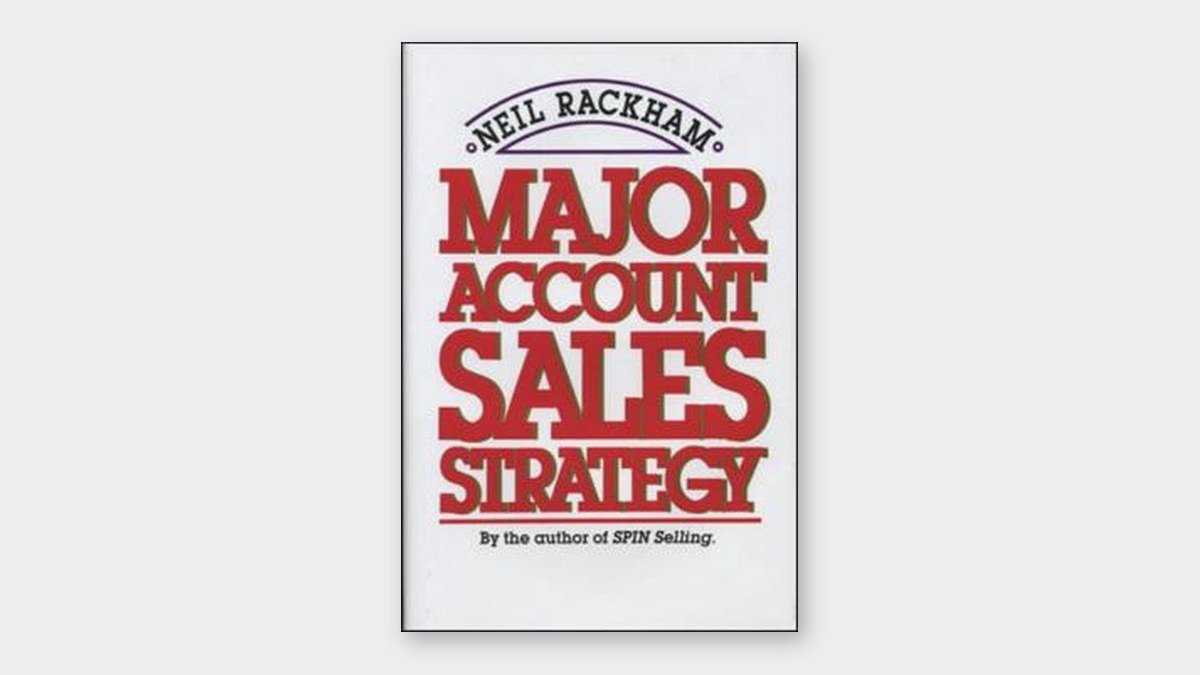
Major Account Sales Strategy is Neil Rackham's follow-up to SPIN Selling. Its main point is that a large sale is not one conversation but a series of phases on the buyer's side, and the selling approach that works in one phase can backfire in the next. The three phases before a decision are recognition of needs, evaluation of options and resolution of concerns. In the first you build dissatisfaction, in the second you influence the buyer's criteria, and in the third you help the buyer deal with their fears. The book then adds account strategy: how to get into an account, find a sponsor, and keep selling after the first deal.
The book facts below come from a bookseller page and a reader database. ThriftBooks lists McGraw-Hill as the publisher, with a January 1989 publication date, 240 pages, in hardcover and paperback. Goodreads gives a first publication date of January 1, 1989 and the subtitle "An Arsenal of Shrewd Tactics and Winning Strategies to Make You a Major Account Sales Success." This is a summary in our own words, based on the public reviews linked below, not a chapter-by-chapter retelling. For the book that comes first, see our SPIN Selling summary.
How it differs from SPIN Selling
SPIN Selling is about the single sales call and the questions you ask in it. This book steps back to the whole sale. Jack Vinson's 2017 review says it follows SPIN Selling and applies the same logic to major accounts, where sales take longer and the effects of a change are harder for the customer's own staff to see. The Goodreads description says the book covers the full major account sales cycle, based on Rackham's research.
Put simply, SPIN gives you the questions, and this book tells you which job those questions should be doing at each point in a long sale. Our SPIN Selling summary covers the four question types, which this summary does not repeat.
The buyer's phases
The reviews we read agree on the central idea: build your strategy around the customer's decision process, not around your own selling steps. The SellingSherpa summary, posted in August 2019, names three phases before a decision and one after. The Kelly's Run review from February 2023 describes the buying process as a circle: recognition of need, evaluation of options, resolution of concerns, decision making, implementation, and then change over time that starts the cycle again.
- Recognition of needs: the buyer moves from mild irritation to real dissatisfaction. The seller holds back on product pitches early, uncovers the source of the dissatisfaction and raises its perceived intensity and urgency, using SPIN-style questions.
- Evaluation of options: the buyer sets the criteria for comparing solutions. SellingSherpa says finding out those criteria is a common blind spot, and the job is then to influence them: reinforce the ones you meet, build up minor ones where you are strong, and play down important ones you cannot meet. Attacking a criterion head-on tends to strengthen it.
- Resolution of concerns: the buyer works through fears and risks before committing. The reviewer says some of these are hidden personal or consequence fears that only the customer can resolve, so the seller's role is to help rather than to resolve them for the customer. Price objections can mask these fears, and the same summary warns against minimizing, prescribing and pressuring.
Vinson's review adds the matching warning: do not push a sale when the customer does not see a problem, and do not keep hammering on the problem once the customer is ready to close.
Account strategy
Beyond single sales, the SellingSherpa summary describes the book's account-level advice. These are one reviewer's condensed points, not the book's own wording.
- Entry. Look for receptivity, dissatisfaction and power. Receptivity alone does not produce business, so find people with dissatisfaction and use them to reach decision makers, ideally through a sponsor who will sell on your behalf.
- Negotiation. Do not negotiate too early. The reviewer says early concessions lose their value and set expectations for bigger ones later.
- Implementation and maintenance. Involve the customer in installation planning, and keep reassessing needs, because competitors win accounts by finding needs you neglected. Keep selling inside existing accounts rather than only protecting them.
The Art of page, which is promotional copy, lists the same range of topics: account entry, competing against larger rivals, price and terms, and ongoing support to keep key clients.
Sales versus marketing, and focusing resources
We could not find a reliable source that describes how the book divides work between sales and marketing, so we are not going to claim it does. The SellingSherpa summary does not discuss marketing roles. It does make a few points about where effort goes: measure health by how much time the sales organization spends with customers versus on internal matters, test new products in smaller accounts first and approach key accounts once you can make a strong needs-based call, and avoid a naive farmers-versus-hunters split. If this is your question, read the book itself.
What it means for RevOps and sales leaders
This section is our own analysis, not something the book or the reviewers say.
- Map your stages to the buyer's phases. If your CRM stages describe what the seller did, try adding the buyer's phase next to them, so a deal is not marked advanced just because a proposal went out.
- Coach by phase. A rep pitching features during recognition of needs, or digging at the problem after the buyer is ready to decide, is a coachable pattern that call reviews can flag.
- Track criteria and concerns. Give reps a place to record the buyer's decision criteria and unresolved concerns, so managers can inspect them in deal reviews.
- Manage accounts, not only deals. Account plans, sponsor mapping and post-sale expansion reviews fit the book's account strategy ideas.
Check the fit first. The Kelly's Run review says the book is mainly aimed at industrial sales, so test which advice carries over to your own market.
Limits to keep in mind
We did not read the full text of the book. The phase descriptions and account advice come from reviewers' summaries and the book's retail and reader-database pages, so details such as how many phases the book itself counts may differ between reviewers. The book is from 1989, and none of our sources test its advice against modern buying committees. Read the book itself for the full argument and the research behind it.
Questions people ask
What is Major Account Sales Strategy about?
It is about selling large, long, multi-call sales. It says to match your approach to the buyer's phase: recognition of needs, evaluation of options and resolution of concerns, and it adds advice on entering and keeping major accounts.
Who wrote it and when was it published?
Neil Rackham. ThriftBooks lists McGraw-Hill as the publisher with a January 1989 date, and Goodreads gives a first publication date of January 1, 1989.
How is it different from SPIN Selling?
SPIN Selling focuses on the questions you ask in a single sales call. This book applies similar thinking to the whole major sale and to account strategy. See our SPIN Selling summary for the first book.
Does it cover sales versus marketing roles?
We could not confirm that from our sources, so this summary makes no claim about it.
Is this a substitute for reading the book?
No. It is an independent summary in our own words from public pages. It is not affiliated with the author or the publisher.
Sources
- ThriftBooks: Major Account Sales Strategy · Publisher, January 1989 date, page count, formats and cover image
- Goodreads: Major Account Sales Strategy · First publication date, subtitle and description
- The Art of: Major Account Sales Strategy · Promotional description of topics covered
- SellingSherpa: Major Account Sales Strategy (August 10, 2019) · Phases, strategy by phase, account strategy and resource points
- Kelly's Run Consulting review (February 1, 2023) · Circular buying process and industrial focus
- Jack Vinson: Major Account Sales Strategy (August 9, 2017) · Relation to SPIN Selling and phase-matching
- Our SPIN Selling summary · The earlier Rackham book
This summary is an independent explainer written in our own words and does not reproduce the book. Facts were read from the linked pages on October 30, 2026; we did not read the full text of the book. Read the book for the full detail.