MEDDICC by Andy Whyte: Summary, the Letters Explained and Key Takeaways
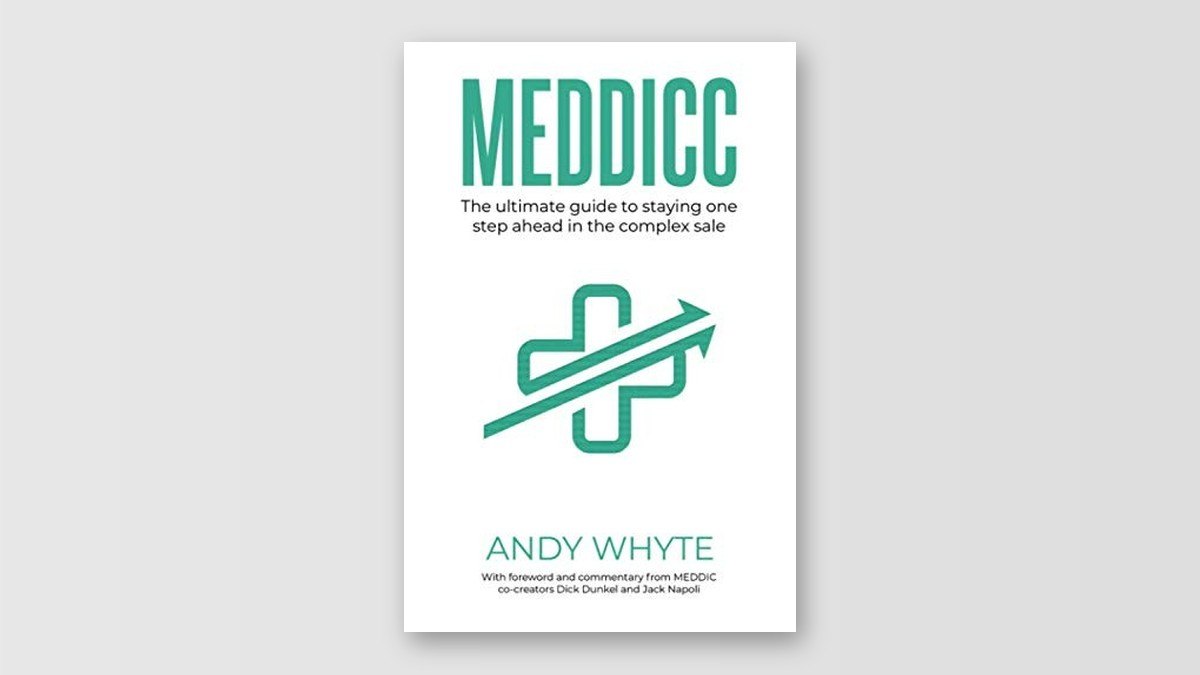
MEDDICC: The ultimate guide to staying one step ahead in the complex sale is a sales-qualification book by Andy Whyte, with a foreword and commentary from the framework's creators Dick Dunkel and Jack Napoli. It was released on November 25, 2020 by MEDDICC LTD, the company Whyte founded, and runs 264 pages per Apple Books. The book walks through each element of the framework one chapter at a time, so a seller can check any complex deal for the facts that usually decide it: the measurable value, the person who controls the budget, how the buyer will decide, the pain, an inside champion and the competition.
The core idea is that complex deals are won or lost on information the seller either has or lacks, and a shared acronym turns that into a checklist the whole team can inspect. MEDDIC was created at PTC in 1996 by Dunkel, per the publisher description. This is a summary in our own words, drawn from public pages and not from the book's text. For how the three versions of the acronym differ, see our explainer on MEDDIC versus MEDDPICC.
The author and where the framework came from
Andy Whyte is the author and publisher. The copyright page, visible in the Perlego preview, names MEDDICC LTD, and Whyte's own book page describes the book as the first to put MEDDICC down in writing. The acknowledgments credit Dick Dunkel, Jack Napoli and PTC sales leader John McMahon for MEDDIC itself, and say the book exists because of them.
According to the company site, MEDDIC was created inside PTC in 1996 by Dunkel. It later gained a second C for Competition and then a P for Paper Process, which is why the same family of ideas appears as MEDDIC, MEDDICC and MEDDPICC. Dunkel writes the foreword, and the MEDDICC book page quotes him saying Whyte took his framework and made it better.
The letters, in plain English
The definitions below paraphrase the MEDDICC company site. The book's table of contents, shown in the Perlego preview, gives each element its own chapter, including Paper Process, so the book effectively covers the full eight-part version even though its title uses the shorter name.
- Metrics. The measurable value your solution delivers to this particular buyer, expressed in numbers the buyer cares about.
- Economic Buyer. The person with overall authority over the buying decision, as opposed to someone who merely influences it.
- Decision Criteria. The principles, guidelines and requirements the buyer uses to judge your solution against others.
- Decision Process. The steps the buyer will take to decide, and who takes part in each one.
- Paper Process. The steps that follow the decision on the way to a signature, such as legal and procurement.
- Implicate the Pain. Finding the problem, confirming it is real, and tying it to consequences the buyer feels, so that doing nothing has a cost.
- Champion. A person with power, influence and credibility inside the customer who will push the deal forward when you are not in the room.
- Competition. Anything that competes for the same budget or attention, including rival vendors, internal projects and doing nothing.
How the book is laid out
Going by the table of contents in the Perlego preview, the book opens with a foreword, a preface and an introduction that asks what MEDDICC is, whether it counts as a methodology, and how it compares with other qualification methods. Short chapters on qualification, what defines an elite seller, discovery, not knocking the competition, price conditioning and the go-live plan come before the letter chapters.
After the letters, the book covers risks, lessons learnt while implementing MEDDICC, a checklist and a scoring approach, then an epilogue and appendix. The checklist and scoring chapters are the most reusable part for a revenue-operations team, because they turn the acronym into something a manager can inspect in a deal review.
Key takeaways
These points are our reading of the book's themes as described by its publisher, the SoBrief summary and the Shortform preview, not quotes from it.
- Use it all the way through the deal. The framework is meant to be revisited as a deal changes, not ticked once at the start and forgotten.
- Qualify out early. Time already spent is not evidence that a deal is real. A deal with no meaningful pain or no route to power may deserve to be dropped so effort goes to better opportunities.
- Quantify the pain. Turn a vague problem into agreed numbers so that inaction visibly costs the buyer something.
- Reach the real budget holder. The named budget owner and the person who can say yes are not always the same person.
- Test your Champion. Friendliness is not the same as influence. A good Champion can be tested and equipped, and should be able to help you reach the Economic Buyer.
- Map the route to go-live. Know the buyer's steps from decision through signature to launch, so late surprises are rarer.
- Score evidence, not optimism. A checklist and confidence score let a manager compare a rep's hope with what the rep has actually confirmed.
How a RevOps team could use it
These ideas are our own suggestions for applying the framework, not recommendations from the book.
- Turn each letter into a CRM field. A deal with a blank Economic Buyer or Paper Process field at proposal stage is a visible risk, and reps stop guessing.
- Review deals against the letters. In pipeline reviews, ask which letters have evidence behind them and which are assumptions.
- Forecast from evidence. Weight a deal by how many elements are confirmed rather than by the rep's stage label alone.
- Coach on the weakest letter. If a team keeps losing late, look for a missing Champion or a skipped Paper Process before blaming price.
- Use one vocabulary. Sales, solutions and customer success can all use the same terms for the same deal facts, which makes handoffs cleaner.
Criticisms and limits
Reception is largely positive. On Goodreads the book averages 4.22 across 504 ratings, with only 6 one-star and 14 two-star ratings. Still, there are fair points to weigh.
- Repetition. The SoBrief summary notes that some readers criticize repetitiveness and occasional typographical errors, and that some find the book dry. A reviewer on another Goodreads edition page makes a similar point about repetition.
- Promotional sources. The author's site claims over 100,000 copies sold and a 4.7 Amazon rating across 1,447+ reviews, per his book page. Those figures are self-reported. The independent Goodreads average is lower, and one early reviewer there says he worked with Whyte, though he also says he bought the copy himself.
- A commercial interest. The publisher also sells MEDDICC training, certification and software, per its own site. The book is a good introduction, but it is also the top of that company's funnel.
- Version drift. The title says MEDDICC, while the company now teaches MEDDPICC. The book has a Paper Process chapter, but expect terms to differ slightly between the book and current training. The company's about page also dates the book to 2019, while retailers list November 2020, so check the edition you buy.
- Fit. A framework built for complex, multi-stakeholder deals can feel heavy for short, transactional sales. The company's own comparison says the lighter versions suit simpler B2B sales.
A sensible reading is that MEDDICC is a useful checklist for deals where several people must agree. It does not replace discovery skill or judgment, and a form filled in without real customer evidence only gives false comfort.
Questions people ask
Who wrote MEDDICC and when was it published?
Andy Whyte wrote it, with a foreword and commentary from MEDDIC co-creators Dick Dunkel and Jack Napoli. Retailers list a release date of November 25, 2020, from MEDDICC LTD.
What does MEDDICC stand for?
Metrics, Economic Buyer, Decision Criteria, Decision Process, Implicate the Pain, Champion and Competition. MEDDPICC adds a P for Paper Process, and the book has a chapter on Paper Process as well.
Who created MEDDIC?
Per the publisher and company pages, Dick Dunkel created MEDDIC at PTC in 1996, with Jack Napoli credited as a co-creator.
How long is the book?
Apple Books and Open Library list 264 pages, while Goodreads lists 266 pages for the Kindle edition.
Is the MEDDICC book good for beginners?
Whyte's own site says yes, and reader reviews on Goodreads describe it as easy to read and practical. It is most useful if you sell, or manage people who sell, deals with several decision makers.
Is MEDDICC the same as MEDDPICC?
Nearly. MEDDPICC is MEDDICC with Paper Process added as its own element. See our explainer on MEDDIC versus MEDDPICC for the history of each version.
Sources
- Apple Books: MEDDICC · Publisher description, MEDDICC LTD, release date and page count
- Perlego preview: MEDDICC · Copyright page, acknowledgments and full table of contents
- Open Library: MEDDICC · Edition record, authors, date and page count
- Goodreads: MEDDICC · Reader rating, page count and reviews
- Andy Whyte: the book · Author's description of the book and the three acronym versions
- MEDDICC: What is MEDDPICC · Origin at PTC in 1996 and the definition of each letter
- MEDDICC: the book · Company book page and Dunkel endorsement
- SoBrief: MEDDICC · Third-party summary, takeaways and reader criticisms
- Shortform: MEDDICC · Third-party summary preview
This summary is an independent explainer written in our own words and does not reproduce the book. Facts were read from the linked pages on October 30, 2026; read the book for the primary detail and judge the vendor-run pages with their commercial interest in mind.