Nudge by Thaler and Sunstein — Cliff Notes Summary for Sellers
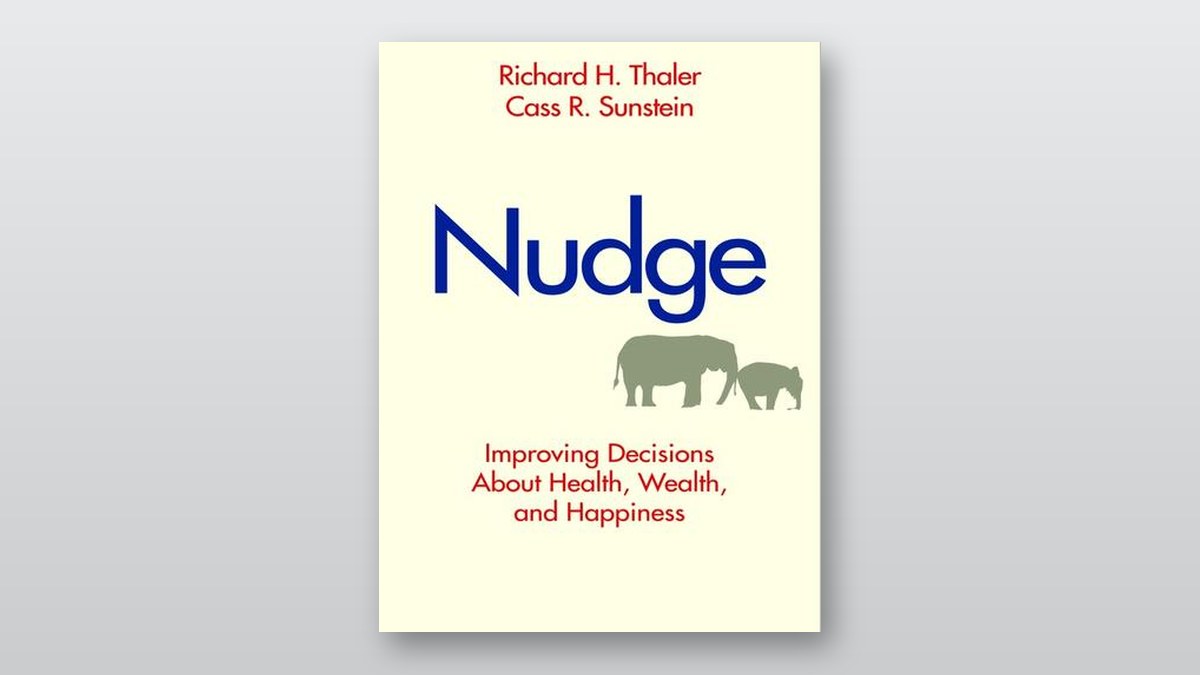
Nudge: Improving Decisions about Health, Wealth, and Happiness is a book by economist Richard H. Thaler and legal scholar Cass R. Sunstein, first published by Yale University Press in 2008 (Open Library). Its core idea is that the way choices are presented shapes what people pick, so anyone who designs a form, a menu or a default is a choice architect whether they mean to be or not. The authors argue that this design power should be used to steer people toward options that improve their own lives, while leaving everyone free to choose differently.
In short: defaults and layout matter more than most people assume, small design changes can move behavior without banning anything, and the authors want that power used openly and for the chooser's benefit. The book is about public policy, health, savings and similar decisions. It is not a sales book, so the seller advice further down is this page's own application, not something the authors claim.
This page is a summary in our own words. We did not read the book itself; it draws on the Wikipedia article about the book), the Open Library edition records and the Nobel Prize announcement.
Who wrote Nudge and what kind of book it is
Open Library lists the first edition as a Yale University Press hardcover from 2008, with a Penguin paperback following in 2009 and a revised Penguin edition, Nudge: The Final Edition, in 2021 at 384 pages. Wikipedia) describes the authors as University of Chicago economist Richard Thaler and Harvard Law School professor Cass Sunstein, and says the book draws on psychology and behavioral economics.
Thaler later received the Nobel memorial prize in economics. The Nobel Prize announcement dated 9 October 2017 credits him for contributions to behavioural economics and says he coined the term nudging and showed how it can help people with self-control, for example when saving for a pension.
The big idea: people are predictably imperfect
According to the Wikipedia summary), the authors push back on the textbook picture of people who always choose well. Real people make predictable mistakes because they rely on mental shortcuts, fall for fallacies and copy others. The book sorts thinking into two modes: an Automatic System that is fast and instinctive, and a Reflective System that is slow and deliberate.
- Anchoring. A guess gets pulled toward whatever number you were handed first.
- Availability. Risks that are easy to picture feel more likely than they are.
- Status quo bias. People tend to stay with whatever they are already in, even when it is not good for them. The summary's example is a free magazine trial that quietly turns into a paid subscription until the reader cancels.
- Herd behavior. People are heavily influenced by what others do, as shown by the classic Asch line-length experiments the book cites.
What a nudge is, and what it is not
The same summary gives the authors' definition: a nudge is any feature of choice architecture that alters behavior in a predictable way without forbidding options or significantly changing the economic incentives. To count as a nudge it should be cheap and easy to avoid. Their example is putting healthier food at eye level in a school cafeteria. Nothing is banned, but behavior shifts.
Because every design has to put something first, the authors say there is no neutral layout. If a default has to exist anyway, they argue, it might as well be one that helps the person.
Libertarian paternalism
The authors call their stance libertarian paternalism. Per Wikipedia), the libertarian half is the insistence that people should be free to do what they like and to opt out of arrangements they dislike. The paternalistic half is the claim that it is legitimate for choice architects to try to influence behavior so people live longer, healthier and better lives. Thaler coined the phrase in conversation, and he and Sunstein wrote articles on it in 2003 before the book.
Where the book applies nudges
The policy chapters, as outlined by Wikipedia), cover finance, health, the environment, schools and marriage. Three examples show the pattern.
- Retirement saving. Enroll employees automatically in a well designed plan while letting them leave, and offer Save More Tomorrow, where people commit in advance to raise contributions when they get pay raises.
- Health plans. The authors critique Medicare Part D as cumbersome choice architecture, and argue for sensible defaults and free online tools to compare plans.
- Organ donation. Require people renewing a driver's license to state whether they want to be a donor, rather than leaving it to chance.
Criticism and limits
The book was named one of the best books of 2008 by The Economist, but it has critics. Per Wikipedia), reviewers at The Times and The Washington Post found the long run of proposals tiresome. Elizabeth Kolbert asked in The New Yorker why stop at a nudge and not a push, and how people who cannot be trusted with their own choices can be trusted to design choices for others.
A UK House of Lords subcommittee reviewing behavior change in July 2011, based on 148 written submissions and evidence from 70 witnesses, reportedly found little evidence that nudges alone work, and said change works best as part of a package with regulation and fiscal measures. Psychologist Gerd Gigerenzer argued in 2015 that the word nudge has been stretched until it means almost anything.
Takeaways for sellers: our own application
- Audit your defaults. Every quote form, checkout and plan page has a pre-selected option. Choose the one that fits most buyers well, and say plainly what it is.
- Make the recommended path the easy path. Putting the plan that suits most customers first, with a short honest reason, is choice architecture a buyer can see and undo.
- Make opting out as easy as opting in. The authors' libertarian half means free exit. Easy cancellation and clear renewal terms are the seller version of that.
- Reduce friction on good decisions. Fewer fields, plain comparison tables and a clear next step help buyers finish a choice they already want to make.
Where nudging a buyer crosses the line
The book's justification is that nudges help the chooser, which is a different test from raising the seller's revenue. By that test, tactics that exploit the biases above would fall outside the authors' framework. Examples are a free trial that rolls into a paid plan the buyer forgot about, a pre-ticked add-on, a cancellation path that is hard to find, or a made-up crowd signal. Each one uses status quo bias or herd behavior against the buyer.
The critics in the previous section raise the same worry in general form: who decides what is best for someone, and when does a nudge become a shove. A practical check is to ask whether you would be comfortable telling the buyer exactly what you did and why. If not, redesign it. This test is our own rule of thumb, not a quote from the book.
Questions people ask
Who wrote Nudge and when was it published?
Richard H. Thaler and Cass R. Sunstein wrote it, and Yale University Press first published it in 2008, according to Open Library. A revised edition, Nudge: The Final Edition, followed in 2021.
What is a nudge in plain English?
A nudge is a change in how choices are presented that predictably shifts behavior without banning any option or significantly changing the incentives, per the definition summarized by Wikipedia). Putting healthy food at eye level is the standard example.
What is libertarian paternalism?
It is the authors' label for letting people stay free to choose and opt out while still allowing choice architects to steer them toward options that make their lives longer, healthier and better.
Did Richard Thaler win a Nobel Prize?
Yes. The Royal Swedish Academy of Sciences awarded him the 2017 prize in economic sciences for his contributions to behavioural economics, as stated in the Nobel Prize announcement.
Is Nudge a sales or marketing book?
No. It covers public policy and personal decisions about health, money and happiness. Using it for selling is our own adaptation, and the authors' emphasis on helping the chooser limits how far that adaptation should go.
Is this a substitute for reading the book?
No. We did not read the book itself and relied on the sources listed below, so check the book for the authors' exact arguments and examples.
Sources
- Open Library: Nudge editions · Publisher, year, page counts and cover of the English editions
- Wikipedia: Nudge (book) · Summary of the book's ideas, definitions, policy examples, reception and criticism
- NobelPrize.org: 2017 economics prize press release · Thaler's Nobel prize and his coining of the term nudging
This summary is an independent explainer written in our own words and does not reproduce the book. Facts were read from the linked pages in November 2026; the book itself was not read, so check it for the authors' exact arguments. The takeaways for sellers are our own and are not claims made in the book.
Top photo: Book cover via Open Library