Pre-Suasion Summary: Key Ideas from Robert Cialdini's Book
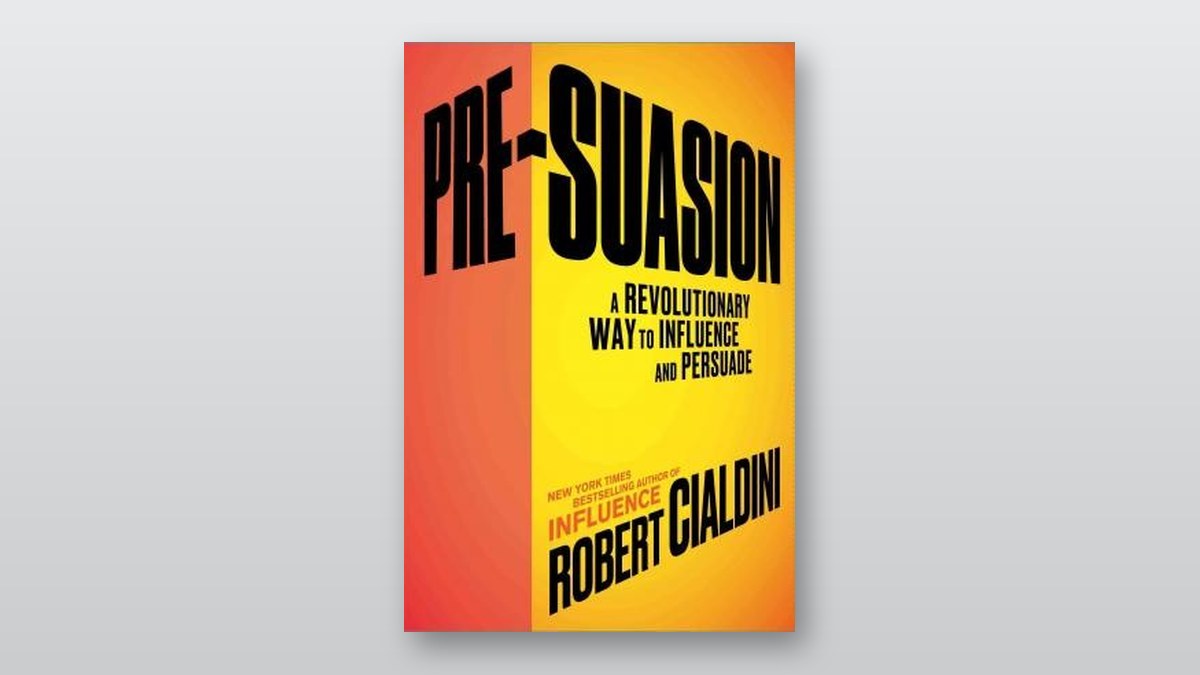
Pre-Suasion by Robert Cialdini argues that what you do in the moment right before a message changes how it lands. Persuasion is not only about the strength of your argument; it is also about what the other person is paying attention to and thinking about when your message arrives. Cialdini calls those moments before the message privileged moments: if you steer attention toward the right idea first, the audience is already leaning your way when you ask.
The book was published on September 6, 2016 by Simon & Schuster and runs 432 pages in the edition we checked, per Open Library and the Simon & Schuster Canada listing. Kirkus calls it a follow-up to Cialdini's 1984 bestseller Influence. This is a summary in our own words, based on the publisher records, reviews and secondary summaries linked below, not a chapter-by-chapter retelling.
The author and the book
Robert Cialdini is a social psychologist and Regents' Professor Emeritus of Psychology and Marketing at Arizona State University, per Wikipedia. He is best known for Influence, which identifies six principles: reciprocity, commitment and consistency, social proof, authority, liking and scarcity.
Pre-Suasion is a follow-up to that book. Kirkus Reviews describes it as an accessible, well-researched inquiry into how minds get changed, drawing on psychology, business and social science research with a bibliography of about 90 pages. The full title is Pre-Suasion: A Revolutionary Way to Influence and Persuade.
Cialdini's own company, Influence At Work, describes pre-suasion as influence that happens in the moment before a message is received. Note that page is a workshop promotion, so we use it only for that definition.
The key ideas
The core idea is simple to state. Reviewer Douglas Kenrick, a professor of psychology who has co-authored research with Cialdini, puts it this way on Psychology Today: a message can fail, or even backfire, if the audience's attention is not directed properly just before it. You have to pre-suade before you persuade.
- Attention comes first. Whatever is in focus at the moment of decision carries extra weight. Kirkus summarizes the point as the factor most likely to drive a choice being whichever is most salient right then, not necessarily the wisest one.
- Focus changes importance. In the Admired Leadership summary, attention signals importance: what we focus on seems more important, and what is focal can even seem causal.
- Grabbing and holding attention are different. Kenrick notes the book separates what captures attention from what keeps it.
- Associations do the rest. Kirkus says persuaders must trigger associations in the audience that favor the change they want.
- Ethics matter. Cialdini argues unethical persuasion creates a culture of dishonesty that eventually harms organizations, per Kirkus.
Kenrick describes the book as three parts: Part I on attention, Part II on association (including a chapter on how location shapes receptivity), and Part III on how to optimize pre-suasion and the ethical questions it raises.
Privileged moments and attention
A privileged moment is the window just before your message when you can shape what the audience is thinking about. The idea is that you do not need a better argument; you need a better starting point for the argument to land on.
The cleanest example in the summaries is a question asked before a request. Per the Admired Leadership summary, asking mall shoppers whether they consider themselves a helpful person before requesting time for a survey raised participation from 29% to 77.3%. Asking whether someone is adventurous before offering a free sample raised uptake from 33% to 75.7%. These figures come from that secondary summary, which does not name the original researchers, so check the book's references before quoting them.
Kenrick gives another example from the book: a job applicant asked interviewers what led them to bring him in for the interview. That question pointed attention at his strengths and the company's reasons for wanting him, rather than at his weaknesses.
Associations and word choice
The second half of the argument is that the concepts you activate bring their own meanings along. Kirkus lists several examples from the book: French background music raising purchases of French wine, a hot drink making someone feel warmer toward you, and the idea that weight is metaphorically linked to seriousness, so a very light e-reader may reduce the perceived value of what it contains.
Cialdini also uses the book to propose a seventh principle of influence, unity, according to Wikipedia: the more we identify with others, the more we are influenced by them. The Power Moves summary adds a practical version, saying that asking for advice rather than opinion creates a together mindset.
Another example in the Admired Leadership summary: participants who tapped in sync with a partner were more likely to help later, with 49% staying to help versus 18% of those who did not tap in sync. Again, treat that as a figure reported by a summary rather than one we checked in the original paper.
The main studies the book cites
We could verify two studies through the Psychology Today review. We did not read the original papers, and the review gives no sample sizes.
- Mandel and Johnson (2002), the sofa website. Two otherwise identical web pages for a sofa store, one with a fluffy-clouds background and one with a pennies background. Per Kenrick, clouds viewers searched more for comfort and would pay a bit more; pennies viewers focused on price and preferred cheaper sofas.
- Griskevicius et al. (2009), the restaurant ad. Co-authored by Cialdini and Kenrick. Participants first watched a scary film (The Shining), a romantic film (Before Sunrise) or nothing, then read an ad for a restaurant that stressed either popularity or uniqueness. Scary-film viewers liked the popularity pitch and disliked uniqueness; romantic-film viewers showed the reverse.
The mall-shopper and tapping results above are the other studies reported most often in summaries. Kirkus also mentions the French music and hot drink findings. Because several of these are known to us only from reviews and summaries, read the book's notes if you need the original details.
How to apply it in sales
The Admired Leadership summary distills the book into practical steps. The sales versions look like this:
- Prepare the mindset before the ask. Use a brief question that connects the buyer to the trait your request needs, such as being open to new things before you offer a trial.
- Lead with your strongest point. Attention inflates importance, per the Power Moves summary, so put your best feature first rather than burying it.
- Tie the message to the buyer's identity. Connect it to their self-image or group. Asking for advice rather than opinion helps create a together mindset.
- Give value first. Giving something up front activates reciprocity. In one example from the summary, 97% of students responded when Cialdini offered extra credit for a parent returning a long questionnaire, against typical adult response below 20%.
- Stay honest. The same summary notes the book warns that deceptive persuasion can backfire, and quotes the line that those who cheat for you will cheat against you.
In a sales call that means thinking about the first thirty seconds, the agenda slide, the opening question and even the setting, not only the pitch. This is our reading of the book's idea, not a script from it.
Criticisms and limits
The main criticism is that much of the book rests on priming research, which has struggled to replicate. The Power Moves summary says priming probably exists but is weaker than popularly believed. A Persuasion Blog post reports a Wall Street Journal review that praised the book overall but called the priming studies largely unreplicated and in serious dispute, while the blogger argues the replication problem is overstated.
Kirkus is more positive but notes that some findings seem obvious and that the ethics argument may not persuade profit-focused leaders. The studies in the book are also mostly small laboratory or website experiments, so treat the effect sizes quoted in summaries as illustrations, not guarantees for your own market.
Who should read it
- Sales and marketing people. Anyone who writes pitches, ads, emails or presentations and wants a framework for the opening moment.
- Readers of Influence. It is billed as a follow-up and adds the idea of what happens before the six principles come into play.
- Skeptical readers. Read it with the replication caveats in mind and test the ideas on your own audience.
Questions people ask
What is Pre-Suasion about?
It is about influence that happens before a message: what a person is focused on and thinking about just beforehand changes how they respond to the message.
Who wrote Pre-Suasion and when was it published?
Robert Cialdini wrote it. Simon & Schuster published it on September 6, 2016, and the edition we checked runs 432 pages.
What is a privileged moment?
It is the moment just before a message arrives, when you can direct attention to an idea so the audience is already receptive when you make your request.
How is Pre-Suasion different from Influence?
Influence, published in 1984, describes six principles that make people say yes. Pre-Suasion is about what you do before the request so those principles land better, and it adds a seventh principle, unity.
What studies does the book use?
Among them, per reviews, are the 2002 sofa website study by Mandel and Johnson and the 2009 restaurant ad study with scary and romantic films. Several other figures we cite come from secondary summaries.
Is the research in Pre-Suasion reliable?
Some of it is disputed. Reviewers note that much of the book relies on priming research that has struggled to replicate, so treat the effects as plausible but possibly weaker than the book suggests.
Is Pre-Suasion worth reading?
Kirkus calls it accessible and well researched. Read it for the framework about attention and the moment before a message, and keep the replication caveats in mind.
Sources
- Open Library: Pre-Suasion · Title, subtitle, English editions, publisher and page count
- Simon & Schuster Canada: Pre-Suasion · Publisher record, publication date and length
- Influence At Work: Pre-Suasion · Cialdini's company description of pre-suasion
- Kirkus Reviews: Pre-Suasion · Independent review, examples and ethics point
- Wikipedia: Robert Cialdini · Author background and the unity principle
- Psychology Today: Pre-Suasion review by Douglas Kenrick · Core idea, book structure and the sofa and restaurant studies
- Admired Leadership: Pre-Suasion summary · Privileged-moment examples and application steps
- Power Moves: Pre-Suasion for salespeople · Sales applications and replication caveat
- Persuasion Blog: Pre-Suasion with Cialdini · Report of the priming criticism and a rebuttal
This summary is an independent explainer written in our own words and does not reproduce the book. Facts were read from the linked pages on October 19, 2026; we did not read the full text of the book, and several study figures come from secondary summaries. Read the book and its references for the full detail.
Top photo: Book cover via Open Library