Solution Selling by Michael Bosworth: Book Summary and Key Lessons in 2027
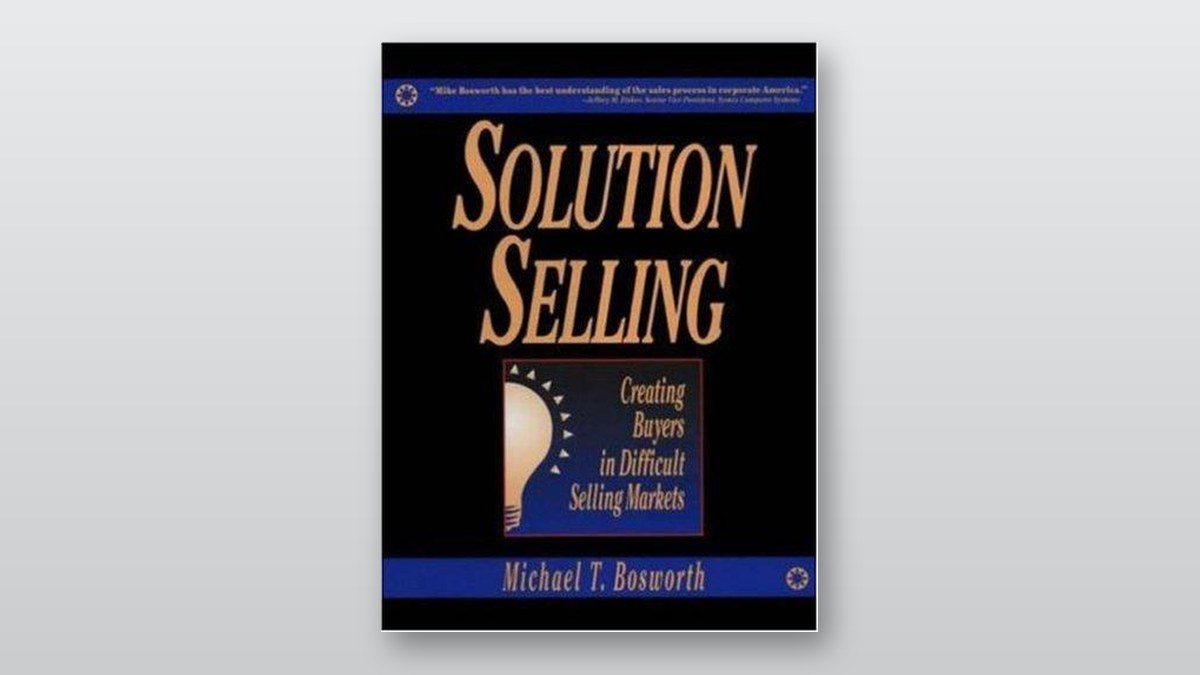
Solution Selling argues that people buy to relieve pain, not to own features. Michael Bosworth's method has the seller diagnose the buyer's problem with questions, help the buyer build a clear picture of a fix that happens to favor the seller's offering, and then steer the buying process with a committed sponsor, instead of pushing a pitch. In short: find the pain, shape the vision, control the process.
The book is published by McGraw-Hill, and Open Library lists an English edition dated 1995 at 239 pages, with 1994 as the first publication year, per Open Library. This is a short summary in our own words, not a chapter-by-chapter retelling.
The author and the book's 1995 origin
Michael T. Bosworth is a sales trainer and consultant who, per getAbstract, lectures at the Stanford Graduate School of Business and in a Stanford marketing program for technology firms. The book's full title is Solution Selling: Creating Buyers in Difficult Selling Markets.
Dates differ by source. ThriftBooks and getAbstract give 1994, while the English edition on Open Library from McGraw-Hill is dated 1995 and runs 239 pages. Either way it is a mid-nineties book written for complex, high-value sales such as software and services, where buyers have many options and long decision cycles.
Pain as the starting point
The core claim is that buyers act when they feel pain, not when they hear about features. getAbstract describes three levels of need. At the first, buyers have latent pain they cannot yet solve or even admit. At the second, they recognize the pain and want a solution. At the third, they have formed a vision of what a solution looks like.
That ladder explains the method. A seller who arrives only when the buyer already has a firm vision is competing on someone else's terms. A seller who helps surface and size the pain earlier gets to shape the vision.
The 9-block vision processing model
The book's best-known tool is a grid of nine blocks, which ThriftBooks reviewers describe as a model for analyzing the sale. The clearest public walkthrough we could read comes from The New Solution Selling, a later book on the same method, so treat the exact labels as that edition's wording rather than the original text.
In that version the grid has three columns of three boxes. The columns cover the reasons for the buyer's pain, the impact of that pain on the organization, and the capabilities that would fix it. Every column follows the same rhythm: an open question to learn the buyer's view, control questions to test and focus it, and a confirming summary.
- Reasons. Why is the problem happening? Each cause is confirmed and drilled into.
- Impact. Who else is affected, and what does it cost the business?
- Capabilities. What would it take to fix it? Capabilities are offered one at a time, tied to a cause.
Diagnosing before prescribing
The book favors a diagnostic, question-driven process over feature-listing and pressure, per getAbstract. The seller plays something like a doctor: ask, listen, confirm the problem, and only then recommend.
In the later book's walkthrough, drill-down questions put numbers on each confirmed reason, such as how much revenue or time is involved, so the buyer sees the size of the problem in their own figures. Open questions come first because they earn the right to ask the sharper control questions.
Creating a buying vision
A buying vision is the buyer's picture of what a solution looks like. getAbstract says the seller's job is to re-engineer that vision so it includes the seller's product, and that effective sellers help buyers form action visions, mental images of using the product and benefiting from it in a specific setting.
In the grid's final blocks, the buyer estimates how much of the lost value each capability could recover, and the vision is confirmed in an "if you had these, could you reach your goal?" form. The goal is simply the inverse of the pain. The critique writes itself: a vision biased toward your solution is persuasion, so it works best when the pain is real and the fit is honest.
Qualifying and controlling the sale: sponsor and power
The later chapter on controlling the buying process says the seller controls the process, not the decision. The buyer keeps the feeling of being in charge while the seller keeps the sale moving.
- Power sponsor. A powerful, committed person who agrees to explore a solution and commit resources to the evaluation.
- Power sponsor letter. A letter covering the pains, their reasons, the buying vision, the organizational impact and an agreement to explore.
- Evaluation plan. A draft sequence of events with timelines and go or no-go points. It stays a draft until the buyer accepts it, and buyers commit more to plans they have edited.
The go or no-go points double as mutual qualification. If a seller cannot gain any control over the process, the chapter says the deal is unlikely to be won and walking away may be smarter. It also asks for a value justification covering what will be measured, who is responsible, how much value is possible and when the investment pays for itself.
How it compares with SPIN Selling and The Challenger Sale
All three are about complex sales, but they differ on who leads. Shortform describes SPIN Selling as question-led and customer-driven, with four question types: situation, problem, implication and need-payoff. It describes The Challenger Sale as teaching-led and rep-driven, where the rep brings an insight that challenges the customer's assumptions.
Solution Selling sits closer to SPIN in being diagnostic, but adds a process layer: the vision, the sponsor and the evaluation plan. Our SPIN Selling summary covers that book.
Challenger authors Brent Adamson, Matthew Dixon and Nick Toman argued in Harvard Business Review in 2012 that classic solution sales weakened because customers now define their own solutions with procurement teams and data-equipped consultants, so they need sellers less. That is a fair caution for the model, though the pain-first discipline still applies when buyers do want help.
Who should read it
- Business-to-business sellers of complex offerings. Software, services and other intangibles where the value must be explained through the buyer's problems.
- Sales managers and trainers. The process steps give a shared language for coaching deals.
- Revenue operations teams. Sponsor, evaluation plan and go or no-go points map neatly to deal stages.
- Readers short on time. The pain, vision and sponsor ideas above carry most of the value.
Skip it if you sell simple, low-cost products, or want a modern account-based playbook. It is a mid-nineties process book, and some of its language will feel dated.
Questions people ask
Who wrote Solution Selling and when was it published?
Michael T. Bosworth wrote it. It is published by McGraw-Hill. Sources date it 1994 or 1995, and the English edition on Open Library is dated 1995 and runs 239 pages.
What is the main idea of Solution Selling?
Buyers act to relieve pain. Sellers diagnose the problem with questions, help the buyer form a vision of a fix, and guide the buying process with a committed sponsor.
What is the 9-block vision processing model?
A grid of nine blocks in three columns covering the reasons for pain, its impact and the capabilities that would fix it. Each column uses open questions, control questions and a confirming summary.
What is a power sponsor?
A powerful, committed person in the buyer's organization who agrees to explore a solution and commit resources to evaluating it.
How is Solution Selling different from SPIN Selling and The Challenger Sale?
SPIN is a customer-driven question sequence and Challenger is a rep-driven teaching approach. Solution Selling is diagnostic like SPIN but adds a process for building a vision and controlling the evaluation.
Is Solution Selling worth reading?
Yes if you sell complex products and want a clear pain-to-vision process. Newer books may suit modern buying better.
Sources
- Open Library: Solution Selling (Irwin Professional edition) · English edition, 1995 date and page count
- Open Library: Solution Selling (McGraw-Hill edition) · McGraw-Hill edition record
- getAbstract: Solution Selling summary · Author background, three levels of need and vision idea
- ThriftBooks: Solution Selling · Publisher, date and reviewer descriptions
- The New Solution Selling: creating visions biased to your solution · Vision processing model walkthrough (later book on the method)
- The New Solution Selling: controlling the buying process · Power sponsor, evaluation plan and qualifying
- Harvard Business Review: The End of Solution Sales · Challenger authors' critique of solution sales
- Shortform: SPIN Selling vs Challenger Sale · Comparison of the two approaches
This summary is an independent explainer written in our own words and does not reproduce the book. Facts were read from the linked pages on October 19, 2026; the publisher's own page did not expose publication details, so those come from Open Library, ThriftBooks and getAbstract. Read the book for the full detail.
Top photo: Book cover via Open Library