The Everything Store by Brad Stone — Cliff Notes Summary
The Everything Store: Jeff Bezos and the Age of Amazon is a book by journalist Brad Stone, published by Little, Brown and Company on October 15, 2013, per Goodreads and Wikipedia. The hardcover runs 384 pages (Publishers Weekly lists 372) and sold for $28. It won the Financial Times Business Book of the Year Award in 2013.
The book tells how Amazon grew from an online bookstore into the everything store: Bezos's decision to leave Wall Street, the near-collapse in the dot-com bust, and the comeback built on Amazon Prime, the Kindle and Amazon Web Services. Along the way it shows the habits behind that run, including the regret-minimization framework, two-pizza teams and the flywheel.
The catch: Bezos did not sit for an interview, and MacKenzie Bezos, then his wife, gave the book a one-star review on Amazon, while an Amazon executive said Stone had not checked his facts. This is a short summary in our own words, not a retelling of the book, and the sales-leader takeaways are our interpretation, not the author's advice.
About the book and the author
- AuthorBrad Stone
- PublisherLittle, Brown and Company
- PublishedOctober 15, 2013
- Length384 pages (hardcover)
- ISBN978-0-316-21926-6
Stone was a senior writer for Bloomberg Businessweek and earlier a reporter for The New York Times and Newsweek, per Wikipedia); he became editor of Bloomberg Businessweek in January 2024. Wikipedia says the book was a New York Times and Wall Street Journal bestseller and has been translated into more than 35 languages. The 2014 paperback adds a long email to the author from Joy Covey, Amazon's first CFO. Stone followed it with Amazon Unbound in May 2021.
Stone spoke with many current and former Amazon executives and with Bezos's parents and friends, but had only limited contact with Bezos himself, per Wikipedia. In Fortune, Adam Lashinsky wrote that Bezos declined an interview. While reporting, Stone tracked down Ted Jorgensen, Bezos's biological father, who had not known his son founded Amazon.
The story the book tells
- Wall Street to a garage. Bezos worked at the hedge fund D. E. Shaw from 1990 to 1994, then founded Amazon in a rented garage in Bellevue, Washington, on July 5, 1994, per Wikipedia. The website launched on July 16, 1995, per Wikipedia).
- Get Big Fast and the dot-com bust. Bezos pushed a Get Big Fast mantra to scale before rivals could, Wikipedia says. The book covers how Amazon nearly failed in the dot-com bust before it recovered, per Wikipedia.
- Prime. Amazon announced Prime in 2005: free two-day shipping for $79 a year, per Wikipedia.
- Amazon Web Services. AWS launched S3 cloud storage on March 14, 2006, and EC2 that August, per Wikipedia. Wikipedia counts AWS among the inventions behind Amazon's revival after the bust.
- The Kindle. Bezos launched the Kindle in November 2007, per Wikipedia.
- Hardball with partners. Publishers Weekly says the book's main focus is retail: price wars, supplier disputes, economies of scale, and distribution and shipping. Fortune adds that it shows a culture willing to use nearly any legal tactic to cut prices, with partners treated as expendable.
The key ideas, paraphrased
- Regret minimization. Bezos decided to leave a secure Wall Street job by imagining himself at 80 and asking which choice he would regret. His answer, as Wikipedia quotes him: "Will I regret missing the beginning of the Internet? Yes."
- Two-pizza teams. Teams should be no bigger than two pizzas can feed, which Amazon's own AWS whitepaper calls the two-pizza team rule. Small teams own their work end to end and move faster. Wikipedia) puts that at about 6 to 8 people or fewer.
- The flywheel. After the dot-com bust, Amazon took Jim Collins's flywheel idea from Good to Great and mapped its own self-reinforcing loop: lower prices bring more shoppers, more shoppers draw third-party sellers who pay commissions, and the extra volume spreads fixed costs such as warehouses and servers, which allows lower prices again, as the passage from the book quoted on Goodreads describes it. Collins writes that Amazon grabbed the concept coming out of the bust in 2001 and calls it an archetype of a powerful flywheel.
- An everything store. The publisher's description sums up the goal as an everything store with endless selection and low prices, and compares Bezos's effect on retail to Henry Ford's on manufacturing.
- Third-party sellers. Fulfillment by Amazon, launched in 2006, let small sellers use Amazon's warehouses, per Wikipedia). That added selection to the flywheel without Amazon owning the stock.
- A demanding, secretive culture. The publisher's description speaks of a culture of intense ambition and secrecy, and Wikipedia notes the book portrays Bezos as a demanding boss and hyper-competitive.
Criticisms of the book and Amazon's response
The loudest criticism came from inside the Bezos family. In November 2013, MacKenzie Bezos, married to Jeff for 20 years, posted a one-star review on Amazon, TechCrunch reported. She said the book was full of factual errors and leaned on speculation about Bezos's motives, and noted he was never interviewed. The one error she named: Stone wrote that Bezos read The Remains of the Day while planning Amazon, but she said he read it a year after founding the company. Wikipedia notes she claimed many inaccuracies but pointed out only that one.
Amazon backed her up. Craig Berman, its VP of Global Communications, told TechCrunch that Amazon set up meetings for Stone with more than half a dozen senior executives and that Stone chose not to fact-check claims from former employees. Former executive Rick Dalzell also posted a critical review, saying the book made Bezos look one-dimensional and left out his warmth and humor.
Stone answered in Bloomberg Businessweek, per TechCrunch: his reporting rested on more than 300 interviews, he would correct any errors the Bezoses identified, and the book's major revelations had not been disputed. Berman then called that reply inaccurate too.
Outside critics were milder. Fortune's Lashinsky called the book authoritative, deeply reported and balanced, and doubted that accuracy was the real objection. Complete Review gave it a B, praising it as a readable overview but calling it magazine-article-like, light on numbers and thin on Bezos the man. Publishers Weekly praised it as entertaining and insightful.
What sales leaders can take from it (our interpretation)
The book is about a retailer and its founder, not about sales teams. These are our suggestions, not the author's or Amazon's.
- Use regret minimization on big calls. Before you pass on a new segment, a key hire or a pricing change, ask which choice you will regret in five years, not which one feels safest this quarter.
- Run two-pizza pods. Small pods of a rep, an SDR and a sales engineer that own one segment end to end make it clear who owns each number and cut handoffs.
- Draw your own sales flywheel. Map the loop that compounds for your team, such as happy customers giving referrals, referrals shortening sales cycles, and shorter cycles freeing reps to serve more customers. Then work on the slowest part of the loop.
- Watch the cost of hardball. The book's price wars and supplier fights won share but cost goodwill. Squeezing every deal can win the quarter and lose the renewal.
- Fact-check your own story. The fight over the book is a reminder that a strong narrative falls apart on one wrong detail. Check every proof point in a pitch before a buyer does.
Questions people ask
Who wrote The Everything Store and when was it published?
Brad Stone, a Bloomberg journalist. Little, Brown and Company published it on October 15, 2013. The hardcover is listed at 384 pages (Publishers Weekly lists 372).
What are the main ideas in The Everything Store?
Bezos's regret-minimization framework, Get Big Fast, two-pizza teams, the flywheel of lower prices, more customers and more sellers, and the big bets on Prime, AWS and the Kindle.
Why did MacKenzie Bezos give the book one star?
In November 2013 she wrote that it had many factual errors and too much speculation about her husband's motives, and that he was never interviewed. The one error she named was when he read The Remains of the Day.
How did Amazon respond to the book?
Amazon's VP of Global Communications, Craig Berman, said Amazon arranged meetings with more than half a dozen executives and that Stone chose not to fact-check claims from former employees. Stone said the book rested on more than 300 interviews and offered to fix any errors.
Did the book win any awards?
Yes. It won the Financial Times and Goldman Sachs Business Book of the Year Award in 2013 and was a New York Times and Wall Street Journal bestseller.
Is The Everything Store still worth reading?
It is still a widely cited account of how Amazon was built through 2013. Read it alongside Stone's 2021 follow-up, Amazon Unbound, and keep in mind that Bezos did not take part.
Sources
- Wikipedia: The Everything Store · Publisher, 384 pages, ISBN, contents, paperback, bestseller lists, translations, FT award, MacKenzie Bezos review, Stone's access
- Goodreads: The Everything Store · First published October 15, 2013; 384 pages
- Publishers Weekly review · Little, Brown, $28, 372 pages, focus on retail, praise
- Hachette Book Group: The Everything Store (large print) · Publisher's description of the book's themes
- Wikipedia: Brad Stone (journalist) · Author background, October 2013 publication, award, Amazon Unbound
- Wikipedia: Jeff Bezos · D. E. Shaw, founding date, Kindle launch, regret-minimization quote, Get Big Fast
- Wikipedia: Amazon (company) · Website launch, Fulfillment by Amazon, two-pizza team size
- Wikipedia: Amazon Prime · 2005 launch, $79 fee
- Wikipedia: Amazon Web Services · S3 and EC2 launch dates
- AWS whitepaper: Two-Pizza Teams · The two-pizza team rule
- Goodreads: flywheel passage from The Everything Store · The book's description of Amazon's flywheel loop
- Jim Collins: Turning the Flywheel · Amazon's flywheel after the 2001 dot-com bust
- TechCrunch, November 4, 2013 · MacKenzie Bezos's one-star review, Dalzell review, Craig Berman statement
- TechCrunch, November 5, 2013 · Stone's reply (300 interviews) and Amazon's response
- Fortune: The uncomfortable truth about Brad Stone's Amazon book (Adam Lashinsky, 2014) · Bezos declined interview, assessment of the book
- Complete Review: The Everything Store · Critical review, grade B
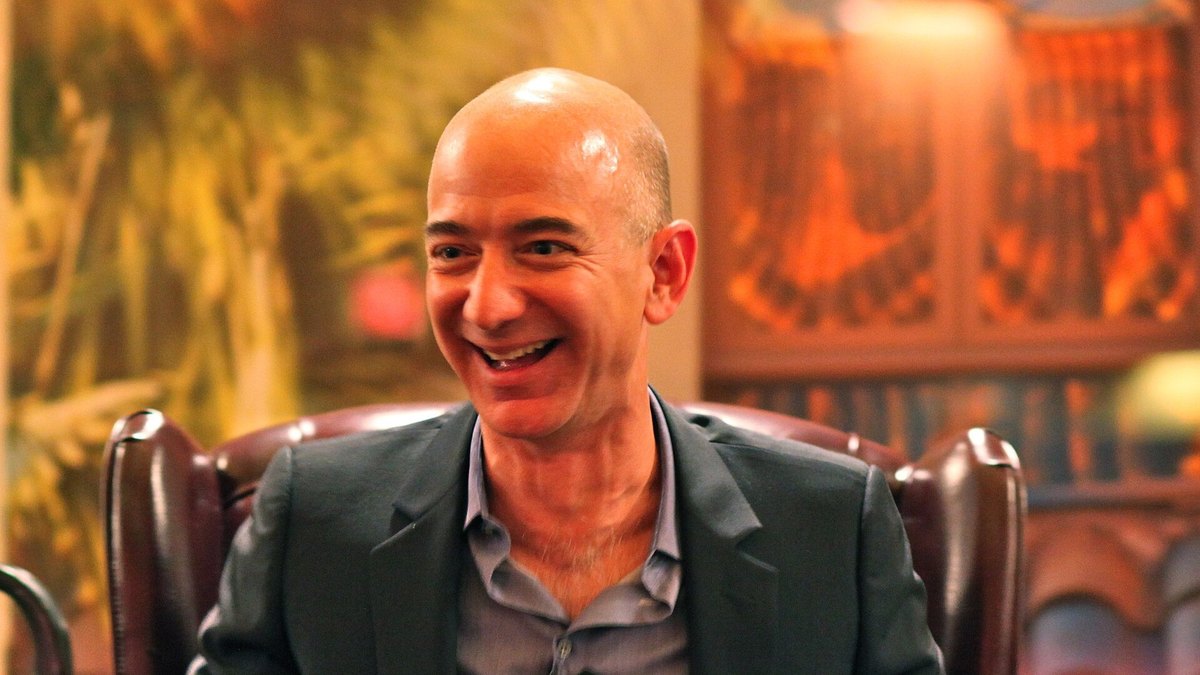
- Wikimedia Commons: Jeff Bezos' iconic laugh (Steve Jurvetson, CC BY 2.0) · Hero photo of Jeff Bezos, 2010
This summary is an independent explainer written in our own words and does not reproduce the book. Facts were read from the linked pages on November 3, 2026; read the book for the primary detail. The hero photo shows Jeff Bezos at the ENCORE awards in October 2010 (Steve Jurvetson, CC BY 2.0, via Wikimedia Commons).
Top photo: Steve Jurvetson / CC BY 2.0 via Wikimedia Commons