The Goal Summary: Goldratt's Theory of Constraints in 2027
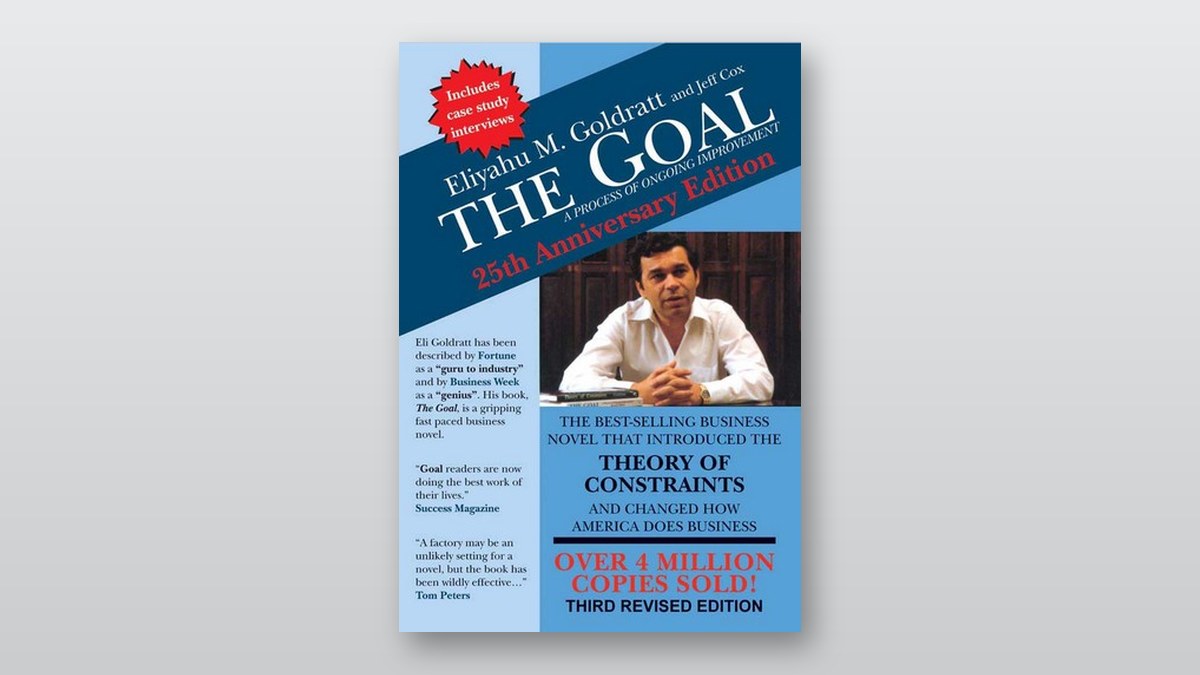
The Goal: A Process of Ongoing Improvement is a business novel by Eliyahu M. Goldratt and Jeff Cox, first published in 1984 (Wikipedia)). It argues that every system has a constraint that sets its output, so improving anything other than the constraint does not improve the whole. The aim is to make money, and the way there is to find the bottleneck, protect it and line everything else up behind it.
It teaches this through a story: plant manager Alex Rogo has about three months to turn his failing factory around, guided by a mentor named Jonah (North River Press).
This is a short summary in our own words, not a chapter-by-chapter retelling. It covers the story, the three measures, the five focusing steps, Herbie and drum-buffer-rope, how operators and revenue leaders can use the ideas, and the limits.
The story in brief: Alex Rogo's plant
Alex Rogo runs a plant owned by UniCo in a small American town. Division executive Bill Peach tells him that if the plant is not turned around in three months, it will be shut down (LitCharts). The publisher puts it as 90 days to save the plant or corporate headquarters will close it (North River Press).
A chance meeting with Jonah, a former professor, starts the turnaround. Jonah teaches mostly by asking questions rather than giving answers, so Alex and his crew work out the fixes themselves (Wikipedia)).
A second storyline follows Alex's strained marriage to Julie (Wikipedia)). According to LitCharts, the plant becomes profitable again within two months, Peach promotes Alex to division manager, and Julie moves back home.
The goal and the three measures
Jonah pushes Alex to say what the goal of the plant actually is. The book's answer is to make money, and he gives Alex three measures to judge any decision against (LitCharts).
- Throughput. The rate at which the system generates money through sales (Wikipedia).
- Inventory. All the money the system has invested in purchasing things it intends to sell.
- Operating expense. All the money the system spends to turn inventory into throughput.
Our reading: producing more parts is not the same as making money, because output only counts once it is sold. That is why the book is skeptical of local efficiency, which rewards keeping every machine busy.
Bottlenecks and the five focusing steps
In the plant, most parts have to pass through two bottleneck machines that cannot be sped up (LitCharts). Wikipedia names them as the NCX-10 machine and the heat-treat process, and says the team added capacity by bringing in an old machine (Wikipedia)).
The process Goldratt built from this is known as the five focusing steps (Wikipedia). The 30th anniversary edition adds them to the book explicitly (North River Press).
- 1. Identify the system's constraint.
- 2. Exploit decide how to get the most out of the constraint.
- 3. Subordinate make everything else support that decision.
- 4. Elevate add capacity to the constraint once exploiting it is not enough.
- 5. Repeat. if the constraint has moved, go back to step 1 and do not let inertia become the new constraint.
Herbie and drum-buffer-rope
The book's best-known scene is a Boy Scout hike with Alex's son Dave. The hikers depend on the one ahead of them, so the troop can only move as fast as its slowest member. Alex puts the slowest kids at the front and the fastest at the back (LitCharts). The slowest hiker, Herbie, has become the book's symbol of a bottleneck.
Drum-buffer-rope turns that picture into a scheduling method. According to Wikipedia, the drum is the pace of the physical constraint, which sets the schedule for the whole plant; the buffer is a time cushion of work ahead of the constraint so it never runs dry; and the rope is the timed release of orders to the shop floor so work is released one buffer-length before it reaches the constraint.
How operators and revenue leaders apply it
- Find the one stage that limits output. In a pipeline, that could be a handoff, a review queue or a single overloaded role, not the stage everyone talks about.
- Do not over-optimize the non-constraint. Extra effort before the bottleneck builds a backlog, and extra effort after it cannot ship more than the bottleneck passes.
- Protect the constraint's time. Keep its queue fed and take away work it should not be doing.
- Measure money, not activity. Judge changes by their effect on throughput, inventory and operating expense.
- Re-check after every fix. Once one constraint is relieved, another takes its place.
Criticisms and limits
The book was influential: Time listed it among the 25 most influential business management books in 2011 (Wikipedia)). It also has critics, summarized on the Theory of constraints page.
- Academic evidence is thin. Gupta and Snyder (2009) say the Theory of Constraints has not yet demonstrated its effectiveness in the academic literature.
- Originality. Critics say Goldratt's books do not adequately acknowledge earlier work such as PERT/CPM and just-in-time.
- Method quality. Trietsch argues drum-buffer-rope is inferior to competing methods, and Linhares argues the product-mix approach is unlikely to be optimal.
- Proprietary. Goldratt was criticized for keeping some algorithms proprietary.
- People are missing. Nave (2002) says the theory does not account for employees.
Separately, and as our own assessment: the story is set in a 1980s factory, so the single-constraint lesson fits best where work flows through a fixed sequence of steps and needs adapting elsewhere.
Questions people ask
Who wrote The Goal and when was it published?
Eliyahu M. Goldratt and Jeff Cox. It was first published in 1984, with revised editions in 1986, 1992, 2004 and 2014 (Wikipedia)).
What is The Goal about?
A plant manager, Alex Rogo, has about three months to save his factory and learns the Theory of Constraints from a mentor named Jonah (North River Press).
What are throughput, inventory and operating expense?
Money the system generates through sales, money invested in things it intends to sell, and money spent turning inventory into throughput (Wikipedia).
What are the five focusing steps?
Identify the constraint, exploit it, subordinate everything else to that decision, elevate it, and repeat if the constraint moves (Wikipedia).
Who is Herbie?
The slowest hiker on the Boy Scout trip, used in the book as a picture of a bottleneck. See the hike described at LitCharts.
Is The Goal still worth reading?
That is a judgment call. Its core idea of finding the constraint first still travels well, but its setting is a 1980s factory and the academic evidence for the method is limited (see the criticisms above).
Sources
- Wikipedia: The Goal (novel) · Authors, editions, plot, bottleneck machines, Time listing
- North River Press: The Goal, 30th Anniversary Edition · Publisher description, 90 days, Five Focusing Steps added
- LitCharts: The Goal summary · Plot, Jonah's three measures, the hike
- Wikipedia: Theory of constraints · Five focusing steps, measures, drum-buffer-rope, criticisms
- Wikipedia: Eliyahu M. Goldratt · Author background and the Goldratt Institute
- Open Library: The Goal · English edition record and cover
This summary is an independent explainer written in our own words and does not reproduce the book. Buy the book from the publisher or your bookseller for the full story.
Top photo: Book cover via Open Library