The Mom Test Summary: Rob Fitzpatrick's Rules for Customer Conversations in 2027
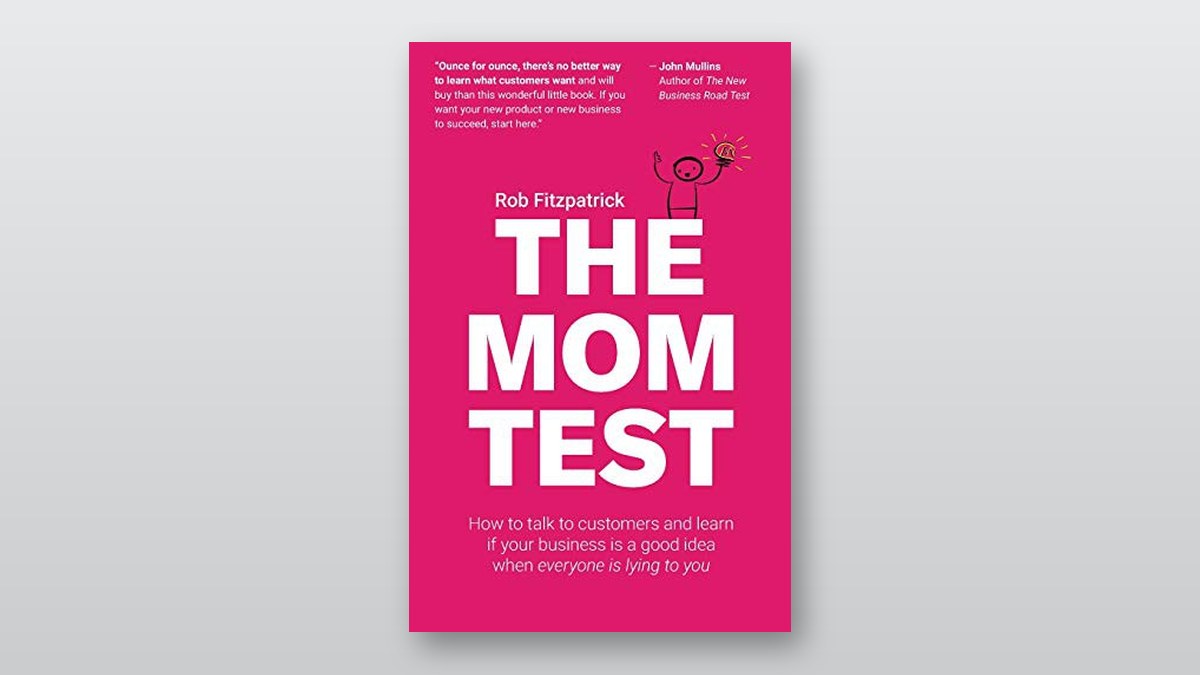
The Mom Test: How to talk to customers and learn if your business is a good idea when everyone is lying to you is a short handbook by Rob Fitzpatrick (a 2014 CreateSpace edition, per Open Library). Its argument is that people will lie to you about your idea, usually out of kindness, so the fix is not to find honest people but to ask better questions: ones about their life and past behaviour that nobody can answer with a polite compliment.
The author calls it practical rather than academic (momtestbook.com). In three lines: talk about their life instead of your idea, ask about specifics in the past instead of opinions about the future, and talk less and listen more. Then ask for a concrete commitment.
This summary is in our own words, built from the author's site and published reviews, not a chapter-by-chapter retelling of the book.
The three Mom Test rules
The book's core is three rules, quoted the same way in reviews by Yevgeniy Brikman and Matt Lynch.
- Talk about their life instead of your idea. Pitching invites people to compliment you to protect your feelings (Sachin Rekhi). Ask about their goals, problems and constraints instead.
- Ask about specifics in the past instead of generics or opinions about the future. Hypotheticals like would you buy a product that did X get optimistic answers nobody can be held to. Ask how they solve the problem today, what it costs in money and time, and what happened the last time it came up (Sachin Rekhi).
- Talk less and listen more. Brikman's shorthand: they own the problem, you own the solution (Brikman).
The name points at the idea that even your mom would tell you your business idea is great. The rules are a way to ask questions that even she could not answer with a polite lie. (That explanation is our own paraphrase of the title's point.)
Bad data to avoid: compliments, fluff and ideas
Brikman's review lists why people mislead you: they do not want to hurt your feelings, they do not know their own preferences, nothing is at stake for them, and they are not product designers (source). He then names three warning signs of bad data.
- Compliments. Praise without facts. Matt Lynch's report calls compliments the fool's gold of customer learning.
- Fluff. Generic claims (always, never), future-tense promises and hypotheticals. Brikman flags I would definitely buy that as the most dangerous.
- Ideas and feature requests. Do not just write them down; dig into the underlying problem, what they do now and why they want it.
The practical test is whether a conversation left you with concrete facts about the person's life rather than opinions about your product. (Our framing.)
Commitment and advancement
Once you have a concept to show, the book shifts from learning to testing real interest. According to Brikman, a meeting succeeds only if the customer commits to a next step, meaning they give up something they value, and advances closer to a purchase. The three currencies are:
- Time. A scheduled next meeting, wireframe feedback or a trial.
- Reputation. Introductions to peers or decision-makers, or a public testimonial.
- Money. A letter of intent, pre-order or deposit.
Strong commitments combine categories, such as a pilot that costs both time and reputation (Rekhi). Rekhi also relays a line attributed to Fitzpatrick: it is not a real sales lead until you have given them such a concrete chance to reject you. Lynch adds that a rejection is still useful information, and that failing to ask for any commitment is the real failure (Lynch).
How founders and sellers can apply it
- Plan the learning before the meeting. Decide what you need to find out and write questions about their past behaviour, not your product. (Our suggestion.)
- Hold the pitch back early. Lynch's note: once you start talking about your idea, they stop talking about their problems (source).
- End every meeting with a next step. If you do not know what happens next, Lynch's report says the meeting was pointless.
- Sellers can use it for discovery calls. Asking what they do now, what it costs and what happened last time is useful before you pitch. This is our own application, not a claim from the book.
- Keep going until you stop learning. Lynch suggests interviewing a handful of customers, or until nothing new comes up, and narrowing the segment if answers all differ (source).
Criticisms and limits
The most detailed critique we found is in Matt Lynch's book report, and the points are his:
- Tension. Banning pitches while demanding commitment can feel contradictory.
- Awkward in practice. Some techniques feel uncomfortable to use.
- Access assumptions. It assumes easy in-person access to customers and is Silicon Valley-centric.
- Pretexts. It suggests pretexts such as claiming to write a book or thesis to get interviews.
- Product risk. The more product risk an idea carries, the less customer conversations alone can validate it.
- The title. It leans on a stereotype about mothers.
Rekhi also notes that the commitment step assumes you have already presented your idea, which comes after the idea-free discovery phase (source).
Questions people ask
Who wrote The Mom Test?
Rob Fitzpatrick. His own site describes him as a YCombinator alum and a programmer who was pushed into a customer-facing role at his first company (momtestbook.com).
What is the Mom Test in one sentence?
A way of asking customer questions so that even someone who wants to be kind to you cannot give you a useless compliment: talk about their life, ask about the past, and listen more than you talk.
What counts as bad data?
Compliments, fluff (generic claims, future promises, hypotheticals) and unexamined ideas or feature requests (Brikman).
What is commitment and advancement?
Commitment means the customer gives up time, reputation or money. Advancement means moving them closer to a purchase (Brikman).
Is the Mom Test worth reading?
The author's site says it is used in courses at Harvard and UCL and at businesses like Shopify (momtestbook.com). Read the criticisms above and decide whether the method fits your market.
Sources
- The Mom Test (momtestbook.com) · Author's site: description, author bio, where it is used
- Open Library: The Mom Test · Edition record: publisher, year and cover
- Yevgeniy Brikman: The Mom Test · Rules, bad data, commitment and advancement
- Sachin Rekhi: A Primer on Talking to Customers · Rules and commitment currencies
- Matt Lynch: The Mom Test book report · Quoted rules and criticisms
This is an independent explainer written in our own words and does not reproduce the book. Facts were read from the linked pages on October 29, 2026 and are secondhand where they come from reviews. Read the book for the full method.
Top photo: Book cover via Open Library