The Sales Bible by Jeffrey Gitomer: Summary, Key Lessons and Sales-Team Takeaways in 2027
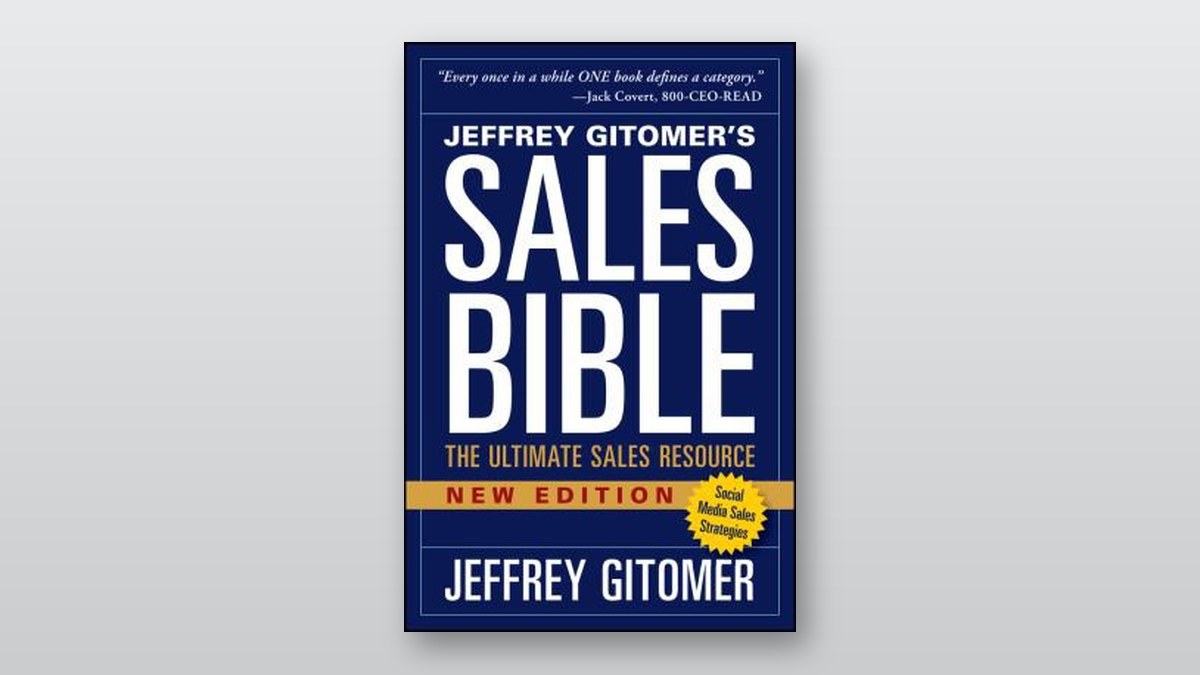
The Sales Bible is a sales reference book by Jeffrey Gitomer, first published in 1994 by William Morrow and later revised for Wiley (2003, then a New Edition in December 2014) and HarperCollins (2008). It is less a single argument than a toolbox: short, practical sections on generating leads, getting appointments, asking good questions and closing, framed around "The 10.5 Commandments of Selling".
The Wiley product page says the 2014 New Edition adds social media answers, runs 320 pages, and follows more than 200,000 copies of earlier editions sold. That is the publisher's own claim, not an audited figure.
For a sales team, the takeaway is to treat it as a reference to dip into, pick one habit at a time, and practice it in real calls. This is an independent summary in our own words; it does not reproduce the book.
About the book and its author
Jeffrey Gitomer is a sales author and speaker. Wikipedia lists fifteen books by him, including New York Times best sellers The Sales Bible and The Little Gold Book of YES! Attitude. His best-known title there is The Little Red Book of Selling, which Wikipedia says has sold more than five million copies.
The Sales Bible has been reissued several times. Wikipedia's bibliography shows the original William Morrow edition (October 1994), a Wiley revised edition (2003) and a HarperCollins new edition (2008); Wiley's New Edition followed in December 2014. Barnes & Noble's description says the Morrow hardcover sold over 117,000 copies and a Wiley paperback another 100,000, which are publisher-side figures.
Page counts depend on the edition: Open Library records 342 pages for the 1994 and 2003 editions, while Wiley lists 320 for the 2014 New Edition. Check the edition you hold before quoting a page.
What the book covers
The Wiley description names these highlights. We paraphrase them here; the book has the full detail.
- The 10.5 Commandments of Selling. A set of core rules for selling that the publisher puts up front. We did not find the full list in the sources we read, so we do not list them.
- Generating leads in any market. The publisher says the book shows how to find leads and close sales whatever the economy is doing.
- Getting hard-to-get appointments. Wiley says the book gives 25 proven ways to set appointments with people who are difficult to reach.
- Top-down selling. The idea is to aim at senior decision makers to fill the pipeline with prospects ready to buy now.
- Asking better questions. Good questions are presented as the way to make more sales in half the time.
- Social media for inbound leads. The 2014 New Edition adds material on using the main social platforms to attract leads and prove value.
The common thread is practical, repeatable behavior over theory: do the small things well, every day, and keep learning.
How the book is built
Gitomer's style is short and punchy. A Time magazine piece, as summarized on Wikipedia, describes his books as full of cartoons and bite-size nuggets of advice. The 1994 edition, per Open Library, came with 25 flash cards. In practice the book works as a reference you reopen when you hit a specific problem, such as a stalled lead or a prospect you cannot reach, rather than something you read once from cover to cover.
Sales-team takeaways: an original example
Imagine a small team of field reps who have a full CRM but struggle to reach decision makers. A manager could use the book as a menu rather than a program. The scenario is made up for illustration, not from the book.
- Pick one technique a week. Choose a single idea, such as a new way to request an appointment, and have every rep try it before the next team meeting.
- Practice the question set. Write the questions each rep asks in first meetings, compare them, and keep the ones that get buyers talking.
- Test top-down outreach. Have each rep aim some outreach at senior contacts and track which approach earns meetings.
- Add a social step. Use the book's social media ideas to warm up a prospect before the first call.
- Review results together. Share what worked, drop what did not, and move on to the next technique.
Criticisms and limits
The book is a broad collection rather than a tightly argued method, so readers who want a single step-by-step framework may find it scattered. It also dates from 1994 in its original form; the social media sections were added later, and tools and channels keep changing.
We found no independent measurement showing that teams using the book sell more. The sales numbers above come from the publisher and a retailer, and the "bite-size nuggets" critique is one magazine writer's view, not a settled verdict.
Is it worth reading now?
For a newer rep, the book is a wide, readable survey of the sales job, and the Dale Carnegie Sales Advantage Program listing it among ten books every salesperson should own, as Wiley states, is a point in its favor. For experienced reps, it works best as a refresher you scan for one useful idea. An English edition record is on Open Library.
Questions people ask
What is The Sales Bible about?
It is a practical sales reference by Jeffrey Gitomer covering leads, appointments, questions, closing and, in the 2014 edition, social media. See the Wiley page.
Who wrote The Sales Bible?
Jeffrey Gitomer, a sales author and speaker with fifteen books, per Wikipedia.
When was The Sales Bible first published?
October 1994 by William Morrow, with later editions from Wiley (2003 and December 2014) and HarperCollins (2008), per Wikipedia and Wiley.
What are the 10.5 Commandments of Selling?
They are the core rules of selling the book is framed around, according to the publisher. We did not find the list in the sources we read, so check the book for the exact wording.
How many copies has it sold?
Wiley says over 200,000 copies of earlier editions sold, and Barnes & Noble says 117,000 hardcovers plus 100,000 paperbacks. Both are publisher-side claims.
Which edition should I buy?
The latest we found is Wiley's December 2014 New Edition, 320 pages, which adds social media answers. See Wiley.
How can a sales team use it?
Treat it as a menu: assign one technique at a time, practice it in real calls, and review what worked. The book publishes no team benchmarks that we could verify.
Sources
- Wiley: The Sales Bible, New Edition · Edition date, page count, copies-sold claim, Dale Carnegie listing and highlights
- Barnes & Noble listing · Morrow hardcover and Wiley paperback sales claims
- Jeffrey Gitomer (Wikipedia) · Author background, edition bibliography and critical comment
- Open Library work record · English edition records, page counts and cover
This summary is an independent explainer written in our own words and does not reproduce the book. Facts were read from the linked pages on October 22, 2026; check the book and the sources above for primary detail.
Top photo: Book cover via Open Library