The Trusted Advisor by Maister, Green and Galford: Summary and Key Ideas
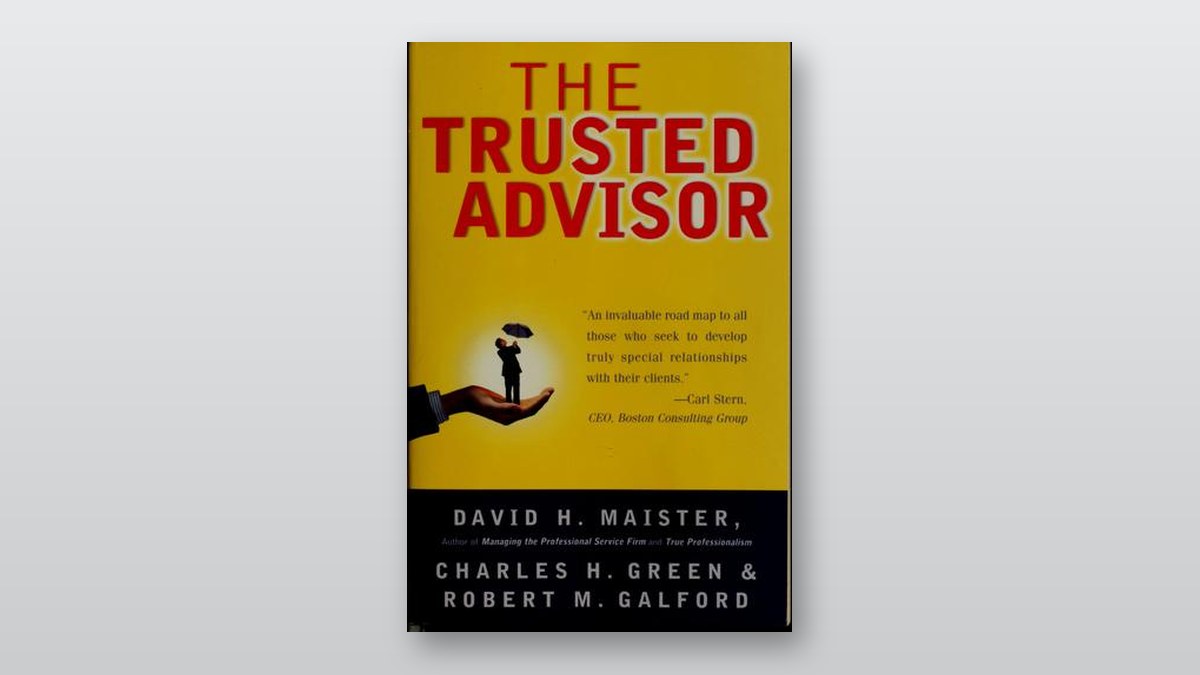
The Trusted Advisor is a business book by David H. Maister, Charles H. Green and Robert M. Galford, published by Free Press in 2000, per getAbstract. Its core idea is that professionals win lasting client relationships by earning trust, not by showing expertise alone: trust grows from credibility, reliability and closeness with the client, and shrinks when the advisor is seen as focused on their own interests.
The book is aimed at consultants and other professional service providers, and describes how a client relationship can deepen until the advisor is consulted on both business and personal concerns.
This is a short summary in our own words, not a chapter-by-chapter retelling. It covers the authors, the main ideas, how to apply them and where the book has limits.
About the book and its authors
- TitleThe Trusted Advisor
- AuthorsDavid H. Maister, Charles H. Green and Robert M. Galford
- Publisher and yearFree Press, New York, 2000
- Lengthxiii, 240 pages in the library catalog record for the 2000 edition; other listings give different page counts for other editions
- AudienceConsultants and professional service providers
According to getAbstract, Maister also wrote Managing the Professional Service Firm and True Professionalism. Charles H. Green is a consultant who taught at Columbia University and Kellogg business schools and has published in Harvard Business Review. Robert M. Galford is a corporate executive who taught at Columbia and Kellogg and has written for The Boston Globe. Trusted Advisor Associates, the firm that carries on Green's work, publishes articles on the model at trustedadvisor.com.
Free Press and Touchstone editions exist, and listings disagree on page counts, so check the copyright page of the copy you hold (Open Library, library catalog).
The core idea: trust is the foundation of advice
The authors start from a problem: clients no longer assume that a professional is trustworthy, and often wonder about an advisor's motives as well as their skill. Their answer is to build an ever-deepening relationship, one in which the client gradually brings the advisor into more and more issues (getAbstract).
In plain terms, technical skill gets you in the door, but trust decides how far the client lets you in. Advisors who are trusted get earlier access to problems, more candid information and more of the client's business.
The main ideas in plain English
The explanations below are ours, based on the summaries listed under Sources.
- The trust equation. Trust is described as credibility plus reliability plus intimacy, divided by self-orientation (Trusted Advisor Associates).
- Credibility. Whether the client believes what you say, based on knowledge, credentials and honesty. It is about your words.
- Reliability. Whether you do what you say you will, consistently. It is about your actions matching your words.
- Intimacy. Whether the client feels safe sharing real concerns with you. It is about emotional safety, not physical closeness.
- Self-orientation. The only factor that lowers trust. It covers selfishness and also where your attention goes: onto the client's problem, or onto your own goals and worries.
- A relationship ladder. One summary describes a progression from subject-matter expert, to an associate valued for several specialties, to a trusted advisor with whom the client discusses personal and professional matters openly.
- Conversations, not tricks. The authors break trust into parts and suggest conversations advisors can use to apply the model, according to the same summary.
Why the last variable matters most
The firm that carries on Green's work argues that most advisors lead with credibility and reliability because those are rational and easy to measure, while intimacy and self-orientation carry more weight in buying decisions, since clients buy emotionally and justify the choice with logic (Trusted Advisor Associates). It calls self-orientation the most powerful variable. This is the authors' side of the argument; we did not find independent research testing it.
How to apply it
These are our own applications, not claims from the book.
- Listen before you recommend. Showing that you understood the client's situation tells them your attention is on them, not on your pitch.
- Keep small promises. Returning calls and delivering minor commitments on time builds reliability steadily.
- Make it safe to be honest. Ask open questions and respond without judgment so clients share the real issue, not just the stated one.
- Check your motive. Before proposing more work, ask whether it serves the client first. If not, say so or drop it.
- Score yourself. Rate yourself honestly on each of the four variables and work on the weakest one.
Strengths and limits
The book gives professionals a simple vocabulary for something that is usually left vague, and the trust equation is easy to remember and discuss with a team. Its audience is consultants and service firms, so product sellers or people in large corporate roles may need to adapt the ideas.
The equation is a thinking tool, not a measured formula: the sources we read give no numeric scores for it. Published in 2000, some of its working-world examples may feel dated, and the case for the model rests on the authors' experience rather than independent studies we could find.
Questions people ask
Who wrote The Trusted Advisor?
David H. Maister, Charles H. Green and Robert M. Galford. It was published by Free Press in 2000.
What is the main idea of The Trusted Advisor?
Professionals earn lasting client relationships by building trust, not just by demonstrating expertise. The more a client trusts you, the more of their business and concerns they bring to you.
What is the trust equation?
Trust equals credibility plus reliability plus intimacy, divided by self-orientation. The first three raise trust; self-orientation lowers it.
What does self-orientation mean?
Self-interest, and also where your attention is focused: on the client or on your own goals and insecurities.
Is the book only for consultants?
It is written for consultants and professional service providers, but the trust ideas are useful to anyone who advises others.
Does this page replace reading the book?
No. It is an independent summary in our own words; the book has the detail, examples and exercises.
Sources
- getAbstract: The Trusted Advisor summary · Authors, publisher and year, main ideas, relationship progression, author backgrounds
- Trusted Advisor Associates: The Trust Equation, a Primer · The trust equation and its four variables
- Louisville library catalog record · Publisher, year and page count for the 2000 edition
- Open Library search: The Trusted Advisor · Editions, publishers and the cover image
This summary is an independent explainer written in our own words and does not reproduce the book. Facts were read from the linked pages on October 18, 2026; check details such as page counts against the edition you own.
Top photo: Book cover via Open Library