Thinking, Fast and Slow by Daniel Kahneman: Summary and Lessons for Salespeople
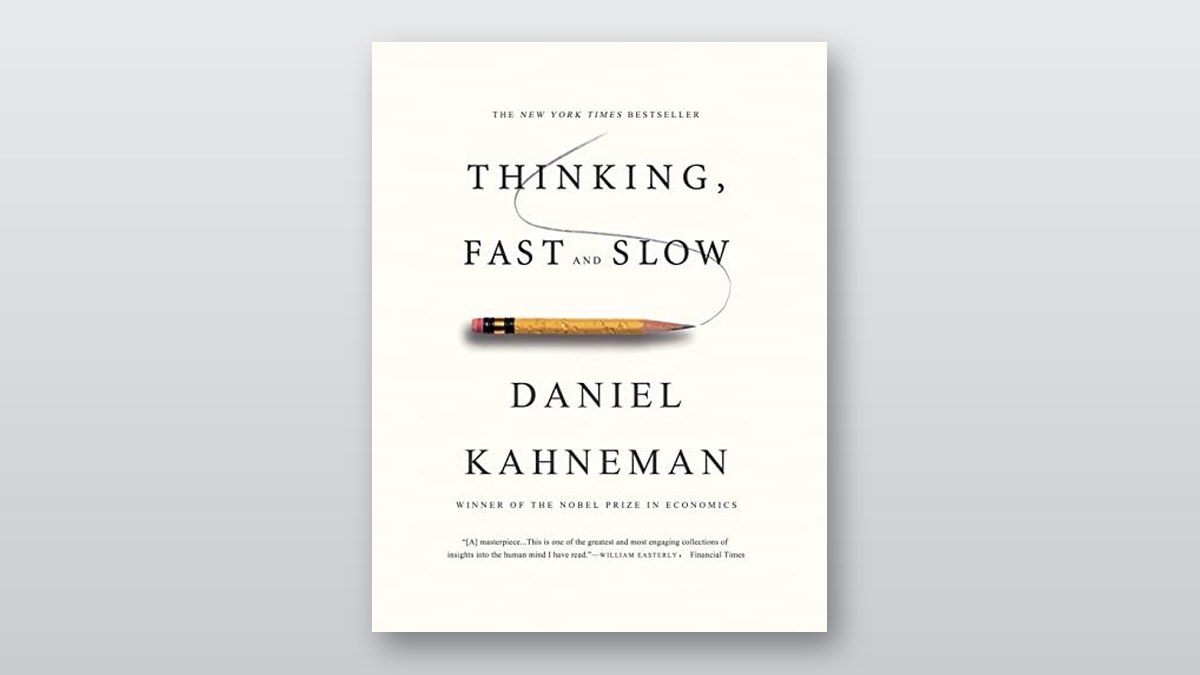
Thinking, Fast and Slow is Daniel Kahneman's 2011 book, published by Farrar, Straus and Giroux and listed at 498 pages by Wikipedia. Its main idea is that the mind works in two modes: System 1, which is fast, instinctive and emotional, and System 2, which is slower, more deliberate and more logical. Most of the book shows how System 1 produces confident but predictable errors, such as being swayed by an irrelevant number, judging likelihood by how easily examples come to mind, and feeling a loss more sharply than an equal gain.
For a salesperson the practical value is in how buyers decide and how sellers misjudge their own deals. Numbers you say first can pull the conversation toward them, the way you frame an option can change whether it is accepted, and a seller who relies only on what they have seen in a deal can be overconfident about it. This is a summary in our own words, drawn from public pages and not from the book's text, and the sales applications below are our interpretation rather than claims made by Kahneman.
The author and why the book carries weight
Kahneman was a psychologist who shared the 2002 Nobel Prize in Economic Sciences, awarded, per the Nobel Prize site, "for having integrated insights from psychological research into economic science, especially concerning human judgment and decision-making under uncertainty." He was born on 5 March 1934 in Tel Aviv, earned his Ph.D. in 1961, was at Princeton University when he received the prize, and died on 27 March 2024.
The Nobel site says his research on decision-making under uncertainty produced prospect theory, and Wikipedia describes prospect theory as the basis for his Nobel prize and as a central part of the book.
System 1 and System 2
The first section of the book, as described by Wikipedia, separates two ways of thinking. System 1 is automatic and effortless: completing a common phrase such as "war and ..." or solving 2 + 2. System 2 is effortful and conscious: multiplying two-digit numbers such as 17 x 24, or counting the letter A in a block of text.
The point is not that one system is good and the other bad. System 1 is quick and usually adequate, but it jumps to conclusions. The same section covers coherence, attention, laziness, association and the idea Kahneman calls WYSIATI, short for What You See Is All There Is: the mind builds a story from the information in front of it and rarely asks what is missing.
The main biases the book covers
- Anchoring. Irrelevant numbers pull estimates toward them. In the Gandhi example, people asked whether he was older than 114 when he died guess a much higher age than people asked whether he was older than 35.
- Availability. People judge how likely something is by how easily examples come to mind, and ease of recall is not a reliable guide to real frequency.
- Conjunction fallacy. In the Linda problem, most people rate "feminist bank teller" as more probable than "bank teller", which cannot be true. Kahneman calls it his best-known and most controversial experiment.
- Optimism and the planning fallacy. People overestimate benefits and underestimate costs. In 2002, per Wikipedia, American kitchen remodels were expected to cost $18,658 on average but cost $38,769.
- Framing. A surgery described with a 90 percent survival rate is accepted more often than the same surgery described with a 10 percent mortality rate.
- Sunk cost. People keep investing in projects with poor prospects because so much has already been spent.
- Loss aversion and prospect theory. A loss tends to weigh more than an equal gain, and the way a choice is framed against a reference point changes the outcome.
How the book is organized
Wikipedia's outline runs from the two systems to heuristics and biases, then overconfidence (Part III, sections 19 to 24), then choices, where prospect theory and framing are developed, and finally the two selves. That last section separates the experiencing self from the remembering self, which rates an experience by its peak and by how it ends rather than by how long it lasted.
For a seller, that last idea is worth keeping: a customer's memory of an implementation or a support call may be shaped by its high point and its ending more than its length. This is our reading, not a claim from the book, which is not a sales book.
How a salesperson could use it
The book is about psychology, not sales methodology, so these are our applications of its ideas, each tied to a finding described above.
- Be deliberate about the first number. Anchoring suggests that the first figure in a conversation, including a price or a savings estimate, shapes what follows. Set it on purpose and expect buyers to do the same.
- Frame the choice honestly. Framing research shows identical facts can be accepted or refused depending on wording. Use that to be clear, not to mislead.
- Put the cost of doing nothing next to the gain. If a loss feels heavier than an equal gain, the cost of the status quo deserves as much space in the conversation as the benefit of the change.
- Check your own forecasts. The planning fallacy and WYSIATI both apply to a pipeline: a seller sees the friendly signals in a deal and underweights what they do not know, such as other stakeholders or a competing project.
- Slow down the big decisions. System 1 handles routine moments well, but a large proposal or a forecast call benefits from the slower, checked reasoning of System 2.
Awards and reception
According to Wikipedia, the book won the 2011 Los Angeles Times Book Prize (Current Interest) and the National Academy of Sciences Best Book Award in 2012, and it was named one of the New York Times Book Review's best books of 2011. It was on the New York Times Bestseller List in 2011 and had sold over one million copies by 2012.
Criticisms and limits
The most serious criticism concerns replication. Wikipedia reports that an analysis of the studies cited in chapter 4, "The Associative Machine", found an R-index of 14, which indicates low reliability. The analysis is a Replication-Index post by Ulrich Schimmack, Moritz Heene and Kamini Kesavan, dated February 2, 2017, covering 31 studies. Wikipedia attributes to Kahneman a response in blog comments admitting, "I placed too much faith in underpowered studies."
Those criticisms concern the studies in that chapter, not every idea in the book. A reasonable reading is to treat the book as a useful map of how judgment goes wrong, while being cautious about any single experiment, and to remember that it is a psychology book, not a tested sales playbook.
Questions people ask
What is Thinking, Fast and Slow about?
It is about two modes of thought: System 1, which is fast, instinctive and emotional, and System 2, which is slower and more deliberate. The book shows how System 1 produces predictable errors in judgment and decisions.
Who wrote it and when was it published?
Daniel Kahneman wrote it, and Farrar, Straus and Giroux published it in 2011. Wikipedia lists 498 pages.
Is it a sales book?
No. It is a psychology book. Salespeople use its ideas on anchoring, framing and loss aversion, but those applications are interpretations, not claims from the book.
What are System 1 and System 2?
System 1 is automatic thinking, such as completing a common phrase or solving 2 + 2. System 2 is effortful thinking, such as multiplying 17 x 24.
Did Kahneman win a Nobel Prize?
Yes. He shared the 2002 Sveriges Riksbank Prize in Economic Sciences in Memory of Alfred Nobel for integrating psychological insights into economic science, especially on judgment and decision-making under uncertainty.
Is the book still reliable after the replication crisis?
Parts of it are disputed. An analysis of the chapter 4 studies gave an R-index of 14, and Kahneman acknowledged placing too much faith in underpowered studies. Treat individual experiments with care.
Sources
- Wikipedia: Thinking, Fast and Slow · Publisher, page count, concepts, examples, awards, sales and replication criticism
- NobelPrize.org: Daniel Kahneman facts · 2002 prize, motivation, birth and death dates, prospect theory
- Replication-Index: priming research · Chapter 4 analysis: 31 studies, R-index of 14%
- Open Library: Thinking, Fast and Slow · Work record and the English edition cover
This summary is an independent explainer written in our own words and does not reproduce the book. Facts were read from the linked pages on November 10, 2026; read the book for the primary detail, and treat the sales applications as our interpretation.
Top photo: Book cover via Open Library