Working Backwards by Colin Bryar and Bill Carr: Book Summary and Key Lessons in 2027
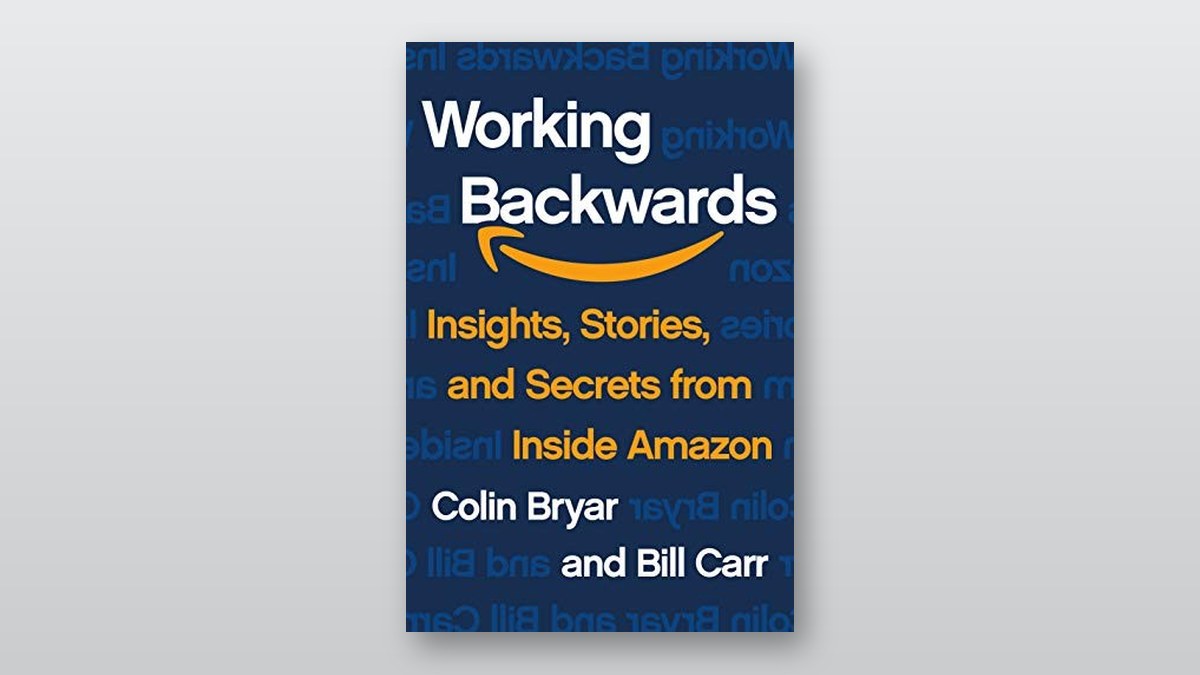
Working Backwards by Colin Bryar and Bill Carr is an insider's account of how Amazon runs itself. Its core claim is that Amazon's success came from well-defined, rigorously executed principles and processes that other companies can copy, rather than from any single leader's genius. The processes it covers include the Leadership Principles, Bar Raiser hiring, single-threaded leadership, written narratives, the PR/FAQ and input metrics.
The hardcover was published by St. Martin's Press on February 9, 2021, and runs 304 pages, per Open Library. Both authors are former senior Amazon executives, and the book is described on workingbackwards.com as a practical guidebook and a corporate narrative. This is a short summary in our own words, not a chapter-by-chapter retelling.
Who are Colin Bryar and Bill Carr?
According to the authors' site, Colin Bryar joined Amazon in 1998, spent 12 years on its senior leadership team and was Chief of Staff to Jeff Bezos for two years. He later became COO of RedMart in Singapore, which was sold to Alibaba.
Bill Carr joined in 1999 and stayed more than 15 years. As Vice President of Digital Media he launched and managed Amazon's global digital music and video businesses, including Amazon Music, Prime Video and Amazon Studios. He later served as COO of OfferUp. Together the site says they spent a combined 27 years as senior Amazon executives, and they co-founded Working Backwards LLC.
The Leadership Principles and how Amazon uses them
The book treats Amazon's Leadership Principles as the foundation. The authors' concept page says there are 16 of them, with examples such as Customer Obsession, Ownership, Dive Deep, Think Big and Bias for Action.
What matters is that they are used, not just posted on a wall. They are the evaluation criteria in hiring, they guide performance management and leadership development, and leaders use them as a lens for decisions when senior people are not in the room. The same page says Bezos and his leadership team spent nearly a year finalizing the first ten, and suggests that a company building its own list should start with 5 to 10.
The site frames five processes as the machinery that keeps the principles alive: Bar Raiser hiring, single-threaded teams, written narratives, the PR/FAQ and input metrics. The next sections take them in turn.
The Bar Raiser hiring process
The Bar Raiser page describes a formal, repeatable way to make hiring decisions and to reduce personal, urgency and confirmation bias. A Bar Raiser is a trained, hand-selected interviewer who must be at the same level as or above the open role and cannot be the hiring manager or report to them.
- The loop. A typical loop has 5 to 7 interviewers, and each usually covers 2 or 3 Leadership Principles with behavioral questions.
- The write-up. Interviewers record notes and a formal assessment with a hire or no-hire vote before the group meets.
- The debrief. People silently read the assessments for 10 to 15 minutes, then discuss each principle, with the Bar Raiser facilitating.
- The decision. The hiring manager decides with the Bar Raiser's input. The Bar Raiser has veto power but is expected to persuade rather than use it, and if either is unsure the right call is not to hire.
Single-threaded leadership
Single-threaded leadership means one senior leader works full time on one major initiative and nothing else, has the skills to make it succeed, and controls the resources it needs. Everyone who reports to that leader forms a single-threaded team that works only on that initiative.
The authors' explanation ties the shift away from a purely functional organization to Amazon's growth past 500 headquarters staff in the early 2000s. It suggests piloting with one to three teams that have few dependencies, and warns of risks such as duplicated effort, loss of functional expertise and hiring challenges.
Narratives (six-pagers) instead of PowerPoint
One of the book's best-known ideas is that Amazon replaced slide decks with written narratives. The authors' page dates the change to 2004, when Bezos was frustrated that important topics kept being revisited and decisions were slow. He had read Edward Tufte's argument that PowerPoint suits large one-to-many presentations rather than small decision meetings, and he treated the switch as an experiment that could be reversed. It worked.
- Length. Six pages or fewer for a one-hour meeting, with a 15 to 20 minute read. Three pages or fewer suits a 30-minute meeting.
- Reading first. Meetings begin with silent reading, so everyone starts from the same information.
- Time shift. The page says slide meetings spent about 75% of the time presenting and 25% discussing, and narratives roughly reverse that.
The PR/FAQ: the working-backwards process
The book's title comes from this method. Before building a product, a team writes the press release and FAQ it hopes to publish at launch, starting from the customer experience and working back to what must be built. The authors' PR/FAQ page says most of Amazon's major products since 2004 were created this way.
The press release names the customer, the problem and how the solution differs from today's alternatives. The FAQ has an external half (price, how it works, support) and an internal half (competition, market size, per-unit economics, upfront investment, risks and assumptions). Review meetings open with 15 to 20 minutes of silent reading and then about 40 minutes of discussion, ending in a go or no-go decision.
The page stresses that the document is a funnel that narrows many ideas, not a tunnel that builds all of them, and that reviews aim to find the truth rather than to sell the idea.
Input metrics versus output metrics
The input metrics page separates the two. Output metrics are lagging results such as revenue, active customers, churn and customer satisfaction, which a team generally cannot control directly. Input metrics are the controllable drivers behind them, such as adding items to the store, lowering costs so prices can drop, or positioning inventory for faster delivery.
Its example is cutting order-to-delivery time from 3 days to 1 day, an input that improves the customer experience while revenue and churn may follow. The page says Amazon's Weekly Business Review covered more than 200 metrics in one hour, and that inputs and outputs should be reviewed together to see which inputs actually matter.
Examples the book covers: Kindle, Prime Video and AWS
The authors draw on products they helped build. Per the PR/FAQ page, Kindle was the first product built this way in digital media, a field where Amazon had no prior capabilities. Carr's own role, according to the about page, included launching Amazon's global digital music and video businesses, including Prime Video.
For AWS, the same page says leaders saw web services as essential in 2004, but the foundational services launched in 2006 after more than a year of PR/FAQ work. It adds that a 2015 shareholder letter said AWS was bigger than Amazon.com was at 10 years old. It also cites the Fire Phone as an example of a great product solving the wrong problem, a useful reminder that the process reduces risk but does not remove it.
Who should read it
- Founders and executives. You get a concrete operating model rather than a slogan about culture.
- Product managers. The PR/FAQ and input metrics are directly usable in planning.
- Hiring managers and HR leaders. The Bar Raiser process is a template for more consistent hiring.
- Revenue and operations leaders. Narratives and input metrics improve how a team reviews its numbers and makes decisions.
A fair caution: the authors are Amazon alumni telling the story of a company they helped build, and their site also sells courses on these methods. Treat the book as a well-informed insider view, and adapt the practices to your own size rather than copying them whole.
Questions people ask
Who wrote Working Backwards and when was it published?
Colin Bryar and Bill Carr wrote it. The hardcover came out from St. Martin's Press on February 9, 2021, and runs 304 pages, per Open Library.
What is the main idea of Working Backwards?
Amazon's success came from well-defined, rigorously executed principles and processes, not any single leader's genius, and other companies can adopt versions of them.
What is the PR/FAQ process?
A team writes the launch press release and an FAQ before building the product, starting from the customer and working back. Leaders then review it and make a go or no-go decision.
What is a Bar Raiser?
A trained, hand-selected interviewer at or above the level of the open role who is not the hiring manager and helps keep hiring decisions consistent against the Leadership Principles.
Why did Amazon replace PowerPoint with narratives?
Per the authors' site, Bezos wanted higher-quality decisions faster. Written narratives of six pages or fewer, read silently, left more meeting time for debate.
Sources
- Working Backwards: the authors' site · Book description and the authors' course and concept pages
- Working Backwards: about the authors · Bryar's and Carr's Amazon roles and years
- Open Library: Working Backwards (St. Martin's Press edition) · Publisher, February 9, 2021 date and page count
- Amazon's Leadership Principles · The 16 principles and how they are used
- Bar Raiser hiring · Loop size, debrief and decision rules
- Single-threaded leadership · What a single-threaded leader and team are
- Narratives and decision making · The 2004 switch from PowerPoint and the six-page limit
- The PR/FAQ process · PR/FAQ structure, review meeting, Kindle and AWS
- Input metrics · Input versus output metrics
This summary is an independent explainer written in our own words and does not reproduce the book. Facts were read from the linked pages on October 19, 2026; read the book for the full detail.
Top photo: Book cover via Open Library