How do you build a climate risk analytics (Jupiter Intelligence / Cervest) go-to-market motion in 2027?
Sell climate risk analytics to the buyer who has to put a number on physical risk, not to a general sustainability budget. In the public record that buyer sits in banks and lenders, asset managers, infrastructure and energy operators and real estate, which are the four industries Jupiter Intelligence lists on its own site. Lead with a decision (a loan, a portfolio, a capital plan, a filing), prove the model passes the buyer's own model-risk review, and treat regulation as a reason to buy now, not the whole reason to buy. Do not build the plan on a disclosure deadline alone: the rules below have moved, been paused and been narrowed.
This page covers the category, not one company. Jupiter Intelligence is the live example: its home page says 3 of 5 largest banks in the U.S. are customers, and it names bank, insurer and energy logos. Cervest is the cautionary example: the UK company went into administration on 20 June 2023 and its technology was sold to Mitiga Solutions. No source read here publishes a market size, a typical sales cycle or a typical contract value for the category, so none is given.
This is general information, not legal, financial or investment advice. Confirm regulatory points on the regulators' own pages before you act.
Who buys, and what they are deciding
Jupiter Intelligence organizes its site around four industries: banking and lending, asset management and private equity, infrastructure and industrial, and real estate and REITs. It claims that 3 of 5 largest banks in the U.S. are customers, that 20% of the Global 100 are customers, and that 50% of the largest lenders in the U.S. are customers. Those are the company's own statistics, not an audited measure.
The products tell you what each buyer is doing with the data. Jupiter lists RiskSignal, Adaptation Hub, Entity Modeling, MetricEngine, Compliance Hub and an MRM Accelerator. Its Adaptation Hub is pitched as quantifying avoided losses, adaptation costs and ROI across multiple time horizons, and regulatory disclosure and compliance appears as a use of its ClimateScore Global model. In go-to-market terms that is three different jobs to be done: price and underwrite risk, plan capital spending, and support a filing.
- Lenders and investors. Need defensible physical-risk numbers by asset and entity. Jupiter says its methods are auditable, clear model risk management (MRM) and that it is MRM-approved by Tier 1 banks.
- Infrastructure, energy and industrial operators. Need to compare adaptation options. This is where the avoided-loss and ROI framing applies.
- Real estate. Need exposure by property and portfolio, for acquisition, lending and reporting.
- Consultancies and engineers. Often the channel rather than the buyer. See the partner section below.
The regulation drivers, and how unstable they are
Disclosure rules are the most-cited reason to buy climate risk analytics, and the public record shows they are not a stable foundation. Here is the status of each one from the regulator's own page, or a dated legal update where the regulator's page does not say.
- SEC climate disclosure rule (U.S.)Adopted March 6, 2024; stayed April 4, 2024; SEC voted to end its defense on March 27, 2025
- California SB 253 (emissions)Entities with revenues above $1 billion; Scope 1 and 2 deadline moved to November 10, 2026
- California SB 261 (climate risk)Revenues of $500 million; enforcement enjoined by the Ninth Circuit on November 18, 2025
- ISSB IFRS S2Issued June 2023; effective for periods beginning on or after 1 January 2024
- EU CSRD scopeOver 1,000 employees and EUR 450 million net turnover, per Directive (EU) 2026/470
United States, federal. The SEC's final climate disclosure rule was adopted on March 6, 2024, and the SEC issued a stay on April 4, 2024, according to the SEC's rule page. On March 27, 2025 the SEC voted to end its defense of the rules. A sales plan that assumed this rule would force purchases has had no support from it since.
California. The California Air Resources Board says SB 253 covers entities with total annual revenues in excess of one billion dollars and SB 261 covers U.S. companies doing business in California with annual revenues of $500 million, which must publish biennial climate-related financial risk reports. SB 261 is the one that matters for physical-risk analytics, because it is about financial risk from climate. A Mayer Brown update dated August 5, 2026 says the Ninth Circuit enjoined SB 261 pending appeal but not SB 253, that a merits decision was still awaited, and that the injunction pauses but does not invalidate SB 261. It also reports that the Scope 1 and 2 deadline moves to November 10, 2026, with Scope 3 not required for the 2026 reporting year. I did not find a merits ruling in the sources read, so check the current status before you quote a date to a prospect.
International. The IFRS Foundation says IFRS S2 covers climate-related physical risks and is effective for annual reporting periods beginning on or after 1 January 2024; the ISSB issued it in June 2023. Whether it binds a given company depends on whether its jurisdiction adopts it. In the EU, Directive (EU) 2026/470, adopted on 24 February 2026, amended the CSRD scope to undertakings above EUR 450 million of net turnover and 1,000 employees, which narrows the set of companies that must report.
Banking supervision. The Basel Committee published principles for the effective management and supervision of climate-related financial risks on 15 June 2022, aimed at banks' risk management and supervisors' practices. That is guidance to banks and supervisors rather than a disclosure mandate, and it is the reasoning behind the model-risk angle in Jupiter's pitch.
What Cervest teaches
Cervest Limited was an AI-powered climate intelligence platform that analysed long-term environmental risks to physical assets, portfolios and spatial areas. Interpath Advisory reports that two of its partners were appointed joint administrators on 20 June 2023, that the business ceased trading and that all 71 employees were made redundant. On 25 June 2023 the administrators sold certain intangible assets to Mitiga Solutions SL, a Spanish company.
Mitiga's own announcement, dated July 5, 2023, says it acquired Cervest's intellectual property rights and intangible assets, including the rights to all of Cervest's technology and know-how, and gives no financial terms. So Cervest as a company no longer operates; its technology was bought out of administration. Some data aggregators describe this simply as an acquisition, which leaves out the insolvency.
The sources do not say why Cervest failed, and this page does not guess. What the record supports is narrower: strong technology and a clear category did not by themselves keep a vendor operating. For a go-to-market lead, the practical reading is to plan for revenue you can show and a customer base you can name, rather than for the category's headline demand.
Build the motion: proof, partners, packaging
Everything in this section is an interpretation of the public record, not a measured benchmark. It follows from what a leading vendor publishes about itself.
- Lead with proof that clears the buyer's review. Jupiter foregrounds MRM approval by Tier 1 banks and auditable methods. A model that cannot pass model risk management cannot be used for a loan decision, so make that evidence part of the first deck, not the last.
- Show coverage and depth in plain numbers. In a March 25, 2026 release Jupiter says ClimateScore Global covers 22.3 billion locations with more than 22,000 metrics per location across nine modeled perils including flood, heat, drought and tropical cyclones. A buyer can test those claims; an adjective cannot be tested.
- Use consultancies and engineers as a channel. Jupiter's press page lists partnerships with Arcadis (November 2025 and the PRICE framework in June 2026), ERM (February 2026) and RINA (April 2026), plus a research partnership with the Stockholm Environment Institute (March 2026). Advisers who already sit with the buyer's resilience or risk team are an obvious route in.
- Package for the decision. Separate offers for credit and portfolio risk, adaptation planning and disclosure support match the three jobs above, and let you price and sell each to the right owner.
- Tie the pitch to money, with honest uncertainty. Jupiter's CEO Rich Sorkin is quoted saying that physical risk is capital risk. If your pitch ties output to money, be explicit about the uncertainty in projections.
The Jupiter and Stockholm Environment Institute release shows another pattern worth noting: a research collaboration that applies the platform to flood exposure at mine sites, processing facilities and trade flows. Research partnerships create case studies, which are the proof assets this category needs.
What to measure
No public source read here gives win rates, sales-cycle lengths or retention for climate analytics, so use your own data and be wary of anyone quoting a benchmark without a link. Useful internal measures follow directly from the motion above.
- Pipeline by buyer type. Lenders, investors, operators and real estate, tracked separately, so you can see which hypothesis holds.
- Model-risk review outcomes. How many deals reach and pass the buyer's validation, and how long it takes.
- Regulation-driven versus decision-driven deals. Tag each opportunity by its trigger. If a disclosure date moves, you will see how much pipeline depended on it.
- Channel-sourced pipeline. Opportunities that come through advisory and engineering partners.
Questions people ask
Is Cervest still operating?
Not as Cervest Limited. Interpath reports administrators were appointed on 20 June 2023 and the business ceased trading; Mitiga Solutions says it acquired Cervest's intellectual property rights and intangible assets.
Who are the main buyers of climate risk analytics?
Jupiter Intelligence lists banking and lending, asset management and private equity, infrastructure and industrial, and real estate as its industries. Those are one vendor's categories, not a market study.
Does the SEC climate rule drive demand now?
Not as a requirement the SEC is defending. The SEC voted on March 27, 2025 to end its defense of the rules.
What is the status of California SB 261?
A Mayer Brown update from August 5, 2026 says the Ninth Circuit enjoined it pending appeal and a merits decision was awaited. Check CARB's program page for the current position.
How big is the climate risk analytics market?
No market size is given here because none of the primary sources read publishes one. Treat any figure without a named, linked source with caution.
Sources
- Jupiter Intelligence · Products, industries and customer statistics
- Jupiter Intelligence press page · Partnerships and dates
- Jupiter Intelligence and SEI release, March 25, 2026 · ClimateScore Global coverage figures
- Interpath Advisory: Administrators appointed to Cervest Limited · Cervest administration and asset sale
- Mitiga Solutions: acquires Cervest's intellectual property rights · Acquirer's own announcement
- SEC press release 2025-58 · SEC ends defense of climate disclosure rules
- SEC climate-related disclosure rule page · Adoption and stay dates
- California Air Resources Board: SB 253 and SB 261 · Revenue thresholds and program status
- Mayer Brown: California climate disclosure laws, August 5, 2026 · Ninth Circuit injunction and deadline change (law firm update)
- IFRS S2 Climate-related Disclosures · Standard scope and effective date
- Directive (EU) 2026/470 (EUR-Lex) · CSRD scope thresholds
- Basel Committee: climate-related financial risk principles · Supervisory principles for banks
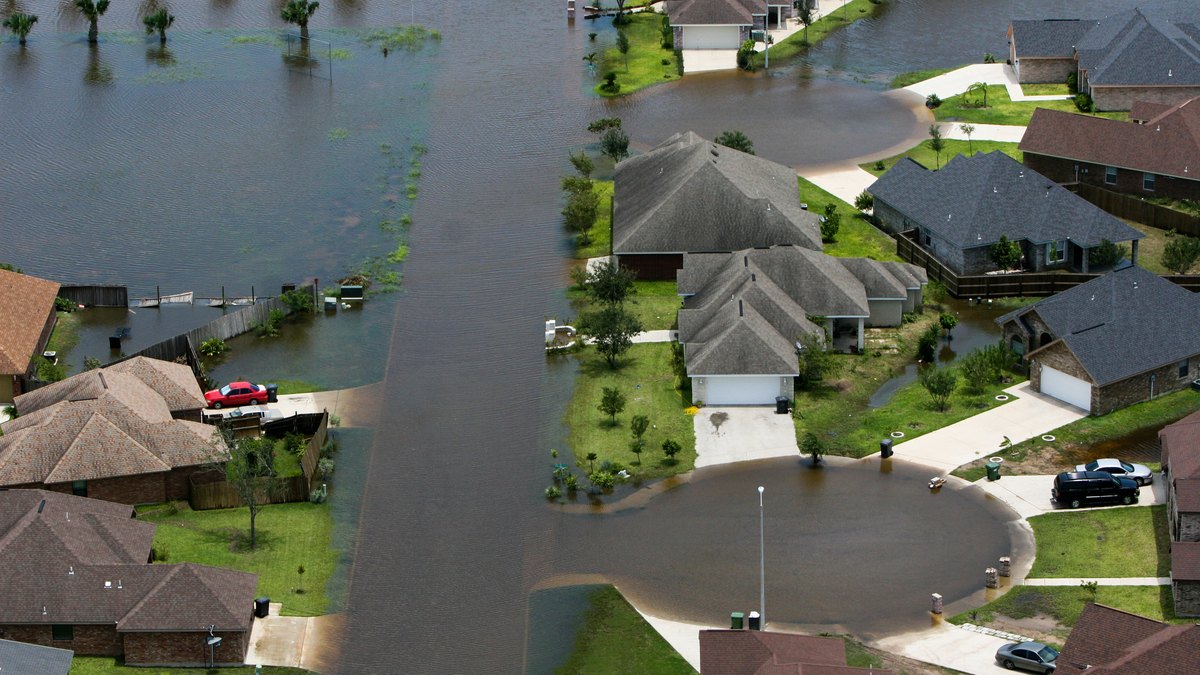
- Wikimedia Commons: FEMA photograph (public domain) · Hero image credit: Jacinta Quesada / FEMA
Figures and statements were read from the linked pages on November 8, 2026. Vendor statistics are the vendors' own claims. Regulatory status can change; confirm on the regulator's page. This is not legal, financial or investment advice.
Top photo: Jacinta Quesada / FEMA, public domain via Wikimedia Commons