What's the right comp structure for a partner/reseller channel in 2027?
Build it in layers, not as one margin number. Give resellers a front-end discount they can count on, pay the bigger money as back-end rebates tied to growth rather than raw volume, gate the richer layers behind program tiers, and price in any marketplace fee when the deal runs through a cloud marketplace.
Two of the largest vendor programs point that way. Cisco describes its 360 program as a mix of upfront discounts and back-end rebates tied to a scored Partner Value Index. In Microsoft's FY27 terms, as its distributor Pax8 reads them, the baseline Core incentive on Microsoft 365 and Dynamics 365 resale was removed for indirect resellers, while the growth rate rose from 7.5% to 12.5%.
There is no published market-standard reseller margin in these sources. Use the vendor programs as models of structure, then set your own rates from your gross margin. This page covers sell-through resale; for referral fees and deal-share in a co-sell motion, see how to compensate channel partners in co-sell. It is not legal or tax advice.
Layer one: a front-end discount the reseller can plan on
The front-end discount is the reseller's gross margin on each deal: the gap between what it pays you, or your distributor, and what it charges the customer. It has to be predictable, because the reseller prices quotes from it before it knows whether any rebate will land.
Cisco frames the 360 Partner Program, which took effect on February 1, 2026, as "a mix of upfront discounts and back-end rebates aligned to the value you bring to customers." The upfront part is the layer a reseller can bank on; the rebate part is where the vendor steers behavior.
In a two-tier model the discount may not even be yours to set line by line. Microsoft says that in its provider-reseller model the distributor buys from Microsoft and the reseller resells, and that distributors can provide support, pricing and billing. If you sell through distribution, design the reseller's margin together with the distributor's, not separately.
Layer two: back-end rebates that pay for growth
Back-end rebates are paid after the period closes, so they can reward what you actually want: new customers, expansion and retention. The clearest public example of the shift is Microsoft's FY27 incentive change, which Pax8, a Microsoft distributor, laid out in a post dated July 28, 2026.
- Baseline removed. Pax8 says the FY26 Core incentive was 3.75% on Microsoft 365 and 4% on Dynamics 365, and that in FY27 those Core incentives are no longer available for indirect resellers. The changes took effect July 1, 2026.
- Growth raised. The Growth Accelerator on Microsoft 365 and Dynamics 365 rose from 7.5% to 12.5%, which Pax8 says is 2.5 percentage points higher than the direct-bill partner rate.
- Growth tiered. On Azure, the base consumption and reservation rates stayed at 3%, while the single 7.5% growth rate became tiers of 7%, 10% and 12%.
The lesson for your own plan is not the percentages, which belong to Microsoft and change each fiscal year. It is the design: a reseller that only renews the base earns less than one that adds customers, seats or new workloads. Cisco also simplified its back end, rolling VIP, Lifecycle Incentives and its services partner program into a single Cisco Partner Incentive.
Layer three: tiers that decide who gets the richer layers
Tiers stop you from paying the full stack to a partner that closes one deal a year. Each published program gates access on measured contribution, and each measures it differently.
- Cisco scores value. Its Partner Value Index measures contribution across four dimensions: Foundational, Capabilities, Performance and Engagement.
- HubSpot counts points and retention. Its 2026 tier table sets Gold at 115 sourced and 345 total points, Platinum at 425 and 1275, Diamond at 1250 and 3750 with average GRR of at least 75%, and Elite at 2,750 and 11000 with at least 80%. Total points combine sourced, assisted and managed business.
- Microsoft uses revenue floors. An indirect reseller needs at least USD $1,000 of CSP transactional revenue in the preceding 12 months, checked annually. To bill Microsoft directly, a partner must have transacted as an indirect reseller for at least 12 months and have at least USD $1 million of eligible CSP revenue, per Microsoft Learn.
Notice what HubSpot puts into the top tiers: a retention floor. If your rebates reward bookings only, a reseller can climb tiers on deals that churn. Adding a retention or renewal measure to the upper tiers closes that gap.
Layer four: market development funds, earned and capped
Market development funds pay for the reseller's demand generation, not for deals already won. Keep them separate from margin and rebates, and make them discretionary.
HubSpot says co-marketing eligibility depends on factors including partner tier, accreditations, managed customer base and product usage, plus a track record in programs such as Market Development Funds, and that these opportunities are "selective, limited in availability, and not guaranteed." Tie any fund to a plan the partner submits in advance and to results you can measure afterward.
Layer five: price in the marketplace fee
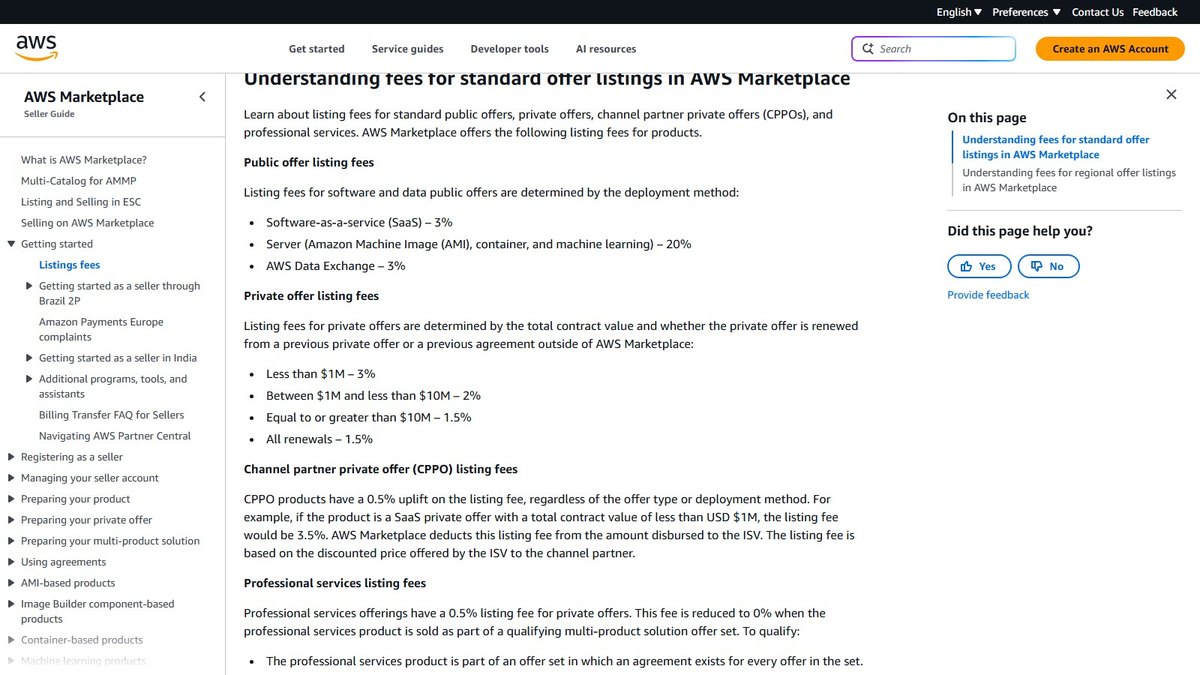
When resale runs through a cloud marketplace, the fee comes out of somebody's margin. AWS lists private offer fees of 3% under $1M of contract value, 2% from $1M to under $10M, 1.5% at $10M or more, and 1.5% on renewals.
For a channel partner private offer, AWS adds a 0.5% uplift, so a SaaS private offer under $1M carries 3.5%. AWS deducts the fee from the amount disbursed to the ISV, and bases it on the discounted price the ISV gives the channel partner. In other words, on AWS the vendor pays the channel fee, so set the reseller discount for marketplace deals with that cost already in it.
What to pay your own channel team
The partner program is only half of channel comp. The other half is how you pay the channel managers and direct reps who work beside resellers, and the vendor programs above do not publish that.
- Pay channel managers on sell-through. Credit them on what their partners sell and keep, not on what partners buy into inventory or sign up for.
- Mirror the partner plan. If the partner earns more for new logos and expansion, the channel manager's plan should weight the same things.
- Keep direct reps neutral. A rep who loses commission when a reseller takes a deal will compete with the channel. Decide account ownership and rep credit before the first conflict.
Questions people ask
Is there a standard reseller margin?
Not one that these sources support. Cisco, Microsoft, HubSpot and AWS each publish structure, tiers or fees, but none of them states an industry-wide margin. Set your rates from your own gross margin and cost of sale.
Should rebates reward volume or growth?
The large vendor programs have moved toward growth. Per Pax8, Microsoft removed the FY27 Core incentive on Microsoft 365 and Dynamics 365 for indirect resellers and raised the Growth Accelerator from 7.5% to 12.5%.
How should partner tiers be measured?
Use measured contribution. Cisco scores four dimensions in its Partner Value Index, HubSpot uses sourced and total points with a retention floor in its top tiers, and Microsoft uses trailing 12-month revenue floors.
Who pays the fee on a marketplace resale deal?
On AWS, the vendor. AWS deducts the listing fee, including a 0.5% uplift for channel partner private offers, from the amount disbursed to the ISV.
Sources
- AWS Marketplace Seller Guide: Understanding listing fees · Private offer and channel partner private offer (CPPO) fees
- Microsoft Learn: Indirect Reseller eligibility requirements · Two-tier model, indirect reseller revenue floor
- Microsoft Learn: Requirements to enroll as a CSP direct-bill partner · Direct-bill revenue and tenure requirements
- Pax8: FY27 Microsoft Incentives · FY26 to FY27 incentive rate changes for indirect resellers
- Cisco Blogs: Launching the New Cisco 360 Partner Program · Partner Value Index, upfront discounts and back-end rebates
- HubSpot: Solutions Partner Program Tiers and Benefits 2026 · Tier thresholds, retention floors, co-marketing eligibility
Terms were read from the linked pages on November 3, 2026. Partner programs change every fiscal year, so confirm current terms with each vendor or distributor. This is not legal or tax advice.