What's the right way to expand from SMB to mid-market without breaking SMB in 2027?
Run two motions side by side instead of moving one motion upmarket: keep SMB low-touch and self-serve, add a separate sales-led motion for mid-market, and measure each segment on its own numbers. That is the structure public software companies describe in their own filings. Freshworks (Form 10-K for 2025) serves SMB, which it defines as 250 or fewer employees, through "low-cost, low-touch, and self-service" demand, and mid-market (251 to 5,000 employees) through inbound, outbound and partner demand. monday.com (Form 20-F for 2025) says it will "continue to expand our sales-led motion and scale our self-serve funnel."
What breaks SMB is usually treating it as a smaller version of mid-market: pulling its reps, its product roadmap or its pricing toward bigger deals. Give each segment its own definition, owner and payback target, such as the under 12 months for SMB and under 18 months for mid-market that Bessemer recommends.
Why an upmarket push can hurt the SMB base
The two segments buy differently. Bessemer's Atlas (September 21, 2021) notes that segments have different contract values, with SMB the smallest, and different churn rates, with SMB the highest, which is why it allows longer CAC payback for larger accounts. The companies themselves list the risk. HubSpot's 10-K warns that "Sales to enterprise customers may entail longer sales cycles and more significant selling efforts," that selling to small businesses "may involve greater credit risk," and that a change in customer mix could lower gross margins. monday.com's 20-F says "the use of differing sales strategies may extend our sales cycles."
My reading of those warnings, not a finding from any study: if the same team, the same process and the same targets have to cover both a quick SMB sale and a multi-month mid-market deal, the longer deals take the attention and the high-volume SMB funnel gets less of it. Splitting the motions is how the filers below avoid that trade.
What three public companies say they run
- Freshworks: segment by size, different demand engines. SMB through inbound and partner demand that is low-touch and self-service, with 14-day free trials. For mid-market and enterprise it says it "significantly strengthened our outbound motion," run by outbound marketing, sales development representatives and field sales representatives. It tracks customers above $5,000 in ARR as "an indicator of our success in expanding upmarket": 24,762 of them at December 31, 2025, making up 91% of ARR.
- monday.com: sales-led and self-serve at the same time. It counts customers above $50,000 in ARR as enterprise customers: 4,281 at December 31, 2025, up 34% from 3,201, and 41% of ARR versus 36% a year earlier. It pairs "high-touch CSM coverage for strategic accounts" with "AI-powered tech-touch at scale" so engagement is "aligned to their segment," and keeps a self-serve funnel where any user can sign up.
- HubSpot: one platform, tiers and partners. It sells to companies with 2 to 2,000 employees and says its freemium products and in-product cross-sell "help close new business with little or no interaction by our sales representatives," while Solutions Partners help reach mid-market businesses at scale. Average subscription revenue per customer rose from $11,343 in 2024 to $11,414 in 2025, driven by Professional and Enterprise products and offset by purchases of lower-priced Starter products.
Define the segments, then measure them apart
Write the segment line down before you hire for it. Freshworks uses employee counts (250 or fewer, 251 to 5,000, 5,001 or more). monday.com uses spend ($50,000 in ARR). HubSpot uses a broad 2 to 2,000 employee band. Any of these works if routing, quota and reporting all use the same line.
Then report retention and payback per segment, because blended numbers hide the difference. monday.com's net dollar retention was 110% overall but 116% for customers above $50,000 in ARR for the three months ended December 31, 2025. Freshworks says net dollar retention on monthly contracts "has generally been lower" than its overall rate of 108%, and monthly subscriptions were 13% of ARR. For payback, Bessemer's targets are under 12 months for SMB, under 18 for mid-market and under 24 for enterprise, so a mid-market team should not be judged on the SMB clock, or the reverse.
Keep the SMB engine low-touch
- Protect self-serve and trials. All three filers keep a no-sales or low-sales entry point: HubSpot freemium, monday.com's self-serve funnel, Freshworks free trials.
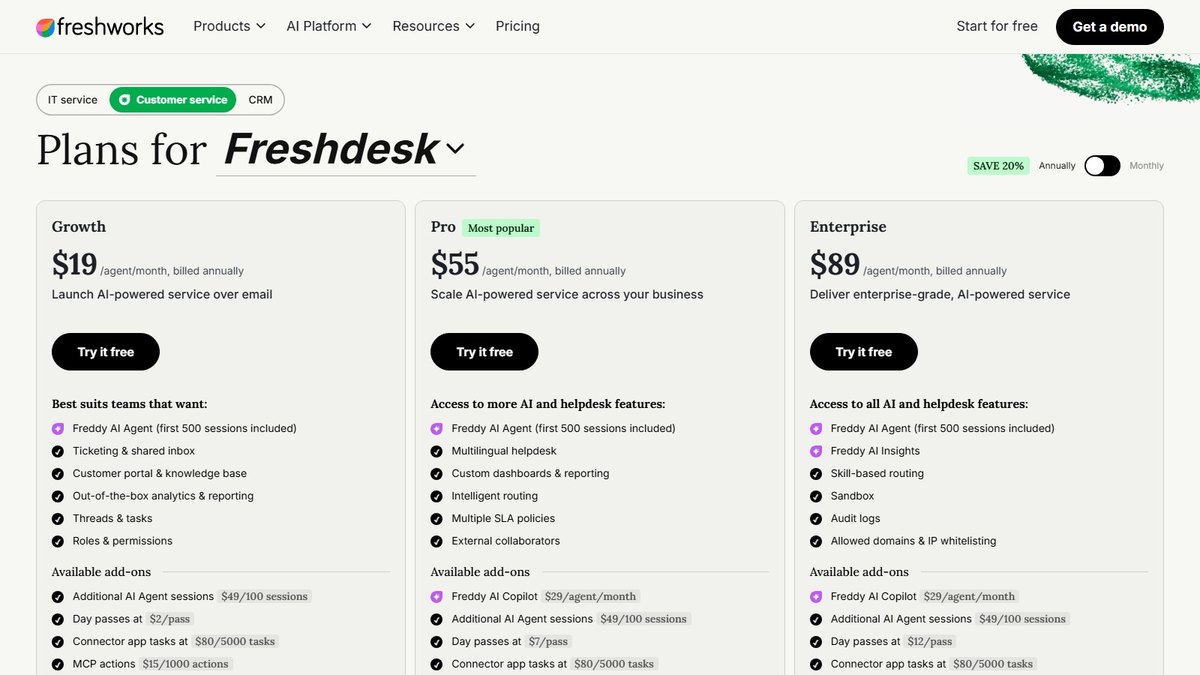
- Use tiers, not a second product. Freshdesk's pricing page shows Growth at $19, Pro at $55 and Enterprise at $89 per agent per month, billed annually, so a small team and a larger one buy from the same page.
- Let partners carry part of the load. HubSpot and Freshworks both name partner demand as a channel for smaller and mid-market buyers.
- Keep SMB support scalable. monday.com describes tech-touch at scale for the broad base and high-touch coverage for strategic accounts.
Build mid-market as an added motion
The mid-market side is additive in every filing: Freshworks added outbound teams, and monday.com describes a dedicated Product Alignment Team that builds with feedback from enterprise-level customers, plus regional partnerships "to strengthen our ability to move upmarket." The payoff shows up in expansion: at monday.com, 29% of enterprise customers had multiple products at December 31, 2025, compared with 6% of sub-$50,000 customers.
For the SMB side, Bessemer's reference point is that successful SMB-focused businesses, including HubSpot in its 3 years before its IPO, ran 70-80% gross retention. If SMB gross retention or SMB payback slips after the mid-market launch, that is the sign the new motion is borrowing from the old one.
What I could not verify
A checklist for 2027
- One written segment line, used by routing, quota and reporting.
- Separate owners and targets, with payback judged against the SMB and mid-market targets Bessemer gives.
- SMB stays self-serve, trial or freemium first, with partners and tiered plans doing the upgrade work.
- Mid-market gets its own outbound and success coverage, added on top, not taken from the SMB team.
- Watch SMB retention and payback monthly after launch; a drop there is the early warning.
Questions people ask
How do public companies define SMB and mid-market?
Freshworks defines SMB as 250 or fewer employees and mid-market as 251 to 5,000. HubSpot sells to companies with 2 to 2,000 employees. monday.com calls customers above $50,000 in ARR enterprise customers.
Should SMB and mid-market have different CAC payback targets?
Bessemer recommends under 12 months for SMB-focused accounts, under 18 for mid-market and under 24 for enterprise.
Can one company run self-serve and sales-led at once?
Yes. monday.com's annual report for 2025 says it will continue to expand its sales-led motion and scale its self-serve funnel, and HubSpot says freemium and in-product cross-sell close business with little or no sales interaction.
What signals that the mid-market push is hurting SMB?
Falling SMB gross retention or longer SMB payback after launch. Bessemer cites 70-80% gross retention for successful SMB-focused businesses such as HubSpot before its IPO.
Sources
- Freshworks Inc., Form 10-K for fiscal 2025 (SEC) · Segment definitions, SMB and mid-market demand motions, outbound teams, $5,000 ARR metric, retention
- monday.com Ltd., Form 20-F for fiscal 2025 (SEC) · Sales-led plus self-serve, $50,000 ARR enterprise customers, retention by cohort, upmarket partnerships
- HubSpot, Inc., Form 10-K for fiscal 2025 (SEC) · 2 to 2,000 employee focus, freemium and partners, revenue per customer, customer mix risk
- Bessemer Venture Partners, Scaling to $100 Million (Sep 21, 2021) · CAC payback targets by segment, SMB gross retention reference
- Freshdesk pricing page (Freshworks) · Tiered plans; page image is a screenshot of this vendor page
Facts were read from the linked filings and pages on November 3, 2026. Figures are as reported by each company or source, opinions are labeled as such, and nothing is estimated. If a page here is out of date, tell us and we will correct it from a source.