How are NIL valuations calculated and what determines an athlete's value in 2027?
There is no single formula for an athlete's name, image and likeness (NIL) value. Anyone's number is an estimate built from a handful of inputs: how many people a post or appearance reaches, how much they engage, the sport and position, the school and local market, performance, and the terms of the deal itself (how many deliverables, for how long, how exclusive). The common back-of-envelope method is to multiply reach by a price per thousand views (a CPM) or engagements by a price per engagement, then add fees and a premium for exclusivity.
The rules decide what can be paid. For Division I athletes at schools in the House settlement, the College Sports Commission's own page says NIL Go checks that a third-party deal has a valid business purpose and does not exceed a reasonable range of compensation, and that range looks at the deal's performance obligations, the athlete's athletic performance and social media reach, the local market and the reach of the school and program (page read November 8, 2026). The CSC's FAQ says NIL Go does not calculate a fair market value for each deal. For 2027, the same page says the school revenue-sharing cap is expected to rise another 4%. Company valuation tools are proprietary estimates, not prices, and I could not read On3's method page, so I give none of its figures.
What "NIL value" actually measures
An NIL value is an estimate of what a company might pay for the right to use an athlete's name, image or likeness. The NCAA's NIL page (undated; read November 8, 2026) defines an NIL deal as any agreement where the athlete is compensated, in money, products or services, for letting a company, brand or person use their name, image or likeness, such as social posts, event appearances or endorsements.
It helps to keep three streams of money apart, because estimates often blur them. The College Sports Commission revenue-sharing page (read November 8, 2026) says athletes at participating schools can receive direct school payments in addition to athletic scholarships and third-party NIL earnings. Only the third stream, a deal with a company or other outside party, is an NIL deal in the sense of this page.
- Scholarship and school benefits. Paid by the school under NCAA rules; not an NIL valuation question.
- School revenue sharing. A school payment under the House settlement, reported through the College Athlete Payment System (CAPS). The CSC says third-party NIL payments do not count against the school's cap, but they are still reviewed by NIL Go.
- Third-party NIL. A deal with a brand, a local business or another outside party. This is where a valuation estimate helps, and where deal review applies.
The inputs that move an estimate
- Audience size and engagement. The CSC's NIL page (read November 8, 2026) lists the athlete's social media reach among the factors in its range-of-compensation review. Opendorse's methodology note (published April 28, 2021) says its estimate uses current follower count, average engagement rate per post and impressions per post. Followers alone are not the whole picture: reach and engagement are separate inputs.
- Sport and position. Opendorse lists the athlete's sport among its inputs. The CSC also publishes aggregated compensation data cut by sport, by football position group and by conference group (October 30, 2026 release; read November 8, 2026), which tells you that pay is tracked by sport and position. I could not read the tables themselves, so I give no percentile values.
- School and market. The CSC says its range-of-compensation review weighs the local market and the market reach of the athlete's institution and program. A deal for a local car dealer and a deal for a national brand are priced in different markets.
- Performance. The CSC lists the athlete's athletic performance as a factor. Note the limit: the NCAA page says pay for athletic participation or achievement is not allowed, so a valid deal pays for the use of NIL, not for results. Performance shows up as audience and attention, not as a bonus for winning.
- Deal type, length and exclusivity. The CSC lists the deal's performance obligations (what the athlete must actually do). The NCAA page says pay with no required promotional activity or deliverables is not allowed, and neither is an agreement that says the NIL will be used later with no defined plan. So a deal's deliverables must be specific. I found no published source that gives a standard exclusivity premium, so the multiplier below is a placeholder you replace with a quote.
The math, as formulas
- Reach-based (CPM) estimate. Value per post = (expected impressions divided by 1,000) x CPM, where CPM is the price per thousand impressions. Hypothetical: 20,000 impressions at a placeholder CPM of $10 is 20 x $10 = $200. Opendorse's note names cost per thousand impressions (CPM) as one of the three paid-post measures behind its estimate.
- Engagement-based (CPE) estimate. Engagements = followers x engagement rate. Value per post = engagements x CPE, where CPE is the price per engagement. Hypothetical: 10,000 followers at a 4% engagement rate is 400 engagements; at a placeholder CPE of $0.50 that is $200. Opendorse's note also names cost per engagement (CPE).
- Whole-deal estimate. Deal value = (number of posts x value per post + fees for appearances or other deliverables) x a usage-or-exclusivity multiplier. Hypothetical: 4 posts x $200 = $800, plus one appearance fee of $500 is $1,300; a placeholder multiplier of 1.25 gives $1,625. The multiplier stands for the extra price of limiting the athlete from working with competitors or of letting the brand reuse the content.
- Check against the rules. Compare the result with what similar athletes are paid in your sport and market. The NCAA page says compensation must be within a reasonable range for people with similar fame or influence. The CSC calls its test a deal-level calculation and says it is informed by external benchmarks. Its method and benchmarks are not published, so you cannot reproduce it.
- Take-home. Net earnings = deal income minus business expenses; then self-employment tax and income tax apply (see the tax section). The IRS uses Schedule C and Schedule SE for the first step. Plan around net, not the headline deal value.
Judgment, not sourced: a CPM estimate suits a brand buying exposure, and an engagement estimate suits a brand that wants clicks or sales. If the two answers are far apart, ask which one the brand actually pays for. A three-step order of work is to estimate reach, convert it to a price per post, then test the total deal against comparable deals.
Valuation tools: proprietary estimates
Opendorse. In an April 28, 2021 blog post the company describes an Estimated Value per Post built from cost per thousand followers, cost per engagement and cost per thousand impressions across paid posts published through its platform since 2012, adjusted for sport, status, followers, engagement rate and impressions, plus "additional proprietary data points." That is the company's description of its own tool, from a post that is now several years old, and the weights are not published. Treat the output as one estimate, not a price.
On3. On3 publishes an NIL Valuation and Roster Value for athletes. I could not read On3's method page: on3.com returned a 403 (blocked) response to my request, so I stopped using that host. I therefore do not describe its current method, and I repeat none of On3's numbers for any named athlete. If you use any company's figure, read how that company says it is made, check its date, and treat it as a proprietary estimate rather than a market price.
The rules in 2026 and 2027
The settlement. The CSC says it was established after the House v. NCAA settlement, approved by a federal court on June 6, 2025, and that the NCAA Division I Board of Directors adopted new bylaws to implement it. NCAA President Charlie Baker's letter of June 6, 2025 says the court maintains jurisdiction over implementation, that the defendant conferences are responsible for launching and enforcing rules on third-party NIL contracts, and that the annual cap on school benefits was approximately $20.5 million in year one.
What is allowed. The NCAA's page says a deal is allowed when the athlete is paid specifically for use of NIL, the deal has a valid business purpose tied to a real product, service or event offered to the public, and the pay is within a reasonable range for people with similar fame or influence. It says an agent or marketing professional may be used. Not allowed: pay with no required deliverables, deals that only say NIL will be used later, pay-for-play, and pay outside a reasonable range.
Reporting and review. The CSC's NIL page says Division I athletes must report third-party deals worth $600 or more in total, within five business days of signing or agreeing payment terms, through NIL Go (built with assistance from Deloitte). Review looks at associated status (a link to the school's athletics program, including a person who has contributed more than $50,000 over a lifetime), valid business purpose, and range of compensation. Outcomes are Cleared, Not Cleared or Returned for Revision; the athlete can revise, cancel and return payment, or appeal to neutral arbitration within 14 days. Going ahead with a deal that was not cleared can bring enforcement, including loss of eligibility. The page also says that, as of July 2026, deals valued between $600 and $15,000 are not reviewed for range of compensation until an athlete reaches $50,000 in associated deals in an academic year.
Revenue sharing and 2027. The CSC's revenue-sharing page says schools can distribute up to 22% of the average revenue among schools in the ACC, Big Ten, Big 12, Pac-12 and SEC from media rights, ticket sales and sponsorships. It estimates the 2026-27 cap at approximately $21.3 million per school and says the cap is expected to increase another 4% for 2027-28, then be re-evaluated every three years over the 10-year settlement period. The CSC's FAQ gives $21.5 million for 2026-27, and an October 1, 2026 release says each participating school can now share up to $21.58 million. These three figures disagree, so use the latest and check before you rely on one. The FAQ also says revenue sharing does not create an employment relationship.
What has been reported. The CSC's October 30, 2026 release says 46,478 NIL deals were cleared in NIL Go with an aggregate value of $582.49 million through August 31, 2026, and that the first revenue-sharing year ended June 30, 2026 with $1.77 billion in direct school payments recorded in CAPS. The CSC says its compensation figures are full contracted amounts for different lengths of time, not annualized earnings. I do not divide these totals into an "average deal" because the page does not define one.
Two state laws, from the legislatures
Virginia, Code § 23.1-408.1 (text on the Virginia Law site; the page showed a date of 11/8/2026 when read). It bars institutions and athletic associations from preventing a student-athlete from earning NIL compensation or from using an athlete agent or attorney, from declaring the athlete ineligible for it, and from cutting an athletic scholarship because of it. Each institution must adopt policies approved by its governing board, and student fees may not be used to pay athletes for NIL. It lists categories in which an athlete may not earn NIL compensation: alcohol, adult entertainment, cannabis, controlled substances, performance enhancing drugs, tobacco, weapons, and casinos or gambling including sports betting. A category barred by state law limits which deals can be priced at all.
Florida, Statute § 1006.74 (2025 Florida Statutes on the Florida Senate site). The Legislature finds that an intercollegiate athlete must have an equal opportunity to control and profit from the commercial use of name, image or likeness. It requires each postsecondary institution to hold at least two financial literacy, life skills and entrepreneurship workshops, each a minimum of 5 hours, before an athlete graduates. It says institutions and their employees are not liable for damages to an athlete's NIL earning ability resulting from decisions routinely taken in intercollegiate athletics.
The NCAA page tells athletes to review the campus NIL policy and applicable state law, and to talk with the compliance office. State laws change; confirm the current version for your state.
Tax basics (general information, not advice)
The NCAA page says income from NIL activities is generally taxable and that athletes should keep accurate records of earnings and expenses. The IRS self-employment tax page (last reviewed or updated October 30, 2026; read November 8, 2026) says the self-employment tax rate is 15.3%, made up of 12.4% for social security and 2.9% for Medicare, and that for 2026 the first $184,500 of combined wages, tips and net earnings is subject to the social security part. You must file Schedule SE if net earnings from self-employment were $400 or more, and a sole proprietor or independent contractor generally uses Schedule C to figure net earnings. The employer-equivalent part of the tax can be deducted when figuring adjusted gross income, and an additional 0.9% Medicare Tax applies above threshold amounts.
The IRS estimated taxes page (last reviewed or updated September 25, 2026; read November 8, 2026) says sole proprietors generally have to make estimated payments if they expect to owe $1,000 or more when the return is filed, and that most taxpayers avoid the penalty if they paid at least 90% of this year's tax or 100% of last year's, whichever is smaller. Form 1040-ES is used to figure it. Because brand payers usually do not withhold, athletes who are self-employed often must set money aside themselves; that is a planning point, not a rule I can apply to you.
A checklist for testing any NIL number
- Name the buyer and the deliverables. What exactly will the athlete do, how many times, and for how long? Vague "use later" terms do not meet the NCAA page's test.
- Estimate reach and engagement honestly. Use your own analytics, not follower count alone, and run both the CPM and CPE formulas.
- Check the sport, position and market. Ask what comparable athletes at similar schools are paid, and note that the CSC publishes aggregate data by sport and position.
- Confirm the deal is reviewable. Know the $600 reporting threshold, the five-business-day clock and whether the payer could be an associated entity.
- Check state law and the campus policy. Categories like alcohol or gambling can be barred outright.
- Plan for tax. Work from net earnings, and ask a tax professional about estimated payments.
Questions people ask
How is an athlete's NIL value calculated?
There is no single published formula. A common estimate multiplies expected impressions (per thousand) by a CPM, or engagements by a price per engagement, then adds fees and an exclusivity premium. Opendorse says its estimate uses sport, status, followers, engagement rate and impressions (blog post dated April 28, 2021). The College Sports Commission says NIL Go does not calculate a fair market value for each deal.
What does the College Sports Commission look at when it reviews an NIL deal?
Its NIL page says it evaluates associated status, valid business purpose and range of compensation. The range looks at the deal's performance obligations, the athlete's athletic performance and social media reach, the local market and the market reach of the school and program (read November 8, 2026).
Which NIL deals must Division I athletes report?
The CSC says third-party deals with a total value of $600 or more in the aggregate must be reported through NIL Go within five business days of signing or agreeing payment terms. The same page says that as of July 2026, deals between $600 and $15,000 are not reviewed for range of compensation until an athlete reaches $50,000 in associated deals in an academic year.
What is the revenue-sharing cap for 2027?
The CSC says the cap is expected to increase another 4% for 2027-28 after the 2026-27 year, with later re-evaluation every three years. For 2026-27 its pages give $21.3 million (revenue-sharing page), $21.5 million (FAQ) and $21.58 million (October 1, 2026 release) per school, so check the current figure.
Is NIL income taxable?
The NCAA page says income from NIL activities is generally taxable. The IRS says the self-employment tax rate is 15.3% and that Schedule SE is required if net earnings from self-employment were $400 or more. This is general information, not tax advice; the IRS pages do not mention NIL by name.
Can I trust company NIL valuations?
Treat them as proprietary estimates. Opendorse describes its own method but not its weights, and I could not read On3's method page, so I cite no On3 figures. Check how the company says the number is made and when it was published.
Sources
- NCAA: Name, Image and Likeness (undated; read November 8, 2026) · Definition, allowed and not allowed, taxes, reporting
- NCAA: A Letter from NCAA President Charlie Baker (June 6, 2025) · Court approval, cap in year one, conference enforcement
- College Sports Commission: home page (read November 8, 2026) · Settlement approved June 6, 2025; CAPS and NIL Go
- College Sports Commission: NIL (read November 8, 2026) · NIL Go, $600 reporting, range of compensation, outcomes
- College Sports Commission: Revenue Sharing (read November 8, 2026) · Cap, 4% increase, 10-year period
- College Sports Commission: FAQ (read November 8, 2026) · NIL Go does not calculate fair market value; cap figure
- College Sports Commission: first-year revenue sharing release (October 1, 2026) · CAPS totals; 2026-27 cap
- College Sports Commission: compensation data release (October 30, 2026) · Cleared NIL deal count and value; report scope
- College Sports Commission: Compensation Reports (read November 8, 2026) · Report definitions; tables not readable by my request
- Code of Virginia § 23.1-408.1 (read November 8, 2026) · State NIL law
- Florida Statutes § 1006.74 (2025) · State NIL law
- IRS: Self-employment tax (last reviewed or updated October 30, 2026) · Rate, base, Schedule SE and C
- IRS: Estimated taxes (last reviewed or updated September 25, 2026) · Who pays estimated tax; safe harbor
- Opendorse: NIL Draft 2021 (April 28, 2021) · Company description of its per-post estimate
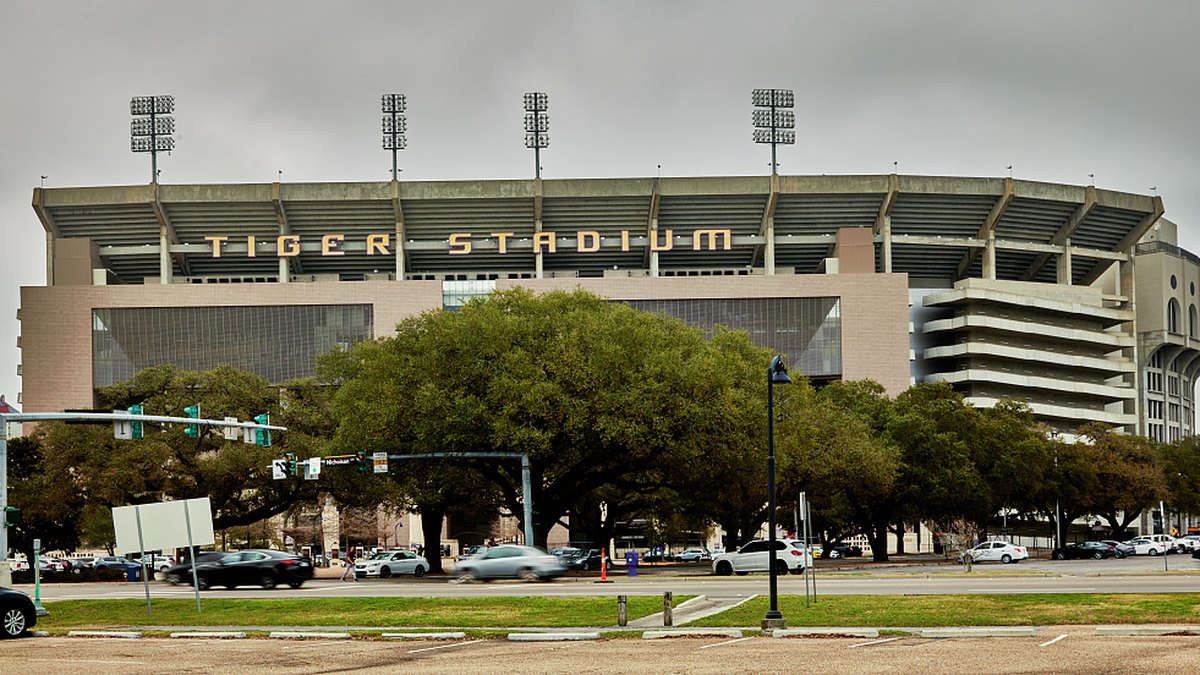
- Hero photo: Carol M. Highsmith, LSU Tiger Stadium, Library of Congress (no known restrictions on publication per the Library) · College football stadium exterior
Everything was read from the linked pages on November 8, 2026, and each carries its date. Gaps: on3.com returned a 403 so On3's method is not described and none of its numbers are repeated; California's legislative site returned a 403 and the Texas statutes site would not render without scripts, so only Virginia and Florida are covered; the CSC's percentile tables load through scripts and were not read; the NCAA NIL page is undated; the CSC gives three different 2026-27 cap figures. No neutral dataset gives a typical NIL value by sport or school, so the dollar examples are hypothetical formulas, not market rates. This is general information, not legal, tax or financial advice.