How do you start a medical spa (med spa) business in 2027?
You start a med spa by settling who may own it and who must supervise the medical work in your state, then adding a medical director, a business plan, licenses, insurance, equipment, software, staff and marketing. State rules come first because they decide your structure. California's Board of Barbering and Cosmetology fact sheet says a spa that offers medical procedures must be owned by physicians, while Texas rules center on delegation and supervision by a physician, PA or APRN.
Published startup budgets differ widely. Boulevard says about $10,000 for a small medspa and up to $500,000 for a large one, Zenoti gives $50,000-$100,000 for a lean build and $150,000-$500,000 for full service, and Pabau gives $150,000-$500,000 including a cash reserve (all vendor-stated). The American Med Spa Association (AmSpa) reports more than 11,000 U.S. med spas in its 2024 report, but its startup-cost figures sit in a paid report.
Vendor figures are labeled vendor-stated, no company is adjusted for, and rules vary by state, so check yours before spending money.
First, find out who can own and supervise in your state
This step decides everything else, and it differs by state. California: the Board of Barbering and Cosmetology's consumer fact sheet (revised 03/2024, reprinted from a Medical Board of California newsletter) says "If a spa offers medical procedures, it must be owned by physicians." It adds that cosmetologists may never inject the skin or use lasers, and that treatments must be done by a physician, or by a registered nurse or physician assistant under a physician's supervision. The physician need not be onsite but must be immediately reachable.
Texas: a TMLT summary of the Texas Medical Board's February 2025 bulletin says a physician, PA or APRN must be on site or immediately available for an emergency consult when qualified non-physicians perform delegated cosmetic procedures. It lists signed, dated protocols reviewed annually, at least one basic life support-trained person present, an emergency plan, and posting the delegating physician's name and license number. It cites Texas Administrative Code Title 22 Part 9, sections 169.25, 169.26 and 169.28.
Other states differ. Boulevard's guide says many states require owners to hold a medical license, and that Arizona and Florida let non-physicians own the business while an MD oversees the medical side (vendor-stated). AmSpa's Med Spa Laws by State pages cover who can own, inject and supervise, but the answers sit behind membership. This page cannot tell you your state's rule.
Second, secure a medical director and delegation setup
Boulevard says a medical director is required "Almost always" (vendor-stated). Zenoti says the director must be a licensed physician (MD or DO) with an active, unrestricted license in the operating state, with a written agreement, and warns against "signature mill" arrangements with uninvolved physicians. Pabau advises hiring the medical director first, then the clinical staff their supervision rules allow.
California's Medical Board article is blunt about paper arrangements. It calls paper-only "rent-a-license" supervision illegal, says directors are held to the same standards as any physician, and says lasers, Botox and filler injections are the practice of medicine. It says only registered nurses, nurse practitioners or physician assistants may use lasers and prescriptive devices, never unlicensed staff such as medical assistants, and never estheticians. It also requires an appropriate prior exam that may not be delegated to nurses, and a medical setting rather than a salon.
Costs vary by source. Zenoti gives a medical director retainer of $500-$3,000 per month. Pabau gives $1,500-$5,000 per month when a non-physician owns the business, plus MSO (management services organization) legal fees of $12,000-$15,000 (both vendor-stated).
Third, plan the business, entity and licenses
Zenoti's licensing list includes a local business license, general liability, professional liability and workers' compensation insurance, HIPAA and OSHA compliance, DEA registration for prescribers, and in some states a health department permit. Boulevard's nine steps run from concept and market research through a business plan, licensing, location, equipment, hiring, marketing, a grand opening and tracking KPIs. Both recommend a healthcare attorney or state-specific checks for ownership structure.
Pabau prices legal and entity setup at $5,000-$20,000 and says to price every startup cost before signing a lease (vendor-stated). Zenoti's body says startups typically open in 4-9 months, while its FAQ says six to twelve months, so plan for a range.
Fourth, budget the startup costs
AmSpa's statistics page lists start-up costs, the medical director and ownership as sections of its full report, which costs $995 or is free for Plus members, with national data only. The free pages read here do not give the dollar figures, so the ranges below are vendor estimates that do not agree with one another.
- Boulevard: about $10,000 for a small medspa, up to $500,000 for a large full-service one, with no category breakdown (vendor-stated).
- Zenoti: $50,000-$100,000 lean, $150,000-$500,000 full service, over $1,000,000 luxury or multi-location. Lease and build-out $50-$150 per sq ft; a medical-grade laser alone $80,000-$200,000; marketing and launch $10,000-$50,000 (vendor-stated).
- Pabau: $150,000-$500,000 to open with reserve included, split into $150,000-$250,000 lean and $300,000-$500,000 mid-size; lease and buildout $100,000-$300,000 for 2,000 sq ft; initial inventory $10,000-$30,000; staff training and compliance $5,000-$15,000 (vendor-stated).
Both Zenoti and Pabau tell owners to hold working capital of three to six months of operating costs. Pabau's example is $135,000-$270,000 at $45,000 per month in overhead. Staffing is a major recurring cost: Zenoti lists NPs at $95,000-$140,000 and RNs at $65,000-$95,000 in salary.
Fifth, choose equipment and software
Pabau advises buying or leasing FDA-cleared equipment for the launch menu only, at $10,000-$20,000 for injectables and $50,000-$200,000 per laser. Pick a menu your licensed staff can legally deliver under the state rules above, then buy devices to match.
Boulevard sells scheduling and payments software and states that its tools are HIPAA-aware, with charting, intake forms and e-prescriptions, and security badges for HIPAA, SOC 2 and PCI Level 1. It also lists an AI receptionist called Beau (vendor-stated). Zenoti states that it serves more than 30,000 salons, spas, med spas and fitness centers and lists online booking, inventory, digital forms, Photo Manager and digital charting (vendor-stated). Pabau describes med spa practice management software covering scheduling, EMR, intake forms and consents, billing, inventory and reporting (vendor-stated). Pabau also advises running one practice management system for scheduling, records, consents and payments.
Sixth, insure the business
Pabau lists first-year insurance at $8,000-$20,000 and recommends general liability, professional liability, workers' compensation and property coverage. Latent Insurance Services, an independent brokerage that says it compares 20+ carriers, states in its med spa insurance page (updated February 24, 2026) that typical professional liability limits are $1M per claim and $3M aggregate, and general liability $1M per occurrence and $2M aggregate. Its estimated annual ranges, which it says are not quotes, are $2,500-$12,000 for professional liability and $600-$1,200 for general liability (vendor-stated).
Latent also says a medical director's personal malpractice policy usually does not extend to the med spa entity, so the spa needs its own professional liability policy. Confirm requirements with your state board and a carrier in writing.
Seventh, fund it, train the team and market the launch
Cherry offers patient financing and states on its site that it is trusted by 60,000 healthcare providers, with APRs of 0% to 35.99%, terms of 1 to 60 months, and amounts of $35 to $65,000. It says providers are paid in full within 2-3 business days and can save up to 50% on merchant fees, with no fee rate stated (vendor-stated). This finances your patients' treatments; it is not an opening loan.
For training, AmSpa lists in-person Boot Camps in Chicago on October 17, 2026 and Anaheim on February 10-11, 2027, plus an on-demand Virtual Boot Camp watchable for six months. AmSpa Basic is $395 per year and Plus is $845 per year. Pabau recommends marketing through a Google Business Profile, a website and social channels, a soft launch to test workflows, then a grand opening, and budgets $5,000-$15,000 for pre-launch marketing (vendor-stated).
What the evidence does and does not show
- The market is large. AmSpa's 2024 report reports more than 11,000 U.S. med spas and more than 100,000 employees, from a survey of owners run from September 2023 to March 2024. Its statistics page says the industry has eclipsed $17 billion.
- State rules decide the structure. A physician-only ownership rule in California and a delegation-and-supervision model in Texas lead to different business set-ups.
- Startup costs are vendor estimates. Boulevard, Zenoti and Pabau give different ranges, none is independently audited, and AmSpa keeps its own figures in a paid report.
- Vendor pages sell something. Software, insurance and financing facts are the companies' own statements.
Questions people ask
Can a non-doctor open a med spa?
It depends on the state. California's Board of Barbering and Cosmetology fact sheet says a spa that offers medical procedures must be owned by physicians. Boulevard says Arizona and Florida let non-physicians own the business while an MD oversees the medical side (vendor-stated). Check your state medical board.
How much does it cost to start a med spa?
Published ranges differ: about $10,000 to up to $500,000 (Boulevard), $50,000-$100,000 lean to over $1,000,000 luxury (Zenoti), and $150,000-$500,000 with reserve (Pabau). All are vendor-stated estimates.
Do I need a medical director?
Boulevard says "Almost always" (vendor-stated). Zenoti says the director must be a licensed physician (MD or DO) with an active, unrestricted license in the operating state, under a written agreement.
How long does it take to open?
Zenoti says 4-9 months in its body text and six to twelve months in its FAQ, so its own page gives a range.
What insurance does a med spa need?
Zenoti lists general liability, professional liability and workers' compensation. Latent Insurance Services says a medical director's personal malpractice policy usually does not cover the med spa entity (vendor-stated).
Sources
- AmSpa 2024 State of the Industry news release · Number of med spas, employees, survey period
- AmSpa med spa statistics · Industry revenue, report price and contents
- AmSpa · Membership prices, Boot Camps, state law pages
- California Board of Barbering and Cosmetology: Medical Spas fact sheet · Physician ownership and supervision
- Medical Board of California: The Business of Medicine - Medical Spas · Delegation, supervision and rent-a-license
- TMLT: Regulations for medical spas in Texas · Texas supervision and delegation rules
- Boulevard: how to open a medspa · Steps, costs, ownership, software
- Zenoti: how to open a med spa · Steps, cost ranges, medical director, licensing
- Pabau: how to start a med spa · Cost ledger, steps, insurance
- Latent Insurance Services: med spa insurance · Coverage limits and annual ranges
- Cherry · Patient financing terms
Facts were read from the linked pages on November 2, 2026. This page is general information, not medical or legal advice; talk to a healthcare attorney and your state medical board. If a page here is out of date, tell us and we will correct it from a source.
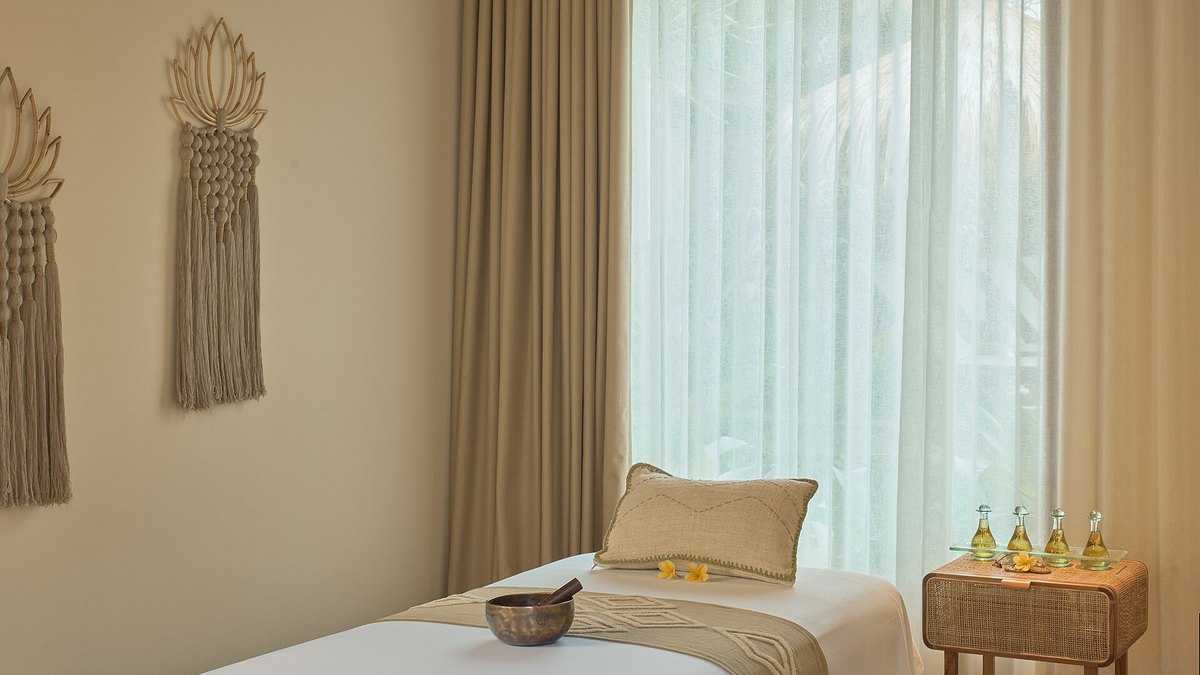
Top photo: Paradisus Bali / CC BY-SA 4.0 via Wikimedia Commons