How do you start a solar panel cleaning business in 2027?
You start a solar panel cleaning business by confirming that cleaning pays off for your customers, checking your state and city licensing, insuring the business, buying a pure-water pole system, choosing a pricing model, and setting up fall-protection practices before you go on a roof. The demand case rests on soiling research: a 2019 *Joule* review estimates soiling cuts global solar output by at least 3-4% even with optimized cleaning, and an NREL-led study of five North Carolina plants found about 10% annual production loss from pollen on unwashed panels.
Published startup budgets run from $7,000 to $25,000 (JIM) with a pole system and DI filter at $2,000 to $5,500, and ZenBusiness itemizes each line from water purification at $800 to $4,500 to registration at $100 to $500. Insureon's median general liability premium for window cleaners is $78 per month. Residential jobs are quoted per visit or per panel, at $250 to $500 per visit (ZenBusiness) or $5 to $10 per panel (JIM). Both are vendor-stated guides, not audited figures.
This page is general information, not legal advice. Licensing and insurance rules vary by state and city, and no company here is adjusted for, so confirm with your state and local offices before spending money.
First, check that the demand is real
Cleaning only sells if dirt costs panel owners meaningful output. Two sources give a sense of scale, and neither guarantees what a given roof will lose.
Ilse and co-authors, writing in *Joule* in 2019, estimate that soiling cuts global solar output by at least 3-4% even with optimized cleaning, with annual revenue losses of at least 3-5 billion euros, and project 4-7% by 2023. That is a global figure across plant types, so local results vary.
An NREL-led study of five North Carolina solar plants of 4 to 9 MW, summarized by pv magazine USA, found efficiency fell by as much as 15% during peak pollen season and that unwashed panels suffered approximately 10% annual production loss. Rain did not remove the pollen, and manual wet-brush cleaning after rain showed a performance increase of 5% to 11%. The data set is from utility plants in one state, and pollen differs by region, so treat it as an example rather than a national average.
Customer supply is the other half. The EIA reports that small-scale (under 1 MW) solar generation rose from 18,812 GWh in 2016 to 92,979 GWh in 2025, with California at 34,411 GWh, 37% of the total, followed by Arizona at 5,795 GWh, Texas at 5,408 GWh and Florida at 5,198 GWh. On the sales side, the SEIA and Wood Mackenzie Q4 2025 report, as reposted by Now.Solar, says residential installed 1,088 MWdc in Q3 2025, that residential capacity through the first three quarters was down 7% from the same period in 2024, and that residential installations are expected to fall by 18% year over year in 2026 after the customer-owned federal credit expires. A shrinking new-install market does not shrink the installed base that needs service, but it does mean competing installers may look to maintenance work.
Second, find out what licenses you need
There is no single national license for cleaning panels. The Small Business Administration's licenses and permits guide says requirements and fees vary based on your business activities, location and government rules, that licensing has federal, state and local layers, and that local governments determine registration, licensing and permitting. It advises checking your Secretary of State website for state licenses and notes that some licenses expire after a set period of time.
Contractor rules are the main question. California's Contractors State License Board describes the C-46 Solar Contractor classification as one that "installs, modifies, maintains, and repairs thermal and photovoltaic solar energy systems." The classification text does not mention cleaning, and this page found no CSLB statement saying whether washing panels counts, so ask the board directly before you take work there. ZenBusiness's guide says most cities require a general business license for a solar panel cleaning business and that contractor licensing applies in some jurisdictions (vendor-stated). JIM's guide also advises checking your state contractor licensing board before starting work.
Third, insure the business
Insureon, an online small-business insurance marketplace, publishes median premiums for window cleaning businesses on its cost page, updated September 8, 2026: general liability at $78 per month or $931 per year with limits of $1 million per occurrence and $2 million aggregate, workers' compensation at $114 per month or $1,364 per year, and a business owner's policy at $81 per month or $968 per year. The figures come from policies cleaning businesses applied for through Insureon, most with fewer than five employees. Solar panel cleaning is not a listed category, so use these as a reference point and get quotes that name roof and panel work.
JIM says general liability with $1 million in coverage is the minimum standard at $400 to $1,500 per year, puts commercial auto at $1,500 to $3,000 annually, and says workers' compensation is required in most states once you hire employees. ZenBusiness budgets general liability and insurance at $600 to $1,500 (both vendor-stated guides).
Fourth, buy the equipment
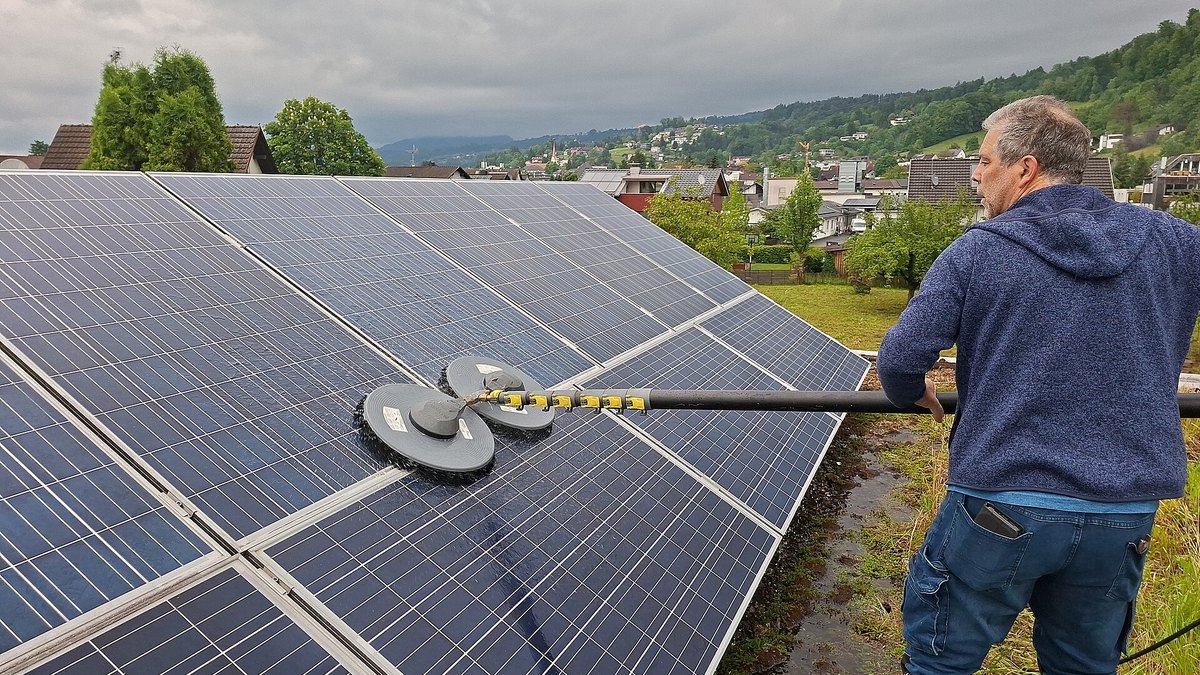
Residential and small commercial work usually uses a water-fed pole with a brush and a deionized (DI) or reverse-osmosis water filter, so the panels dry without mineral spots. ZenBusiness lists water purification at $800 to $4,500, poles and brushes at $300 to $1,200, and hoses, reels and fittings at $200 to $600. JIM puts a pole system, brushes and DI filter together at $2,000 to $5,500.
- Tucker: its site says "It's all we've done since 1957," lists a Castle Rock, Colorado address, and offers solar panel cleaning agents, brushes, kits and robots, with the Alpha Scrubber described as great for windows or solar panels (vendor-stated).
- Unger: its nLITE page says the water-fed telescopic pole system was developed for professional cleaning of windows, facades and solar panels, and lists an 11,90 m Carbon 24K pole and an 8,60 m Carbon Composite pole, made in Germany (vendor-stated).
- Ionic Systems: a UK maker based in Swindon whose site lists Reach and Wash waterfed poles, hoses, filters and ion exchange resin water treatment. Its home page lists no solar-specific products, so ask the company which of its poles and brushes it supports on panels.
- SolarCleano: a Luxembourg-based robot maker founded in 2017. pv magazine reported on September 9, 2025 that its portable L1 has 2.45 m brushes, cleans wet or dry, covers 2,000 m2 per hour for up to 4 hours, handles inclines up to 27 degrees and can be run by one person (vendor-stated). It is aimed at rooftops, carports and ground-mounted systems.
- Ecoppia: its site says it makes robotic cleaning for large-scale sites, with 35+ large-scale sites, 5,000+ MW of deployments and 3.89 billion panels cleaned (vendor-stated). Its customers are utility-scale operators, so it is a reference for where the industry goes, not a purchase for a new residential business.
Ask any maker whether its brush, pole and water setup is approved for the panel brands you will touch, and what it says about warranty. This page did not find a source that settles that question.
Fifth, choose a pricing model and a budget
ZenBusiness says pricing models vary between a flat rate per home and a price per panel, and cites $250 to $500 per residential visit. JIM says residential work is typically $5 to $10 per panel, large commercial projects might drop to $2 to $4 per panel, suggests a minimum charge such as $150, and gives a 50-60% gross margin target. JIM is a payments company and ZenBusiness is a business-formation service, so these are guides, not audited market rates; test them against local competitors' quotes.
- Water purification: $800 to $4,500 (ZenBusiness).
- Poles and brushes: $300 to $1,200 (ZenBusiness).
- Work vehicle, down payment or lease: $2,000 to $8,000 (ZenBusiness); a used vehicle $5,000 to $20,000 (JIM).
- Insurance: $600 to $1,500 (ZenBusiness).
- Safety and fall protection gear: $300 to $900 (ZenBusiness).
- Marketing and branding: $400 to $1,200 (ZenBusiness).
- Registration and local permits: $100 to $500 (ZenBusiness).
- Whole-business total: $7,000 to $25,000 for most new businesses (JIM).
Sixth, set up scheduling, quoting and invoicing
Field-service software handles quotes, recurring visits and payments. Jobber lists on its pricing page a Core plan for one user at $49 per month with no commitment or $29 billed annually, including quotes, invoices, online payments and online booking, with Connect for one user at $139 and Grow at $199 on the no-commitment rate, and additional users at $29 per month each. Housecall Pro lists on its pricing page a Basic plan at $59 per month on annual billing for one user with online booking, invoices and payments, scheduling and dispatching and quotes, Essentials at $149 per month for five users, and Max at $299 per month for eight users with recurring service plans, plus a 14-day free trial (vendor-stated). Try each trial against your own quoting and recurring-visit workflow.
Seventh, plan for safety before the first roof
OSHA's fall protection page says fall protection is required at four feet in general industry workplaces and six feet in the construction industry, and names safety harness and line, safety nets and guardrails among the systems that may be required. Its Fall Prevention Campaign gives a three-step method: plan ahead to get the job done safely, provide the right equipment, and train everyone to use the equipment safely. Whether a given roof job falls under general industry or construction rules is a question for OSHA or a safety professional.
A water-fed pole lets you clean many ground-mounted and low roof arrays from the ground, which is one reason the pole-and-DI setup is the common starting point. Walking a roof is a different risk, so price it separately and train for it.
What the evidence does and does not show
- Soiling losses are real but uneven. The 3-4% global estimate and the 10% pollen loss in North Carolina come from different settings, and neither is a promise for a particular roof.
- Startup numbers are guides. The $7,000 to $25,000 and the per-line ranges come from JIM and ZenBusiness, companies that sell to small businesses, and are not audited.
- Licensing is local. This page found no state statement that cleaning panels requires a contractor license, and none that it does not; check your state and city.
- Residential demand is shifting. The SEIA figures show new residential installs falling, while the installed base keeps growing in the EIA generation data.
- Vendor pages sell something. Equipment, robot and software facts are the companies' own statements, and no company is adjusted for.
Questions people ask
How much does it cost to start a solar panel cleaning business?
JIM says most new businesses need between $7,000 and $25,000, and puts a water-fed pole system, brushes and DI filter at $2,000 to $5,500. ZenBusiness itemizes each line, from $800 to $4,500 for water purification to $100 to $500 for registration and permits. Both are vendor-stated guides.
Do I need a license to clean solar panels?
It depends on your state and city. The SBA says requirements vary by activity, location and government rules, and ZenBusiness says most cities require a general business license. California's C-46 classification covers installing, modifying, maintaining and repairing solar systems and does not mention cleaning, so ask your state board.
What insurance do I need?
Insureon's median general liability premium for window cleaning businesses is $78 per month with $1 million per occurrence and $2 million aggregate limits, and workers' compensation is $114 per month. JIM says workers' compensation is required in most states once you hire employees.
How much do solar panel cleaners charge?
ZenBusiness cites $250 to $500 per residential visit and says pricing varies between a flat rate per home and a price per panel. JIM says residential jobs are typically $5 to $10 per panel and suggests a minimum charge such as $150. Check local quotes before you set prices.
Do rain and nature clean panels for free?
Not always. An NREL-led study of five North Carolina plants found rain did not fully remove pollen, with about 10% annual production loss on unwashed panels and a 5% to 11% gain from manual wet-brush cleaning. Results vary by region.
Sources
- Ilse et al., Joule (2019): soiling losses · Global soiling loss estimate
- pv magazine USA: NREL-led pollen soiling study · Pollen loss and cleaning gain
- EIA: small-scale solar generation · Generation by state
- SEIA / Wood Mackenzie Q4 2025 (via Now.Solar) · Residential installs and forecast
- SBA: apply for licenses and permits · Federal, state, local licensing
- CSLB: C-46 Solar Contractor · Classification text
- OSHA: fall protection · Fall protection heights
- OSHA: Fall Prevention Campaign · Plan, provide, train
- Insureon: window cleaning insurance cost · Median premiums
- ZenBusiness: solar panel cleaning business · Cost ledger and pricing
- JIM: how to start a solar panel cleaning business · Budget, per-panel pricing, insurance
- Tucker · Pole maker, solar products
- Unger nLITE water-fed poles · Pole system for solar
- Ionic Systems · Waterfed poles and filters
- pv magazine: SolarCleano L1 · Robot specs
- Ecoppia · Utility-scale robots
- Jobber pricing · Field-service software plans
- Housecall Pro pricing · Field-service software plans
Facts were read from the linked pages on November 2, 2026. This page is general information, not legal advice; talk to your state licensing office, an insurance broker and a business attorney. If a page here is out of date, tell us and we will correct it from a source.
Top photo: Asurnipal / CC BY-SA 4.0 via Wikimedia Commons