How do you start an adult day care center business in 2027?
Start by deciding which kind of center you are, because that one choice sets your license, your staff, your space and who pays. A social model center sells supervision, meals and activities. An adult day health model adds nursing or therapy services. Then read your own state's rules before you sign a lease, since licensing, staffing ratios and floor space per participant are all set state by state.
Two state rules show the pattern. Florida requires one direct-service staff member for every six participants present at all times, with at least two staff on site, and at least 45 square feet of net floor area per participant for centers licensed after November 9, 1995. Virginia also requires one staff person for every six participants, or portion thereof. The sections below cover the payer mix (private pay, Medicaid waivers, the VA program and long-term care insurance), startup costs, and where referrals come from.
This is a business guide. It makes no health or treatment claims and is not legal advice. I found no published national startup-cost figure from a neutral source, so I show how to estimate it instead. If you are weighing a home-based model, see how to start a non-medical senior home care agency.
Pick the model first: social or adult day health
There is no single national definition, so use your state's wording. Florida's statute (The 2026 Florida Statutes, section 429.901) defines an adult day care center as a building or part of a building that provides, for a part of a day, basic services to three or more people aged 18 or older who are not related to the owner. Basic services include a protective setting, therapeutic programs of social and health activities, leisure activities, self-care training, rest, nutritional services and respite care. Supportive and optional services include speech, occupational and physical therapy, direct transportation and referrals for follow-up services.
Virginia draws a different line. Its Department of Social Services rule (page version dated 11/8/2026) defines an adult day center as a facility that provides supplementary care and protection during only part of the day to four or more adults who are aged, infirm or have disabilities. It excludes a facility or part of a facility licensed by the State Board of Health or the Department of Behavioral Health and Developmental Services. In other words, a center with a health-agency license sits outside that rule, so the model you choose can change which agency you answer to.
The federal Medicaid rule uses a third phrase. 42 CFR 440.180 (eCFR text version dated October 1, 2026) lists adult day health services among the home and community-based waiver services a state may offer, as the state defines them and CMS approves them. The VA describes its Adult Day Health Care program (page last updated March 6, 2026) as a daytime program for social activities, peer support, companionship and recreation, and says health services from nurses, therapists and social workers may also be available.
My working definition, a judgment and not a legal term: a social model center is built around supervision, meals, activities and personal-care help, and a health model center adds licensed nursing or therapy staff and takes the extra rules, staffing and payer paperwork that come with them. The two states above name and license these services differently, so ask your agency which license fits the service list you want to sell before you write a budget.
Licensing: what two states require
Florida. Section 429.907 says a license from the Agency for Health Care Administration is required to operate an adult day care center. Separate premises need separate licenses even under the same management, but separate buildings on the same premises do not. The license application fee is set by rule and may not exceed $150, and county-operated or municipally operated centers are exempt from the fee. The operating rules sit in Chapter 59A-16, Florida Administrative Code, which lists rules 59A-16.101 through 59A-16.111.
Virginia. Centers fall under the Department of Social Services, in 22VAC40-61, Standards and Regulations for Licensed Adult Day Centers. The definition covers a facility that is operated for profit or that desires licensure and serves four or more adults for part of the day. I did not read Virginia's application steps or fees, so look those up before you budget.
What to do with this: before you lease space, call or read the agency page for your state, ask for the current application packet, the plan-review or zoning requirements, and the list of required policies. Ask whether Medicaid or VA participation needs a separate approval on top of the license.
Staffing ratios as the rules write them
Florida's rule 59A-16.102(8) (effective 7/1/2019) requires a minimum ratio of one staff member who provides direct services for every six participants, present in the center at all times. It also requires no fewer than two staff members at all times, one with an approved first aid and CPR certification. Staffing must always be enough to meet the needs in participant files. The owner or operator may count toward the ratio only if they provide direct services and appear on the work schedule, and they are not counted more than once, calculated on daily census.
Virginia's 22VAC40-61-200 (page version dated 11/8/2026; effective December 29, 2019) requires at least one staff person on duty providing direct care and supervision for every six participants in care, or portion thereof, at the center or on field trips. The ratio is calculated for the center, not for a room or an activity. Extra staff depend on the program and services, the assessed functional levels and current needs of participants, and the size and layout of the building.
How I would plan around it (judgment): treat the ratio as a floor, not a target. Build the schedule from your expected daily census hour by hour, add coverage for breaks, absences and any transport run, and price the payroll before you price the program. Remember the phrase "or portion thereof": under the Virginia wording a participant beyond a full group of six adds another required staff person.
Facility and capacity planning
Florida ties capacity to space. Rule 59A-16.109 (effective 7/1/2019) says participant capacity is set by the total net floor space available to participants. Centers licensed before the rule's effective date must provide 30 square feet of net floor area per participant, and centers initially licensed after November 9, 1995 must provide at least 45 square feet per participant, with more space for special target populations. The center must include bathrooms, dining, kitchen, rest, and recreation and leisure areas, plus a private area for first aid, special care and counseling. Rest areas must be available for at least one-fourth of participants who are present four or more hours a day, and bathroom hot water must be between 105 and 115 degrees Fahrenheit. Centers receiving federal funds must meet Americans with Disabilities Act access rules.
The planning formula this implies: take the net floor area you can actually use for participants, divide by your state's square feet per participant to get licensed capacity, and then test whether the staffing ratio and the payer rates make that capacity profitable at a realistic average daily attendance. Capacity is a ceiling. Your daily census, which is who actually shows up, drives both payroll and revenue.
Check the lease, zoning, fire and accessibility approvals for the exact address first. Space that does not meet your state's net-floor-area rule after walls, storage and offices are subtracted cannot be licensed at the capacity your budget assumes.
Payer mix: private pay, Medicaid waivers, the VA and long-term care insurance
Most centers blend several payers, so model each one separately. Here is what the primary sources say, with dates.
- Private pay. The CareScout Cost of Care Survey for 2025, released March 2, 2026, put the national median adult day health care rate at $95 per day, or $24,700 a year at five days a week, a 5% decline. CareScout collected more than 25,000 rates from providers between July and November 2025, at the metropolitan area level. It adds that private pay rates in this setting are heavily influenced by Medicaid reimbursement rates, which serve as a benchmark in many markets. Your local rate is the number that matters.
- Medicaid home and community-based waivers. 42 CFR 440.180 (eCFR text version dated October 1, 2026) lets a state include adult day health services in a waiver. States define and CMS approves the service, so rates, provider enrollment and authorization rules differ by state. The most recent NCHS count says that in 2022 most adult day services center participants were Medicaid users (NCHS Data Brief No. 502, July 2024), and 32% were younger than age 65. I could not read Medicaid.gov, which refused my requests, and I found no national Medicaid rate, so get your state's fee schedule from its Medicaid agency.
- VA Adult Day Health Care. Per the VA page (last updated March 6, 2026), the program may be provided at VA medical centers, State Veterans Homes or community organizations. Enrolled Veterans are eligible if they are eligible for community care, meet the clinical criteria and the service is available. A copay may be charged. A VA social worker helps find a center. For a community center, that means being known to the VA social workers in your area. Ask your local VA about how it contracts with community providers, because I did not find contracting terms on the public page.
- Long-term care insurance. ACL says most policies sold today are comprehensive and can pay a daily benefit in settings that include adult day service centers (page last modified 02/18/2020). Under ACL's benefits page (same date), most policies pay when a person needs help with two or more of six activities of daily living or has a cognitive impairment, after an elimination period of 30, 60 or 90 days, up to a pre-set daily limit. That means insurer paperwork and a care manager's plan of care, so ask each carrier what it needs from you, such as licensure or a provider form.
To build your own mix, list the payers above, put a realistic daily rate and attendance on each, and show what share of your revenue each one is at full census. A center that depends on a single payer carries more risk than one that blends them. The NCHS brief counts participants, not revenue, so it does not give a revenue split.
Startup costs: what is published and how to estimate
One cost is published: Florida caps the license application fee at $150 (section 429.907). Fees elsewhere differ, so ask your agency.
To estimate the rest, build it from your own quotes. First, space: the net floor area your state requires times your target capacity, then lease and build-out quotes for that area. Second, payroll: the staff the ratio requires, for every hour you are open, for the months it takes to reach your break-even census. Third, insurance, a vehicle if you provide transport, food service, supplies and software. Fourth, licensing and legal fees. Fifth, cash to cover months of operation before attendance fills the room and for the time each payer takes to start paying. Get written quotes for each line, and ask a state small business development center or an accountant to review the model.
Marketing and referral sources
Sources that point families to centers are the same professionals who coordinate care, so referral relationships matter more than ads. These are the ones the primary pages name:
- Area Agencies on Aging. ACL describes an area agency on aging (page last modified 08/12/2024) as a public or private nonprofit agency designated by a state to serve older people regionally and locally, and says AAAs coordinate services such as home-delivered meals and homemaker assistance. Families can find their local one through the Eldercare Locator or by calling 1-800-677-1116. Introduce your center to the one covering your county.
- VA social workers. The VA page says a VA social worker can help a Veteran find a center near home, if available.
- Medicaid case managers. Case management is one of the services a waiver may include under 42 CFR 440.180, so waiver case managers are a likely source of referrals. Ask your state agency how a new provider is listed for participants.
- Long-term care insurers. A policyholder's care manager approves a plan of care, so a carrier may be a referral partner once you meet its provider requirements.
My judgment, not a sourced finding: hospital and clinic discharge planners, physician offices, faith organizations and family caregiver groups are also natural contacts. Offer a one-page handoff that states hours, the service list, the ratio you staff to, the fee and which payers you accept. Keep every claim to what the center does. Do not promise outcomes for a participant's health. For the in-home side of the same market, see the non-medical senior home care agency guide, where the same referral partners appear.
A working plan in six steps (judgment, not data)
- Choose the model. Social or health model, and write the service list you will sell.
- Read your state rules. Get the license type, the ratio, the space per participant and the application steps from the agency itself.
- Find the space. Confirm net floor area, zoning, fire and accessibility for the address before you sign.
- Build the payer model. Private pay rate for your area, your state Medicaid fee schedule, VA contracting, and insurer requirements.
- Price the first year. Payroll from the ratio, rent, insurance, transport and cash to cover the months before break-even census.
- Open referral channels. Meet the area agency on aging, VA social workers, waiver case managers and discharge planners before opening day.
Questions people ask
What is the difference between a social and an adult day health center?
No single national definition exists. A social model center focuses on supervision, meals and activities. A health model adds nursing or therapy services. States license and name them differently, so use your own state agency wording. Florida lists therapeutic programs of social and health activities as basic services, and Virginia excludes facilities licensed by its Board of Health from its adult day center rule.
What staffing ratio does an adult day center need?
It depends on the state. Florida rule 59A-16.102(8) requires one direct-service staff member for every six participants at all times, with at least two staff present. Virginia 22VAC40-61-200 requires one staff person for every six participants, or portion thereof. Check your state rule for the current ratio.
How much space does an adult day center need?
In Florida, centers initially licensed after November 9, 1995 must have at least 45 square feet of net floor area per participant under rule 59A-16.109, and capacity is set by net floor space. Other states set their own figures.
Who pays for adult day services?
A mix of private pay, state Medicaid waiver programs, the VA Adult Day Health Care program for eligible enrolled Veterans, and long-term care insurance policies that cover adult day service centers. The CareScout 2025 survey put the national median private rate at $95 per day.
How much does it cost to start an adult day care center?
No neutral published figure was found. Florida caps its license application fee at $150, but space, payroll, insurance and working capital are your own quotes. Build the estimate from the floor space your state requires, the payroll the ratio requires, and months of cash before break-even.
How do adult day centers get referrals?
Primary sources point to area agencies on aging, VA social workers, Medicaid waiver case managers and long-term care insurer care managers. Meet them before you open and give each a one-page handoff.
Sources
- The 2026 Florida Statutes, section 429.901: Definitions · Adult day care center, basic services, supportive services
- The 2026 Florida Statutes, section 429.907: License requirement; fee; exemption · License required, separate premises, application fee cap of $150
- Florida Administrative Code 59A-16.102 (effective 7/1/2019) · Staffing ratio of one to six, two staff minimum
- Florida Administrative Code 59A-16.109 (effective 7/1/2019) · Net floor area per participant, required spaces
- Florida Administrative Code Chapter 59A-16: Adult Day Care (rule list, read November 2026) · Rules 59A-16.101 through 59A-16.111
- Virginia Administrative Code 22VAC40-61-10: Definitions (page version dated 11/8/2026) · Adult day center definition and exclusions
- Virginia Administrative Code 22VAC40-61-200: Staff-to-participant ratio (page version dated 11/8/2026) · One staff person for every six participants
- eCFR: 42 CFR 440.180 (text version dated October 1, 2026) · Adult day health services in Medicaid home and community-based waivers
- NCHS Data Brief No. 502, Adult Day Services Center Participant Characteristics: United States, 2022 (July 2024; abstract on PubMed Central) · Most participants were Medicaid users; 32% under age 65
- VA: Adult Day Health Care (last updated March 6, 2026) · Program description, eligibility, copay, referral through a VA social worker
- CareScout (Genworth): 2025 Cost of Care Survey results (press release dated March 2, 2026) · National median adult day health care rate of $95 per day
- ACL: What Long-Term Care Insurance Covers (last modified 02/18/2020) · Comprehensive policies can pay in adult day service centers
- ACL: Receiving Long-Term Care Insurance Benefits (last modified 02/18/2020) · Benefit trigger, elimination period of 30, 60 or 90 days, daily limit
- ACL: Area Agencies on Aging (last modified 08/12/2024) · What area agencies on aging do and how to find yours
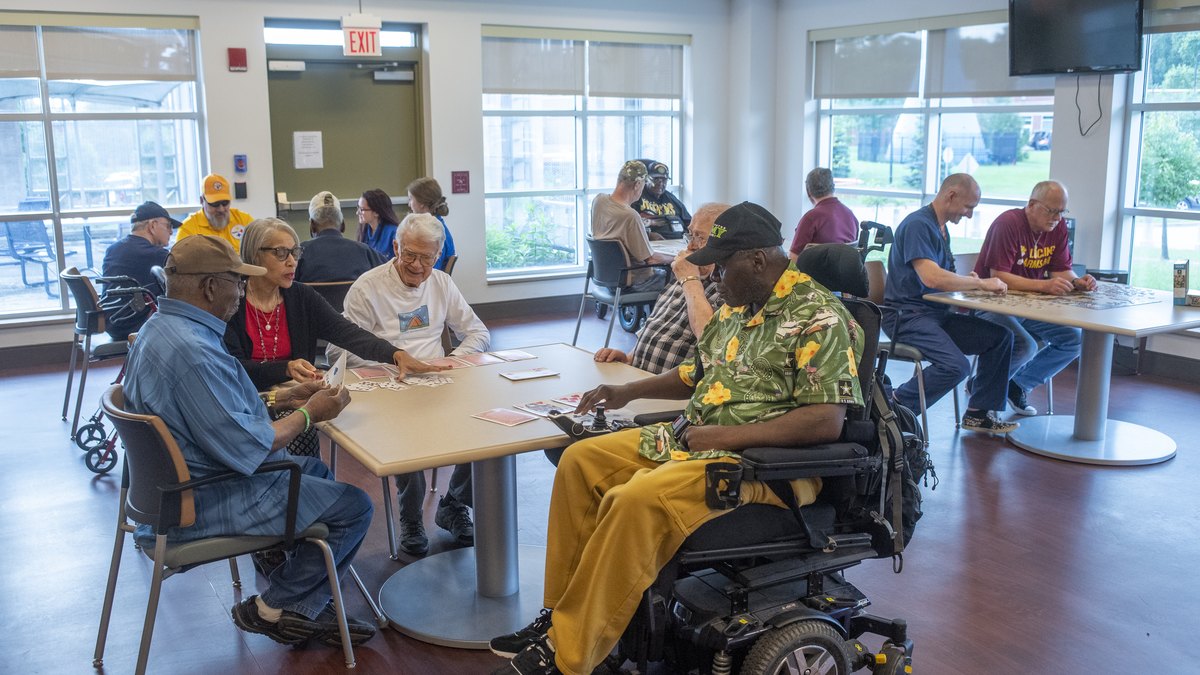
- Hero photo: U.S. Department of Veterans Affairs, U.S. government work, via VA.gov (file CBC-ADHC-2019, cropped) · Adult day health care program room
Figures were read from the linked pages in November 2026 and every figure carries the year or date shown beside it. I could not read CDC.gov, Medicaid.gov, the Texas HHSC site or the New York State Department of Health site, which refused automated requests, so I give no center count or national Medicaid rate and no Texas or New York rules. I found no neutral startup-cost figure. This is a business guide, not medical, legal, tax or financial advice.