How Do You Start a CNC Machining Shop Business in 2027?
Start by choosing a niche and the customers who will buy from you, then budget the machine, tooling, software, space and power, then add certifications only when customers ask. The costs in our sources span a wide range: a new Tormach 770M mill lists from $11,995, while a used 2020 Haas VF-2 was listed at $74,500. For financing, the SBA offers 7(a) loans up to $5 million, 504 loans for real estate and long-term machinery, and microloans up to $50,000. The BLS puts the median machinist and tool and die maker pay at $28.66 per hour (2025).
Everything labeled as our advice is our own judgment, not a finding from those sources. Sourced figures are cited with the page and the date we read it, October 30, 2026.
Pick a niche before you buy a machine
This is our own advice, not a sourced finding: decide who you will make parts for before you price any equipment, because the niche decides your machines, your certifications and your quality system. Common starting points are prototype and low-volume work for local manufacturers, repeat production for a few industrial customers, or regulated work such as aerospace and defense. Regulated work opens doors, but it adds registration and audit costs that a general job shop can skip.
The labor market is a useful reality check. The U.S. Bureau of Labor Statistics (BLS) projects machinist and tool and die maker employment to decline 1 percent from 2025 to 2035, yet still expects about 30,400 openings per year on average. For a new shop that means demand for parts is not the same as an easy hiring market.
- BLS: median pay, machinists and tool and die makers (2025)$59,620 per year ($28.66 per hour)
- BLS: machinist and tool and die maker medians (May 2025)Machinists $58,750; tool and die makers $64,050
- BLS: outlook, 2025 to 2035Employment projected to decline 1 percent, with about 30,400 openings per year on average
- BLS: number of jobs (2025)344,900
Startup costs: machines, CAM, tooling, space and power
The SBA tells new owners to separate one-time costs, such as major equipment and permits, from monthly costs such as salaries, rent and utilities, and to budget for at least one year of monthly expenses. For a CNC shop the big one-time item is the first machine, and it ranges enormously depending on what you buy. The two prices below are real listings, shown as examples and not as a budget.
- New compact mill: Tormach 770M, Machine Only (Tormach, read October 30, 2026)$11,995; the Premium package with stand, enclosure, vise, tooling, probe, coolant and a 10-pocket tool changer is $39,770.50
- Used production mill: 2020 Haas VF-2 (Star Equipment on SurplusRecord, read October 30, 2026)Asking $74,500 or best offer, about 4,330 runtime hours, sold with a 20 HP digital phase converter
- Power for the Tormach 770M (Tormach)Single-phase 115 VAC on a 15 A breaker
- Power note on the Haas listingThe sale includes a Phase Perfect PTO210 digital phase converter rated 20 HP, 240V, 64A continuous output; the listing does not state the machine's own input requirement
These two listings show the power question. A small mill can run from an ordinary circuit, while the production-class machine was sold together with a phase converter, which suggests it expects three-phase power. We could not read a Haas spec sheet (Haas blocked our request), so confirm each machine's electrical needs with the seller and have an electrician check your building before you sign a lease. That is our advice, not a figure from the listing.
Not published in the sources we could read: tooling and workholding budgets, CAM software cost, lease rates and build-out costs. Autodesk's Fusion pricing page returned an error, so no software price is given here. Get written quotes for CAM, tooling, coolant, inspection tools and rent before you finalize a budget. For software options, see our guide to the 10 best tech stack tools for CNC machine shops.
Certifications and registrations
No source we read says a general machine shop needs a certificate to open. Certifications are mostly something your customers ask for. Three come up most.
- ISO 9001. The international quality management standard that AS9100 is built on. ISO's own pages blocked our request, so we have no ISO-sourced detail to quote. Confirm what a customer expects before you pay for an audit.
- AS9100. Managed by the International Aerospace Quality Group (IAQG). Per Amtivo, a certification body, it is based on ISO 9001, keeps its core requirements and adds aerospace-specific controls. Certification can only be issued by a certification body accredited by an IAF-recognised national accreditation body and listed in IAQG's OASIS database, through a Stage 1 readiness review and a Stage 2 audit, with surveillance audits at least once a year. Amtivo says OASIS is the official source for current AS9100 certification status.
- ITAR registration. Under 22 CFR 122.1, any person in the United States in the business of manufacturing defense articles or services must register with the State Department's Directorate of Defense Trade Controls, and one occasion of manufacturing is enough. The rule says a manufacturer who does not export must nevertheless register. The Tier 1 registration fee is $3,000 per year for new registrants under 22 CFR 122.3, which Holland & Knight reported as an increase from $2,250 effective January 9, 2025.
Finding your first customers
Our advice: start with the customers you can reach without a certificate, such as local manufacturers, contract engineers and fabricators who need overflow capacity, and use quality credentials to move up later. Three official channels are worth knowing.
- SAM.gov registration. The federal site says a registration allows you to bid on government contracts and apply for federal assistance.
- NIST MEP. The Manufacturing Extension Partnership network includes nearly 1,400 manufacturing advisors at more than 450 service locations, per NIST's July 22, 2026 release. NIST says small and medium-sized manufacturers make up 98% of the U.S. manufacturing base.
- SBA Small Business Development Centers. They offer individualized business advising on planning, operations, financial management, marketing and sales. The SBA page does not state a price, so ask your local center.
We also tried to read the APEX Accelerators page for government contracting help and it did not return usable text, so we have no sourced detail on that program beyond naming it as a place to ask.
Quoting and shop rates
Published shop-rate data is thin. The only source we could read in full is a vendor blog, so treat its numbers as a rough sanity check, not a benchmark.
- 3-axis mill, hourly (Fabcon, published March 30, 2026)$35-60 per hour
- 5-axis mill, hourly (same article)$100-200 per hour; the article also cites a separate $75-$300 range
- What the rates leave out (same article)Setup, materials and finishing are added on top of hourly rate times machining hours
Fabcon says its figures exclude setup and material costs and does not describe how it gathered them. Our advice: build your own rate from your costs (machine payment, rent, power, tooling, labor, overhead) plus the margin you need, then compare it with those ranges and with quotes from shops near you. Do not copy a published rate without checking it against your costs.
Staffing
Pay is the one staffing number we could source. BLS lists a median of $28.66 per hour for machinists and tool and die makers combined (2025), with machinists at $58,750 per year and tool and die makers at $64,050 (May 2025). Many one-person shops start with the owner running the machine, then hire when the schedule fills. That is our observation, not a BLS finding. With about 30,400 annual openings across the occupation per BLS, expect to compete for experienced people. Ask local community colleges and your state workforce agency about training programs.
Financing: SBA loan programs
The SBA does not lend directly. Borrowers apply through participating lenders, and SBA's Lender Match tool helps find one. Three programs fit a machine shop.
- SBA 7(a) loans (sba.gov, read October 30, 2026)Maximum $5 million; uses include equipment and machinery, working capital, and real estate
- SBA 504 loans (sba.gov, read October 30, 2026)Real estate and long-term machinery and equipment with a useful remaining life of at least 10 years; the page says both up to $5 million and $5.5 million
- SBA microloans (sba.gov, read October 30, 2026)Up to $50,000, average about $13,000, repayment up to seven years; can fund supplies and production tools but not real estate
Our reading: a used machine or a small mill can fit a microloan, while a building or a production machine is a 504 or 7(a) conversation. The SBA's 504 page gives two different caps, so confirm the number with a lender. Lenders will want the startup-cost estimate described above.
A sensible order of operations
- Choose a niche and talk to potential customers about what they buy and what quality paperwork they require.
- Write a startup budget with one-time and monthly costs, using written quotes for machines, tooling, software and rent, and an electrician's check of the power.
- Line up financing by meeting an SBDC advisor and a participating SBA lender.
- Register the business and SAM.gov, and decide whether ITAR registration applies before you accept any defense-related drawings.
- Buy the first machine last once a customer is ready to give you work, and add AS9100 or ISO 9001 when customers ask for it.
Questions people ask
How much does it cost to start a CNC machine shop?
No single source gives a total. Published examples: a new Tormach 770M mill from $11,995 up to $39,770.50 in its Premium package (Tormach), and a used 2020 Haas VF-2 asking $74,500 (SurplusRecord listing). Add tooling, software, rent, power work and a year of monthly expenses, as the SBA advises (SBA).
Do you need ITAR registration for a CNC shop?
Only if you manufacture defense articles or services. Under 22 CFR 122.1 a manufacturer must register even if it does not export, and the Tier 1 fee is $3,000 per year for new registrants (eCFR). Ask your customer and an export-control attorney whether a part qualifies.
How much do machinists earn?
BLS reports a 2025 median of $59,620 per year ($28.66 per hour) for machinists and tool and die makers, with machinists at $58,750 and tool and die makers at $64,050 (May 2025) (BLS).
Can I get an SBA loan for CNC machines?
Yes, the SBA lists equipment and machinery among 7(a) uses, with a $5 million maximum, and long-term machinery and equipment among 504 uses. Microloans go up to $50,000 for supplies and production tools (7(a), 504, microloans).
What hourly rate should a CNC shop charge?
Fabcon, a vendor blog, lists $35-60 per hour for 3-axis and $100-200 for 5-axis, excluding setup and material (Fabcon). Our advice is to build your rate from your own costs and use ranges like this only as a check.
Sources
- BLS: Machinists and Tool and Die Makers (page modified October 29, 2026) · Pay, outlook, openings
- SBA 7(a) loans (read October 30, 2026) · Loan maximum and uses
- SBA 504 loans (read October 30, 2026) · Real estate and equipment uses
- SBA microloans (read October 30, 2026) · Amount, uses, term
- SBA: Calculate your startup costs (read October 30, 2026) · Startup cost guidance
- SBA: Small Business Development Centers (read October 30, 2026) · Advising services
- eCFR: 22 CFR Part 122 (read October 30, 2026) · ITAR registration and Tier 1 fee
- Holland & Knight: ITAR registration fee increases (December 11, 2024) · Fee change effective January 9, 2025
- Amtivo: AS9100 certification (read October 30, 2026) · AS9100, IAQG, OASIS
- SAM.gov entity registration (read October 30, 2026) · Federal bidding registration
- NIST release on MEP centers (July 22, 2026) · MEP network size
- Tormach 770M (read October 30, 2026) · Prices and power
- Star Equipment used Haas VF-2 listing (read October 30, 2026) · Used machine price
- Fabcon: CNC machining hourly rates (published March 30, 2026) · Hourly rate ranges
Figures were read from the linked pages on October 30, 2026. Prices change, and some official pages (ISO, IAQG, Haas, Autodesk, APEX Accelerators) blocked or did not return usable text, so no figures from them are used. Shop-rate data comes from a vendor blog. Anything labeled as our advice is our own judgment. This is not legal, tax or financial advice.
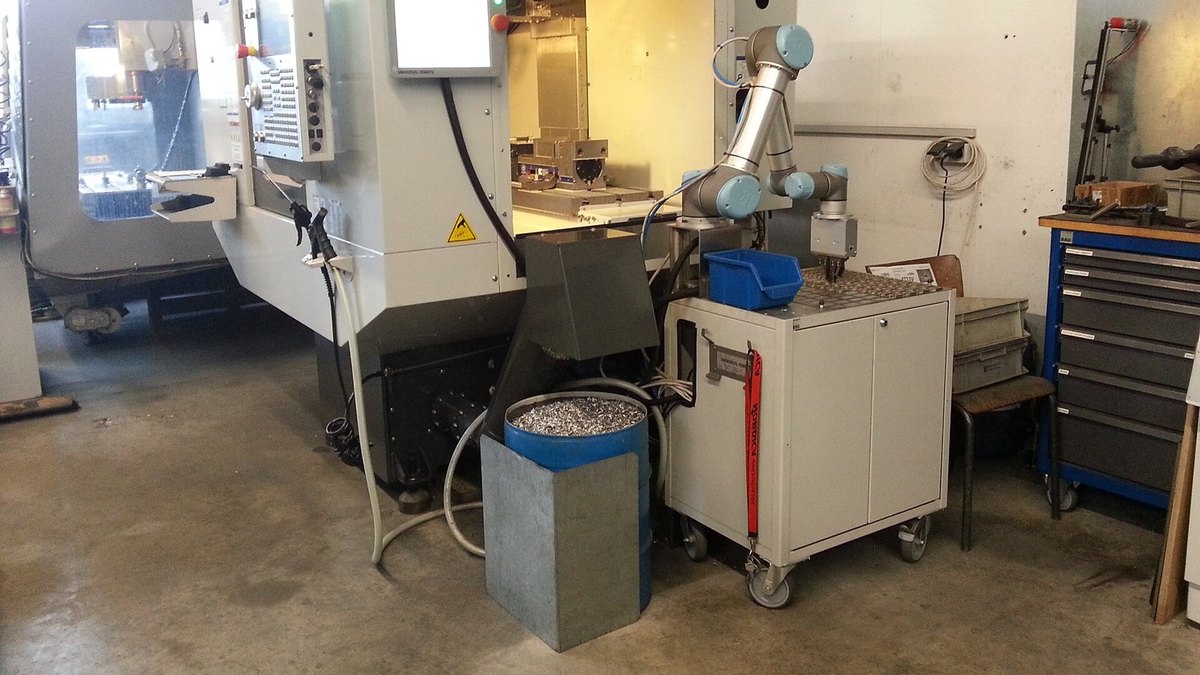
Top photo: EGU-Metall / CC BY-SA 3.0 via Wikimedia Commons