How Do You Start a Container Home Builder Business in 2027?

You start a container home builder business by getting the contractor license your state or locality requires, learning the building code and zoning rules for each place you will build, sourcing containers that carry a safety approval plate, hiring a structural engineer for the design, and finding customers who can finance the build. The license and the local permit rules come first, because they are set by your state, county or city and decide whether you can legally sell and build at all.
Published prices for container homes come mostly from builders and blogs. One builder lists a 160 square foot model at a starting price of $39,995, and a review of another Texas builder reported a 20-foot home at $40,000 before site work. Treat every cost figure on this page as the claim of whoever published it, not a verified result.
This page is general information from public sources read on November 5, 2026. It is not legal or financial advice. Talk to your state licensing board, your local building department, an attorney and an accountant before you commit money.
Contractor licensing depends on your state
There is no single national contractor license. Each state decides who must be licensed to build, and some states leave part of it to counties and cities. Two state licensing boards read for this article show how different the starting points are.
- California. The Contractors State License Board says anyone who contracts to perform work on a project that requires a building permit, uses employee labor, or is valued at $1,000 or more for combined labor and materials must hold a current, valid license from the board. It points to a licensed B General Building contractor when a project combines plumbing, electrical and carpentry work under one contract.
- Florida. The state's Construction Industry Licensing Board FAQ describes two routes. A certified contractor passes the Florida examination and can work throughout the state. A registered contractor starts with a local county or city license and may only practice in that county or city. The FAQ adds that local licensing laws can still apply, so check each jurisdiction where you plan to work.
Those two states do not match in thresholds, exams or what a local license means, and the other states differ again. Use your own state's licensing board as the source of truth, and ask it whether a builder who sells finished homes needs a general contractor license, a residential license, or a different credential. You may also need to register a business entity and carry insurance. The SBA lists applying for licenses and permits as a step in launching a business.
Building codes and zoning: ICC, state and local rules
The International Code Council (ICC) publishes the model International Building Code (IBC). An ICC-hosted conference handout on container structures says most governments trust the ICC's suggested codes and adopt the IBC into law. The same handout describes the container situation before recent code changes as a patchwork of inconsistent regulations, and says a shipping container building code should not be one-size-fits-all.
Adoption is local in practice. One Alaska example, the Matanuska-Susitna Borough, states that the provisions of 2021 IBC Section 3115 and other applicable sections apply to intermodal shipping containers used as structures. It also requires construction documents that verify the container's dimensions and a structural analysis meeting Section 3115.8.4 to be given to the building official. Your jurisdiction may have adopted a different edition, may have its own amendments, or may treat containers differently, so ask your building department which code edition and rules apply to the address.
Permanent structures are held to the code like any other building, according to STRUCTURE magazine. The article adds that a code official can reasonably rely on a data plate to confirm a container was built and inspected to the appropriate ISO standard, and that a container without a CSC Safety Approval Plate can and should be rejected by code officials.
Zoning is a separate question from the building code. The SBA says zoning laws are typically controlled at the local level and that ordinances can restrict or ban specific uses, so a buyer's lot must permit the home you are selling. Check with the city or county planning office before you promise a customer a delivery date.
Sourcing containers and structural engineering
The container is a structural steel box built for shipping, and cutting windows and doors into it changes how it carries load. STRUCTURE magazine names a lack of information on the material properties and specifications of the container's steel elements as a key problem, and notes that the ICC-ES acceptance criterion AC462 is not meant for overall building code compliance. It addresses the container's physical and chemical properties.
For a builder, that points to three habits. Buy containers that carry a CSC Safety Approval Plate and keep the paperwork. Have a licensed structural engineer prepare the design and analysis your building official asks for. Ask your jurisdiction whether it also requires engineer-stamped foundation plans, because the rules are local.
Container suppliers sell the raw material. Conexwest, a seller, says it offers new, used and refurbished containers from 10 feet to 45 feet. That is a vendor's description of its own inventory, so confirm condition, dimensions and the data plate before you buy.
Financing for your buyers: what lenders say
Many of your customers will need a loan, so how lenders treat container homes affects your sales. Finder, a comparison site, said in an article last updated June 9, 2026 that lenders tend to be conservative with this type of construction and that most banks will not fund property that is not permanently fixed to the site. It adds that many lenders will not provide funds before a certain building stage has been reached, and some release funds only after the home is completely installed.
Conexwest, a container seller, says in its mortgage guide that a container home may qualify for a traditional mortgage if it is a permanent structure on a permanent foundation with utility hookups, on land the buyer owns. It lists a credit score of 620 or higher as generally needed for a conventional loan. Those are a seller's statements, not a lender's rules, and every lender sets its own terms.
What this means for a new builder: build on a permanent foundation with permits and plans a lender can review, and expect buyers to ask lenders early. A builder who can hand a lender engineered plans, permits and a clear schedule makes the buyer's job easier. Whether a given lender will finance a given container home is something only that lender can tell you.
You may need financing too. The SBA says its 7(a) loan program has a maximum loan amount of $5 million, and that eligible uses include acquiring, refinancing or improving real estate and buildings, working capital, and machinery and equipment. SBA says it does not provide 7(a) loans directly to borrowers, so you apply through a lender.
Costs: what builders publish
Nobody publishes a single verified cost for starting this business, and no earnings figures are given here. What exists are builder prices for homes, which show what customers see. Each figure below is attributed to its publisher and is unverified.
- Alternative Living Spaces, ALT 20' model (builder's page)Starting price $39,995 for 160 square feet, with a solid foundation or wheels listed as options
- Backcountry Containers, 20' single container (Prefab Review, May 23, 2022)Base $40,000 for 150 square feet, excluding site work, and $55,000+ all-in
- Backcountry Containers, 40' single container (Prefab Review, May 23, 2022)Base $60,000 for 280 square feet, excluding site work, and $88,000+ all-in
- Backcountry Containers per square foot estimate (Prefab Review)$314 to $367+ per square foot, including shell, shipping and site work
Sources: Alternative Living Spaces and Prefab Review. The Prefab Review article is a third-party review from 2022, so prices may have changed. The ALT page lists a hookup and HVAC package as included, and the Prefab Review all-in figures add an average of $10,000 for site preparation and a shipping fee of $3 to $4 per mile from Houston, Texas. Land, upgrades and extra site work are excluded.
Those are the prices of finished homes. They do not tell you a builder's own startup cost, margin or profit, and this page does not state any. For your own numbers, price your local permits, engineering, foundation, delivery, labor and insurance, and use the SBA startup cost guide to separate one-time costs from monthly costs.
Finding your first customers
The SBA's market research guide says market research lets you reduce risks, advises gathering demographic information, and says competitive analysis shows what rivals do well and where you can differ. It lists free federal sources such as the U.S. Census Bureau and the Bureau of Labor Statistics.
- Check demand where you will build. Ask your building department how many container projects it has permitted and what it requires. If your area bans or limits them, you will know before you buy inventory.
- Study published competitors. Builders such as Alternative Living Spaces post model names, sizes and starting prices on their own sites. Compare what is included before you set your own pricing.
- Line up financing partners. Because lenders are cautious about container homes, talk to local banks and credit unions about what they need and share that with buyers.
- Show finished work. Photos, permits and the engineer's plans for completed projects give buyers and lenders something concrete to review.
Check before you spend
- Call your state licensing board. Ask what license a builder of your size needs and what it costs.
- Ask the building department which code edition applies. Get its rules for shipping containers in writing.
- Confirm zoning for each lot. Ask the planning office whether a container home is permitted at the address.
- Hire a structural engineer. Have the design and analysis done before you buy containers.
- Talk to a lender and an attorney. Ask what a buyer's lender will require and have an attorney review your contracts and entity setup.
Questions people ask
Do I need a contractor license to build container homes?
In most places, yes, but the rules are set by each state and sometimes by counties and cities. California's CSLB requires a license for projects that need a building permit, and Florida has certified and registered tiers. Check your own state board.
Are shipping container homes allowed by building code?
It depends on where you build. The ICC publishes the model code and local governments adopt their own editions and amendments. One borough read for this page applies 2021 IBC Section 3115 to containers used as structures. Ask your building department.
Can buyers get a mortgage on a container home?
Sometimes. Finder says lenders tend to be conservative and most banks will not fund property that is not permanently fixed to the site. Each lender sets its own terms.
How much does a container home cost?
Builders publish different prices. Alternative Living Spaces lists a starting price of $39,995 for a 160 square foot model, and Prefab Review reported Backcountry Containers at $314 to $367+ per square foot in 2022. These are unverified claims by their publishers, and site work is often extra.
How much profit does a container home builder make?
There is no verified figure in the sources read for this page, so none is given. Build your own budget from local permit, engineering, foundation, delivery and labor costs.
Sources
- California CSLB: What kind of contractor do you need? · California license rule
- Florida DBPR: Construction industry FAQs · Certified and registered contractors
- ICC 2019 conference handout: Safe use of modified shipping containers · Code adoption and container guidelines
- Matanuska-Susitna Borough: Intermodal shipping containers · Local adoption of IBC Section 3115
- STRUCTURE magazine: Safe building with shipping containers · Structural and data plate points
- SBA: Pick your business location · Local zoning
- SBA: Apply for licenses and permits · Licenses and permits step
- SBA: 7(a) loans · Loan program and uses
- SBA: Calculate your startup costs · One-time and monthly costs
- SBA: Market research and competitive analysis · Customers and competitors
- Finder: Buying a shipping container home · How lenders treat container homes
- Conexwest: Can you get a mortgage for a shipping container home? · Seller's financing notes and inventory
- Alternative Living Spaces: ALT 20' container home · Builder's published price
- Prefab Review: Backcountry Containers prices and cost · Third-party report of builder prices (2022)
Figures were read from the linked pages on November 5, 2026. Prices and financing statements are the published claims of the named authors, not verified results, and some pages come from companies that sell containers or homes. Photos are credited under each image. This is general information, not legal or financial advice.
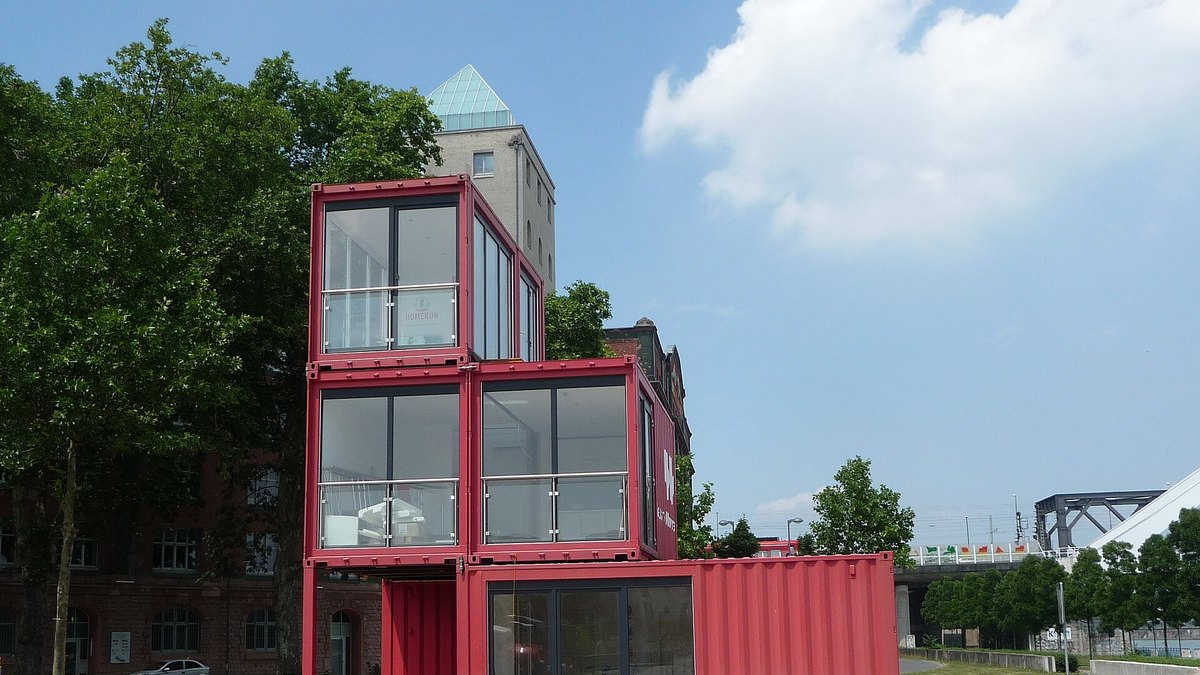
Top photo: The wub / CC BY-SA 4.0 via Wikimedia Commons