How Do You Start a Drone Light Show Business in 2027?
You start a drone light show business by getting your pilots certified under FAA Part 107, buying a fleet with show software, winning FAA waivers to fly many aircraft at night, getting airspace authorization for each site, carrying insurance, and then selling shows. The fleet is only half the job: the waivers, the airspace approvals and the sales pipeline are what let you fly.
Start-up cost is dominated by hardware. One third-party guide, The Drone Girl, says UVify charges roughly $1,585 per drone and a 50-drone starter fleet is $79,250+, while Verge Aero and most other vendors do not publish fleet prices at all. On the revenue side, operator Sky Elements says smaller shows start at $20,000, medium shows are closer to $40,000 and larger shows can get above $100,000.
The biggest new risk is policy. In July 2026 the FCC proposed restrictions that name multi-drone light shows as "swarming" drones, which could limit where operators can buy aircraft and parts. This page is not legal, insurance or financial advice; check the FAA pages linked below and talk to an aviation attorney before you buy a fleet.
Get certified under FAA Part 107
Commercial drone work in the U.S. runs through a remote pilot certificate. The FAA says to become a pilot you must be at least 16 years old, be able to read, speak, write and understand English, be in a physical and mental condition to safely fly a drone, and pass the initial aeronautical knowledge exam, Unmanned Aircraft General - Small (UAG).
The FAA lists the path as: create an FAA Tracking Number through an IACRA profile, schedule the test at an FAA-approved Knowledge Testing Center with a government-issued photo ID, pass it, complete FAA Form 8710-13 in IACRA, and wait for the TSA security background check email, after which you can print a temporary certificate. A permanent certificate arrives by mail. Test topics include operation at night, which matters for this business.
The FAA page does not state the testing fee, so check the testing center for the current charge. Certificate holders must also complete an online recurrent training every 24 calendar months, so budget that for every pilot on your crew.
Plan for waivers: multiple aircraft and night
A light show breaks two basic Part 107 rules. The FAA waiver page says you do not need a waiver when you comply with all Part 107 rules, and lists the rules a show typically hits:
- Fly multiple small UAS with only one remote pilot107.35 Operation of Multiple Small UAS
- Fly at night or in civil twilight without anti-collision lighting107.29 Operation at Night
- FAA review target for a waiver requestWithin 90 days of submission, varying with complexity and completeness
Waiver requests have moved: the FAA says the waiver application process has transitioned to its Aviation Integrated Safety (AIS) Services system, while the Part 107 airspace authorization process stays in the FAADroneZone. Your application must describe where you will fly, your maximum altitude above ground level, how the aircraft are contained (for example geo-fencing), your termination system and how your personnel are trained. The FAA says an application that does not identify hazards and propose mitigations will be disapproved for insufficient information, and if you do not answer a request for information within 30 days the application is canceled and you must resubmit.
If you intend to use a waiver at night, the FAA says you must include details on how you will mitigate the additional risk or you may be restricted to daylight operations only. Operators also describe this in their own words: DroneDJ reports that operator Skyworx says it operates under an FAA waiver covering its multi-drone operations. Verge Aero says on its fleet page that it gives regulatory guidance for FAA, EASA and pyro waivers to buyers. Those are vendor and operator claims, not FAA statements.
Airspace authorization with LAANC and DroneZone
Waivers cover how you fly; authorization covers where. The FAA says drone pilots planning to fly under 400 feet in controlled airspace around airports must receive an airspace authorization before they fly. LAANC automates that process and, if approved, pilots can receive authorization in near-real time. It is available at 726 airports.
For a show you will often need more than the standard ceiling. The FAA says a further coordination request, for flying above the designated altitude ceiling on a UAS Facility Map up to 400 feet, can be made up to 90 days in advance and is coordinated manually. If an operation in controlled airspace needs both a waiver and an airspace authorization, the FAA says you must apply for both through DroneZone. Near airports that do not offer LAANC, use the manual process.
Operators describe the same sequence. Sky Elements says it obtains airspace permission before each show and flies up to 400 feet above the ground; for higher, it says it can request special exemptions but that the process takes up to 90 days and approval is not guaranteed.
Buy a show platform: drones plus software
You can buy a vertically integrated system, or assemble your own. Published prices are scarce, so here is exactly what the sources say.
- UVify IFO, per The Drone Girl (third-party guide)Roughly $1,585 per drone; starter fleet of 50 drones $79,250+; sold as turnkey with software, support and training
- Verge Aero, vendor fleet pageScales from 50 drones to thousands; pricing discussed on a 30-45 minute consultation call, no prices published
- Verge Aero starter package, AOPA (October 2023)50 drones, training and access to its show production software; no price given
- Skybrush, open-source show softwareCommunity Server limited to 10 drones; Skybrush Live Professional is paid, price not on the pages read
- SPH Engineering Drone Show Software Diamond (100 drones), Maverick listingQuote requested on the main listing; a related-products tile on the same page shows $39,999.00
Verge Aero markets one in-house system of drones, design software and ground control, with in-person training and 24/7/365 support. The Drone Girl adds that UVify is the largest maker of light show drones and will not let you buy just one. Treat both as vendor positions, and ask for written quotes.
On the software side, Skybrush calls itself the leading open-source suite for designing, visualising, testing and delivering shows. Operators need at least Skybrush Server and Skybrush Live and must install custom firmware on their drones. Its documentation says the pre-compiled community Server is limited to 10 drones, the open-source Python server can become painfully slow and unreliable above around 500-800 drones, and a professional licence removes the limits. So open source is a way to learn and test cheaply, but a real fleet needs the paid tier.
For DJI: UAV Coach reports that, since the FCC's late-2025 move, new foreign-made drones without FCC approval cannot be imported, marketed or sold in the U.S. without an exemption, while existing approved DJI drones are not banned. None of the sources read for this page describe a DJI drone show system, so this page does not treat DJI as a show-fleet option. SPH Engineering sells its Drone Show Software through resellers such as Maverick. Holoswarm could not be verified from any page read, so it is not covered.
Insurance and venue requirements
The Drone Girl says drone insurance is not required in the U.S. under FAA rules, but many event spaces require it, so check with the property owner. It lists waivers, insurance, safety staff and barriers, permitting and site rental among the additional costs of shows.
SkyWatch, an insurance seller, says liability insurance covers third-party bodily injury or property damage claims and that hull insurance, which can optionally be applied, can safeguard the aircraft against damage, loss or theft. It notes coverage is subject to the terms, conditions and exclusions of the actual policy, so read exclusions for night and multi-aircraft flying before you buy. For reference, Sky Elements says it carries aviation, general liability, workers comp and automotive insurance.
Price your shows
These are the only price points used here, and each comes from the page named.
- Sky Elements (operator pricing page)Smaller shows start at $20,000; medium shows about $40,000; larger shows can get above $100,000
- The Drone Girl guide: typical per-drone rate$200 to $300 per drone, shows typically start at 100 drones, base costs about $20,000 to $30,000
- North America average, 2024 market analysis via The Drone GirlAverage show cost $52,455; average cost per drone $233
- Small-town fireworks, The Drone Girl$2,000-$7,000
Sky Elements says shows are mainly priced by the number of drones, and that peak days such as the 4th of July or New Year's Eve are often the most expensive. It also says congested cities such as New York City may require road closures, city permits and costly launch-space rentals. The Drone Girl notes that prices often include design, animation, FAA approvals and onsite operation, while setup, travel or extra effects can cost more. These are what clients may pay; they are not your profit.
Fireworks are the real competitor in a small town, and the same guide puts small-town displays at $2,000-$7,000, far below a drone show. Your pitch has to be about what a drone show can do that fireworks cannot, not about being cheaper.
The 2026 FCC risk to know before you buy
This is the part most start-up guides miss. The Drone Girl reports that on July 21, 2026 the FCC released Public Notice DA 26-758 proposing a ban on importing and marketing foreign-produced "military-grade" drones and their critical components, and that one category, "Swarming UAS", is defined to include multi-drone light shows. It stresses this is a proposal, not an actual ban, and that currently operating fleets would not be grounded. But because critical components are covered, operators might not be able to import replacement parts.
The same article says UVify, used by Sky Elements, is based in South Korea, and that American-made options include Texas-based Verge Aero and Michigan-based Firefly. DroneDJ reported on September 14, 2026 that operator Skyworx asked the FCC to exclude purpose-built entertainment drones, saying its drones weigh no more than 3 pounds and every show is flown under the continuous control of an FAA-licensed remote pilot.
A practical starting order
- Get certified first. Pass the Part 107 knowledge test and complete the TSA vetting, so you can fly and so your crew can be named in waiver applications.
- Talk to vendors before you borrow. Request written quotes from UVify, Verge Aero and others, and ask about FCC exposure and parts supply.
- Test on a small scale. Skybrush community software handles up to 10 drones, enough to learn the workflow before a larger purchase.
- File the waiver early. The FAA aims to decide within 90 days, and incomplete safety explanations get disapproved.
- Line up insurance and venue rules. Many event spaces require insurance, so get quotes and ask what the venue demands.
- Sell shows you can fly. Quote clients after your waiver, airspace authorization and insurance are in place, and price around peak dates.
Questions people ask
Do I need a license to run a drone light show business?
Yes, pilots need a Part 107 remote pilot certificate. The FAA says you must be at least 16 years old and pass the initial aeronautical knowledge exam, then complete TSA vetting. Shows also need waivers and airspace authorization.
Which FAA waivers does a drone show need?
The FAA waiver page lists 107.35 for flying multiple small UAS with only one remote pilot and 107.29 for operating at night. The FAA aims to review waiver requests within 90 days.
How do I get airspace authorization near an airport?
Use LAANC for near-real-time authorization under 400 feet, or a further coordination request up to 90 days ahead for higher altitudes within 400 feet, per the FAA. If you need a waiver and an authorization together, apply for both through DroneZone.
How much does a drone light show fleet cost?
Prices are mostly unpublished. The Drone Girl says UVify charges roughly $1,585 per drone, so a 50-drone starter fleet is $79,250+. Verge Aero does not publish prices on its fleet page.
How much can I charge for a drone show?
Sky Elements says smaller shows start at $20,000, medium shows are closer to $40,000 and larger shows can get above $100,000. Those are one operator's published ranges, not a guarantee.
Is Skybrush free?
Partly. Skybrush is open-source, but its documentation says the community Server is limited to 10 drones and recommends a professional licence for large shows. Professional prices were not on the pages read.
Does insurance matter if the FAA does not require it?
Yes. The Drone Girl says many event spaces require drone insurance even though the FAA does not.
Sources
- FAA: Become a Drone Pilot · Part 107 eligibility, test steps, TSA vetting, recurrent training
- FAA: Part 107 Waivers · 107.35 and 107.29 waivers, the 90-day target, AIS Services and DroneZone
- FAA: UAS Data Exchange (LAANC) · Airspace authorization, further coordination, DroneZone
- Sky Elements: Drone Show Pricing Guide · Operator show price ranges and pricing factors
- Sky Elements: FAQ · Operator statements on insurance and airspace permission
- The Drone Girl: How much does a drone light show cost · Per-drone rates, UVify prices, insurance and extra costs
- Verge Aero: Buy a Drone Show Fleet · Vendor system description, no published prices
- AOPA: Drone show in a box · Verge Aero X7 starter package announcement
- Skybrush: Suite modules · Open-source show software modules
- Skybrush docs: Running shows FAQ · Community version limits
- Maverick: SPH Engineering Drone Show Software Diamond · Software package listing
- SkyWatch: Drone light show insurance · Liability and hull insurance (insurer sales page)
- The Drone Girl: FCC drone light show proposal · FCC Public Notice DA 26-758 and swarming category
- DroneDJ: FCC plan alarms American operators · Skyworx filing and operator safeguards
- UAV Coach: The DJI Ban · Status of new and existing DJI drones
Figures were read from the linked pages on October 31, 2026. Prices are vendor or operator statements and change; the FCC item is a proposal. This is not legal, insurance or financial advice.
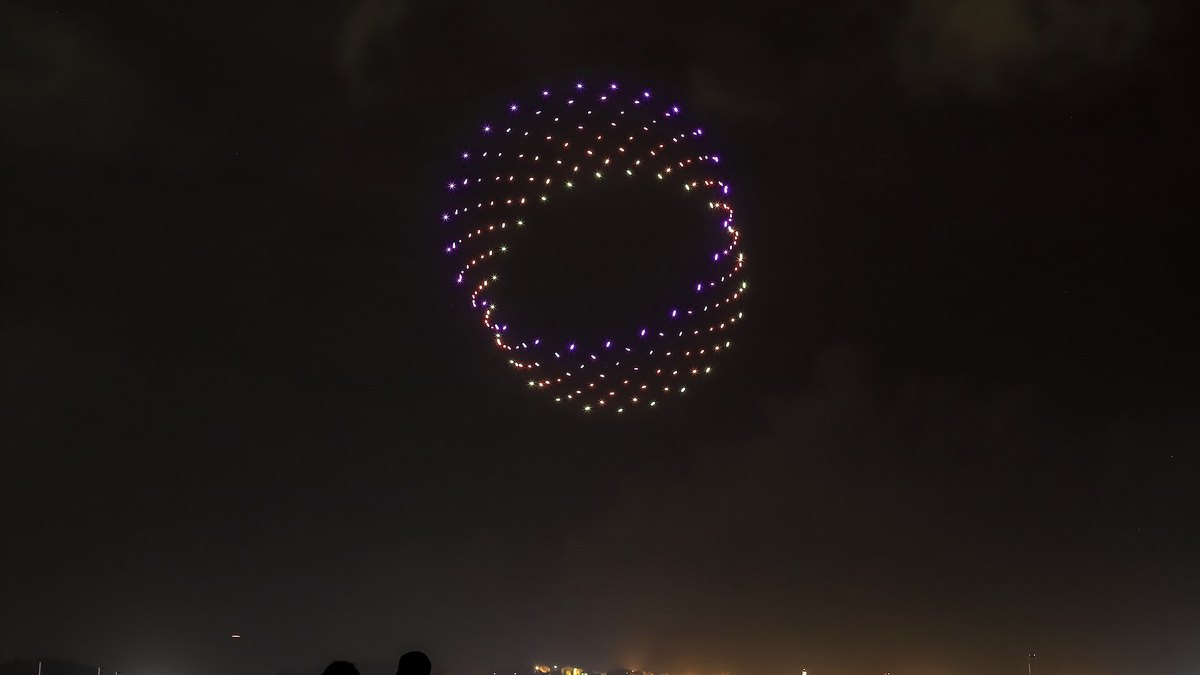
Top photo: David Álvarez López from Gijón, España / CC BY 2.0 via Wikimedia Commons