Who Are the LLM-as-a-Service Vendors to Know in 2027?
LLM-as-a-Service vendors fall into four groups, and most buyers end up using more than one. The frontier labs sell their own models by the token (OpenAI, Anthropic, Google's Gemini API and the Grok API). Lower-cost and open-weight labs compete hard on price (Mistral, DeepSeek, Cohere). The big clouds resell many labs' models under one contract (Amazon Bedrock and Azure OpenAI in Microsoft Foundry). Inference specialists host open-weight models (Together AI, Fireworks AI and GroqCloud).
Every price below is a list price per 1 million tokens in USD, read from the vendor's own pricing or docs page on November 3, 2026. These pages change often, and several already announce scheduled increases, so check the linked page before you sign anything.
This is a map of who sells what, not a ranking. Quality, speed and terms differ by workload, and no single vendor wins on all of them.
The frontier labs that sell their own models
OpenAI. The API pricing page lists four flagship models at standard rates: gpt-6-astra at $10.00 input and $50.00 output, gpt-6.1-sol at $2.00 and $10.00, gpt-6.1-terra at $1.00 and $5.00, and gpt-6-luna at $0.10 and $0.50. Batch halves those rates (gpt-6-astra drops to $5.00 and $25.00), while the faster tiers cost more: Fast mode lists gpt-6-astra at $20.00 and $100.00, and Ultrafast at $60.00 and $300.00. OpenAI also says regional processing (data residency) endpoints carry a 10% uplift for models released on or after March 5, 2026, and that Priority processing was renamed Fast mode on July 30, 2026.
Anthropic. The Claude pricing page lists Claude Fable 5.1 at $10 input and $50 output, Claude Opus 5.5 at $4 and $20, Claude Sonnet 5.5 at $2 and $10, and Claude Haiku 5.5 at $0.10 and $0.50 for prompts up to 100,000 tokens. The Batch API gives a 50 percent discount on input and output tokens. Claude is also sold through Amazon Bedrock, Google Cloud and Microsoft Foundry, and Anthropic says regional and multi-region endpoints include a 10 percent premium over global endpoints. One detail that changes real cost: Claude 4.7 and later models use a newer tokenizer that, per Anthropic, produces approximately 30% more tokens for the same text.
Google. The Gemini Developer API pricing page offers a Free tier, a Paid tier and an Enterprise tier. Its flagship, Gemini 4 Argon, is not on the Free tier and costs $2.00 input and $10.00 output through November 30, 2026, then $4.00 and $20.00 starting December 1, 2026. Gemini 3.8 Flash is $0.75 and $3.75 through December 31, 2026, then $1.50 and $7.50 starting January 1, 2027. The Paid tier includes a Batch API with a 50% cost reduction.
Grok API. The Grok models page lists grok-4.7 as the flagship, with a 500k-token context, $2.00 input and $6.00 output, and a knowledge cut-off of May 2026. The same docs carry guides for using Grok through Google Cloud Vertex AI and Microsoft Foundry.
Lower-cost and open-weight labs
Mistral. The API pricing page lists Mistral Large 4 at $0.7 input and $2.1 output, and Mistral Small 4 at $0.15 and $0.6. The models overview calls Mistral Large 4 open-weight under the Mistral Ecosystem Open Weight License and lists Mistral Small 4 under Apache 2.0. Mistral also serves third-party open models, including Z.ai GLM 5.3 and DeepSeek V4.1 Flash 1017, from the same API.
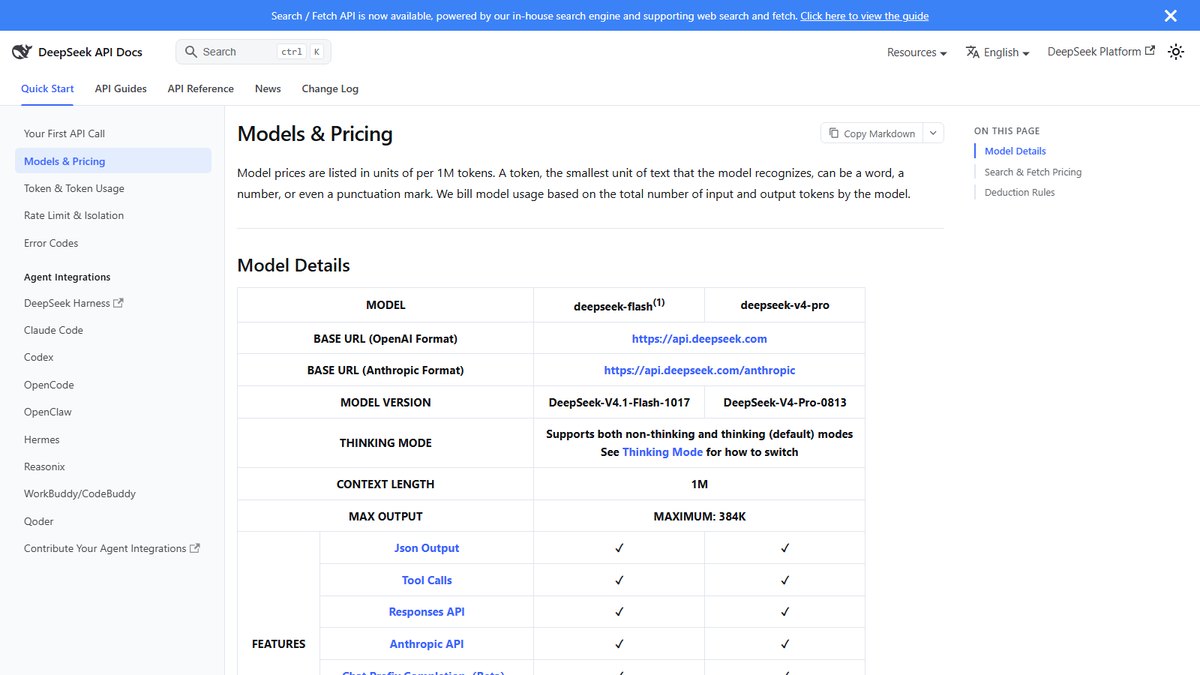
DeepSeek. The Models and Pricing page offers deepseek-flash and deepseek-v4-pro with a 1M context length, and base URLs in both OpenAI and Anthropic formats. Prices change by time of day: at peak, deepseek-flash costs $0.3 per 1M input tokens on a cache miss and $1.2 per 1M output tokens, and deepseek-v4-pro costs $1.32 and $3.96. DeepSeek says off-peak rates are half of the peak rates, with peak hours of 01:00 - 04:00 and 06:00 - 10:00 UTC, Monday through Friday.
Cohere. Cohere's pricing page leads with enterprise products and Model Vault, a dedicated platform that runs Cohere's models and leading open-weight models, priced by the GPUs your model runs on and the number of replicas. An H100 80GB lists at $6.25 per GPU per hour on demand, with a promotional $4.25 through March 31, 2027. Trial API keys are free but rate limited and not allowed for production; production keys are billed pay-as-you-go.
Cloud platforms that resell many labs
If your company already buys from AWS or Microsoft, a model platform on that cloud can be the simplest contract to get approved.
- Amazon Bedrock The pricing page lists models from AI21 Labs, Amazon, Anthropic, Cohere, DeepSeek, Google, Luma AI, Meta, MiniMax AI, Mistral AI, Moonshot AI, NVIDIA, OpenAI, Qwen, Stability AI, TwelveLabs, Writer, xAI and Z AI, plus Custom Model Import. It supports Standard, Flex, Priority and Reserved tiers, and offers batch inference on select models at a 50% lower price than on-demand.
- Azure OpenAI in Microsoft Foundry The Azure OpenAI pricing page offers Global and Data Zone (EU or US) deployments, Provisioned throughput units (PTUs) with monthly and annual reservations, and a Batch API that returns completions within 24 hours for a 50% discount on Global Standard pricing.
- Claude in Microsoft Foundry Anthropic says Claude in Microsoft Foundry bills through the Azure Marketplace in Claude Consumption Units at $0.01 USD per CCU, so it lands on the Azure bill as a single line item.
The tradeoff is that partner platforms set their own prices and regions. Anthropic's page notes that Bedrock and Google-managed Claude have independent regional pricing, so compare the cloud's own page, not the lab's.
Inference specialists for open-weight models
These vendors do not train the frontier closed models; they run open-weight models fast and cheaply, with an API that usually mirrors OpenAI's.
- Together AI The pricing page lists serverless models such as Kimi K3 at $3.00 input and $15.00 output, GLM-5.3 at $1.40 and $4.40, and GLM-5.3-Flash at $0.15 and $0.50, alongside batch inference, provisioned throughput, dedicated inference and GPU clusters.
- Fireworks AI The pricing page starts serverless at $0.05 per 1M input tokens and lets you switch modes per request: Standard, Priority, Fast, Batch at 50% off, and Spot at 30% off on best-effort capacity where throughput can drop to zero. It lists GLM 5.3 at $1.40 and $4.40 and OpenAI GPT OSS 120B at $0.15 and $0.60.
- GroqCloud The supported models page lists OpenAI's GPT OSS 120B at $0.15 input and $0.60 output with a speed of about 500 tokens per second, and GPT OSS 20B at $0.075 and $0.30 at 1000 tokens per second, each with a 131,072-token context window.
How to choose between them
- You need the strongest closed models Start with the frontier labs directly; their own APIs usually get new models and features first.
- Procurement or data residency rules Use Bedrock or Azure OpenAI in Microsoft Foundry, and budget for regional premiums: OpenAI and Anthropic both list a 10% uplift for regional processing on newer models.
- Cost matters more than the last bit of quality Compare Mistral, DeepSeek and the open-weight hosts; DeepSeek's off-peak rates are half its peak rates.
- Work that can wait Batch discounts of 50% are listed by OpenAI, Anthropic, Google, Amazon Bedrock, Azure OpenAI and Fireworks AI.
- You want a way out Keep a second vendor wired in. Our guide to routing requests across multiple LLM providers covers how, and our explainer on AI inference costs and gross margins shows how these per-token fees hit your P&L.
Token counts are not equal across vendors. Anthropic says its newer tokenizer produces approximately 30% more tokens for the same text, so the cheapest headline price is not always the cheapest bill. Run your own prompts through each candidate and compare the invoice, not the rate card.
Questions people ask
What is LLM-as-a-Service?
It means renting a large language model through an API and paying per token or per unit of capacity, instead of hosting the model yourself. OpenAI, Anthropic, Google, Mistral and DeepSeek all publish per-1M-token prices on their own pages.
Which LLM API is cheapest?
Among the flagship pages read on November 3, 2026, small models are cheapest: OpenAI's gpt-6-luna and Anthropic's Claude Haiku 5.5 both list $0.10 input and $0.50 output, and DeepSeek's deepseek-flash lists $0.3 input and $1.2 output at peak, half that off-peak. The right answer depends on your quality bar and token counts.
Can I buy OpenAI or Anthropic models through my cloud provider?
Yes. Amazon Bedrock's pricing page lists both Anthropic and OpenAI among its model providers, Azure OpenAI sells OpenAI models inside Microsoft Foundry, and Anthropic says Claude is also available on Google Cloud and Microsoft Foundry.
Are LLM API prices going up or down?
Both. Google's page schedules Gemini 4 Argon to rise from $2.00 to $4.00 input on December 1, 2026, while Anthropic lists Claude Opus 5.5 at $4 input against $5 for Claude Opus 5. Always check the live page.
Do I need a contract to start?
No for most vendors. Google offers a Free tier, Cohere gives free trial keys, and Fireworks AI serverless needs no commitment. Reserved capacity, provisioned throughput and volume discounts are where contracts come in.
Sources
- OpenAI: API pricing · flagship model prices, Batch, Fast and Ultrafast tiers, regional uplift
- Anthropic: Claude pricing · Claude model prices, Batch discount, cloud platforms, tokenizer note, Foundry billing
- Google: Gemini Developer API pricing · Gemini 4 Argon and Gemini 3.8 Flash prices and scheduled changes, Batch API
- Grok API: Models and pricing · grok-4.7 context, prices and knowledge cut-off
- Mistral: API pricing · Mistral Large 4, Mistral Small 4 and hosted third-party model prices
- Mistral: Models overview · model licenses and third-party models
- DeepSeek: Models and Pricing · model details, context length, peak and off-peak prices
- Cohere: Pricing · Model Vault GPU pricing, trial and production keys
- AWS: Amazon Bedrock pricing · model providers, service tiers, batch discount
- Microsoft: Azure OpenAI pricing · deployment types, PTUs, Batch API discount
- Together AI: Pricing · serverless model prices and product lines
- Fireworks AI: Pricing · serverless modes, Batch and Spot discounts, model prices
- GroqCloud: Supported models · GPT OSS model prices, speeds and context windows
All prices are list prices in USD per 1 million tokens unless stated, read from the linked official pages on November 3, 2026. Vendors change prices and model names often, and some changes are already scheduled, so confirm on the live page before you commit budget. The top image is a screenshot of DeepSeek's official Models and Pricing documentation page, taken November 3, 2026.