Should I Open an Independent Tire Shop in 2027?
Open one only if you can show that your local market has more tire demand than the shops already in it, and you can staff the technician jobs. Public data says the category is large and stable, not booming: BLS counted 21,108 private tire dealer establishments (NAICS 441340) employing 193,083 people in 2025, and the U.S. Tire Manufacturers Association (USTMA) forecasts replacement passenger tire shipments of 218.3 million in 2026, down from 221.9 million in 2025.
The largest public company in the space shows the pressure. Monro, which reported 1,115 company-operated stores at the end of its fiscal 2026, closed 145 underperforming stores, saw tire units fall 5% in its fourth quarter and said higher technician labor costs, mostly wage inflation, offset part of its margin gain. A new independent has no such scale, so the question is whether you have a local edge: a location, a fleet or dealer relationship, or a service the chains do not give.
No public source cited here gives a typical startup cost, profit margin or revenue for a new independent tire shop, so none is given. The sections below show what the public data does support and how to build those three numbers yourself from supplier and landlord quotes. This page is not legal or financial advice.
What the federal data says about the industry
BLS publishes counts for NAICS 441340, Tire dealers, in its Quarterly Census of Employment and Wages (QCEW). The 2025 national annual averages for private establishments are 21,108 establishments and 193,083 employees, with average annual pay of $56,982. The 2024 figures are 20,725 establishments, 192,297 employees and $54,890; the 2023 figures are 20,629, 188,872 and $53,521. QCEW counts employer establishments covered by unemployment insurance, so a one-person shop with no payroll will not appear.
- BLS QCEW, tire dealers (NAICS 441340), 202521,108 establishments, 193,083 employees, average annual pay $56,982.
- BLS QCEW, tire dealers, 202420,725 establishments, 192,297 employees, average annual pay $54,890.
- BLS QCEW, tire dealers, 202320,629 establishments, 188,872 employees, average annual pay $53,521.
The establishment count rose in each of those three years, which means more competitors, not fewer. That is an observation about the national count, not about your town. County-level QCEW data for the same code lets you see how many tire dealer establishments your county has before you sign anything.
Demand: replacement tire shipments are flat to down
A tire shop lives on replacement tires, not new-car sales. USTMA's July 2026 forecast, released August 6, 2026, puts 2025 replacement shipments at 221.9 million passenger tires, 37.7 million light truck tires and 24.7 million medium and commercial truck tires, for total shipments (including original equipment) of 336.3 million. Its 2026 forecast is 218.3 million, 37.1 million, 22.9 million and 330.3 million.
- USTMA, replacement passenger tire shipments221.9 million in 2025; 218.3 million forecast for 2026.
- USTMA, replacement light truck tire shipments37.7 million in 2025; 37.1 million forecast for 2026.
- USTMA, replacement medium and commercial truck tire shipments24.7 million in 2025; 22.9 million forecast for 2026.
Every replacement category is forecast lower in 2026. USTMA's figures are national shipments from manufacturers, not retail sales in your area, and they do not say how many tires an independent shop sells. They tell you that you are entering a market that is not expanding, so your sales have to come from taking share.
What a public tire retailer is telling investors
Monro, Inc. is a public company that sells tires and automotive service, and its May 27, 2026 results are the best public look at store economics. For the fiscal year ended March 28, 2026, sales were $1.157 billion, down 3.2%, primarily because of the closure of 145 underperforming stores. Comparable store sales rose 1.4%, gross margin was 35.0% against 34.9%, and net income was $2.2 million. It ended the year with 1,115 company-operated stores and 47 franchised locations.
The fourth quarter was weaker. Monro reported a 5% decline in tire units, a net loss of $6.6 million, and said consumers deferred higher-ticket spending and gravitated toward lower-cost alternatives. It also said higher technician labor costs, mostly from wage inflation, partly offset its margin gains.
Read this carefully. Monro is a chain with a service-heavy mix, and its gross margin is a company-wide figure that includes brakes, alignments and other services, not a tire-only number. It is not a benchmark for what a new independent will earn. What it does show is that a large operator closed stores that did not reach its profit expectations, and that labor cost is a real pressure.
Labor: the technician is the constraint
BLS reports a May 2025 median of $50,620 per year ($24.34 per hour) for automotive service technicians and mechanics, 825,800 jobs in 2025, projected growth of 5 percent from 2025 to 2035, and about 66,200 openings per year. The typical entry path is a postsecondary nondegree award.
For tire repairers and changers specifically, the BLS occupational wage page we could read showed May 2022 figures: 99,980 employed, a median hourly wage of $16.46 and a median annual wage of $34,240. That is an older year, and the wages have moved since, so pull the current figure for your state and metro area from BLS before you budget payroll. The QCEW average annual pay for tire dealers in 2025 was $56,982, which blends managers, counter staff and technicians.
- BLS: median pay, automotive service technicians and mechanics (May 2025)$50,620 per year ($24.34 per hour).
- BLS: tire repairers and changers (May 2022, the version we could read)99,980 employed; median wage $16.46 per hour ($34,240 per year).
Rules you take on when you sell tires
Federal tire registration. Under 49 CFR 574.8, an independent tire dealer must, for each tire sale or lease, either hand the buyer a registration form showing the tire identification number and the dealer's name and address, or record the buyer's name and address, the tire identification number and the dealer's details and send them to the manufacturer or its designee within 30 days, on paper or by secure electronic transmission. Under 574.7, recorded registration information must be kept for not less than five years. This is how owners get recall notices, so build it into your point-of-sale process on day one.
Worker safety. OSHA's 29 CFR 1910.177 covers servicing multi-piece and single piece rim wheels on large vehicles such as trucks, tractors, trailers and buses. It excludes rim wheels on automobiles and on pickups and vans using tires designated LT. If you plan to service commercial truck tires, it requires that no employee services a rim wheel without training, and a restraining device or barrier that withstands 150 percent of the maximum tire specification pressure. Passenger-only shops fall outside that standard, but general OSHA duties still apply, so ask your state OSHA program what applies to you.
Scrap tires. The EPA's archived page says scrap tires are managed primarily at the state level, that about 48 states have laws or regulations specifically dealing with them, and that Alaska and Delaware have none. Typical features include tire fees, hauler licensing, manifests and pile clean-up. The page shows no date, so read your own state's current rules. As one example, Texas's environmental agency says tire retailers must register if on-site storage exceeds certain thresholds, and a storage site must register if it holds more than 500 used or scrap tires on the ground or more than 2,000 in enclosed and lockable containers. USTMA reports 273 million end-of-life tires were generated in 2025 and 79% reached end-use markets. Your cost for taking customers' old tires is set by your state and your local hauler, and no source cited here publishes it.
How to build the numbers no public source gives
We found no public benchmark for startup cost, margin or revenue of a new independent tire shop, and an owner who quotes you one is quoting their own shop. Build your own from quotes:
- Startup cost: get written quotes for the building or lease and build-out, a tire changer, wheel balancer, alignment equipment if you will offer it, lifts, an air system, and your opening tire inventory. Add insurance, licenses, point-of-sale software and a cash reserve. Ask your supplier or distributor what they will extend on credit.
- Margin: ask your tire distributors for their price lists on the sizes you expect to sell most, then compare with the shelf prices local competitors post. The gap, minus mounting, disposal and labor, is your starting point. Treat Monro as a ceiling for a service-heavy chain, not a promise.
- Revenue: count the vehicles near your site, count the tire dealer establishments in your county from QCEW, and call a few of them as a customer to learn their prices and wait times. Then estimate how many cars you could service per technician per day and set that against your payroll.
- Break-even: divide your total fixed monthly costs by your realistic gross profit per vehicle. If the answer needs more customers than your area plausibly has, that is your answer.
When it makes sense, and when it does not
- It can make sense when you already have technicians or experience in a tire or service shop, a site with traffic and parking, a fleet, dealership or contractor relationship that will send you volume, or a niche such as commercial, farm, off-road or mobile service that the chains handle poorly.
- Think twice when your plan depends on beating national chains on price, you have no way to hire and keep technicians, or your own quotes show break-even needs more customers than your trade area has.
- A cheaper test: work in or buy into an existing shop, start mobile service, or add tires to an existing garage before you commit to a lease and equipment.
Questions people ask
How many tire shops are there in the United States?
BLS QCEW counted 21,108 private tire dealer establishments (NAICS 441340) in 2025, employing 193,083 people. That counts employer establishments only, so it leaves out businesses with no payroll.
How much does it cost to open a tire shop?
No public source cited here publishes a typical startup cost. Get written quotes for the lease or building, tire changer, balancer, lifts, air system and opening inventory, then add insurance, licenses and a cash reserve.
Are tire sales growing?
USTMA forecasts 218.3 million replacement passenger tire shipments in 2026, down from 221.9 million in 2025, with light truck and commercial truck replacement also forecast lower. These are national manufacturer shipments, not local retail sales.
What pay should I budget for technicians?
BLS reports a May 2025 median of $50,620 per year for automotive service technicians and mechanics. For tire repairers and changers the page we could read showed a May 2022 median of $16.46 per hour, so check the current BLS figure for your area.
Do I have to register the tires I sell?
Under 49 CFR 574.8, an independent dealer must either give the buyer a tire registration form or record the buyer and tire details and send them to the manufacturer or its designee within 30 days. Registration records must be kept for not less than five years.
Is it a good time to open a tire shop?
The public data shows a large, mature industry with flat to lower replacement shipments forecast and labor pressure. Whether it is a good time depends on your local market and your own quotes, which this page explains how to build.
Sources
- BLS QCEW: NAICS 441340 Tire dealers, 2025 annual averages · Establishments, employment, average annual pay, 2025
- BLS QCEW: NAICS 441340 Tire dealers, 2024 annual averages · Establishments, employment, average annual pay, 2024
- BLS QCEW: NAICS 441340 Tire dealers, 2023 annual averages · Establishments, employment, average annual pay, 2023
- BLS: Automotive Service Technicians and Mechanics · May 2025 median pay, 2025-2035 outlook, openings
- BLS OEWS: Tire Repairers and Changers (49-3093) · May 2022 employment and wages
- USTMA: July 2026 forecast · 2025 and 2026 forecast replacement shipments, August 6, 2026
- USTMA: report on end-of-life tires reaching end-use markets · 273 million end-of-life tires, 79% to end use, 2025
- Monro, Inc.: Fourth Quarter and Fiscal 2026 Results · Sales, store counts, closures, tire units, margin, May 27, 2026
- 49 CFR 574.8: Tire registration, independent dealers · Registration form or 30-day submission
- 49 CFR 574.7: Information requirements · Record retention
- 29 CFR 1910.177: Servicing multi-piece and single piece rim wheels · Scope, training, restraining devices
- TCEQ: Tires regulated activities · Example state scrap tire registration rules
- EPA archive: Scrap tire laws and statutes · State-level management, about 48 states with laws
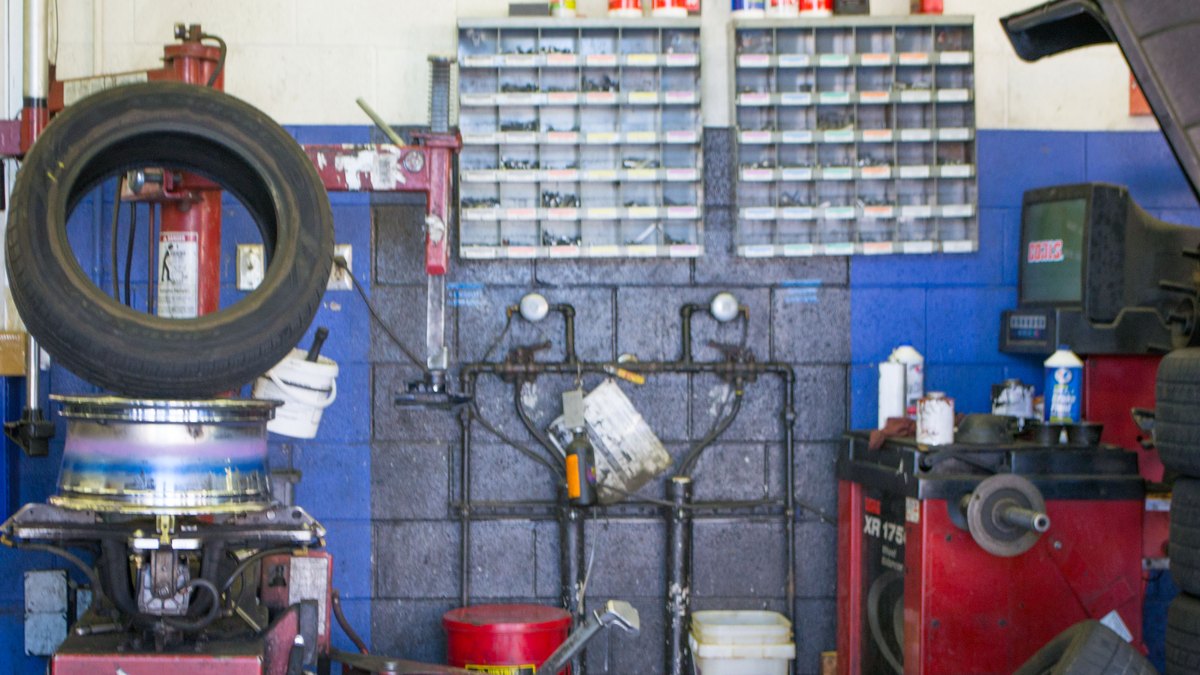
- Wikimedia Commons: Inside a Tire Shop (Visitor7, CC BY-SA 3.0) · Hero photo
Figures and rules were read from the linked pages on November 8, 2026. Fees, counts and rules change, so confirm each on the source site. This page is not legal or financial advice.
Top photo: Visitor7 / CC BY-SA 3.0 via Wikimedia Commons