Top 10 Database Management Systems for IoT Applications in 2027
By Kory White · Updated Nov 2026 · 7 min read
Direct answer
Apache IoTDB is the best database for IoT applications: it is documented as an industrial IoT time-series database with an edge-cloud design, an Edge mode that runs in one JVM, and a free Apache-2.0 license. TDengine is the best for industrial connectivity (OPC, MQTT, Kafka) with a free tier for 5,000 tags, and InfluxDB 3 Core is the easiest free start at the edge.
Edge and mobile apps that must keep working offline and then sync documents to a central Couchbase back end
Pick by what you want
Best overall
Apache IoTDB
Best for industrial connectivity
TDengine
Best free start at the edge
InfluxDB 3 Core
Best on Postgres
TimescaleDB
Best SQL for mixed data
CrateDB
Best offline-first on devices
Couchbase Lite
The ranking
1
Apache IoTDB
Answrs VerdictThe only pick here named, built and documented around IoT time-series data from the start.
Price: Free and open source (Apache-2.0 license listed on GitHub)What it is: An industrial IoT time-series database management system for integrated collection, storage, management and analysis of IoT time-series dataEdge and cloud: Lightweight architecture with edge-cloud collaboration; IoTDB Edge runs the ConfigNode and DataNode in one JVM for resource-constrained, single-node deploymentsStorage format: Depends on TsFile, a columnar storage file format designed for time series dataIntegrations: SQL-like language, JDBC standard API, and Hadoop, Spark, Flink and Grafana integrationsGitHub stars: 6,429 stars on apache/iotdb as of Nov 8, 2026
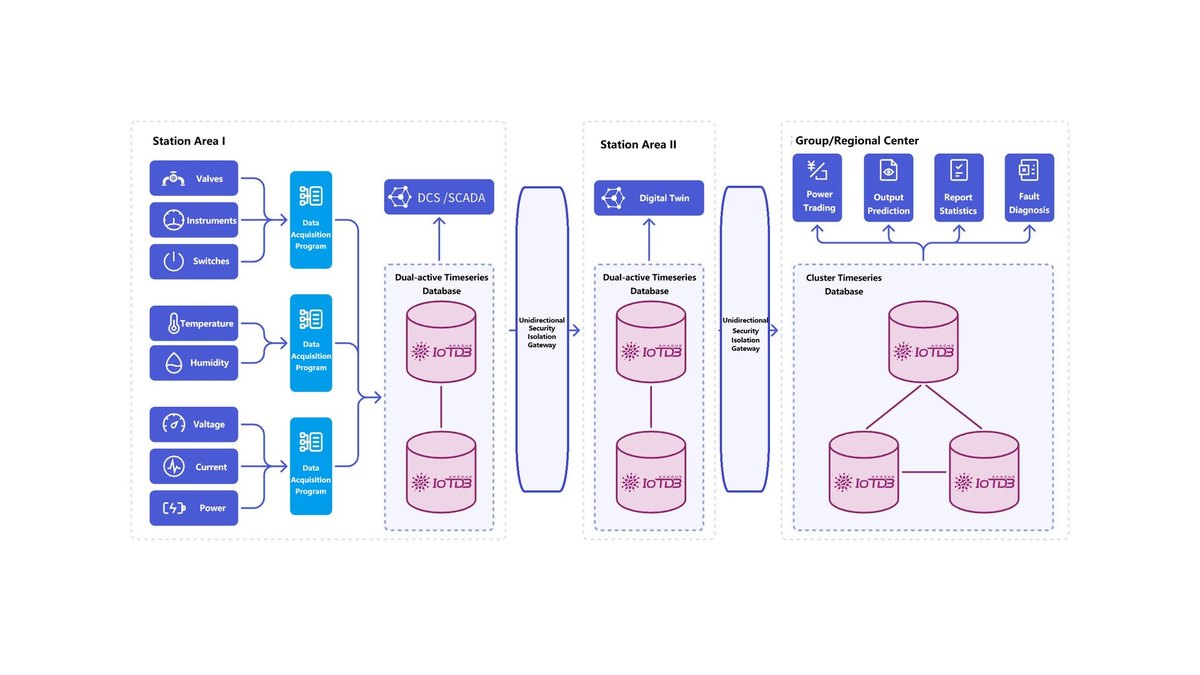
Apache IoTDB is an industrial IoT time-series database management system for integrated collection, storage, management and analysis of IoT time-series data. It has a lightweight architecture with edge-cloud collaboration, and IoTDB Edge runs the ConfigNode and DataNode in one JVM for resource-constrained, single-node deployments. Data is stored in TsFile, a columnar format designed for time series. It uses a SQL-like language and JDBC, integrates with Hadoop, Spark, Flink and Grafana, is Apache-2.0 licensed, and has 6,429 GitHub stars. The image is an IoTDB architecture diagram of a station-to-regional-center deployment.
Go ifIndustrial and device-fleet teams that want a database built specifically for IoT time-series data, with an edge deployment mode
Skip ifYou want a managed cloud service with a posted monthly price
Why #1 over #2: It is built for IoT data and has an Edge mode, while TDengine focuses on connecting industrial sources.
2
TDengine
Answrs VerdictThe strongest industrial connectivity story, with a free tier for up to 5,000 tags.
Price: Free forever for up to 5,000 tags; paid cloud and enterprise quotes depend on tag count, sites, deployment model and supportIndustrial connectivity: Connects to OPC, MQTT, Kafka and other industrial data sources, with built-in ETL for cleaning and transformationDeployment: Public cloud, on premises or edge-cloudUse cases: Manufacturing, renewables, utilities, and oil and gas; Nevados scaled from 4,000 to 34,000 trackers for a 1 GW solar fleetOpen source: TDengine TSDB-OSS is a fully open-source time-series database with clustering; GitHub lists the AGPL-3.0 licenseGitHub stars: 25,187 stars on taosdata/TDengine as of Nov 8, 2026
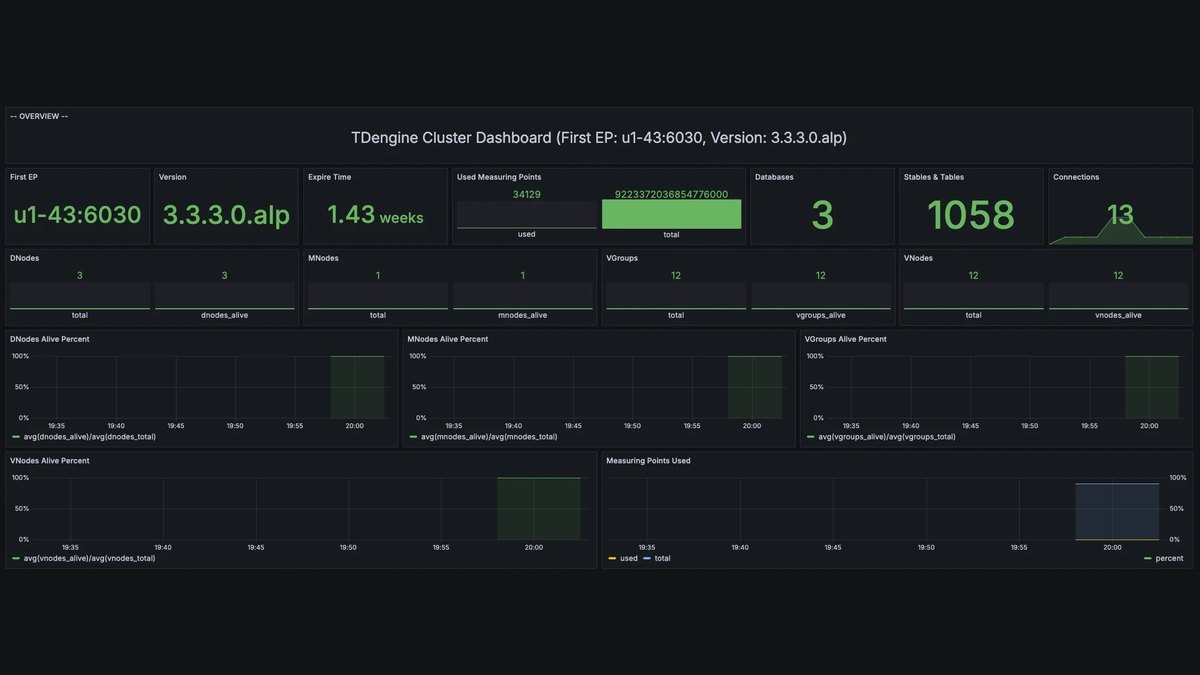
TDengine connects to OPC, MQTT, Kafka and other industrial data sources with built-in ETL, and runs on public cloud, on premises or edge-cloud. It is free forever for up to 5,000 tags, and paid quotes depend on tag count, sites, deployment model and support. TDengine lists manufacturing, renewables, utilities, and oil and gas use cases, and Nevados scaled from 4,000 to 34,000 trackers for a 1 GW solar fleet. The open-source edition is listed under AGPL-3.0 on GitHub, with 25,187 stars. The image shows a TDengine cluster dashboard.
Go ifPlants and energy operators that pull from OPC and MQTT sources and want a free tier to start
Why #2 over #3: It connects to OPC and MQTT out of the box with a free 5,000-tag tier, while InfluxDB 3 Core leaves source connectivity to you.
3
InfluxDB 3 Core
Answrs VerdictThe easiest free start for edge and prototype IoT work, with a large community.
Price: Core has no usage fees and no telemetry requirements; Enterprise trials run 30 days by defaultEdge use: Core is positioned for edge computing, IoT prototypes and single-node production workloads, and can run on edge devices, on-premises servers, private clouds or hybrid setupsSpeed: Sub-10 millisecond query responses for live and recent data (vendor claim)Processing: A Python processing engine runs inside Core, and it supports SQL and InfluxQLLicense: Core is licensed under MIT and Apache 2.0GitHub stars: 31,802 stars on influxdata/influxdb as of Nov 8, 2026
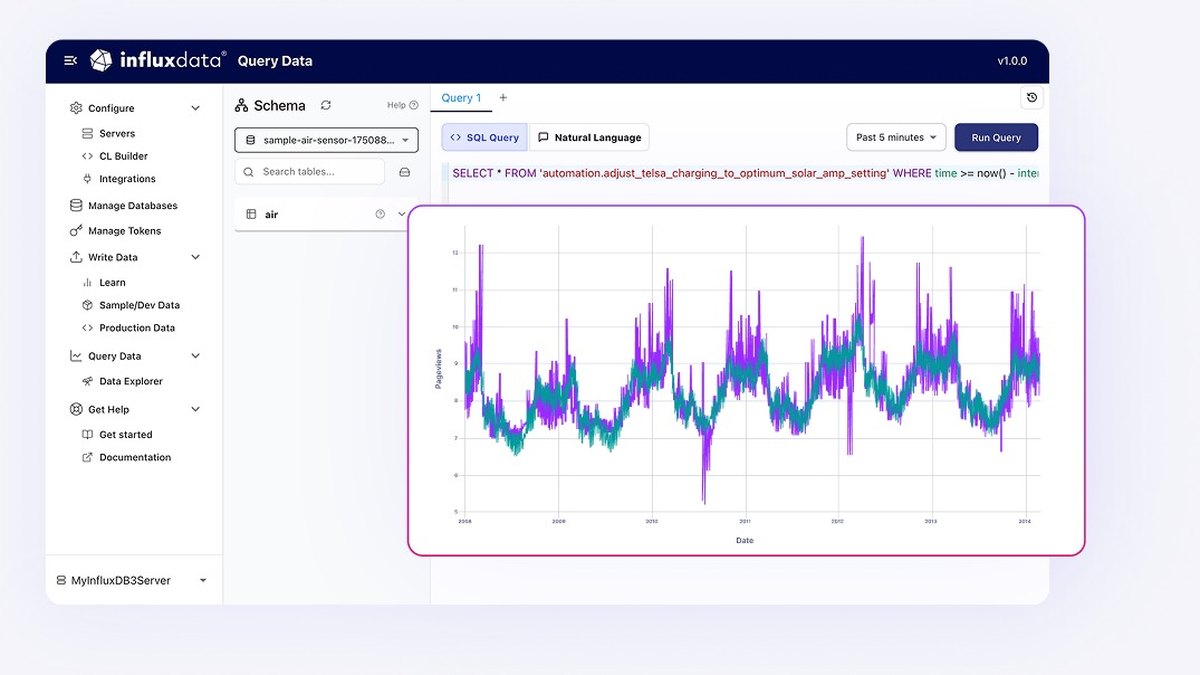
InfluxDB 3 Core is positioned for edge computing, IoT prototypes and single-node production workloads, and can run on edge devices, on-premises servers, private clouds or hybrid setups. InfluxData claims sub-10 millisecond queries for live and recent data, a Python processing engine inside Core, and SQL and InfluxQL support. Core has no usage fees and is licensed under MIT and Apache 2.0; Enterprise trials run 30 days by default. The repository has 31,802 GitHub stars. The image shows the InfluxDB 3 Data Explorer query screen.
Go ifTeams that want a free, single-node time-series engine that runs at the edge and in the cloud with SQL
Skip ifYou need multi-node high availability without paying for Enterprise
Why #3 over #4: It runs free at the edge with SQL, while TimescaleDB ties you to Postgres.
4
TimescaleDB
Answrs VerdictThe best fit when sensor data has to live next to relational Postgres tables.
Price: Tiger Cloud Performance starts at $30/month and Scale at $36/month; 30-day free trial with no credit cardHypertables: Turn any Postgres table into one automatically partitioned by time or id, with partition skipping at query planningCompression: Claims storage cuts of up to 95% using delta, dictionary and RLE encodings (vendor claim)Continuous aggregates: Incrementally refreshed rollups, with a real-time mode that includes the latest changesSQL functions: About 200 native SQL functions (hyperfunctions)GitHub stars: 23,825 stars on timescale/timescaledb as of Nov 8, 2026
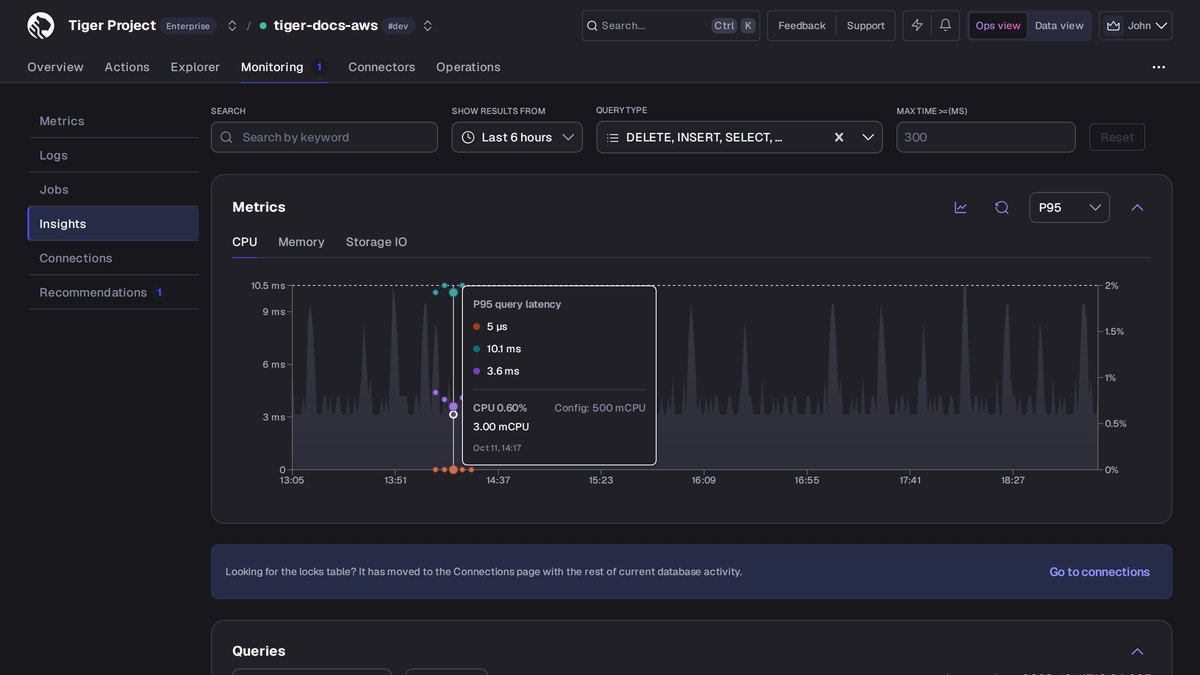
TimescaleDB turns any Postgres table into a hypertable partitioned automatically by time or id, compresses data by up to 95% (a vendor claim), and refreshes continuous aggregates incrementally, with about 200 native SQL functions. Tiger Cloud Performance starts at $30/month and Scale at $36/month, with a 30-day free trial and no credit card. The repository has 23,825 GitHub stars. The image shows the Tiger Cloud monitoring view.
Go ifTeams that already run Postgres and want device data in the same SQL database as their relational data
Skip ifYou need an edge-native engine; the vendor page frames it for cloud Postgres
Why #4 over #5: It keeps sensor and relational data in one Postgres database, while CrateDB is a separate distributed SQL engine.
5
CrateDB
Answrs VerdictThe most flexible SQL option for mixed IoT data, with a free cloud plan.
Price: Free plan with no credit card; Dedicated from $0.246 per hour including basic supportIngest: Ingests millions of events per second from sensors, telemetry streams, Kafka or application logs, queryable immediatelyQuery: Standard SQL with JOINs, aggregations and window functions, joining device metadata at query time without ETLDeployment: Licensed under Apache 2.0; runs on-prem, at the edge, in any cloud or as a managed serviceCustomer figures: ABB: 1 million values ingested per second; TGW Logistics: 900,000 sensors per distribution center (as quoted by CrateDB)GitHub stars: 4,450 stars on crate/crate as of Nov 8, 2026
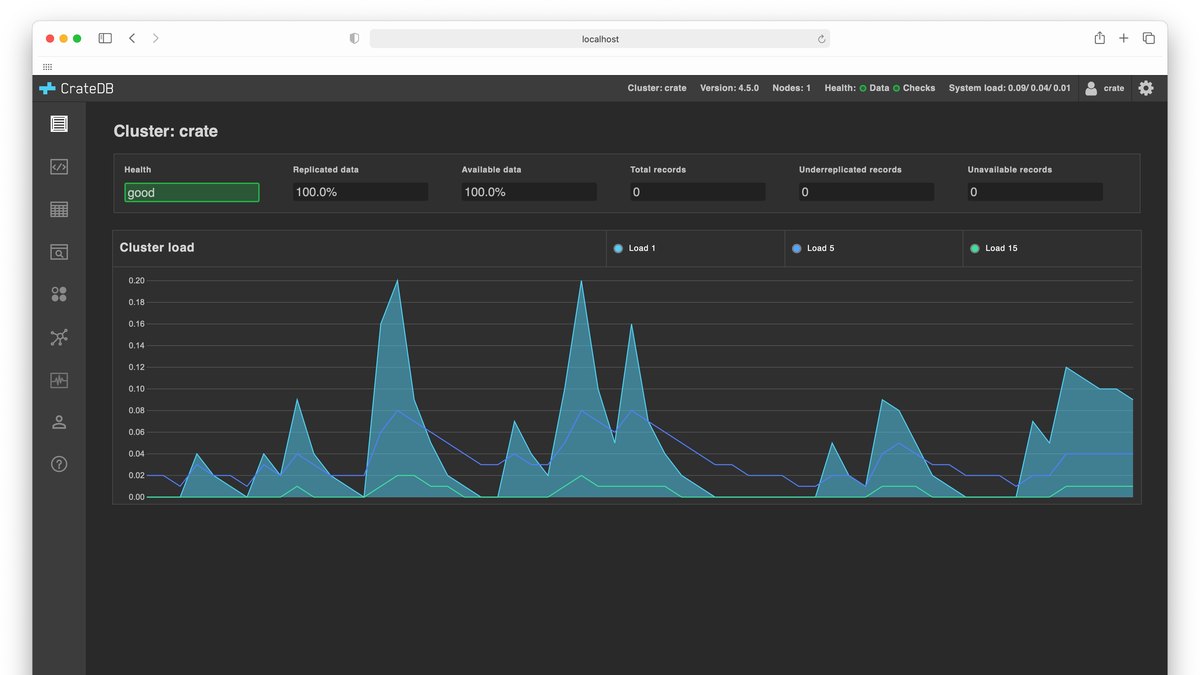
CrateDB says it ingests millions of events per second from sensors, telemetry streams, Kafka or application logs, with data queryable immediately. It uses standard SQL, joins device metadata at query time without ETL, and runs on-prem, at the edge, in any cloud or as a managed service under Apache 2.0. ABB reports 1 million values ingested per second and TGW Logistics 900,000 sensors per distribution center, as quoted by CrateDB. There is a free cloud plan, and Dedicated starts at $0.246 per hour. The image is the CrateDB Admin UI cluster view.
Go ifTeams that want one SQL engine for sensor streams, device metadata, JSON, full-text and geospatial queries
Skip ifYou want the largest open-source community around a single database
Why #5 over #6: It is open source with a free cloud plan and edge support, while Azure Data Explorer has no list prices and is Azure only.
6
Azure Data Explorer
Answrs VerdictThe strongest managed analytics engine for large telemetry on Azure.
Price: Billed per minute per VM plus a markup that scales with engine vCores; no list prices shown on the page; markup not charged on Developer tier clustersUse: Described as useful for log analytics, time series analytics, IoT and general-purpose exploratory analyticsIngestion: High velocity of millions of events per second, with low latency of seconds and linear-scale ingestionTime series: Functions for filtering, regression, seasonality detection, anomaly detection and forecasting, optimized to process thousands of time series in secondsQuery language: Kusto Query Language (KQL), an open-source language created by the team; T-SQL is also supported
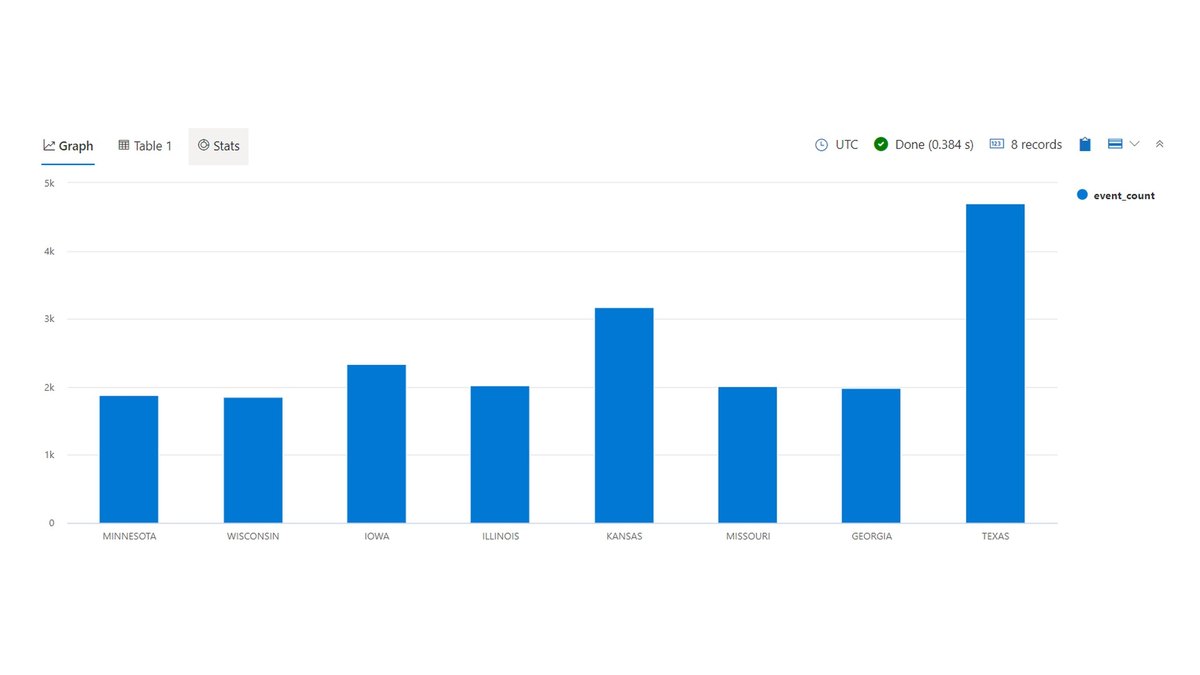
Azure Data Explorer is described as useful for log analytics, time series analytics, IoT and general-purpose exploratory analytics. It ingests at a velocity of millions of events per second with latency of seconds, and provides time series functions for regression, seasonality detection, anomaly detection and forecasting, optimized for thousands of time series in seconds. It uses Kusto Query Language and also supports T-SQL. Billing is per minute per VM plus a markup, and the markup is not charged on Developer tier clusters. The image is a column chart in the Azure Data Explorer web UI.
Go ifAzure teams that need ad hoc analytics, anomaly detection and forecasting over very large telemetry volumes
Skip ifYou want a published price list or a self-hosted, open-source engine
Why #6 over #7: It has built-in anomaly detection and forecasting, while Google Cloud Bigtable is a key-value store without them.
7
Google Cloud Bigtable
Answrs VerdictThe simplest way to scale device-reading ingestion on Google Cloud.
Price: Enterprise edition default list price $0.65 per node per hour (Enterprise Plus $0.85); region and discounts varyUse cases: Google lists time-series data and Internet of Things data, such as readings from energy meters and home appliancesScale: A sparsely populated table that can scale to billions of rows and thousands of columnsThroughput: Scales in direct proportion to the number of machines in the cluster, with high read and write throughput at low latencyReplication: Add a second cluster to an instance and replication starts automatically
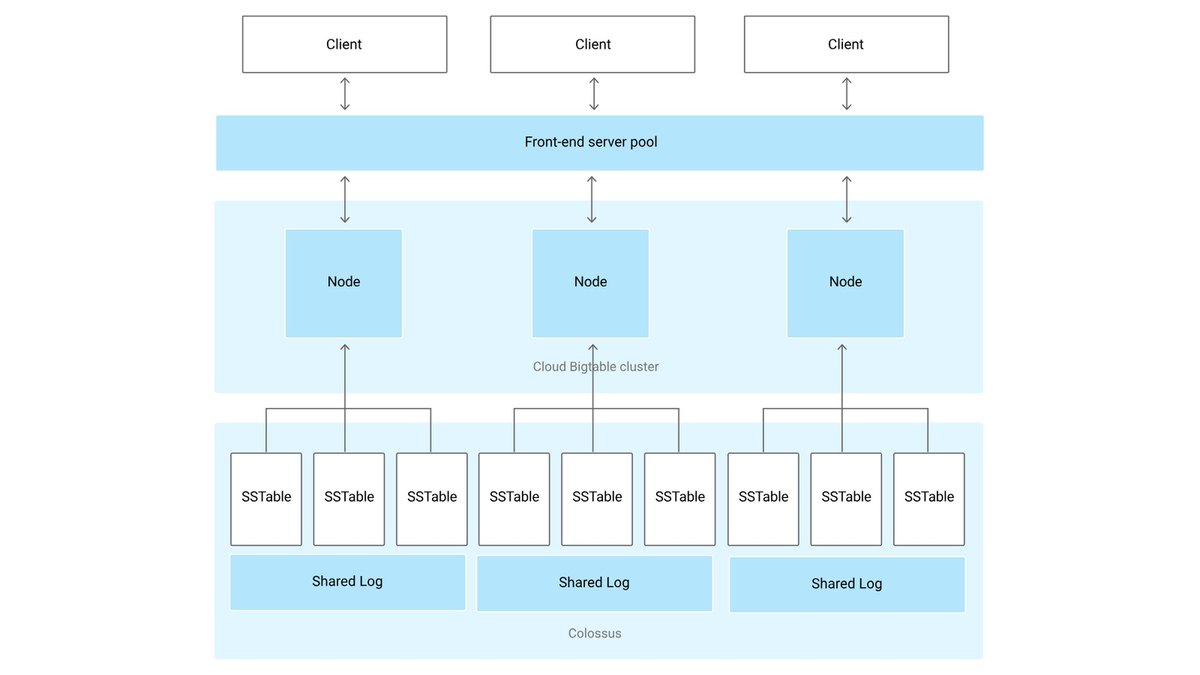
Google Cloud Bigtable lists time-series data and Internet of Things data, such as readings from energy meters and home appliances, among its use cases. It is a sparsely populated table that can scale to billions of rows and thousands of columns, scales in proportion to the number of machines in the cluster, and replicates automatically when you add a second cluster. The Enterprise edition default list price is $0.65 per node per hour. The image is the Bigtable architecture diagram.
Go ifGoogle Cloud teams ingesting very large streams of device readings with predictable key-based access
Skip ifYou need SQL joins and ad hoc analytics across many dimensions
Why #7 over #8: It scales ingestion by adding nodes with automatic replication, while MongoDB is better suited to document-shaped data.
8
MongoDB
Answrs VerdictA practical choice when sensor data is one part of a document-based app.
Price: Free M0 tier with 512 MB storage; Flex from $0.011 per hour, capped at $30/month; Dedicated from $0.08 per hourIoT: IoT is the first use case in the time series collections table, with sensor data such as smart home devices or fleet logisticsStorage: Time series collections use a columnar storage format in time order, reducing disk usage and read I/OAvailability: Time series collections were new in version 5.0Indexes: MongoDB 6.3 and later automatically creates a compound index on the time and metadata fieldsGitHub stars: 28,678 stars on mongodb/mongo as of Nov 8, 2026
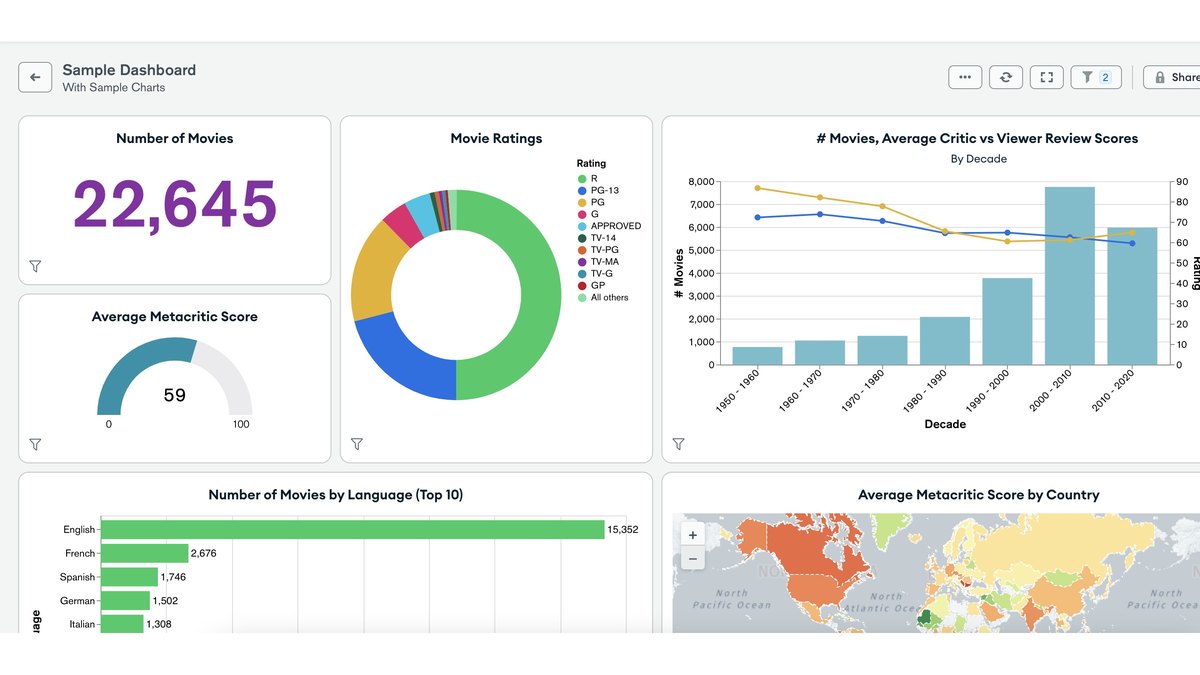
MongoDB lists IoT first among time series collections use cases, with sensor data such as smart home devices or fleet logistics. Time series collections use a columnar storage format in time order, which reduces disk usage and read I/O, and MongoDB 6.3 and later creates a compound index on the time and metadata fields automatically. They were new in version 5.0. Atlas has a free M0 tier with 512 MB, Flex from $0.011 per hour capped at $30/month, and Dedicated from $0.08 per hour. The image is an Atlas Charts sample dashboard.
Go ifTeams that already store device documents in MongoDB and want time-ordered sensor data in the same database
Skip ifYou need to update individual measurements; updates can only match on the metaField
Why #8 over #9: It stores sensor data in the same database as device documents, while Redis TimeSeries is aimed at recent values in memory.
9
Redis TimeSeries
Answrs VerdictThe fastest option for recent readings, with the largest GitHub following here.
Price: Redis Cloud free plan up to 30 MB; Essentials from $0.007 per hour ($5/month); Pro from $0.014 per hour with a $200/month minimumIoT: Listed use cases include Internet of Things (IoT) sensor data and smart meteringIngestion: TS.ADD appends a sample and TS.MADD adds samples to several series in one callRetention and rules: A per-series retention period, and compaction rules that aggregate data into a destination seriesLabels: Name-value labels select subsets of series for queries and aggregationsGitHub stars: 77,287 stars on redis/redis as of Nov 8, 2026
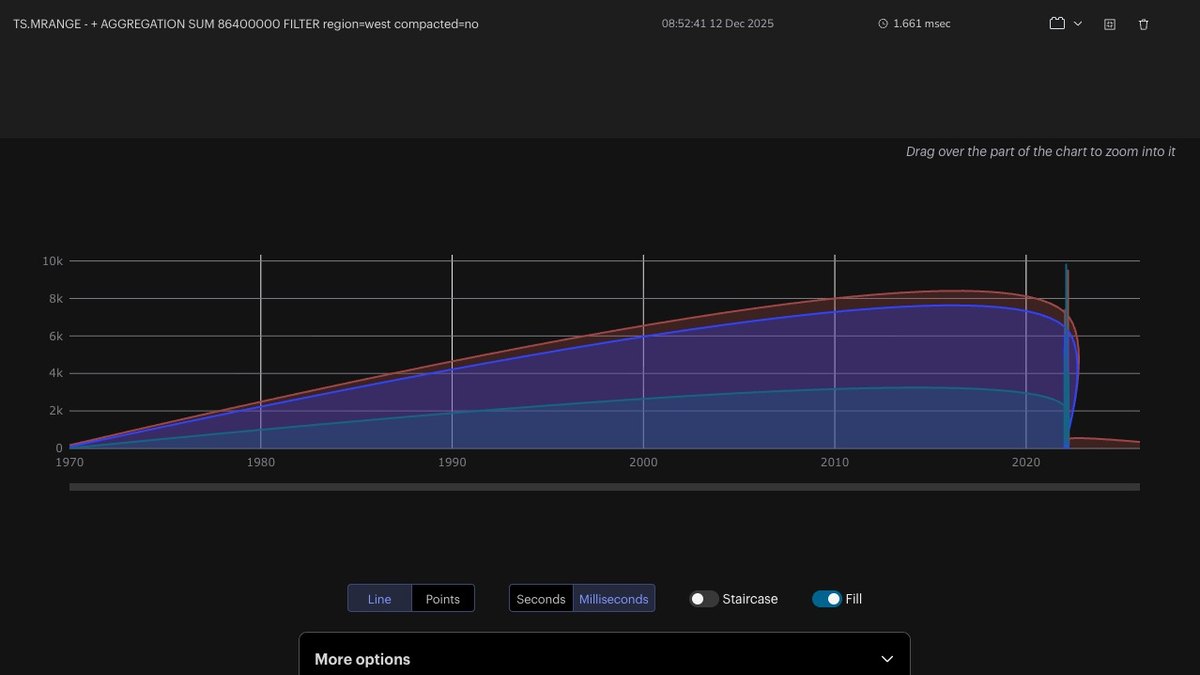
Redis TimeSeries lists Internet of Things (IoT) sensor data and smart metering among its use cases. TS.ADD appends a sample, TS.MADD adds samples to several series in one call, each series can have a retention period and labels, and compaction rules aggregate data into a destination series. Redis Cloud has a free plan up to 30 MB, Essentials from $0.007 per hour ($5/month) and Pro from $0.014 per hour with a $200/month minimum. The redis/redis repository has 77,287 GitHub stars. The image is the Redis Insight time series chart view.
Go ifTeams that already use Redis for caching or messaging and need fast reads of recent sensor values
Skip ifYou need to keep years of history on cheap disk storage
Why #9 over #10: It is a time-series engine, while Couchbase Lite is an embedded document store for device data.
10
Couchbase Lite
Answrs VerdictThe pick for offline-first device apps rather than sensor analytics.
Price: Not published on the documentation pageWhat it is: An embedded NoSQL JSON document database designed for mobile and edge devicesOffline: Works without a constant internet connection, so apps can run offline-firstSync: Bi-directional sync with cloud and edge through Sync Gateway; peer-to-peer sync between devices is also availableQuerying: SQL++ querying with full CRUD support, plus vector search
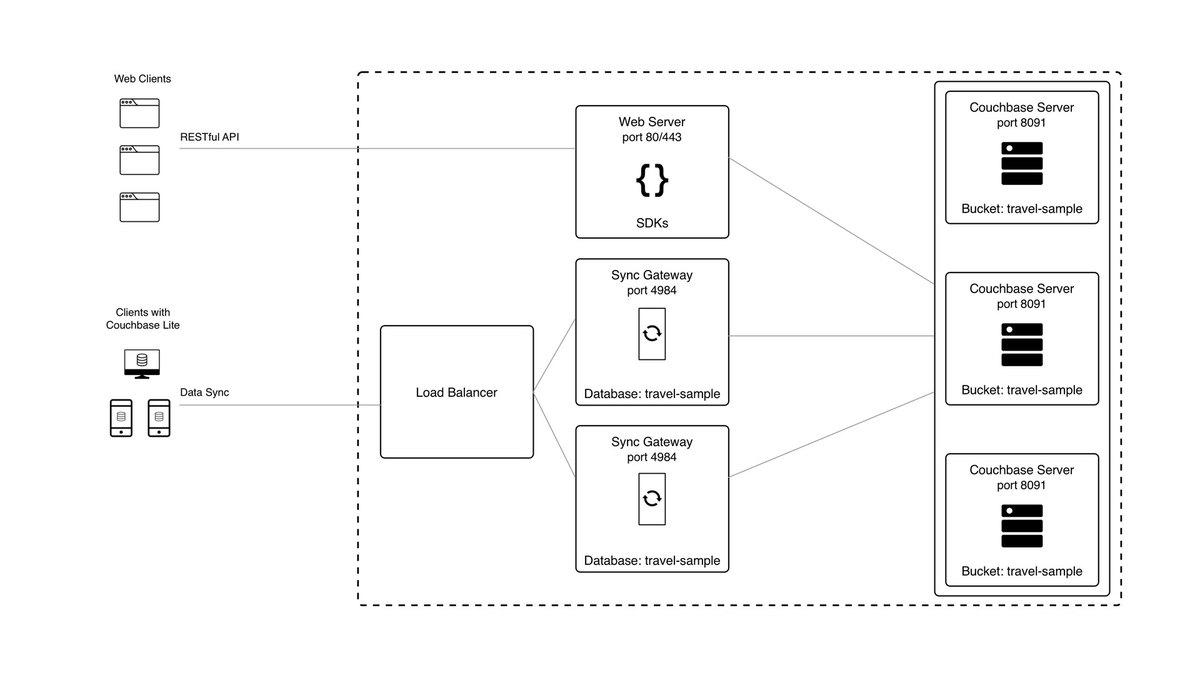
Couchbase Lite is an embedded NoSQL JSON document database designed for mobile and edge devices. It works without a constant internet connection, offers bi-directional sync with cloud and edge through Sync Gateway, supports peer-to-peer sync between devices, and queries with SQL++ plus vector search. Pricing is not published on the documentation page. It is not a time-series database, so it suits offline-first device apps rather than sensor analytics. The image is the Couchbase Lite and Sync Gateway architecture diagram.
Go ifEdge and mobile apps that must keep working offline and then sync documents to a central Couchbase back end
Skip ifYou need a time-series engine; this is a document database for local data on devices
How we ranked these
We ranked the databases by how directly each documents IoT or device-data use, covering edge deployment, industrial connectivity, ingestion and time-series features, then by published pricing, using each vendor’s own documentation, pricing pages and GitHub repository for every fact. Prices not published by the vendor are marked as such. Performance and compression figures are vendor claims, and the chart compares GitHub stars on one date, not product quality. Facts are taken from each maker's own published information; check the official site before you buy.
Questions people ask
What is the best database for IoT applications?
Apache IoTDB. It is documented as an industrial IoT time-series database for collecting, storing and analyzing IoT data, with an edge-cloud design and an Edge mode that runs in one JVM, and it is free under the Apache-2.0 license.
Which IoT database has a free tier?
TDengine is free forever for up to 5,000 tags, InfluxDB 3 Core has no usage fees, CrateDB Cloud has a free plan, MongoDB has a free M0 tier with 512 MB, and Redis Cloud has a free plan up to 30 MB.
Can a general-purpose database store IoT sensor data?
Yes. MongoDB lists IoT first among its time series collections use cases, and Redis lists IoT sensor data and smart metering for Redis TimeSeries. Both are covered in this list.
Which IoT database runs at the edge?
InfluxDB 3 Core can run on edge devices, Apache IoTDB has an Edge mode that runs in a single JVM, and Couchbase Lite is an embedded database for mobile and edge devices with offline-first sync.
GitHub stars on the main public repository, as of Nov 8, 2026 at a glance
CrateDB4,450 stars
Apache IoTDB6,429 stars
TimescaleDB23,825 stars
TDengine25,187 stars
MongoDB28,678 stars
InfluxDB31,802 stars
Redis77,287 stars
GitHub stars on the main public repository, as of Nov 8, 2026, as published by each maker. Picks without a published figure are left off.