How Do You Handle Model Rollbacks Safely in Production in 2027?
You roll back a model safely by never retiring the last good version until the new one has proved itself, shifting traffic to the new version in small steps, and wiring rollback to automatic triggers instead of a person watching a dashboard. Concretely: register every model as an immutable version, serve it behind a pointer you can move (an alias, a traffic weight or a feature flag), send a small share of traffic to the candidate, and let latency, error and quality metrics decide whether it advances or reverts.
The pattern comes from release engineering. Google's SRE workbook defines canarying as a partial, time-limited deployment of a change and its evaluation, and says a canary that diverges meaningfully from the control should be paused and rolled back or escalated to a human. Its worked example sends 5% of traffic to the canary. The tools below implement that idea for models: KServe pins traffic back to the previous revision, Argo Rollouts aborts when an analysis fails, SageMaker rolls back when CloudWatch alarms trip, and LaunchDarkly can roll a flag back on a detected regression.
Models add three problems ordinary services lack: a quality regression can be silent while latency and errors look fine, the model depends on feature data that may have changed, and hosted LLMs can be retired by the provider. All tool descriptions are vendor-stated or documentation-stated and were not tested here. For adjacent how-tos see our pages on model registries, AI model monitoring tools and how to A/B test different LLMs in production.
Start with a version you can go back to
A rollback is only safe if the previous version still exists, is still deployable and is reachable by changing one pointer. Each source below was read on November 2, 2026.
- MLflow Model Registry: each registered model can have many versions, and a new model added under the same name gets the next version number. Aliases are mutable, named references to a version; the page's example points a champion alias at the version intended for production and says you can move production serving by reassigning the alias to a different version. Each version links back to the run or notebook that produced it. The page does not describe a rollback procedure, so write your own runbook.
- Weights & Biases Registry: a central repository for artifact versions; each logged artifact gets a version, with the first being v0. Linking a version to a registry collection creates a pointer and does not copy the artifact. It supports lineage and audit history and automation for model CI/CD. The page read does not describe aliases, so check current docs before relying on one.
- Rule of thumb (practitioner judgment, not a sourced finding): keep the previous production version warm or at least redeployable until the new version has passed its observation window, and keep the container image, model artifact and configuration for each version together, so a rollback never means retraining.
Our page on model registries compares more options.
Shift traffic gradually: canary, linear and blue/green
The idea is to expose the new version to a small slice of traffic first and compare it with the version still serving the rest.
- Google SRE workbook on canarying. The chapter says the canary should be a small slice of production and uses 5% in its example, where 20% errors on the canary become a 1% overall error rate. It advises running one canary at a time, making it large and long enough to be representative, and choosing a small set of strong indicators of user-facing problems, perhaps no more than about a dozen. Its example canary runs for 30 minutes. It warns that before/after comparisons are noisy because of time-of-day effects and that blue/green makes rollback a simple router reversal at the cost of doubling resource use.
- KServe: canaryTrafficPercent sets how much traffic goes to the new revision, and KServe tracks the last good revision that was rolled out with 100% traffic. On rollback, 100% of traffic is pinned to the previous healthy revision. Promotion makes the new revision the fully rolled-out one. The page says the canary strategy is only supported in serverless deployment mode.
- Amazon SageMaker deployment guardrails: blue/green deployments with all-at-once, canary and linear traffic shifting, plus rolling deployments. CloudWatch alarms you specify monitor the new fleet for a baking period, and SageMaker terminates the old fleet only if no alarm trips. Canary shifting moves traffic in two steps and linear shifting extends this to n linearly spaced steps. Guardrails apply to asynchronous and real-time inference endpoints.
- Argo Rollouts: an AnalysisTemplate defines the metrics to run, how often and what counts as success or failure. A failed background analysis aborts the rollout and sets the canary weight back to zero; for blue/green, a failed post-promotion analysis switches traffic back to the previous stable ReplicaSet. An inconclusive run pauses and needs manual action. failureLimit defaults to 0, so no failed measurements are tolerated. The page's examples query Prometheus or a web endpoint.
- Flagger: a progressive delivery tool for Kubernetes that supports canary releases, A/B testing and blue/green mirroring through a service mesh or ingress controller, and queries backends such as Prometheus and Datadog during analysis. It describes itself as a CNCF graduated project in the Flux family. The page read does not mention automatic rollback.
- BentoML (BentoCloud): keeps track of all deployment revisions and lets you roll back from the Revisions tab; rolling back does not delete any revisions. The page notes that apply overwrites the whole configuration and may reset unspecified fields to defaults, while update patches only the fields you give.
- Seldon Core 2: a Kubernetes-native framework for deploying ML and LLM systems. Its experiments feature defines a traffic split between models or pipelines by weight, which can be exposed on an existing endpoint. The page does not use the word canary.
Shadow first: test on real traffic without user impact
Shadowing copies live requests to the candidate and discards its answers, so users never see it. It catches crashes, latency problems and obviously different outputs before any user is exposed.
- Seldon Core 2 mirror experiments: a mirror is a single model that traffic is mirrored to, and responses from this model are not returned to the caller. It works for models and pipelines.
- Istio traffic mirroring: mirrored requests are fire and forget and the responses are discarded; mirroring happens out of band of the critical request path. The mirrorPercentage field mirrors only part of the traffic, and without it all traffic is mirrored.
- Limits (practitioner judgment): shadowing doubles the compute for the shadowed share, and it cannot show user reactions or downstream effects, because nobody acts on the candidate's output. Anything the candidate writes, such as database updates or tool calls, must be switched off in shadow mode.
Automatic rollback triggers
Decide the triggers before the release and make them machine-checkable. The sources give mechanisms; the thresholds are yours to set from your own baseline.
- Latency and error rate. These are the strongest, fastest signals. The SRE workbook names HTTP error codes and latency as strong signals and CPU as weaker because it can be noisy, and says to exclude 400-level codes such as 404, which often reflect client behavior. It also says metric intervals should be no longer than the canary duration.
- Alarms and analysis runs. SageMaker's CloudWatch alarms and Argo Rollouts' AnalysisRun are the two documented mechanisms that revert without a human. Set failure tolerance deliberately: Argo's default of 0 reverts on the first failed measurement.
- LaunchDarkly guarded rollouts: release a flag gradually while watching selected metrics. A regression is a statistically significant negative impact on a monitored metric, detected with sequential testing. If automatic rollback is enabled, LaunchDarkly rolls the release back; it can also notify the flag's maintainer. The page says guarded rollouts need an Enterprise plan with the Guardian add-on, and it is a vendor product, so compare with open-source options.
- Quality and drift metrics. A model can be fast and wrong, so latency and errors are not enough. Use a quality signal you can compute online: an evaluation score on sampled traffic, agreement with the previous model, or a drift statistic on inputs and outputs. Our page on monitoring LLMs for drift and hallucinations covers the signals. Ground-truth labels often arrive late, so pair a fast proxy with a slower confirmation.
Monitoring vendors that can feed those triggers (vendor-stated, not compared here):
- Arize: describes Arize AX as helping teams monitor, improve and scale production AI systems, with tracing and evaluations including online evals that run on live data, and says Phoenix traces LLM calls and runs evals. The page lists 1 trillion spans processed and 1 billion evals per year as its own figures.
- Evidently: an open-source framework (Apache 2.0) with 100+ metrics, usable as a Python library or a self-hosted platform, with quickstarts for testing tabular data quality and data drift and for evaluating LLM output quality.
- WhyLabs: its site says WhyLabs, Inc. is discontinuing operations and that the complete platform has been open sourced, with the LangKit toolkit for monitoring LLMs listed as available open source. Check the current repositories before adopting it.
For a broader comparison, see best AI model monitoring tools.
Check the data and features before you roll back
Rolling back the model does not roll back the world around it. Before you flip a pointer, confirm what the older model expects.
- Feast: an open-source feature store. A feature view is a collection of features, and the page says feature views allow Feast to model feature data in a consistent way in both offline (training) and online (serving) environments. Its versioning feature is marked alpha: each time feast apply detects a schema or UDF change, a versioned snapshot is saved to the registry. With validation enabled, type mismatches are logged as warnings and do not block execution.
- Compatibility checklist (practitioner judgment): does the old model accept the current feature schema and encodings; were features it relied on renamed or removed; was the embedding or tokenizer model it was trained with changed; and has any downstream consumer started depending on the new output format. If the answer to any is yes, a rollback needs the data or contract change reverted too, or a compatibility shim.
- Stateful side effects. Caches, vector indexes built with a new embedding model, and stored model outputs can all outlive the rollback. Version them with the model, or purge them as part of the runbook.
LLMs: pin versions and version your prompts
With hosted models you do not control retirement, so the rollback target can disappear.
- OpenAI model pages: say snapshots let you lock in a specific version of the model so that performance and behavior remain consistent. The GPT-4.1 page lists one snapshot, gpt-4.1-2025-04-14, and marks it deprecated, which shows that a pinned snapshot is itself temporary.
- Anthropic model deprecations: Anthropic says it provides at least 60 days' notice before retirement for publicly released models, and that requests to retired models fail. As an example, its table lists claude-sonnet-4-5-20250929 as deprecated on September 30, 2026 with retirement on November 30, 2026 and claude-sonnet-5-5 as the recommended replacement. It advises testing newer models well before the retirement date and offers a usage export by API key and model to find deprecated usage.
- Langfuse prompt management: saving a prompt under an existing name creates a new version; the production label marks the version fetched at runtime, and you can request a specific version number through the API. SDKs cache prompts client-side, so your application keeps using the cached prompt if Langfuse goes down. Moving a label back is the natural way to revert a prompt, although the page does not describe rollback explicitly.
- Practice (practitioner judgment): store the model snapshot ID, prompt version, system settings and tool definitions together as one release, and roll them back together. Keep a tested fallback model from a second snapshot, and run your own evaluation set against it on a schedule so the fallback is known good when you need it. See our page on A/B testing LLMs in production and LLMOps platforms.
A rollback runbook
- Before release. Register the version, record the previous good version, define triggers and the observation window, and confirm the old model works with current features.
- Release. Shadow if you can, then a small canary, with automated analysis comparing candidate and control. One canary at a time.
- During. Let triggers revert automatically. Treat an inconclusive result as a pause for a human, as Argo Rollouts does.
- Rollback. Move the pointer (alias, traffic weight, flag or revision), confirm traffic and metrics returned to baseline, and keep the failed version and its logs for review.
- Afterward. Write up what the trigger missed, add a test or metric for it, and rehearse the rollback so it is not first tried during an incident. Orchestration tools can automate the sequence; see AI workflow orchestration tools.
What the evidence does and does not show
- The mechanics are well documented. KServe, Argo Rollouts, SageMaker, BentoCloud and LaunchDarkly each document a way to shift traffic and revert.
- Thresholds are not universal. No source read here gives a standard error or quality threshold for reverting a model. Set them from your own baseline.
- Quality regressions need quality metrics. The documented rollback triggers are mostly infrastructure metrics. Detecting a silent quality drop depends on evaluation and drift signals you build or buy.
- Several pages do not describe a rollback procedure. MLflow, Langfuse and Flagger pages as read do not explicitly describe rollback, so test the revert path in your own environment.
Questions people ask
What is the safest way to roll back a model in production?
Keep the previous version deployable, move traffic with a pointer such as an alias, traffic weight or flag, and watch latency, errors and a quality metric. KServe, for example, pins 100% of traffic to the previous healthy revision on rollback.
How big should a canary be?
Google's SRE workbook uses 5% of traffic and a 30-minute run in its example, and says the canary must be large and long enough to be representative. Those are examples, not universal values; size yours so the metrics have enough data to compare.
Can rollbacks be automatic?
Yes. Argo Rollouts aborts and returns the canary weight to zero when analysis fails, SageMaker rolls back when CloudWatch alarms trip during its baking period, and LaunchDarkly can roll back on a detected regression if automatic rollback is enabled.
How do I roll back an LLM-based application?
Roll back the whole release: pinned model snapshot, prompt version, settings and tools together. Providers retire models, so OpenAI's pages and Anthropic's deprecation table show why you should track retirement dates and keep a tested fallback.
Why can a model rollback fail?
The older model may expect feature schemas, encodings or embeddings that have since changed. Check compatibility with current feature data before relying on the rollback, and revert data or contract changes together with the model.
Sources
- Google SRE Workbook: Canarying Releases · Canary definition, 5% example, 30 minutes, metric selection
- MLflow Model Registry · Versions, aliases, lineage
- Weights & Biases Registry · Versions, links, lineage, automation
- Argo Rollouts: Analysis · AnalysisTemplate, abort, failureLimit
- Flagger · Progressive delivery, strategies, CNCF
- KServe canary rollout · canaryTrafficPercent, previous revision pinning
- Amazon SageMaker deployment guardrails · Canary, linear, alarms, baking period
- Seldon Core 2 experiments · Traffic splits and mirror
- Seldon Core 2 · Kubernetes-native framework
- Istio traffic mirroring · Fire and forget, mirrorPercentage
- BentoML: manage deployments · Revisions and rollback
- LaunchDarkly guarded rollouts · Regression detection, automatic rollback
- Arize · Tracing, evals, stated figures
- WhyLabs · Discontinuing operations, open sourced
- Evidently documentation · Open source, drift, LLM evals
- Feast: feature views · Offline and online consistency, versioning
- Langfuse prompt management · Versions and labels
- OpenAI GPT-4.1 model page · Snapshots and deprecation
- Anthropic model deprecations · 60 days' notice, example retirement
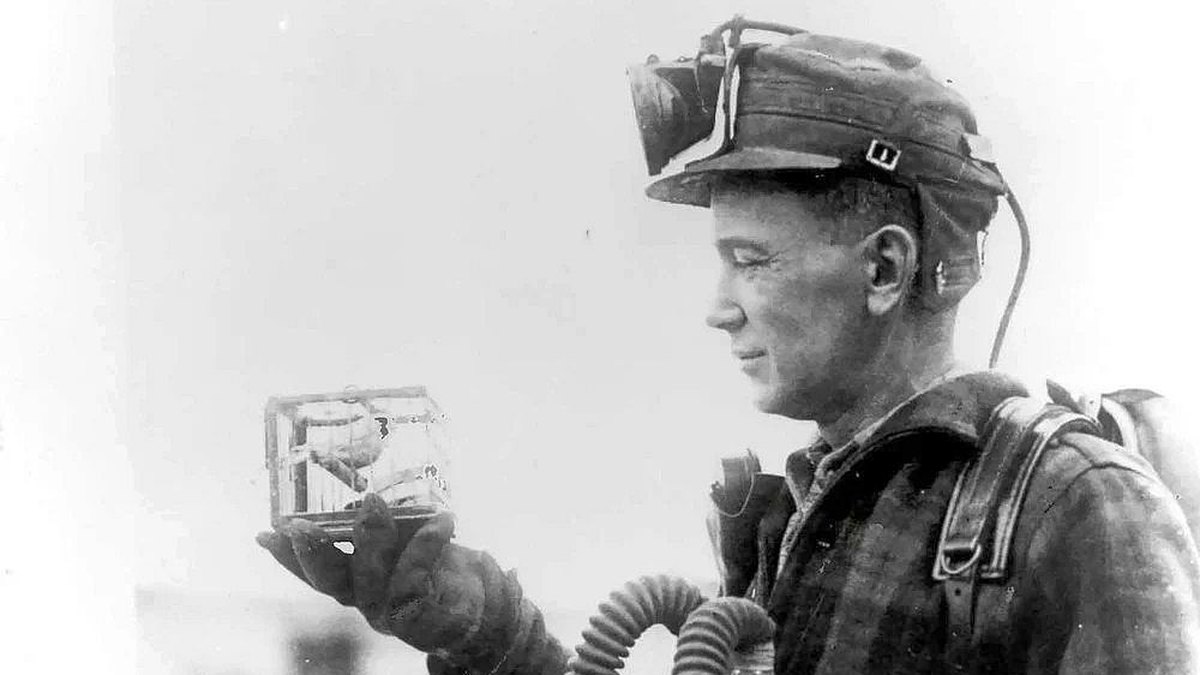
- Miner with canary in a cage, 1928 (U.S. Bureau of Mines, public domain) · Hero image
Facts were read from the linked pages on November 2, 2026. Descriptions are the vendors' or projects' own statements and none was tested here. If a page is out of date, tell us and we will correct it from a source.
Top photo: George McCaa, U.S. Bureau of Mines / Public domain via Wikimedia Commons