What are the RLHF benchmarks for LLMs in 2027?
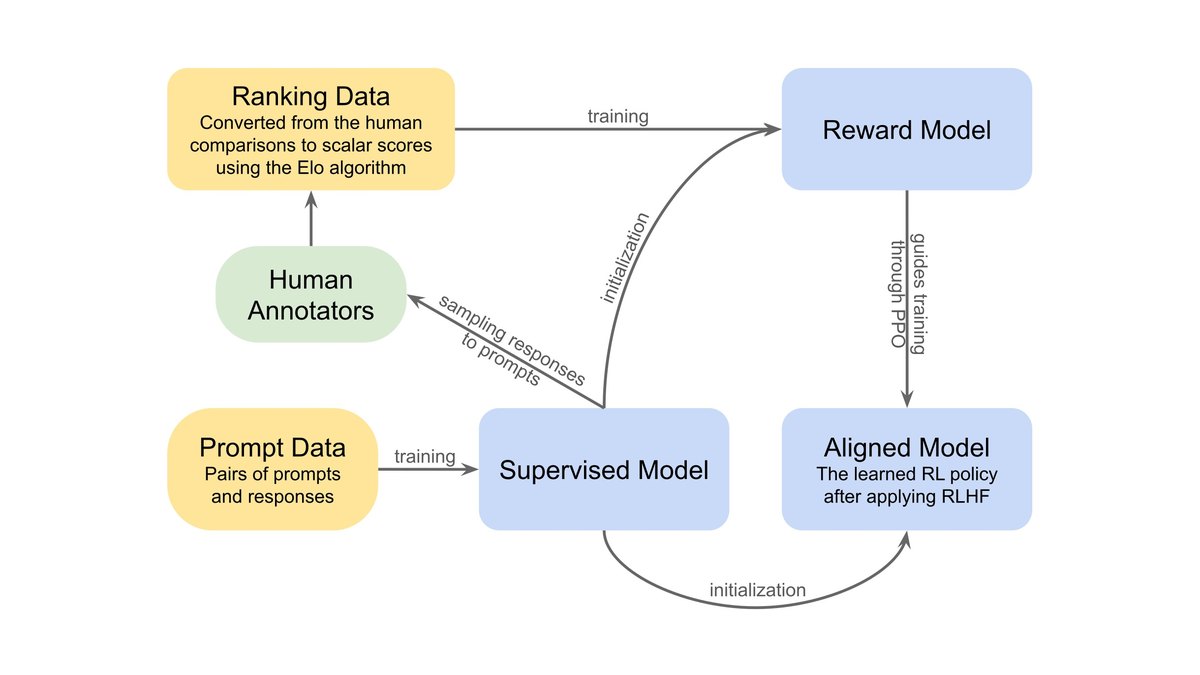
There is no single standard RLHF benchmark. RLHF (reinforcement learning from human feedback) has several stages, and each is checked with a different tool: preference datasets such as Anthropic's HH-RLHF supply the human comparisons, reward-model benchmarks such as RewardBench test the reward model, and chat evaluations such as MT-Bench, Chatbot Arena and AlpacaEval judge the finished model.
So when someone asks for "the RLHF benchmark score" of a model, the honest answer is: which stage, and on which test? This page names the datasets and leaderboards actually used and what each measures. It gives no model scores, because leaderboard tables change and none are reprinted here; open the linked live pages for current numbers.
What "RLHF benchmark" really means
RLHF fine-tunes a language model so its outputs match human preferences. The InstructGPT paper is the classic example: its abstract reports that outputs from the 1.3B parameter InstructGPT model are preferred to outputs from the 175B GPT-3, despite having 100x fewer parameters. Anthropic's helpful and harmless assistant paper applied preference modeling and RLHF in the same spirit and reports that the alignment training improves performance on almost all NLP evaluations.
The pipeline in the diagram above has three things you can measure: the human preference data, the reward model trained on it, and the final aligned model. Benchmarks exist for each, but none covers all three.
Preference datasets: HH-RLHF
The Anthropic HH-RLHF dataset is the best-known public source of human preference comparisons. Its dataset card lists 169,352 rows, with sub-directories including harmless-base and red-team-attempts.
It is training and research data first. The card says the preference data is meant to train preference (or reward) models for subsequent RLHF training, not for supervised training of dialogue agents, and that the red-team data is meant to help understand how crowdworkers red team models. It also warns that the data contains content that may be offensive or upsetting, including discussions of abuse, violence, self-harm and exploitation.
Reward-model benchmarks: RewardBench and RewardBench 2
The RewardBench paper opens by saying reward models are at the crux of successfully using RLHF. RewardBench is a collection of prompt-chosen-rejected trios spanning chat, reasoning and safety, built to test reward models on challenging, structured and out-of-distribution queries.
- What it measuresWhether a reward model scores the chosen response above the rejected one for the same prompt
- Size2985 prompts, per the dataset card
- GroupsChat, Chat Hard, Safety, Reasoning
The dataset card explains the scoring: a prompt-chosen pair is compared with a prompt-rejected pair, and the comparison succeeds when the chosen response gets the higher score. The Chat group includes easy and medium subsets drawn from AlpacaEval and MT Bench, and the Reasoning group is made of code and math subsets.
RewardBench 2 is a newer multi-skill reward modeling benchmark. Its abstract says models score about 20 points lower on average than on the first RewardBench while the results stay highly correlated with downstream performance, and the paper checks that link in best-of-N sampling and PPO-based RLHF training. The authors also say it uses newly sourced human prompts. The live scores sit on the benchmarks' own pages, not here.
Chat-quality evaluations: MT-Bench, Chatbot Arena and AlpacaEval
These judge a finished model's answers rather than the reward model. The paper Judging LLM-as-a-Judge introduces two benchmarks: MT-bench, a multi-turn question set, and Chatbot Arena, a crowdsourced battle platform. It reports that strong LLM judges such as GPT-4 reach over 80% agreement with human preferences, the same level of agreement as between humans.
- MT-Bench. A multi-turn question set scored by an LLM judge.
- Chatbot Arena. People compare two anonymous models head to head. The Chatbot Arena paper reports over 240K votes at the time and good agreement between the crowdsourced votes and expert raters.
- AlpacaEval. An automatic evaluator for instruction-following models. Its repository describes length-controlled win-rates that adjust for output length, 805 instructions in the default set, and a Spearman correlation of 0.98 between AlpacaEval 2.0 and Chatbot Arena.
These tests are not RLHF-specific. A model trained with other methods can be scored on them too, which is why they say little about the RLHF step itself.
How to compare RLHF results fairly
- Name the stage. Say whether you are comparing reward models, preference data or the final chat model.
- Check the benchmark version. RewardBench and RewardBench 2 are different tests, and scores between them are not interchangeable.
- Read the live table. Leaderboards change as models are added; link to the source instead of copying a number.
- Watch for judge bias. LLM judges can favor longer answers, which is why AlpacaEval offers a length-controlled score.
- Test your own task. Public benchmarks do not replace a fixed set of your real prompts.
For the wider picture of model evaluation, see our guide to LLM evaluation metrics and benchmarks, and for how RLHF compares with another alignment method, Constitutional AI vs RLHF.
Questions people ask
Is there a standard RLHF benchmark?
No. RLHF is a training method with several stages, so it is checked with preference datasets such as HH-RLHF, reward-model tests such as RewardBench and chat evaluations such as Chatbot Arena.
What does RewardBench measure?
Whether a reward model gives the chosen response a higher score than the rejected one, across chat, reasoning and safety prompts, per the dataset card.
What is the difference between RewardBench and RewardBench 2?
RewardBench 2 is a newer multi-skill benchmark with newly sourced human prompts; its abstract says models score about 20 points lower on average than on the first RewardBench.
Is HH-RLHF a benchmark?
Mainly it is training data. Its dataset card says it is meant to train preference or reward models for RLHF training.
Can I compare models by one RLHF score?
Not reliably. Pick the stage you care about, use the benchmark that tests it and read the current table on its own page; no model scores are given here.
Sources
- InstructGPT paper (arXiv 2203.02155) · RLHF-tuned model preferred over a far larger base model
- Anthropic helpful and harmless RLHF paper · Preference modeling and RLHF for assistants
- Anthropic HH-RLHF dataset card · Rows, subsets, intended use and content warning
- RewardBench paper · Reward model benchmark across chat, reasoning and safety
- RewardBench dataset card · Prompt count, groups and scoring
- RewardBench 2 paper · Newer multi-skill reward model benchmark
- MT-Bench and Chatbot Arena paper · LLM-as-a-judge agreement with human preferences
- Chatbot Arena paper · Crowdsourced pairwise votes
- AlpacaEval repository · Automatic evaluator, length-controlled win-rates
- RLHF diagram on Wikimedia Commons · Hero diagram by PopoDameron, CC BY-SA 4.0
- Top diagram: "RLHF diagram" by PopoDameron, Wikimedia Commons, CC BY-SA 4.0 · Credit for the pipeline diagram at the top of this page
Facts were read from the linked pages on November 6, 2026. Benchmarks and leaderboards change, so check each source for current results. This page reprints no model scores.
Top photo: Diagram: PopoDameron / CC BY-SA 4.0 via Wikimedia Commons