Conceptual Selling — Cliff Notes Summary
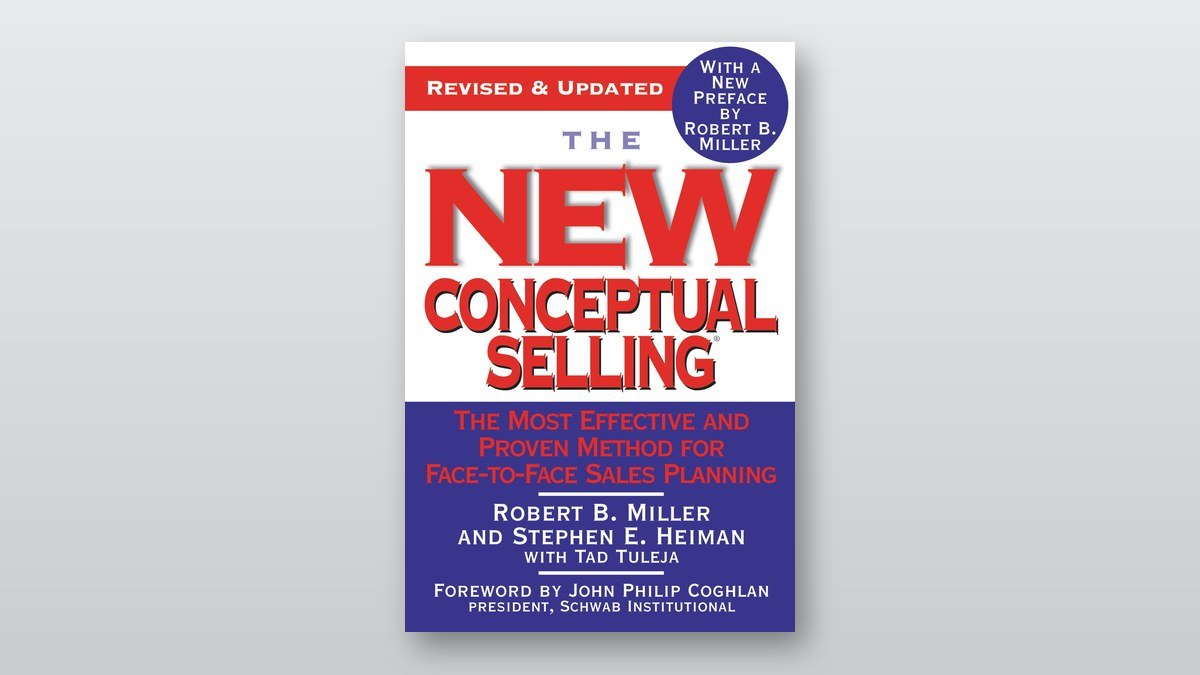
Conceptual Selling is the Miller Heiman method for planning and running face-to-face sales conversations, set out in the book by Robert B. Miller and Stephen E. Heiman with Tad Tuleja, first published in 1987. The edition most readers find today is the revised paperback The New Conceptual Selling, published by Grand Central Publishing on April 20, 2005, at 386 pages (Hachette Book Group). Its core idea is that buyers act on their own picture of what a solution will do for them, so a seller should learn that picture through questions before presenting anything.
The method is the meeting-level companion to Miller and Heiman's deal-level book; our New Strategic Selling summary covers that one. This page is about Conceptual Selling only.
This summary is in our own words and is built from public material: the publisher page, library catalog records and secondary write-ups, all linked below. We did not read the full book.
Editions and authors
The Hachette page lists the revised paperback as written by Robert B. Miller, Stephen E. Heiman and Tad Tuleja, with a foreword by John Philip Coghlan. It is priced at $19.99 and described as a revision of the book first published in 1987.
A library record at the Internet Archive shows an earlier revision, *The New Conceptual Selling*, from Warner Books in 1999, described as revised and updated for the 21st century. The catalogs disagree on its length: the Archive lists 390 pages and Open Library lists 374, so we treat neither as settled. The 2005 paperback is the edition with a clear publisher date.
The core idea: the customer's concept
The central term is the buyer's "concept": the customer's own picture of a successful result. A Umbrex overview puts it as customers buying their concept of what a solution will accomplish for them. That changes the seller's first job from explaining a product to finding out what the buyer imagines, and agreeing with the buyer on the problem before linking any solution to it (Umbrex).
The publisher's description adds that the book is about uncovering true needs through active listening, tailoring each sale with a consistent but flexible system, and building trust through deals that benefit both sides.
The Green Sheet
Conceptual Selling comes with a planning worksheet, the Green Sheet, used for a single customer meeting. The Umbrex framework page organizes it around getting information, giving information and getting commitment, and lists six elements: the call objective, what you know and don't know, the customer's concept, a question plan, the information you will offer, and the commitment you want.
The same page says routine calls take roughly 20 to 45 minutes to prepare, and that the sheet is a planning aid, not a full qualification system. Treat that as one commentator's guidance, not the book's own instruction.
Five kinds of questions
Several write-ups, including Gong and Umbrex, list five question types: confirmation questions check what you already believe you know; new-information questions uncover facts and circumstances; attitude questions explore opinions, concerns and priorities; commitment questions test readiness to act; and basic-issue questions surface the core problem or consequence.
Umbrex stresses these are not a rigid script. The write-ups are secondary and word the categories slightly differently, so check the book for the authors' exact definitions.
Getting a commitment
Each meeting is meant to end with the customer agreeing to a concrete next step. Umbrex's methodology page describes the goal as an advance, a commitment that moves the sale forward, not a final decision, and lists five rules, including: don't present prematurely, focus on the customer's perception rather than reality, ask for the customer's opinion, make each interaction add value, and get a clear commitment at the end of each meeting.
How it relates to Strategic Selling
A Salesmotion guide calls Conceptual Selling the meeting layer: the Blue Sheet from Strategic Selling plans the deal, and the Green Sheet plans and runs the conversations inside it. The Umbrex Green Sheet page suggests using the Blue Sheet to decide which stakeholder meeting is needed, then a Green Sheet to prepare it. Both are Miller Heiman programs, now part of Korn Ferry; Umbrex dates that acquisition to 2019.
Criticisms and limits
The one independent review we found, a 2008 blog review rated at 4 out of 5, praised the book for rejecting tricks and helping readers plan calls, but said it holds so much detail that most salespeople may lack the time to apply all of it, and that it can feel clunky at first. The reviewer preferred SPIN Selling.
Umbrex lists the sheet's limits as a call-level view, heavy reliance on the seller's judgment, and no qualification score. Our own note: much of the public material comes from training and software vendors, and the book predates today's remote and digital selling, so we have not tested how well it fits current buying behavior.
What it means for sellers
- Plan one meeting at a time. Before a call, write down what you want from it, what you know, and what you still need to learn.
- Ask before you present. Find out what the buyer thinks a good result looks like, then show how your offer fits that picture.
- Mix your questions. Check assumptions, ask open discovery questions, and ask about attitudes, not only facts.
- Aim for an advance. End with a specific next step the buyer agrees to, and have a fallback if they will not give the ideal one.
- Keep it light. If the full worksheet is too heavy for small deals, borrow the questions and the commitment habit alone.
Questions people ask
Who wrote Conceptual Selling and when was it published?
Robert B. Miller and Stephen E. Heiman wrote it with Tad Tuleja, and it first appeared in 1987. The revised paperback, The New Conceptual Selling, came from Grand Central Publishing on April 20, 2005, per the Hachette page.
What is the Conceptual Selling Green Sheet?
A worksheet for planning a single customer meeting, covering the objective, known facts, the customer's concept, questions, information to share and the commitment sought, as described by Umbrex.
What are the five question types?
Confirmation, new-information, attitude, commitment and basic-issue questions, according to Gong and Umbrex.
How is it different from Strategic Selling?
Strategic Selling plans the whole opportunity; Conceptual Selling plans and runs the individual conversations, per the Salesmotion guide.
Is this summary a substitute for the book?
No. We did not read the book; this page is written in our own words from public material, so read the book for the authors' full method.
Sources
- Hachette Book Group product page · Authors, imprint, date, pages, price and description of the revised edition
- Internet Archive catalog record · 1999 Warner Books revision and its relation to the 1987 original
- Open Library record · 1999 edition record and page-count discrepancy
- Umbrex Green Sheet page · Green Sheet elements, question types, limits, Korn Ferry acquisition date
- Umbrex Conceptual Selling page · Customer concept, rules and the idea of an advance
- Gong blog · The five question types
- Salesmotion guide · Relationship between Blue Sheet and Green Sheet
- Relentless Pursuit blog review · 2008 reader review with praise and criticisms
- Hachette cover image · Cover of the revised Grand Central paperback
This summary is an independent explainer written in our own words and does not reproduce the book. Facts were read from the linked pages in November 2026; check the book itself for the authors' exact method. The seller suggestions are our own.
Top photo: Book cover via Grand Central Publishing / Hachette Book Group