The New Strategic Selling Summary: Key Ideas from Miller and Heiman
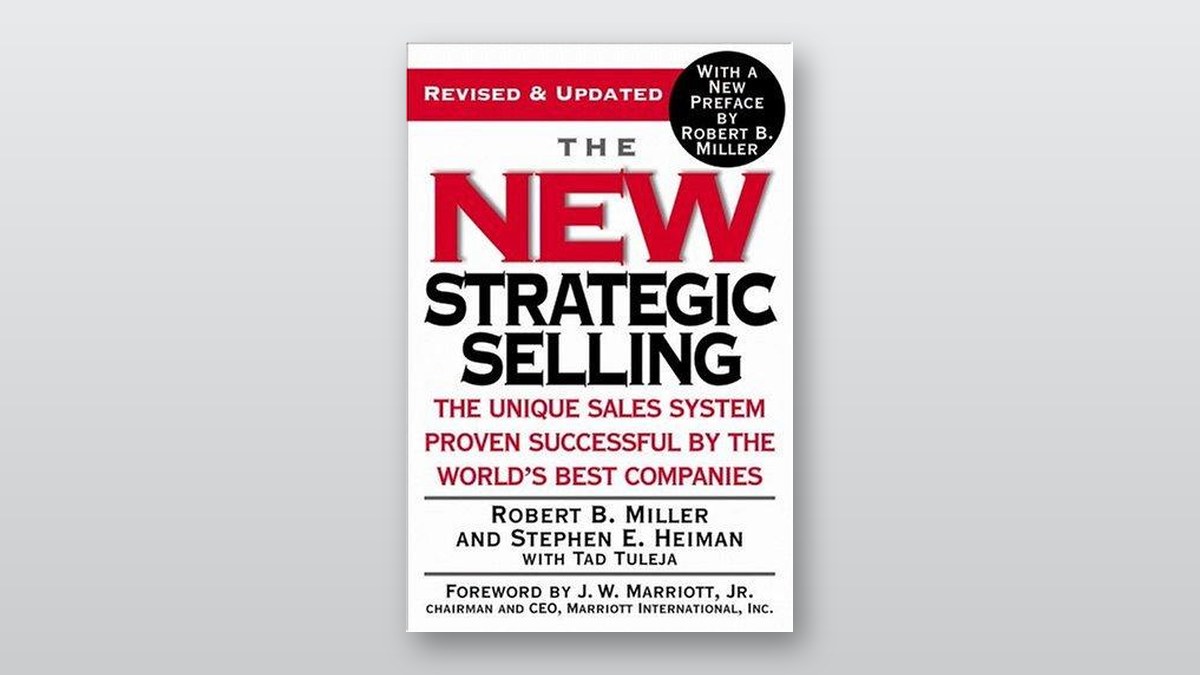
The New Strategic Selling argues that a complex B2B sale is rarely decided by one person, so you win by finding everyone who can influence the decision and positioning your solution for each of them. Robert B. Miller and Stephen E. Heiman, writing with Tad Tuleja, call these people buying influences and sort them into four roles: the economic buyer who gives final approval, the user buyers who live with the result, the technical buyers who screen the proposal, and the coach who guides you. The rest of the method (red flags, buyer response modes, win-results, an ideal customer profile and a sales funnel) is built to help you act on that map.
This summary refers to the revised and updated edition of the book. Its publisher, Grand Central Publishing, lists a 448-page paperback dated April 20, 2005, and says it builds on the 1985 book Strategic Selling. A third edition from Kogan Page followed in June 2011. It is our own short summary, not a retelling of the book.
The core idea: map the buying influences, then position for each
The book defines a complex sale as one where several people must give approval or input before a decision is made. Per Dan Doescher's outline of the book, that happens when the buyer or the seller has multiple options, many levels of responsibility are involved, or the buyer's decision process is seldom obvious to outsiders.
From that follows the book's first move: put strategy before tactics. A polished presentation delivered to the wrong person, or to one person while others stay unaware, does little. The method has you analyze where you stand in an account, think through alternative positions, build an action plan and keep reassessing. The outline lists six key elements of the strategy blueprint, which the sections below follow.
- Buying influences. Who can affect the outcome, whatever their title.
- Red flags and leverage from strength. What could block the sale and what you can build on.
- Response modes. How each buyer sees the need for change.
- Win-results. The business result that gives each person a personal win.
- Ideal customer profile. Who you sell to best.
- Sales funnel. How you manage your time across opportunities.
Miller Heiman Group, the training company built around the method, is now part of Korn Ferry, which completed that acquisition on November 1, 2019, per Training Industry.
The four buying influences
Per the same outline, every complex sale has four kinds of buying influence, and the book says not to assume one person covers them all or to be fooled by titles.
- Economic buyer. Provides final approval. There is only one per sale, though it could be a board or committee. This person controls spending and holds veto power, and focuses on the bottom line.
- User buyers. They judge how the purchase affects daily work, will live with your solution, and often have a personal stake in its success.
- Technical buyers. Gatekeepers who screen out harmful proposals and judge the measurable aspects. They can say no on specifications but cannot give final approval.
- Coach. A guide inside the buying organization. Coaches are found and developed. Three tests: you have credibility with them, they have credibility with the other influences, and they want your solution. Asking for coaching is not the same as asking for a referral.
The outline also names five factors for judging how much weight a person carries: organizational impact, level of expertise, location, personal priority and politics. It warns that a technical gatekeeper can act as a deal killer and that an economic buyer who seems to rubber-stamp a recommendation can still reassert authority.
A related point from the publisher's description: the book promises to show how to identify the four real decision makers and how to prevent sabotage by an internal deal-killer.
Red flags and leverage from strength
A red flag is a warning that could prevent a close. The outline lists automatic ones: critical information missing, uncertainty about information, any buying influence you have not contacted, a buying influence new to the job, and a reorganization, which may be subtle.
The book asks you to treat red flags positively, as signposts to opportunities rather than only road hazards. The other half is leverage from strength: using something you do better than competitors to deal with a weakness. A true strategic strength must be an area of differentiation, usable to improve your position and relevant to the current sales objective. Done well, it reduces the pull of price competition. The outline's advice on red flags is to avoid hammering away at a problem and to avoid ignoring the roadblock; use leverage from strength instead.
Response modes: how each buyer sees the need to change
Asking someone to buy is asking them to change. The book sorts each buying influence into one of four response modes, and stresses that perceptions are individual, so there is no single company perception.
- Growth. The buyer wants potential growth or better quality. Probability of action is high and this is usually the easiest mode to sell into.
- Trouble. The buyer needs a solution to a problem. Probability of action is high, the quickest fix tends to win, and extra bells and whistles do not help.
- Even keel. The buyer sees no reason to change and may see you as a threat. Probability of action is low.
- Overconfident. The buyer thinks the status quo beats the likely results of change. The outline says probability of action is nil, so do not push; be patient.
The outline adds a rating scale from -5 to +5 for how each buyer feels about your proposal, with +4 and +5 counted as strengths and severely negative ratings as red flags. It says a real coach must be in growth or trouble mode and rated at least +3. The International Journal of Sales Transformation (Bob Apollo) notes that growth and trouble signal a current opportunity, while even keel and overconfident make a sale harder.
Win-results: companies get results, only people win
A result is a corporate, measurable impact on a business process. A win is personal and subjective. A win-result is the objective business result that gives one or more buyers a personal win. The outline puts it as companies get results but only people win.
Practically, that means you should not treat the business case as the whole story. The book says to infer a buyer's wins from the results they want, ask directly what is in the sale for them, and use your coach. It warns against two mistakes: reading the result as the win, and assuming your own win matches theirs.
The same chapter frames four outcomes of any buy and sell encounter: both win, you win and they lose, you lose and they win (doing the buyer a favor), and both lose. The goal is the first, and the outline says the book treats win-win as the only acceptable conclusion. The publisher's description credits the original book with introducing win-win and framing selling as a joint venture.
The ideal customer profile and the sales funnel
The ideal customer profile goes beyond demographics to psychographics, meaning a company's character and way of working. You list your best and worst customers, note what they share, and keep the top five characteristics as a profile. The outline's examples of good traits include wanting a win-win relationship and committing to quality; bad ones include inflexibility on price and slow decisions. The idea is to spend time on accounts where the odds of a good outcome are best.
The sales funnel is the time management part. It tracks single sales objectives, not whole accounts, and its stated purpose is to smooth the roller-coaster effect of uneven income. The outline describes four levels.
- Universe. Companies that seem a reasonable fit with your ideal customer profile.
- Above the funnel. A possible match with their immediate needs, with at least one growth or trouble you may be able to address.
- In the funnel. You have confirmed the possibility of an order by speaking with at least one buyer, and you are covering the bases with every buying influence.
- Best few. All bases covered, with at least a 90% chance of closing the order in half or less of your normal selling cycle.
How a sales team can apply it today
The method's working document is the Blue Sheet, a one-page summary of an opportunity covering objectives, competition, buying influencers and planned actions, per the Sales Transformation article. RevenueGrid describes it as a strategy on a page that the account executive owns and reviews with the sales manager. A simple way to start without any software:
- Pick one live deal. State the single sales objective in one sentence.
- Draw the four roles. Name who plays each one, and mark anyone you have not met as a red flag.
- Mark each person's response mode and rating. Be honest about who is even keel.
- Write a win-result for each person. Include the personal win, not only the business result.
- Check your coach. Do they pass the three tests?
- Plan one action per red flag. Review in the next deal meeting.
Teams selling simpler or faster deals may find this too heavy, which the next section covers. For other ways to diagnose a buyer, compare the pain-first method in our Solution Selling summary, the gap-based approach in our Gap Selling summary and the question framework in our SPIN Selling summary.
Criticisms and limits
Independent criticism of the book itself is thin; most of what is written is from sales-software vendors, so weigh it as commentary. RevenueGrid, a vendor blog, lists the main limits:
- It takes training and steady upkeep, including CRM discipline to keep Blue Sheets current.
- It can feel overly complex for smaller or simpler deals and is less suited to transactional or high-volume inbound sales.
- Training and certification can be expensive for smaller teams.
Two more limits come from the method's own design. The mapping depends on honest information from inside the buyer's company, and the outline's rating scale is a judgment call rather than data. Apollo suggests pairing it with Challenger Selling when prospects are overconfident, since the book tells you to wait rather than to push them. The method also dates from 1985 in origin, so check that its approach to buying groups fits how your buyers research and decide today.
Questions people ask
What is The New Strategic Selling about?
It is a method for complex B2B sales, where several people influence the decision. It teaches you to identify four buying influences (economic, user, technical and coach), judge how each sees the need for change, and plan your approach for each.
What are the four buying influences?
The economic buyer gives final approval and controls spending. User buyers use or supervise the solution. Technical buyers screen proposals and can say no but cannot give final approval. The coach is a guide inside the buying organization who helps you.
What are the four response modes?
Growth, trouble, even keel and overconfident. Growth and trouble buyers are likely to act. Even keel buyers see no reason to change, and overconfident buyers believe the status quo beats the likely results of change.
Which edition does this summary cover, and who wrote it?
It covers the revised and updated edition by Robert B. Miller and Stephen E. Heiman with Tad Tuleja, published by Grand Central Publishing (Business Plus) with a listed date of April 20, 2005 and 448 pages. A third edition from Kogan Page followed in 2011 with 288 pages. The book builds on the 1985 book Strategic Selling, and an Open Library edition note refers to an earlier edition dated 1998, which we could not find a page for.
What is a win-result?
It is the objective business result that gives a buyer a personal win. The book separates corporate results from personal wins and says companies get results but only people win.
Is Strategic Selling still worth using?
It suits complex B2B sales with many decision makers and long cycles. It is heavier than needed for small or transactional deals, so many teams use it only on their larger opportunities.
Sources
- Grand Central Publishing (Hachette): The New Strategic Selling · Publisher page: edition details and book description
- Kogan Page: The New Strategic Selling, third edition · Third edition details and author notes
- Open Library: The New Strategic Selling (revised and updated edition) · Edition record with the earlier 1998 edition note
- Dan Doescher: The New Strategic Selling detailed outline, Fall 2015 · Chapter outline with the book's key elements
- International Journal of Sales Transformation: Spotlight on Strategic Selling · Overview, strengths and fit
- RevenueGrid: Miller Heiman Sales Process guide · Blue Sheet description and limitations (vendor blog)
- Training Industry: Korn Ferry completes acquisition of Miller Heiman Group · Korn Ferry release dated November 1, 2019
This summary is an independent explainer written in our own words and does not reproduce the book. Facts were read from the linked pages on October 20, 2026. We could not open the book itself, so chapter detail comes from the publisher descriptions and a published outline of the book; Korn Ferry's own course pages did not load. Read the book for the full detail.
Top photo: Book cover via Open Library