Cracking the Sales Management Code by Jason Jordan and Michelle Vazzana: Summary, Key Lessons, and RevOps Takeaways
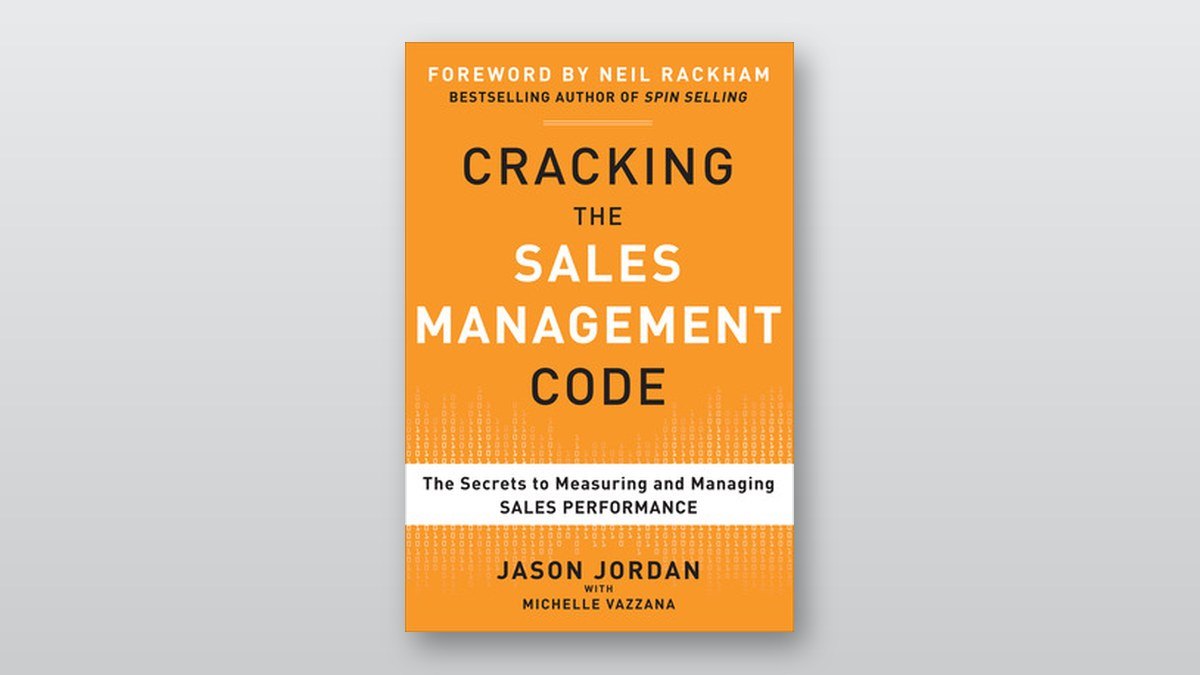
Cracking the Sales Management Code is a book about which sales numbers a manager can actually control. Jason Jordan and Michelle Vazzana, whom the Sales Management Association describes as founding partners of the sales management training firm Vantage Point Performance, sort sales metrics into three levels: activities, objectives and business results. Their argument is that managers should steer through activities and objectives instead of chasing results directly. The McGraw Hill listing shows the 1st edition, published September 20, 2011 with a 2012 copyright, a foreword by Neil Rackham, and print prices from $37.00 (McGraw Hill). It also names five sales processes that activities fall under.
For related reading on sales method and measurement, see our SPIN Selling summary and our Measure What Matters summary.
This summary is in our own words and is built from public material: the publisher listing, a Sales Management Association blog post, a Baylor University Keller Center review and a consultancy write-up, all linked below. We did not read the full text, and research figures are the authors' claims as relayed by those pages.
About the book and its authors
The publisher listing calls the book a guide built on research into how world-class companies measure and manage their sales forces, and describes it as the first operating manual for sales management (McGraw Hill). Dates differ by source: the same page gives a September 2011 publication date and a 2012 copyright, and a Baylor University review cites the book as McGraw-Hill, 2012, so we mention both years rather than pick one. The page does not list a page count, and we do not give one.
The Sales Management Association describes Vazzana and Jordan as founding partners of Vantage Point Performance, a sales management training firm. That is a trade-association blog post from 2018, so the authors' current titles and affiliations may differ and we did not verify them. The listing also says the book is aimed at sales managers who want to focus on the metrics that matter most.
The core idea: you cannot manage what you cannot control
The starting complaint is that CRM systems and dashboards give managers a flood of numbers and a false sense of control. The first chapter title on the publisher's contents list says as much, and the Sales Management Association says CRM has increased reporting without necessarily increasing control. The authors' answer is to separate what a manager can directly manage from what only moves as a consequence.
Their research basis, as relayed by the Sales Management Association, is a review of 306 sales performance metrics gathered from dozens of global sales forces through a survey run with the Sales Education Foundation. A write-up from COACT Associates describes the same 306 measures as coming from Fortune 100 sales forces, so the sample is described differently depending on the source. None of the pages we found gives sample sizes or method detail.
The three levels: activities, objectives, results
- Sales activities. What sellers and managers do and can fully control, such as account planning, coaching time or CRM use. The Sales Management Association calls these the leading indicators.
- Sales objectives. Outcomes such as customer retention or win rate. They depend on the cooperation of customers or staff, so a manager influences them only through activities.
- Business results. Company-wide outcomes such as revenue, profit and market share. The authors argue a sales manager cannot directly command these, and should mainly use them to judge success.
The logic runs backward. Start from the result you want, identify the objectives that produce it, then pick the activities that move those objectives. The Baylor Keller Center review says the book wants activities to be the last thing a manager examines, not the first, and the book's three parts follow that order: the problem, the code itself, then how to apply it.
Why most metrics are out of the manager's hands
The Sales Management Association says that in the authors' sample about 17% of metrics were activities, so roughly 83% fall outside direct control, and it concludes managers should focus on activities first. Two cautions apply. The splits for the other two levels are inconsistent across pages: the Sales Management Association text shows about 28% results and 55% objectives, while COACT shows 24% results and 59% objectives, with activities at 17% in both. And the Baylor review describes 12 categories in total: three for business results, four for objectives and five for activities. We did not see the book's own tables, so treat all percentages as second-hand.
The five processes behind activities
The Baylor review lists five activity categories, which the publisher listing calls five critical processes:
- Call management. Planning and conducting customer interactions.
- Opportunity management. Navigating individual, often complex deals.
- Account management. Maximizing the long-term value of existing customers.
- Territory management. Allocating selling effort across regions or segments.
- Sales force enablement. Improving the team's ability to sell.
The publisher says the book also helps readers choose the right processes for a particular team, prioritize conflicting objectives and align seller activities with business results. It uses the shorthand A-O-R, for activity, objective and result, and distinguishes call, opportunity, account and territory managers.
A worked example of the reverse-engineering
COACT's write-up gives an illustration, and we cannot confirm it comes from the book itself. A goal of 3% revenue growth becomes 4 new customers per quarter, which in turn becomes 16 extra prospecting calls per quarter. The point is the chain: a result target is translated into an objective and then into a specific, controllable activity. Treat the numbers as an example of the method, not as a benchmark.
Cautions and limits
Most public material about the book comes from the publisher, a trade association and consultancies that sell related services. The Sales Management Association post also says the book influenced companies such as GE, 3M and Tyco, without evidence we could check. The method as described is also tidy: it treats activities as cleanly controllable, while in practice the quality of execution varies. We have not tested the framework, and we did not read the full book.
RevOps takeaways
- Audit your dashboard by level. Tag every metric in your CRM reports as an activity, an objective or a result. Many teams will find the mix tilts toward results they cannot act on directly.
- Build the chain backward. For each quarterly result target, write down the objectives and the activities you expect to move it, so a manager knows what to inspect first.
- Report leading and lagging separately. Show activity and objective metrics next to results in forecast reviews, so conversations focus on what can still change.
- Match processes to the team. A territory-heavy team and an enterprise opportunity team need different activity metrics, which fits the book's idea of choosing processes per team.
- Use enablement as a lever. Treat enablement and coaching time as measurable activities with owners, not as background.
- Check your assumptions. Test whether your chosen activities actually predict the objectives in your own data before you hold people to them.
Questions people ask
Who wrote Cracking the Sales Management Code?
Jason Jordan with Michelle Vazzana, published by McGraw-Hill, per the publisher listing. The Sales Management Association describes them as founding partners of Vantage Point Performance.
When was it published?
The publisher lists September 20, 2011, with a 2012 copyright. Some references cite the book as 2012.
What is the A-O-R framework?
A three-level way to sort sales metrics: activities (controllable), objectives (influenced) and results (company-level outcomes). See the Baylor Keller Center review.
What are the five processes?
Call, opportunity, account and territory management, plus sales force enablement, per the Baylor review.
Where did the 306 metrics come from?
The Sales Management Association says a survey run with the Sales Education Foundation covered dozens of global sales forces; COACT says Fortune 100 sales forces. Neither gives method detail.
Is this summary a substitute for the book?
No. We did not read the full text. This page is in our own words from public material, so read the book for the authors' own cases and tools.
Sources
- McGraw Hill product page · Edition, dates, price, description and table of contents
- Sales Management Association blog (April 27, 2018) · Authors' firm, 306 metrics, three levels, 17% and 83% claims
- Baylor University Keller Center review (June 1, 2013) · 12 categories and the five activity processes
- COACT Associates blog · Fortune 100 description, alternate splits and worked example
- Book cover image (McGraw Hill) · Cover of the 1st edition
This summary is an independent explainer written in our own words and does not reproduce the book. Facts were read from the linked pages in November 2026; check the book itself for the authors' exact framework and data. Research figures are the authors' claims as relayed by third parties. The RevOps takeaways are our own interpretation.
Top photo: Book cover via McGraw Hill