Gap Selling Summary: Key Ideas from Keenan's Book
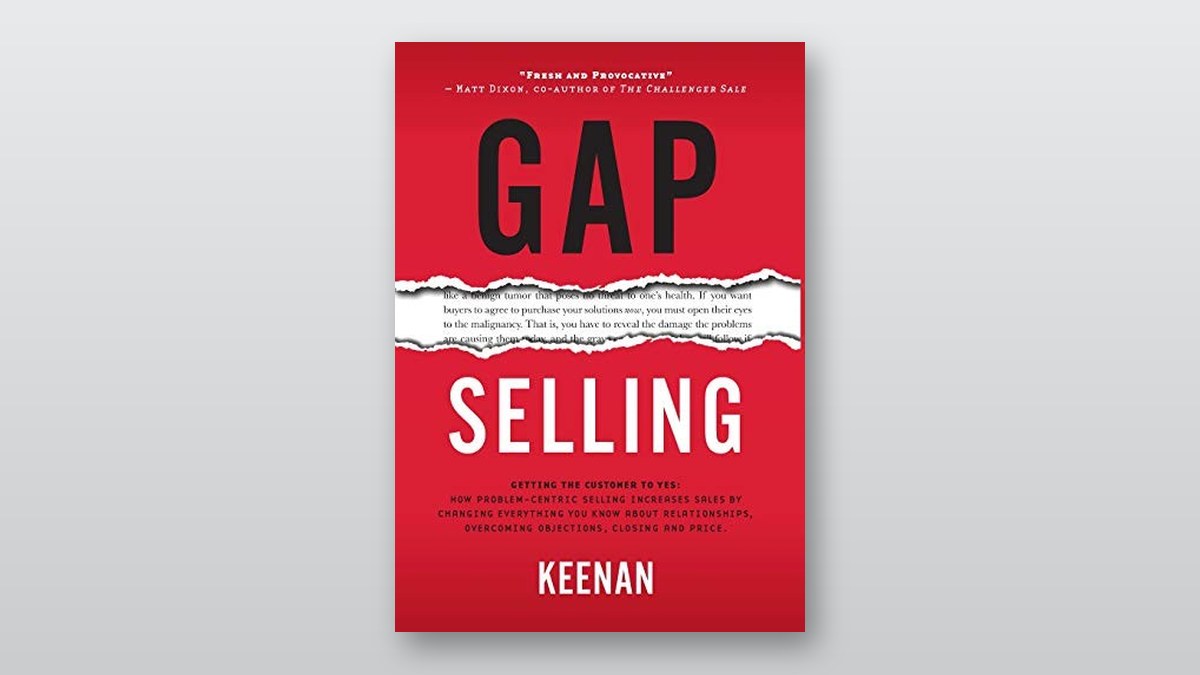
Gap Selling by Keenan argues that you sell by finding the gap between where the buyer is now and where they want to be, and that the gap, not your product, is the reason to buy. This is problem-centric selling: understand the buyer's current state in depth, define the future state, and only then talk about your solution as the way to close the gap. Per Built In, buyers change only when their current situation becomes untenable, and the seller's job is to influence that change.
The book is *Gap Selling: Getting the Customer to Yes*, published by A Sales Guy Publishing in 2018, and Open Library lists a hardcover of 262 pages, per Open Library. This is a short summary in our own words, not a retelling of the book.
The author and the book
Keenan goes by his last name. Built In says he ran sales training for nearly 10 years before creating gap selling. He is the founder of A Sales Growth Company, which describes itself as an enterprise B2B sales training and consulting firm and the creator of Gap Selling. Built In calls his earlier firm A Sales Guy, which is also the name of the book's publisher.
The full subtitle, listed on Open Library, is How Problem-Centric Selling Increases Sales by Changing Everything You Know About Relationships, Overcoming Objections, Closing and Price. A paperback followed in 2019 at 260 pages. The company's own site cites over 150,000 copies in circulation, which is a claim by the author's own company and not an independent sales figure.
The core idea: problem-centric selling
Built In says Keenan watched reps push product benefits and the cost of inaction, then leave the buyer to draw their own conclusions, which makes outcomes hard to control. Gap selling replaces that with in-depth discovery before the product comes up.
The shift is from what you sell to what the buyer is stuck with. Gong, a sales software vendor, notes the framework rejects the conventional advice to identify a need and sell it, because solving a stated need can miss the real problem. A wider gap means a stronger motivation to buy.
Current state, future state and the gap
Built In lists five elements of the current state. Together they describe the buyer's world before you change it.
- Environment. The physical and literal situation, such as location, customers, team size and industry.
- Problem. The type of problem, seen from technical and business angles.
- Impact. How the problem affects the company, including quantifiable costs.
- Root cause. The underlying issue or misalignment producing the problem.
- Emotion. How the problem makes the buyer feel.
The future state is where the buyer could be if the problem were solved: the outcome they want and its effect on them and their business, per Gong. The difference between the two states is the gap. Built In says it becomes the context for discussing the product and the buyer's motivation to buy.
Root cause: fix the cause, not the symptom
Root cause is the point where the seller proves understanding. Gong's example is project managers lacking a single source of truth, which causes delayed projects. Built In's example is inaccurate Salesforce data costing $100,000 in lost revenue each month, with the root cause that reps were too busy prospecting to enter data manually.
The lesson is that a stated problem is usually a symptom. A seller who only treats the symptom competes on features, while one who finds the cause can show why a particular fix matters.
Discovery: the problem identification chart and questions
The book is about method more than a formula. Gong gives six steps: build a Problem Identification Chart, gather facts, uncover impact and root cause, define the future state, determine decision criteria, and close the gap. Built In describes the chart as three columns: problem, business impact and root cause.
Gong lists four question types.
- Probing. Open-ended questions that get the buyer talking.
- Process. Questions about how things work today.
- Provoking. Questions that surface problems the buyer has not considered.
- Validating. Close-ended questions that confirm what you heard.
Gong adds that discovery should run throughout the call, and Keenan suggests spending about a quarter of the sales cycle learning the current and future states. It also cites a talk-to-listen ratio of 46:54 for top reps against 68:32 for average reps; treat that as a vendor-reported figure.
Emotional and business impact
Impact has two sides. On the business side, Built In points to quantifiable costs, and Gong's example is delayed projects leading to unhappy clients and lost revenue. On the personal side, emotion is how the current state affects the prospect, listed separately from business impact.
Numbers also work as a filter. Built In's example sets a $250,000 annual revenue cost against a $10,000 product, and notes that a $5,000 gap might not justify pursuing the sale. If the gap is small, the buyer has little reason to change.
The conventional wisdom it challenges
The subtitle on Open Library says the method changes what you know about relationships, overcoming objections, closing and price. We could not read the book's chapters, so we do not summarize its arguments on each. What the sources do support is the logic behind them.
- Need-based selling. Gong says it rejects identify a need and sell it, because a stated need can hide the real problem.
- Benefit pushing. Built In says pushing product benefits leaves buyers to reach their own conclusions.
- Solution Selling. Gong contrasts it with Gap Selling, which focuses on problems rather than needs.
How a sales team can apply it
- Use one chart per deal. Fill in problem, business impact and root cause before any demo.
- Ask for numbers. Put a dollar or time figure on each impact, as in the examples above.
- Define the future state first. Agree where the buyer wants to be before presenting how to get there.
- Coach on the questions. Review calls for probing, provoking and validating questions.
- Plan for training. A Sales Growth Company offers instructor-led Gap Selling training, Gap Prospecting for SDRs and Gap Manager for frontline leaders. That is the author's own commercial offer.
Built In says the method requires in-depth discovery before the product is discussed, so it changes how calls are run, not just what is said.
Criticisms and limits
Most public coverage is friendly, and some of it comes from vendors, so read the praise with that in mind. The limits that sources do name are consistent.
- Hard to master. Built In says Keenan admits it takes time and there is no fixed question checklist. Gong says there is no script.
- Needs business acumen. Mark Cope, SVP of Sales at CentralReach, calls it a double-edged sword whose simplicity comes at a cost, per Built In.
- Poor fit for simple sales. Gong says transactional and retail buyers will not tolerate extended questioning; it suits complex B2B sales.
- Time and training cost. Heavy discovery may be impractical for some teams, and Gong notes it requires investment in training.
Questions people ask
What is Gap Selling about?
Gap Selling by Keenan teaches problem-centric selling. The seller finds the gap between the buyer's current state and desired future state, and uses that gap to justify buying.
Who wrote Gap Selling and when was it published?
Keenan, founder of A Sales Growth Company, wrote it. A Sales Guy Publishing released the hardcover in 2018, and Open Library lists 262 pages.
What are the five parts of the current state?
Environment, problem, impact, root cause and emotion, per Built In and Gong.
What is the gap in Gap Selling?
The difference between the buyer's current state and future state. A wider gap means a stronger motivation to buy.
Is Gap Selling the same as Solution Selling?
No. Gong contrasts them: Gap Selling focuses on problems rather than needs. See our Solution Selling summary for the other book.
Is Gap Selling worth reading?
Yes for sellers of complex B2B products who want a disciplined discovery method. It is a poor fit for simple transactional sales, and it takes practice.
Sources
- Open Library: Gap Selling (work record) · Editions, subtitle and publication dates
- Open Library: Gap Selling (hardcover edition) · Publisher, date, page count and cover
- A Sales Growth Company · Author's company, books and training offers
- Built In: Gap Selling, the what, how and why · Current state, examples and criticisms
- Gong: Our Complete Guide to Gap Selling · Steps, question types and limits
This summary is an independent explainer written in our own words and does not reproduce the book. Facts were read from the linked pages on October 20, 2026. We did not have the book's full text, so for exact wording and chapter detail, read the book itself.
Top photo: Book cover via Open Library