High Output Management Summary: Key Ideas from Andy Grove's Book
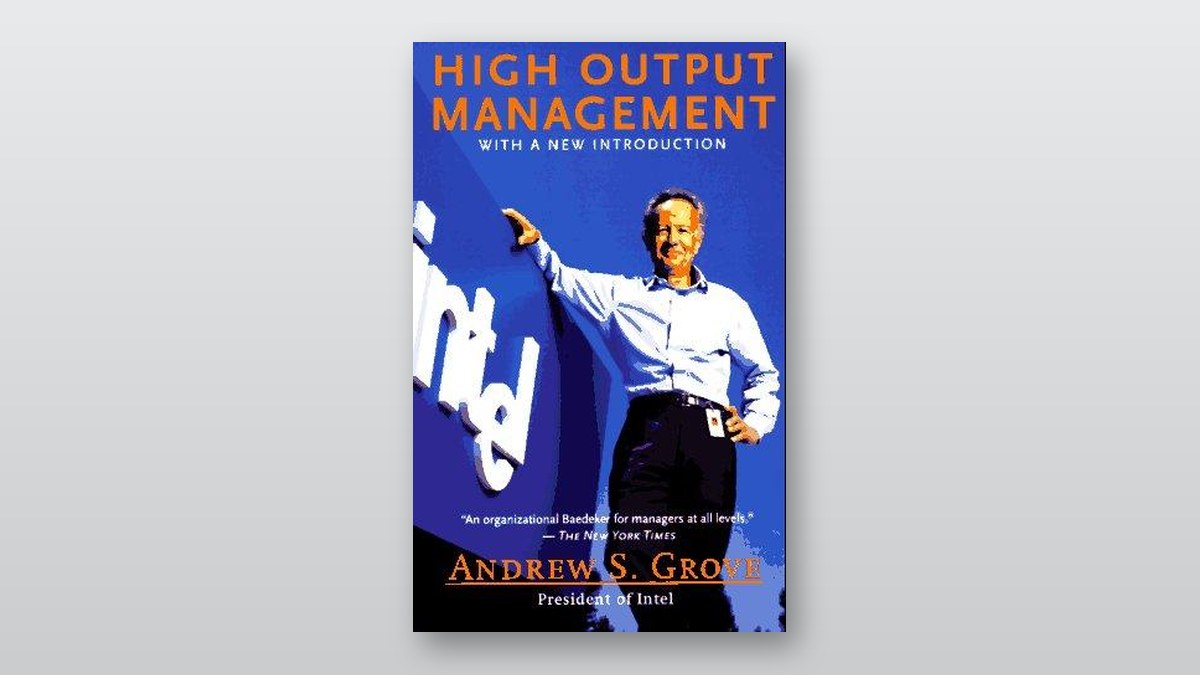
High Output Management by Andrew S. Grove argues that a manager's output is not their own work. It is the output of their team plus the output of the neighboring teams they influence. So the job is to raise managerial leverage: spend your time on the activities that multiply the output of many people, and drop or delegate the ones that do not. Grove, who helped found Intel and became its CEO in 1987, builds the idea from a factory analogy (the breakfast factory) and applies it to meetings, one-on-ones, decisions, reviews and goal-setting.
The book first appeared in 1983 from Random House. The Vintage paperback most readers buy was published on August 29, 1995 and runs 272 pages, per Penguin Random House. Facts below refer to those two editions. This is a summary in our own words built from the publisher page and published summaries, not a chapter-by-chapter retelling.
The author and the editions
Grove emigrated from Hungary to the United States in 1956, became Intel's president in 1979 and CEO in 1987, and died in 2016, per Penguin Random House. The Computer History Museum says he was the first recruit when Moore and Robert Noyce founded Intel in 1968, and that highly quantitative management by objectives became part of Intel's culture and was linked to its success.
Open Library records the work as first published in 1983, with the Vintage edition following in 1995. The cover of the Vintage edition says it comes with a new introduction. The publisher describes the book as equally appropriate for sales managers, accountants, consultants and teachers.
The core idea: a manager's output and leverage
Grove's starting point is a factory that makes breakfasts, where the output is simply breakfast. A manager's output is harder to see. Per Shortform, it is the combined output of the teams she influences, not her individual work. Evan Samek's chapter summary adds that the output of neighboring organizations a manager influences counts too, so an influential individual contributor can be a manager in this sense.
That is why leverage matters. Shortform describes managerial output as the sum of each activity multiplied by its leverage, with a worked example: two activities worth 10 and 20 at leverage 1 give an output of 30, and raising the first activity's leverage to 5 gives 70.
The breakfast factory and production principles
The early chapters use the breakfast analogy to teach production basics. According to Samek's summary:
- Goal. Deliver to customer demand, on schedule, at acceptable quality and at the lowest cost.
- Limiting step. Whatever takes longest to prepare sets the pace, so manage that step first.
- Indicators. Measure output, not activity, and pair indicators (for example inventory with shortages) so you do not overreact to one.
- Catch problems early. Find defects at the lowest-value stage of production, before more work is added on top.
High-leverage activities
Samek's summary lists three kinds of high-leverage action: those that affect many people, those that affect one person for a long time, and those where key information shapes a large group's work. Leverage can also be negative, such as meddling with subordinates or waffling on decisions.
Grove's own examples include training. Brikman's notes say the book counts training among the highest-leverage activities a manager can perform. The same summaries stress information gathering, and they describe reports as a tool of self-discipline: writing one matters more than reading one.
Meetings and one-on-ones
Samek separates two kinds of meeting. Process meetings are recurring and structured: one-on-ones, staff meetings and operation reviews. Mission-oriented meetings are ad hoc, and Samek reports that spending over 25% of your time in them signals poor organization. His tips for them: state the objective, keep attendance to about 8, give a detailed agenda and circulate minutes.
On one-on-ones, the Lighthouse guide says Grove wrote that one should last an hour at minimum and is the subordinate's meeting, so the subordinate sets the agenda and tone. The manager prepares questions, takes notes and follows up on promises. Frequency depends on the person's task-relevant maturity: weekly for inexperienced staff, every few weeks for experienced veterans.
Decision-making
Per Samek, Grove's ideal process runs from free discussion, to a clearly understood decision, to full support, even from people who disagreed. Decisions should be made by those closest to the situation, and Shortform adds the rule of the lowest competent level.
Before a meeting, Samek says to clarify what decision is needed, its deadline, who decides, who is consulted, who ratifies and who is informed. He also flags peer-group syndrome, where peers avoid the core issue while sensing out consensus.
Task-relevant maturity
Task-relevant maturity (TRM) measures how educated, experienced and mentally ready someone is for a particular task, not in general. Shortform maps it to a management style:
- Low TRM. Give structure and detailed direction on how, when and what.
- Medium TRM. Give some structure and exchange ideas.
- High TRM. Set clear objectives and step back.
Everyone still gets monitored, and you adjust as maturity changes. Brikman compares this to parenting: as people mature, the manager steps back.
Performance reviews
The main goal, per Shortform, is to improve performance rather than merely assess it. Its process: set expectations, assess against them, distill the assessment into broad themes and suggest improvements. Managers find reviews hard because feedback is awkward, performance is hard to judge and reviews are tied to pay.
Samek adds that you should consider output, avoid judging potential instead of performance, write your own review before reading self-reviews, and treat 360 reviews as advisory.
Where OKRs come from
The book's planning chapter covers what Grove called management by objectives. Samek reports it asks where you want to go (the objective) and how you will measure progress (the key results), and that a manager's key result can become a subordinate's objective. He also says it should not be applied mechanically in reviews.
What Matters says Grove created the OKR method at Intel and taught it to John Doerr, who named it and introduced it to Google's founders in 1999. Intel's version was called iMBOs, built on Peter Drucker's MBOs, and OKRs differ by being quarterly and separate from compensation. For the full story see our Measure What Matters summary, which covers Doerr's book on OKRs.
How a sales leader can apply it
This section is our interpretation, not a claim from the book. A sales leader's output is the team's results, so the leverage questions are practical:
- Coach where it multiplies. Training and regular one-on-ones touch every rep for a long time, which fits Grove's high-leverage test.
- Run one-on-ones as the rep's meeting. Let the rep bring the deals and problems, and take notes you follow up on.
- Match style to maturity. A new hire needs detailed direction on calls and process. A veteran needs clear targets and room.
- Pair your indicators. Track activity next to outcomes so one number does not distort behavior, in line with Grove's paired indicators.
- Guard your time. Cut ad hoc meetings that do not raise anyone's output.
Criticisms and limits
Readers' complaints, per Brikman: the book is dated and its praise of email shows its age, parts on one-on-ones and goal-setting feel obvious to people who work at large companies, it targets middle managers at large physical-product companies, and early chapters lean on platitudes.
Our own caution: the summaries we read are second-hand, and some are uniformly favorable, so read the book for Grove's exact reasoning. Hybrid and dual-reporting structures, which Samek notes create ambiguity, are an area where a modern company may adapt rather than copy.
Questions people ask
Who wrote High Output Management and when?
Andrew S. Grove wrote it. It was first published in 1983, and the Vintage paperback came out on August 29, 1995 at 272 pages, per Penguin Random House.
What is the main idea of High Output Management?
A manager's output is the output of their team plus the neighboring teams they influence, so the manager's job is to raise leverage by focusing on high-leverage activities.
What is task-relevant maturity?
It is how educated, experienced and mentally ready a person is for a specific task. Low maturity calls for detailed direction, high maturity for clear objectives and room.
How long should a one-on-one be, per Grove?
Per the Lighthouse guide, Grove wrote that a one-on-one should last an hour at minimum, and that it is the subordinate's meeting.
Did Andy Grove invent OKRs?
Per What Matters, Grove created the method at Intel, where it was called iMBOs, and taught it to John Doerr, who named it OKRs.
Is High Output Management only for managers?
No. The publisher says it suits sales managers, accountants, consultants and teachers, and Samek notes influential individual contributors count as managers in Grove's sense.
Sources
- Penguin Random House: High Output Management · Publisher, 1995 Vintage edition, page count, author bio
- Open Library: High Output Management · 1983 first publication and edition records
- Computer History Museum: Remembering Andy S. Grove · Grove's career at Intel and management by objectives
- Evan Samek: High Output Management chapter summary · Production, leverage, meetings, decisions, OKRs, reviews
- Shortform: High Output Management summary · Leverage formula, TRM, decisions, reviews
- Yevgeniy Brikman: notes on the book · Training, TRM and critiques
- Lighthouse: Grove's one-on-ones · One-on-one length, agenda and frequency
- What Matters: What is an OKR? · OKR origin at Intel
This summary is an independent explainer written in our own words and does not reproduce the book. Facts were read from the linked pages on October 19, 2026; we did not read the full text of the book. Read it for Grove's full detail.
Top photo: Book cover via Open Library