Influence Summary: Robert Cialdini's 7 Principles of Persuasion
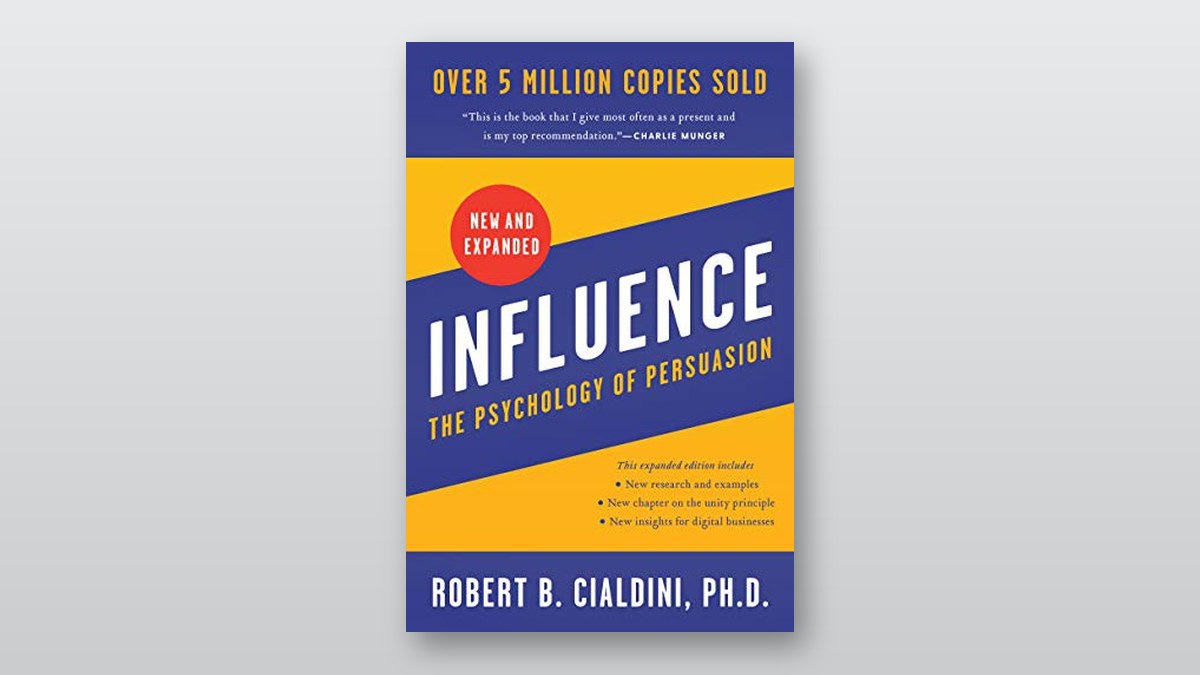
Influence: The Psychology of Persuasion by Robert Cialdini argues that a small number of mental shortcuts trigger near-automatic compliance: we often say yes without thinking hard, because certain cues tell us that yes is the sensible answer. The book names six such principles, reciprocity, commitment and consistency, social proof, liking, authority and scarcity, and the 2021 new and expanded edition adds a seventh, unity. Learn the cues and you can spot when they are being used on you, and use them honestly when you are the one making the request.
The book first appeared in 1984. Facts about the book itself below refer to the 2021 new and expanded edition from Harper Business, which runs 592 pages in the edition we checked, per Open Library. This is a summary in our own words, based on the public pages linked below, not a chapter-by-chapter retelling. For the author's follow-up on timing, see our Pre-Suasion summary.
The author and the book
Wikipedia records that the book was first published in 1984 as Influence: The Psychology of Persuasion and republished in 1985 as Influence: Science and Practice. The 2021 new and expanded edition, published May 4, 2021 by Harper Business per Open Library, is the one that makes unity the seventh principle. Its cover says the edition includes new research and examples, a new chapter on the unity principle and new insights for digital businesses, and it carries an "Over 5 million copies sold" banner.
Cialdini says he went undercover in car and door-to-door sales to see persuasion from the practitioner's side, per Wikipedia. We could not load the HarperCollins product page, so publisher facts here come from Open Library and the cover itself.
The core idea: shortcuts that trigger an automatic yes
Reader notes by Graham King, hosted on Cialdini's own site, describe the framework this way: we can analyze information thoroughly, or we can use judgmental heuristics, which are shortcuts that save effort. Persuasion works when a cue triggers the shortcut. Those notes are one reader's summary, not the book's text, and they say they do not link to the research the book cites.
Each principle below is a cue that is usually a good guide to the right answer, which is exactly why it can be exploited when someone fakes the cue.
Reciprocity
People feel obliged to repay what they first received. The best-known illustration is the Hare Krishna devotee who presses a flower or book into your hand; you feel awkward keeping it for free and end up giving money. That is the version described in King's reader notes; the book's own wording is in the book.
Cialdini's company Influence At Work cites restaurant studies in which one mint at the end of a meal raised tips about 3%, two mints about 14%, and one mint offered with a personal extra-mint remark about 23%. Treat that as the company's summary of the research, and check the original study before quoting it.
The principle also covers concessions: Wikipedia describes the door-in-the-face technique, where a large request is followed by a smaller one.
Commitment and consistency
We want to act in line with what we have already said or done. The classic example is the foot-in-the-door effect: per Wikipedia, in the 1966 Freedman and Fraser study, 76% of people who first agreed to a small window sign later complied with the large request, against 17% of those who were not given the earlier request. Influence At Work gives a related example in which homeowners who first accepted a small Drive Safely window card were four times as likely to agree to a large roadside billboard.
King's notes add that commitments work best when they are public, active, effortful and freely chosen, and describe the low-ball tactic: a car salesman quotes an artificially low price, then the price rises after the buyer has already committed.
Social proof
When we are unsure, we look at what other people do, especially people similar to us. Influence At Work describes hotel towel cards: a card citing environmental benefits drew about 35% compliance, citing that 75% of guests reuse towels raised reuse by 26%, and citing that 75% of people who stayed in that very room reused their towel raised it by 33%.
The lesson in the examples is that specific, similar others persuade better than a generic crowd. Testimonials and bestseller labels work on the same shortcut, per King's notes.
Liking
We say yes more readily to people we like, and the book points to similarity, compliments and cooperation toward shared goals as the main drivers; Wikipedia also lists physical attractiveness. Influence At Work describes negotiation studies in which about 55% of groups reached agreement when they got straight to business, versus 90% when they first shared a personal similarity, with those deals worth about 18% more to both sides.
King's notes add a warning worth keeping: compliments can raise liking even when the receiver suspects they are not genuine, so liking can be manufactured.
Authority
We defer to credible experts, and symbols of expertise such as titles, uniforms and expensive cars can be enough to trigger deference, per Wikipedia. Influence At Work reports that real estate agents whose receptionists mentioned colleagues' credentials saw a 20% rise in appointments and a 15% rise in signed contracts, and that a uniform makes people more likely to give change for a parking meter.
The ethical point is that authority should be real and relevant. Claiming expertise you do not have is manipulation, not persuasion.
Scarcity
People want more of what they can have less of. Influence At Work cites British Airways: after announcing in 2003 that it would stop the London to New York Concorde flight, sales jumped the next day even though the flight itself had not changed. Wikipedia lists limited-availability marketing and restricted information as other forms.
Unity (added in the 2021 edition)
Unity is the principle added in the new and expanded edition. The Cialdini Institute defines it as shared identity moving people: group membership such as family, nationality, faith, region or profession. It is different from liking, which rests on what two people have in common rather than who they are together.
The main study it cites is Levine and colleagues (2005): Manchester United supporters were much more likely to help an injured man wearing their own team's shirt than a rival's or a plain top, but when the identity was framed as football fans, the rival shirt was helped too. The page gives no sample sizes or percentages.
The same page notes the downside: any in-group implies an out-group, and a mechanism that makes people generous to insiders can make them indifferent to outsiders. The Influence At Work principles page itself gives no description of unity, so the Institute page is our source.
How a sales leader can use the principles ethically
The ideas below are our own interpretation of the framework, not advice quoted from the book.
- Give first, for real. Reciprocity works when the gift is genuinely useful to the buyer, such as a relevant diagnostic or a straight answer. A token gift used to extract a yes is the manipulative version.
- Ask for small, honest commitments. A buyer agreeing to a short next-step meeting is consistent with wanting to evaluate the product. Avoid low-balling, where terms change after commitment.
- Use true social proof from similar customers. The towel-card examples suggest peers in the same situation persuade better than a generic logo wall. Use real customers and real results.
- Build liking through real similarity. Find actual common ground rather than mirroring tricks.
- Let real expertise show. Credentials and experience that are relevant to the buyer's problem are authority; borrowed titles are not.
- Make scarcity true. Only mention limited capacity or deadlines that really exist.
- Invoke unity only when it is real. The Cialdini Institute suggests a test: would the shared identity still hold if the person said no, and would you agree to the same request from a stranger on the same terms?
A useful team rule is to apply one test to every principle: would the buyer still feel fairly treated if they saw exactly what you were doing?
Criticisms and limits
Evidence quality varies. Many of the figures above are reported through summaries, including the author's own company. We have not checked each original study, so treat the percentages as the sources' reports. The Wikipedia page on the book does not discuss criticisms or replication, and we did not find a source that systematically tests the whole framework.
Individual effects are debated. On the foot-in-the-door technique, Wikipedia notes mixed results for charitable donations, with some studies finding more giving and others finding no statistically significant effect, and says the mechanism is disputed: self-perception theory is the best-known explanation, but Burger (1999) argued the effect is simpler. It also says effects appear strongest for pro-social requests and that online use needs more research.
Context matters. King's notes say commitments work best when public, active, effortful and freely chosen, which means the same tactic may do little when those conditions are missing.
Unity cuts both ways. The Cialdini Institute itself warns that identity-based appeals can create outsiders, so use them carefully.
Questions people ask
What is Influence: The Psychology of Persuasion about?
It explains how a few mental shortcuts, such as reciprocity, social proof and scarcity, lead people to say yes almost automatically, and how to recognize and use them honestly.
What are Cialdini's 7 principles of persuasion?
Reciprocity, commitment and consistency, social proof, liking, authority, scarcity and unity. The first six date to the 1984 original; unity was added in the 2021 new and expanded edition.
What is new in the 2021 new and expanded edition?
Per its cover, new research and examples, a new chapter on the unity principle and new insights for digital businesses. It was published May 4, 2021 by Harper Business.
Is Influence worth reading for sales leaders?
It is a widely read primer on why buyers say yes, and the examples translate to sales. Check the original studies behind any figure you plan to quote, and keep the ethics test in this summary in mind.
Is the book still reliable if some psychology studies fail to replicate?
We found no source testing the whole framework. Some individual effects, such as foot-in-the-door on charitable giving, show mixed results, so treat the principles as useful heuristics rather than guarantees.
Sources
- Open Library: Influence, New and Expanded · Edition, publisher, publication date and page count
- Influence At Work: the 7 principles · Cialdini's company page with study examples for six principles (promotional)
- Cialdini Institute: Unity · Definition, the Levine study and ethics caution for the seventh principle
- Wikipedia: Influence: Science and Practice · Publication history and the principles overview
- Wikipedia: Foot-in-the-door technique · Freedman and Fraser figures and the mixed later evidence
- Graham King's reader notes · Reader summary hosted by Cialdini's company
- Our Pre-Suasion summary · Cialdini's 2016 follow-up
This summary is an independent explainer written in our own words and does not reproduce the book. Facts were read from the linked pages on October 20, 2026; we did not read the full text of the book, and several study figures come from secondary summaries. Read the book and its references for the full detail.
Top photo: Book cover via Open Library