Only the Paranoid Survive Summary: Key Ideas from Andy Grove's Book
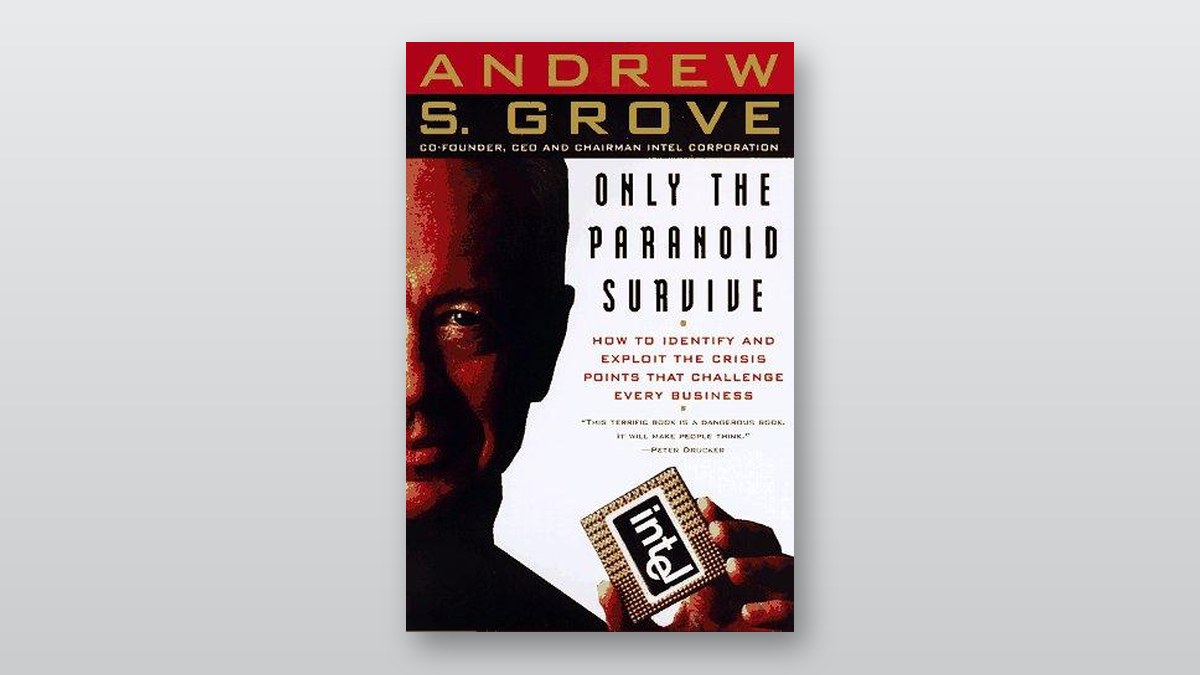
Only the Paranoid Survive by Andrew S. Grove argues that every business eventually hits a strategic inflection point: a moment when the old picture of the business dissolves and something new takes its place. Grove ties these moments to a 10X change, a force roughly ten times larger than normal, hitting one of the forces that shape an industry. The book's advice is to stay alert enough to spot the change early, separate real signals from noise, and then lead the company through the painful stretch ("the valley of death") to the other side. Grove, who ran Intel from 1987 to 1998, builds the argument from Intel's own crises, including its exit from memory chips and the 1994 Pentium flaw.
The book was first published in 1996 by Currency/Doubleday, and the paperback most readers find was released March 16, 1999 at 240 pages, per Penguin Random House. This is a summary in our own words built from the publisher page and published reviews, not a chapter-by-chapter retelling.
The author and the editions
Grove emigrated from Hungary in 1956, helped found Intel, served as CEO from 1987 to 1998, was Time magazine's 1997 Man of the Year, and died in 2016, per Penguin Random House. Open Library records the work as first published in 1996, with a 210-page Currency Doubleday edition and the 240-page 1999 paperback.
The publisher says the book draws on Grove's Intel experience, including the 1994 Pentium flaw and the rapid growth of the Internet. It quotes Forbes calling it probably the best business book by a businessperson since Alfred Sloan's My Years with General Motors, and Steve Jobs saying leaders must learn about strategic inflection points.
What a strategic inflection point is
Per the publisher, a strategic inflection point is a major change, such as intense competition, new regulations or a modest-looking technology shift, that forces a company to adapt quickly or fall behind. A well-handled one can also be a chance to come out stronger.
Hoala Greevy's review on Paubox captures Grove's picture: the old strategic picture dissolves into a new one, and the curve changes permanently. These points rarely arrive with a bang. They approach quietly and are often clear only in hindsight. Grove's first example, from 1994, was a public relations problem that showed Intel was no longer selling mainly to computer makers but to the mass consumer market.
The six forces and the 10X force
Grove's test for an inflection point is a 10X change: a force that has changed by roughly a factor of ten. Per Paubox, he argues every 10X change creates a strategic inflection point, and every inflection point involves a 10X change.
The forces come from Michael Porter's five-forces model, which Grove summarizes and extends. His addition is a sixth, the force of complementors: businesses whose complementary products customers buy alongside yours. We could not confirm the full list of Porter's five from the sources we read, so check the book for Grove's exact wording of each.
Signal vs noise, and the Cassandras
Most changes are noise. Per Paubox, Grove says there is no formula for separating signal from noise, so decisions should be reexamined as time passes. He offers aids:
- The silver bullet test. Ask which competitor you would save your one bullet for.
- Three questions. Is your key competitor about to change? Is your key complementor about to change? Do people seem to be losing it around you?
- The trap of the first version. Do not judge a new technology by how weak its first product is. The example given is Apple's Newton in 1993.
The warning signs often come from inside. Grove's helpful Cassandras are people who recognize impending change quickly, usually in middle management and often in sales. The lesson is to listen to them rather than dismiss them.
Intel's exit from memory chips
The book's central story is Intel leaving the memory business. Intel's first product was a memory chip, per Paubox. By 1985 Japanese competitors were selling memory below cost, and demand for Intel's memory chips fell, per Wikipedia's Grove entry.
NPR's 2012 account of Grove and Gordon Moore says they sat in Grove's cubicle, and Grove asked what a new outside owner would do if the board replaced them. Moore said the new leader would exit the memory business. Grove then suggested they do it themselves. Intel cut more than 7,000 employees, almost a third of its workforce, and shifted focus to microprocessors, which led to its later success. NPR relies on recollections told decades later, so treat the exact words as approximate.
Paubox notes the thought experiment shows how people with no emotional stake see needed changes sooner. That is the practical takeaway: look at your business as an outsider would.
The Pentium flaw episode
The publisher lists the 1994 Pentium flaw among the book's examples. Per Wikipedia's account of the FDIV bug, math professor Thomas Nicely first noticed inconsistencies on June 13, 1994 and reported them to Intel on October 24, 1994. Intel said in November 1994 the flaw was not serious and would affect few users, and at first offered replacements only to people who could prove they were affected.
IBM paused sales of PCs with Intel CPUs. On December 20, 1994, Intel began replacing flawed Pentiums on request, and on January 17, 1995 it announced a $475 million pretax charge. Grove was CEO at the time and later acknowledged that the mistake was presuming to tell customers what they should worry about.
This ties to the book's theme: Intel's customers had shifted from computer makers to a mass consumer market, and the old rules of engineering-first communication no longer fit.
The valley of death and how to lead through it
Per Paubox, the valley of death is an unavoidable part of every inflection point. Its summary of Grove's advice:
- Know the stages. Management typically moves from denial, to escape or diversion, to acceptance and action. Strategic dissonance is a sign a company is struggling.
- Picture the other side. Form a clear mental picture of the company after the change before you act.
- Move early and clearly. Leaders tend to wait too long, and acting early costs less than acting late. A strong, clear direction matters more than the perfect one.
- Change in steps toward a defined goal. Grove favors incremental changes that serve a clearly defined end goal.
- Alternate chaos and control. Let experimentation run, then rein it in.
- Keep moving. Competitors are chasing you, and the greatest danger is standing still. Fighting a new technology wastes time and usually loses.
Lessons for sales and revenue leaders
This section is our interpretation, not a claim from the book. Grove says Cassandras are often in sales, so revenue leaders are well placed to spot an inflection point:
- Treat the field as an early-warning system. Collect what reps and customers say about new competitors, new buyers and new complementary products, and escalate patterns rather than one-offs.
- Apply the three questions. Review them with your team each quarter: key competitor, key complementor and whether people around you seem to be losing it.
- Do not dismiss the weak first version. A rival or new channel that looks crude today may matter. Watch the trend, not the polish.
- Look from the outside. Ask what a new leader would change about your segments, pricing or channels, as Grove asked of Moore.
- Move early. If the signals point one way, shift targets and coaching sooner, since acting early costs less than acting late.
Criticisms and limits
The book is a leader's account of Intel, so it rests on one company's experience and on hindsight, which is how Paubox says many inflection points become clear. Grove also admits there is no formula for telling signal from noise, so the framework does not tell you when to act, only what to watch.
It was written in 1996, so its internet chapter is a period piece. Our own caution: we read the publisher page and second-hand reviews, not the full book, and Paubox is a single reader's review. Read the book for Grove's full reasoning.
Questions people ask
Who wrote Only the Paranoid Survive and when?
Andrew S. Grove wrote it. It was first published in 1996, and the Currency paperback came out on March 16, 1999 at 240 pages, per Penguin Random House and Open Library.
What is a strategic inflection point?
A major change, such as intense competition, new regulations or a modest technological shift, that forces a company to adapt quickly or fall behind, per the publisher.
What does 10X mean in the book?
A force that has changed by roughly a factor of ten. Per Paubox, Grove argues every 10X change creates a strategic inflection point.
What are the six forces?
Grove summarizes Porter's five forces and adds a sixth, the force of complementors: businesses whose complementary products customers buy.
Why did Intel leave the memory business?
Japanese competitors were selling memory below cost and demand for Intel memory fell. Per NPR, Grove and Moore decided to exit and focus on microprocessors.
How much did the Pentium flaw cost Intel?
On January 17, 1995 Intel announced a $475 million pretax charge to cover replacements, per Wikipedia.
Sources
- Penguin Random House: Only the Paranoid Survive · Edition, page count, description, author bio
- Open Library: Only the Paranoid Survive · 1996 first publication and edition records
- Paubox: key takeaways review · Inflection points, 10X, Cassandras, valley of death
- NPR: Intel Legends Moore And Grove · The 1985 decision to exit memory
- Wikipedia: Pentium FDIV bug · Timeline and cost of the 1994 flaw
- Wikipedia: Andrew Grove · DRAM exit and publication details
This summary is an independent explainer written in our own words and does not reproduce the book. Facts were read from the linked pages on October 20, 2026; we did not read the full text of the book. For the same author's management classic, see our High Output Management summary.
Top photo: Book cover via Open Library