Rework by Jason Fried and David Heinemeier Hansson: Summary, Key Ideas and Takeaways
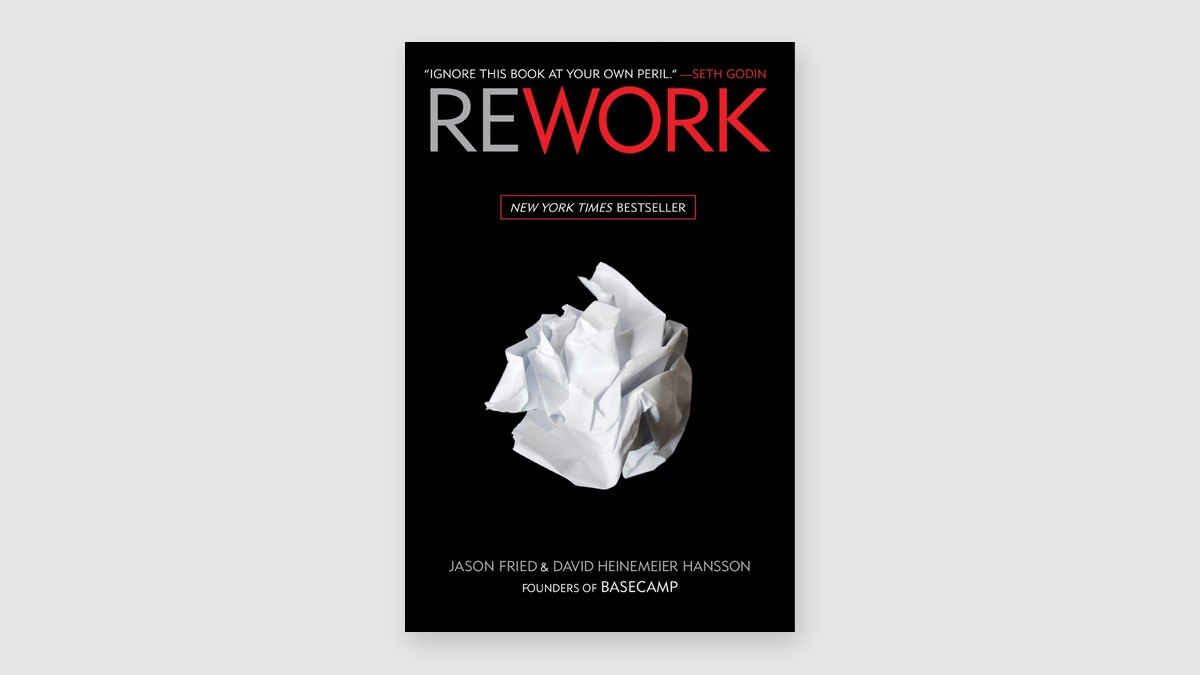
Rework is a business book by Jason Fried and David Heinemeier Hansson, the founders of Basecamp (formerly 37signals), published in 2010 by Crown Business, per Open Library. The publisher, via its Penguin Random House page, lists a March 9, 2010 release and 288 pages. The authors argue that most conventional startup advice, such as writing a business plan, studying competitors and raising outside money, is unnecessary or even harmful, and that you need less than you think: fewer people, fewer meetings, less planning and less growth for its own sake. The book is a run of very short chapters rather than one long argument, closer to a collection of essays than a how-to manual.
This is a summary in our own words, drawn from the publisher, retailer listings and independent reviews, not from the text of the book. Most of the claims are the authors' own opinions and their account of running their company, so we label them that way. For a very different, data-driven take on building a sales team, see our summary of The Sales Acceleration Formula.
The authors and the book
Jason Fried and David Heinemeier Hansson wrote the book together. According to the Penguin Random House bios, Fried is cofounder and president of Basecamp, formerly called 37signals, a privately held company based in Chicago, and Hansson is a partner there and the creator of Ruby on Rails. Both also coauthored the earlier books Getting Real and Remote: Office Not Required.
Edition details vary a little by source. Penguin Random House, Apple Books and Open Library all give 288 pages, while Goodreads lists 279 for the hardcover. Open Library names the publisher as Crown Business, while Penguin Random House and Apple Books show Crown or Crown Currency. Penguin Random House also lists a $32.00 hardcover and an audiobook of about 2 hours 50 minutes, which tells you how short a read it is.
Where the ideas come from: 37signals and Basecamp
The book is closely tied to the authors' own company. On its about page, Basecamp says it grew out of 37signals, once a web design firm, whose team built its own project management tool because existing ones did not fit. Clients asked to use it, it was released as a product, and about a year later the product reportedly earned more than the design business, so the firm stopped doing client design work. That is the company's own account.
That origin story explains the book's tone. Rework reads like a defense of staying small, self-reliant and profitable, written by people who built a software company that way. The publisher says the authors present it as a better, faster, easier way to succeed, and Basecamp's own books page pitches it as an alternative to the usual advice for entrepreneurs, small-business owners and artists. Keep that in mind when weighing the claims: they are the authors' experience, not a controlled study.
The big idea: do less, on purpose
The Penguin Random House description and the Apple Books description frame the book as a case against the standard playbook of business plans, competitor research and outside investors. A Pregame HQ brief sums up the core message as simplicity: modern business is overcomplicated, and keeping things simple makes it more effective. Aaron Armstrong's review adds that the authors see the basic rules of work as stuck in an earlier era even though the economy has moved on.
Three themes run through almost every chapter.
- Start small and start now. Build something useful, test it with real customers and skip the long planning phase.
- Protect focus. Cut interruptions, meetings and busywork, and avoid the long-hours culture.
- Stay lean and independent. Raise outside money only as a last resort, avoid growing faster than you need to and keep the company easy to run.
How the book is laid out
The contents list on Open Library shows a long series of one-line chapter titles gathered under a few broad headings. Rather than repeat the titles, here is the shape of the book, in our paraphrase:
- Opening and takedowns. The case that the old rules no longer hold, followed by short attacks on popular beliefs such as the value of learning from failure and the need to plan.
- Getting started. Scratch your own itch, begin with what you have, keep outside funding as a last resort and build a real business instead of a startup meant to be flipped.
- Progress. Embrace constraints, make something small and good rather than big and sloppy, and get it into customers' hands quickly.
- Productivity. Interruptions, meetings, long to-do lists and bad estimates are the enemies; quick wins and small decisions keep work moving.
- Competitors. Do not copy them. Differentiate, take a stand and do less than they do on purpose.
- Evolution. Say no by default, let customers outgrow you if needed, and do not confuse enthusiasm with priority.
- Promotion. Teach, share your process and build an audience instead of buying attention or chasing the press.
- Hiring. Hire when the workload hurts, test candidates by working with them, and favor good writers and people who manage themselves.
- Damage control and culture. Own bad news quickly and honestly, and accept that culture grows out of behavior and cannot be declared. The book closes with a short conclusion.
The ideas in more detail
The paragraphs below paraphrase the book's themes as shown in the publisher's description, the contents list and the reviews linked on this page. They are not quotes.
Planning and funding. The authors treat long-range plans as guesses and argue that you learn more by doing than by forecasting. The contents list on Open Library also shows chapters aimed at outside money, which the authors see as a last resort. Their preferred route is to build a business that earns its way from the start, which echoes Basecamp's own story of building its product while still a design firm, per the about page.
Productivity. The book is hard on meetings, interruptions and the habit of working all hours. Aaron Armstrong highlights its criticism of workaholism and its view that a mission statement is empty unless people actually live it. The practical advice is to shrink the task, make small decisions and ship something good enough rather than wait for perfect.
Competitors and positioning. Instead of tracking rivals, the authors suggest focusing on your own customers and deliberately doing less, so that you stand out rather than blend in. Readers on Goodreads single out advice such as not copying competitors and saying no by default as the most useful takeaways.
Promotion. The book favors teaching and sharing what you know to build an audience over press releases and paid hype. Goodreads reviewers also pick out building an audience through content as a lasting idea.
Hiring and culture. The authors advise hiring slowly, when the work really demands it, and trying people out on real work. They prefer people who can run themselves and write clearly. On culture, the contents suggest that it emerges from how people behave day to day and cannot be installed on day one. Armstrong also points to the book's call to sound like yourself and its essay on words such as can't and need.
Key takeaways
These points are our reading of the book's themes as described by the publisher and independent reviewers, not quotes from it.
- Plans are hypotheses. Write down your best guess, then let real customer behavior change it.
- Start with what you have. Build a small version people can use now, instead of waiting for funding or permission.
- Guard uninterrupted time. Meetings and chat interruptions are expensive, so make them the exception.
- Make decisions small. Break work into pieces that can be decided and finished quickly, so progress is visible.
- Say no more often. Every feature, hire and commitment has a long-term cost, so make each one earn its place.
- Differentiate, do not imitate. Pay attention to your customers more than to what other companies are doing.
- Teach to promote. Share what you know and let an audience come to you.
- Hire for the work in front of you. Wait until the need is real and test candidates on actual tasks.
How a RevOps or small-team leader could use it
These ideas are our own suggestions for applying the book, not recommendations from it.
- Audit your meetings. List every recurring meeting, ask what it produces and cancel or shorten the ones with no clear decision or output.
- Trim reporting. Keep the few dashboards and fields that change decisions, and retire the rest of the busywork.
- Ship process changes small. Pilot a routing or handoff tweak with one team before a company-wide rollout.
- Hire against a real backlog. Tie each new role to specific work that is not getting done, and trial the person on a real task where you can.
- Balance it with measurement. Rework prizes simplicity, but revenue teams still need clean data. Pair its minimalism with a hiring and coaching system like the one in The Sales Acceleration Formula summary linked above.
Criticisms and limits
Reception is positive but not unanimous. On Goodreads the book averages 3.98 across 179,825 ratings and 5,400 reviews, with 40% of ratings at five stars and 30% at four, while 6% are two stars and 3% are one star. Apple Books shows an average of 4.4 across 653 ratings. Fair criticisms from readers include:
- Thin evidence. Reviewers on Goodreads call the support anecdotal, and one finds the repeated pattern of others saying it cannot be done while the authors did it unpersuasive.
- Small software bias. Several readers say the advice fits small, digital companies better than in-person, traditional or large-scale businesses.
- Not all new. One reviewer says it repackages lean and Scrum ideas, though he still praised the chapter on resumes.
- Weak or contradictory alternatives. A popular critical review argues that the book challenges norms well but offers shaky replacements, with some unsupported advice.
- Style. Armstrong found some of the profanity forced and wanted more on when work should happen.
- Survivor's story. The authors' results come from one company that grew from a design firm into a successful product. Treat the book as their experience, not proof that the same moves work everywhere.
A sensible reading is that Rework is a provocative, quick prompt to question habits such as heavy planning and meeting overload, rather than a complete operating manual. The Pregame HQ brief argues that businesses outside tech can still benefit from its common-sense practices, and readers on Goodreads who liked it say they took away practical ideas about staying small and profitable.
Questions people ask
Who wrote Rework and when was it published?
Jason Fried and David Heinemeier Hansson, the founders of Basecamp (formerly 37signals), wrote it. Open Library lists Crown Business as the 2010 publisher, and Penguin Random House lists a March 9, 2010 release.
What is Rework about?
It argues against conventional business advice such as writing business plans, studying competitors and raising outside money, and makes the case for starting small, staying focused and doing less.
How long is Rework?
Penguin Random House, Apple Books and Open Library list 288 pages, and Goodreads lists 279 for the hardcover. The audiobook runs about 2 hours 50 minutes.
Is Rework worth reading for a non-tech business?
Some readers say the advice leans toward small software companies, while one reviewer argues that traditional businesses can still benefit from its common-sense practices. Test each idea against your own market.
What is the relationship between 37signals and Basecamp?
Penguin Random House describes Basecamp as formerly 37signals. Basecamp says it grew from a design firm that built its own project tool and later stopped doing design work.
What are the main criticisms of Rework?
Readers cite anecdotal evidence, a small-software bias, advice that is not always new, and some unsupported or contradictory suggestions.
Sources
- Penguin Random House: Rework · Publisher page: March 9, 2010, 288 pages, price, description and author bios
- Open Library: Rework · Edition record: Crown Business, 2010 and the contents list
- Open Library: Rework edition · Publisher and pagination for the first edition
- Apple Books: Rework · Publisher, release date, page count, description and rating
- Basecamp: Rework · Authors' own page for the book and related titles
- Basecamp: books · List of books written by the Basecamp team
- Basecamp: about · Company account of how 37signals and Basecamp began
- Goodreads: Rework · Reader ratings and reader praise and criticism
- Aaron Armstrong: book review · Independent review of themes, praise and criticism
- Pregame HQ: book brief · Short summary of the core idea
This summary is an independent explainer written in our own words and does not reproduce the book. Facts were read from the linked pages on October 31, 2026; read the book for the primary detail and weigh the authors' claims against their own interest in the way they ran their company.