The Sales Acceleration Formula by Mark Roberge: Summary, the Four Formulas and Key Takeaways
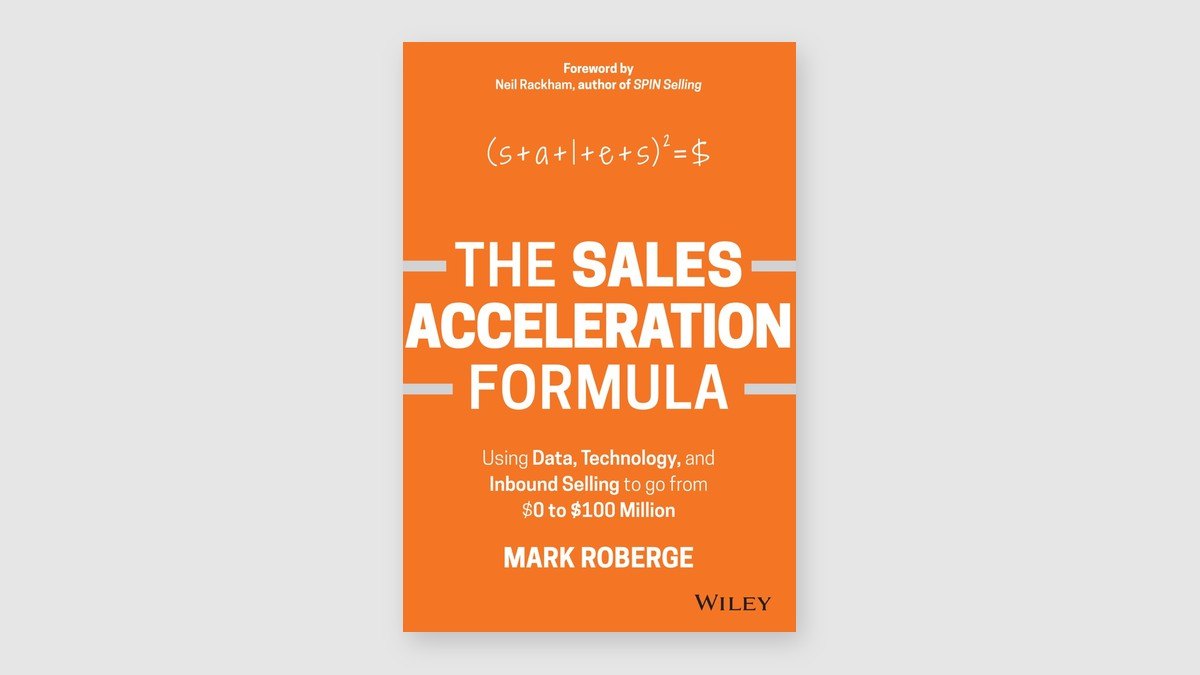
The Sales Acceleration Formula: Using Data, Technology, and Inbound Selling to go from $0 to $100 Million is a sales-management book by Mark Roberge, published by Wiley in 2015. Wiley lists the hardcover at 224 pages, per its publisher page. Roberge draws on his years as SVP of Worldwide Sales and Services at HubSpot, where, he says, his teams acquired and retained the company's first 10,000 customers. His argument is that sales can be run as a repeatable, data-driven process instead of an art, built on four formulas: hire the same kind of successful salesperson every time, train every rep the same way, hold every rep to the same sales process, and give every rep the same quality and quantity of leads each month.
This is a summary in our own words, drawn from the publisher, retailer listings and independent reviews, not from the text of the book. Most of the results are Roberge's own account of HubSpot, so we label them that way. For other books on qualifying and running complex deals, see our summaries of MEDDICC and The JOLT Effect.
The author and the book
Mark Roberge wrote the book, and Wiley lists it as a February 2015 release. Apple Books gives a release date of February 3, 2015, while Google Books shows February 24, 2015, so retail dates vary by edition. The cover on Apple Books credits a foreword by Neil Rackham, author of SPIN Selling.
According to Wiley's author bio, Roberge is an MIT alum with an engineering background who was HubSpot's SVP of Worldwide Sales and Services from 2007 to 2013, and later Chief Revenue Officer of the HubSpot Inbound Sales Division. The bio says revenue rose by more than 6,000% and the team grew from 1 to 450 employees in that period. Those figures come from the publisher's author bio and are the author's account, not an independent audit. The Apple Books description says the book is aimed at business owners, sales executives and investors who want to build a $100 million revenue company but struggle to scale sales.
The big idea: sales as a formula
The Wiley description says sales has long been treated as an art, and that today's data-rich environment makes a repeatable process possible. Roberge's engineering background shows in the approach: measure what successful reps do, test it, and turn the result into a process that can be repeated as the team grows.
The book is organized around four formulas, plus a thread about using technology to make buying easier for customers and selling faster for reps.
- Sales Hiring Formula. Hire the same kind of successful salesperson every time.
- Sales Training Formula. Train every salesperson the same way.
- Sales Management Formula. Hold every salesperson to the same sales process.
- Demand Generation Formula. Give every salesperson the same quality and quantity of leads each month.
How the book is laid out
The contents list on Open Library shows 16 chapters. The summary by Paubox groups the book into five parts: hiring, training, management, demand generation and experiments. The chapter titles are roughly in that order:
- Hiring. Uncovering the characteristics of a successful salesperson; five traits great salespeople have and how to interview for them; finding top performers; and the ideal first sales hire.
- Training. Setting up a predictable sales training program, and manufacturing helpful salespeople your buyers trust.
- Management. Metrics-driven sales coaching; compensation plans and contests; and developing sales leaders with a promote-from-within culture.
- Demand generation. Flipping the demand generation formula so buyers find you; converting inbound interest into revenue; aligning sales and marketing with an SLA; and technology to sell better and faster.
- Experiments. Running successful sales experiments, and HubSpot's most successful ones, followed by a conclusion.
The four formulas in more detail
The details below paraphrase independent summaries from Chili Piper, Bowery Capital and Paubox, not the book's own text. Where summaries disagree, we say so.
Hiring. Roberge scored candidates against a set of traits and compared those scores with how reps performed after hire. Bowery Capital lists the five traits that mattered most at HubSpot as coachability, curiosity, prior success, intelligence and work ethic, with coachability weighted most. Chili Piper names problem-solving ability where Bowery Capital says intelligence, so check the book if the exact wording matters. Chili Piper also describes scoring each candidate on a 1 to 5 scale per trait using the same rubric for everyone. Paubox adds that the book favors building an in-house recruiting function and using LinkedIn to find passive candidates over leaning on agencies.
Training. The Paubox summary says having new hires shadow a top performer does not scale. Instead, the training program is built around the buyer's journey, the sales process and a qualifying framework, with top reps teaching classes and exams or certifications to check what was learned. Bowery Capital adds that reps are taught their customers' industries, the roles of decision makers and what buyers' working days look like, so each rep can apply their own style to the buyer's real needs. Chili Piper makes the underlying point that top performers win in different ways, so training built around one star's habits is hard to repeat.
Management. The management formula centers on coaching with metrics. Paubox describes finding the one skill with the biggest impact on each rep and building a coaching plan around it, plus simple, aligned compensation, monthly contests and promotion tiers. Chili Piper gives an example of reading funnel metrics by stage: a rep who demos well but loses prospects at objections needs objection-handling coaching, not more leads. Both summaries note the preference for promoting from within.
Demand generation and the SLA. Roberge favors inbound, where buyers find you through content, search and social media, over interruptive outbound methods, per Chili Piper. Paubox notes ideas such as putting marketing on a revenue quota and calling new leads fast. Bowery Capital describes the SMarketing SLA, a service level agreement between sales and marketing that sets when marketing hands over leads, how many are expected, how quickly sales follows up, and what content supports them.
Customer success and experiments. Bowery Capital says Roberge urges founders to focus on customer success early, with a suggested target of 80% or more of new customers healthy on the company's success score within 60 to 90 days. The final chapters, per Open Library and Paubox, push a culture of running sales experiments and sharing what worked at HubSpot.
Key takeaways
These points are our reading of the book's themes as described by the publisher and independent reviewers, not quotes from it.
- Define success before you hire. Write down what your best reps have in common and score every candidate the same way, rather than hiring on gut feel.
- Weight coachability. Reviewers say the book gave it the most weight, because a rep who learns fast keeps improving.
- Train for the buyer, not the star. Build onboarding around the buyer's journey and the sales process, so results do not depend on one rep's personal style.
- Coach from the numbers. Find the single weakest stage in a rep's funnel and coach that, instead of giving generic advice.
- Keep pay simple. Compensation and contests should be easy to understand and tied directly to behavior you want.
- Agree what sales and marketing owe each other. A written SLA turns lead handoff into something both teams can be measured against.
- Treat sales as a lab. Run small experiments, record the results and keep what works.
How a RevOps team could use it
These ideas are our own suggestions for applying the book, not recommendations from it.
- Build a hiring scorecard. Turn the traits you care about into a rubric in your applicant tracking system, then compare scores with ramp and quota results after hire.
- Report on funnel conversion by stage and rep. A conversion dashboard shows managers where each rep loses deals, which gives coaching a target.
- Write the SLA down. Define lead acceptance, follow-up time and routing rules, then track them as shared metrics.
- Route leads evenly. If every rep is supposed to get the same lead flow, make sure routing rules deliver it and audit them.
- Log experiments. Keep a simple record of what you tested, the result and the decision, so lessons survive staff turnover.
Criticisms and limits
Reception is largely positive. On Goodreads the book averages 4.25 across 2,842 ratings, with only 18 one-star and 72 two-star ratings, and Bowery Capital rates it 4.5 out of 5. Still, there are fair points to weigh.
- Fit for small teams. Some Goodreads reviewers found the systematized approach better suited to large teams than small businesses, and thought the training and management sections applied less to small teams.
- B2B focus. At least one reviewer felt the heavy B2B focus made much of the book irrelevant to consumer businesses.
- A HubSpot pitch. Some readers felt it reads like a sales pitch for HubSpot or is very HubSpot-centric, though one reviewer noted the company follows its own advice.
- Outbound is not dead. A reviewer in the Paubox summary disagrees with the claim that outbound marketing no longer works, arguing their own results show otherwise. Another Goodreads reviewer said it depends on the product and market.
- Dated tactics. Some readers on Goodreads called specific tactics outdated, noting that the web is noisier than when the book was written.
- Depth. One Goodreads reader wanted more case studies and data, and Bowery Capital wished for more on HubSpot's history and wider organizational lessons.
- Self-reported results. The headline growth figures come from the author and the publisher's bio. Treat them as the author's account of one company at one moment.
A sensible reading is that the book is a practical guide to building a repeatable sales engine in a company selling software, and that its frameworks need adapting to your market, deal size and team size.
Questions people ask
Who wrote The Sales Acceleration Formula and when was it published?
Mark Roberge wrote it. Wiley lists it as a February 2015 release, with retailers giving release dates of February 3 and February 24, 2015 depending on the edition.
What are the four formulas in the book?
Sales Hiring, Sales Training, Sales Management and Demand Generation: hire the same successful salesperson every time, train every rep the same way, hold every rep to the same sales process, and give every rep the same quality and quantity of leads each month.
What traits does Roberge hire for?
Independent summaries list coachability, curiosity, prior success, intelligence and work ethic, with coachability weighted most. One summary names problem-solving ability in place of intelligence.
How long is the book?
Wiley, Apple Books and Google Books list 224 pages. Open Library lists xix plus 203 pages and Goodreads lists 217 pages for the Kindle edition, so counts vary by edition.
Is it good for small companies or startups?
Bowery Capital calls it one of the most practical guides to early revenue generation in SaaS, but some Goodreads reviewers found it better suited to larger teams, so adapt it to your size.
What is the SMarketing SLA?
Per the book's contents and a Bowery Capital review, it is a service level agreement between sales and marketing that sets when leads are passed over, how many are expected and how fast sales follows up.
Sources
- Wiley: The Sales Acceleration Formula · Publisher page: February 2015, 224 pages, description and author bio
- Apple Books: The Sales Acceleration Formula · Publisher Wiley, release date, page count, description and cover
- Google Books: The Sales Acceleration Formula · John Wiley & Sons, date and page count
- Open Library: The Sales Acceleration Formula · Edition record and 16-chapter contents list
- Goodreads: The Sales Acceleration Formula · Reader rating and reader criticisms
- Chili Piper: Sales Acceleration Formula summary · Third-party summary of the four formulas
- Bowery Capital: book review · Investor review: traits, training, SLA and criticism
- Paubox: takeaways · Company blog summary by part, with a dissenting view on outbound
This summary is an independent explainer written in our own words and does not reproduce the book. Facts were read from the linked pages on October 31, 2026; read the book for the primary detail and weigh vendor and author claims with their commercial interest in mind.