The 12 Week Year Summary: Key Ideas for Sellers
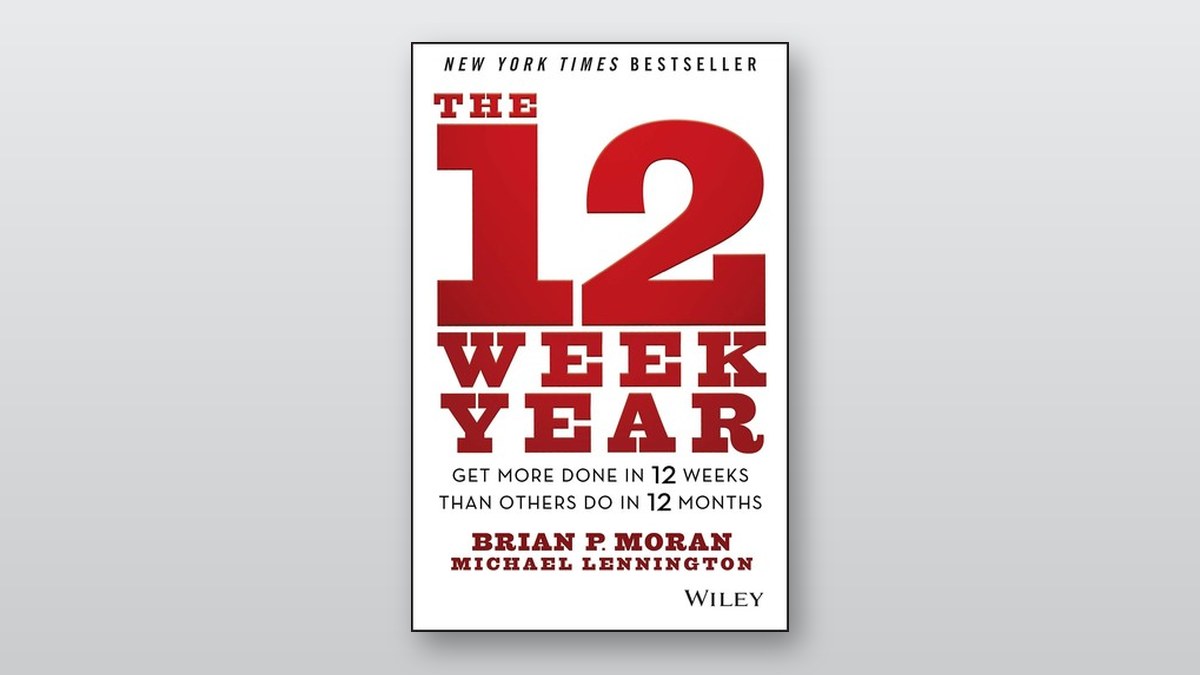
The 12 Week Year by Brian P. Moran and Michael Lennington argues that the annual planning cycle is the problem: a year is long enough that urgency fades. Instead, treat every 12 weeks as a full "year", with its own vision, plan, weekly scoring and finish line. Per Wiley, the book aims to shorten the execution cycle from one year to twelve weeks so a short timeframe creates urgency and focus.
The method in short: write a vision, build a 12-week plan of a few goals and deadline-driven tactics, score the share of planned actions you complete each week, meet weekly for accountability, and protect blocks of focused time. Wiley lists it as a 208-page hardcover from May 2013. This is a short summary in our own words, based on the publisher's page, the authors' site and published summaries, not a retelling of the book.
The authors and the book
Per Wiley, Brian P. Moran is founder and CEO of The Execution Company and held management and executive roles at UPS, PepsiCo and Northern Automotive. Michael Lennington is Vice President of The Execution Company and works as a consultant, coach and leadership trainer.
The book is pitched as a how-to guide for individuals and organizations. Open Library shows the title first published in 2013, with a later companion titled The 12 Week Year Field Guide.
The core idea: a 12-week "year"
According to Shortform's summary, setting goals in 12-week cycles instead of annual ones creates urgency, makes the steps to a goal easier to see, and gives you progress data sooner. The emphasis is on executing a plan, not only knowing what to do.
The authors' site frames it the same way: focused 12-week execution cycles, long-term visions broken into weekly and daily tasks, and regular check-ins with performance tracking.
Step one: the vision
monday.com's guide describes writing two statements: an aspirational one for one to three years out, and a short-term one describing success at the end of the 12-week cycle. Shortform says to determine the long-term vision and short-term goals first, then write the 12-week plan.
The authors' site includes a line attributed to Moran that a vision without a plan is a pipe dream, so the vision is the starting point, not the deliverable.
The 12-week plan and tactics
The plan turns the vision into a small set of goals. monday.com's article suggests two to three goals per cycle. Shortform says tactics should be action-oriented with deadlines, so they become daily and weekly responsibilities, and that writing the plan down makes the actions concrete.
- Goals. A few, specific and time-bound for the 12 weeks.
- Tactics. The actions that drive each goal, each with a deadline.
- Weekly plans. Each 12-week goal broken into weekly goals, with daily actions listed under each.
Weekly accountability meetings
Shortform describes starting each week by reflecting on progress, reviewing measurements and meeting with a peer-support group. monday.com calls this a weekly accountability meeting: a short check-in to review the scorecard, talk through blockers and recommit to the coming week, suggesting 15 to 20 minutes.
The point is social: other people looking at your numbers changes behavior. Pitfalls monday.com lists include having no accountability partner at all.
Scoring execution and the 85% target
Each week you tally the share of planned actions you completed. Shortform says scores around 85% or higher indicate you are on track, and that low scores point to where to improve, not failure. monday.com likewise gives 85% as the benchmark and says the score measures actions taken, not results.
The book separates lead indicators (actions, such as sales calls) from lag indicators (end results, such as an income increase). If results lag while execution scores are high, the plan may need adjusting. If execution is low, fix execution before judging the plan.
Time blocking
Shortform and monday.com both describe three kinds of block:
- Strategic block. One three-hour, uninterrupted weekly block for the highest-priority work.
- Buffer block. 30 to 60 minutes for email, calls, admin and low-priority requests.
- Breakout block. A three-hour block for learning, creative thinking, rest or development; Shortform says to start monthly and move to weekly.
Shortform says to schedule the strategic block first in a model week, then buffer blocks, then any breakout block, then everything else.
How a seller or sales team can apply it
The book is not about sales specifically, so this section is our own application, not the authors' claim. Sales already runs on short cycles, which makes a 12-week frame a natural fit with a quarter.
- Pick lead indicators. Choose a few actions you control, such as prospecting calls or follow-ups, and score yourself on completing them each week.
- Protect a strategic block. Use the three-hour block for outreach or account planning, with buffer blocks for admin and email.
- Run the weekly meeting as a team. Each rep reports last week's score and next week's commitments in 15 to 20 minutes.
- Keep results separate. Track closed revenue as the lag indicator, and do not confuse a missed deal with a missed week.
Criticisms and limits
We did not find independent studies testing the method; most available coverage is by summary sites and vendors. monday.com sells a supporting product, so its framing may be promotional. It lists common pitfalls: unrealistic goals, taking on too much in the first cycle, skipping weekly tracking, lacking an accountability partner, and tracking only lagging indicators.
Practical limits are ours: an 85% completion score only means you did the planned actions, so a bad plan can score well. Reactive roles such as support or heavy-meeting jobs may struggle to protect a three-hour block. Read it as a structured planning habit, not proven science.
Questions people ask
What is The 12 Week Year about?
Treating 12 weeks as a full year so urgency and focus stay high, using a vision, a 12-week plan, weekly scoring and weekly accountability.
Who wrote The 12 Week Year?
Brian P. Moran and Michael Lennington of The Execution Company, published by Wiley in May 2013.
What is the 85% target?
Per Shortform and monday.com, a weekly execution score around 85% or higher, the share of planned actions completed, indicates you are on track.
What are strategic, buffer and breakout blocks?
A three-hour focused strategic block, 30 to 60 minute buffer blocks for admin, and a three-hour breakout block for learning or rest, per Shortform and monday.com.
Is it useful for salespeople?
It can be, as a planning and accountability habit built around lead activities and a quarter-length cycle, though the book is not sales-specific.
Sources
- Wiley: The 12 Week Year product page · Publisher description, May 2013, 208 pages, author bios
- The 12 Week Year (authors' site) · Framework overview: vision, plan, weekly tasks, accountability
- Open Library: The 12-week year · Editions and 2013 publication
- Shortform: The 12 Week Year summary · Plan, scoring, 85%, accountability meeting and time blocks
- monday.com: 12 week year guide · Five steps, 85% benchmark, 15-20 minute meeting, block durations, pitfalls
This summary is an independent explainer written in our own words and does not reproduce the book. Facts were read from the linked pages on October 20, 2026. We did not have the full text of the book, so for exact wording and chapter detail, read the book itself.
Top photo: Book cover via Open Library